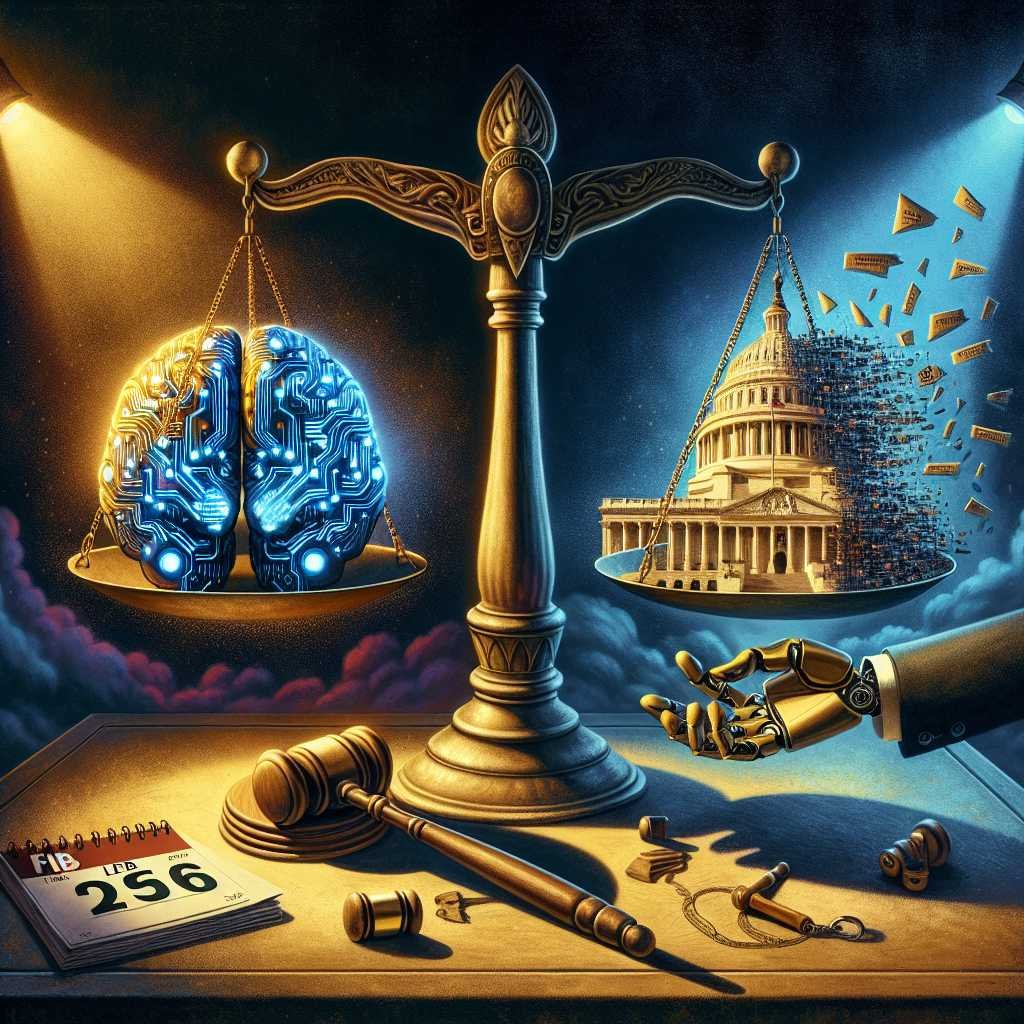
February 2026 Is the Tipping Point for U.S. AI Rules: Will Federal Preemption Crush State Laws—or Create a Common-Sense Compromise?
If you care about AI—whether you build it, buy it, regulate it, or simply worry about its impact—circle February 2026 on your calendar. It’s shaping up to be a regulatory knife’s edge in the United States. On one side: state laws like California’s push for AI transparency and Texas’s governance-focused rules. On the other: a newly assertive federal government, with the Department of Justice scrutinizing legal inconsistencies and the Department of Commerce moving to standardize AI safety evaluations.
Will Washington preempt the states and unify the rules of the road? Or will we see a constitutional collision that leaves innovators navigating a patchwork of overlapping, possibly conflicting, obligations? Add to that the very real challenges of power-hungry data centers and workforce disruption—and February 2026 looks less like a news cycle and more like a crossroads.
Below, we unpack what’s coming, the stakes, who’s at risk, and how to prepare—today.
Note: This post draws on reporting by the ETC Journal previewing ongoing February events: AI in February 2026: Three Critical Global Decisions—Cooperation or Constitutional Clash?. It also references publicly available federal frameworks and legal concepts for context.
Why February 2026 Became the Flashpoint
A few threads are converging all at once:
- States moved first. California and Texas took different paths to “do something” about AI safety and transparency. Their approaches are influential well beyond their borders thanks to the size of their economies and vendor ecosystems. The result: a growing expectation that companies would need to comply with two (or more) potentially divergent standards to sell or operate nationwide.
- The federal government is stepping in. Per the ETC Journal, the Department of Justice has stood up an AI Litigation Task Force to scrutinize state-federal conflicts and enforce consistency where necessary. Meanwhile, the Department of Commerce is due to publish or finalize evaluation protocols that could set de facto national baselines for testing, red-teaming, and reporting on AI safety.
- Big players are bracing. Foundation-model developers like OpenAI and large enterprise deployers reportedly expect litigation or enforcement activity to escalate quickly. The choice is stark: negotiated alignment—or a court fight over constitutional authority.
- The stakes are systemic. Power constraints (think: data centers and grid stress) and labor displacement risks add urgency. Even the best-crafted rules will stumble if there’s not enough electricity to run modern AI—and not enough workforce support to manage transitions.
Bottom line: February is not just another policy month. It’s a pivot point.
The Constitutional Crux: Federal Preemption vs. State Police Powers
To keep this simple:
- Federal preemption is the legal doctrine that federal law overrides state law when the two conflict under the Constitution’s Supremacy Clause. Preemption can be explicit (Congress says so), or implied (federal law occupies the field, or state law conflicts with federal objectives).
- States, however, retain broad “police powers” to protect health, safety, and welfare—historically including product safety, professional licensing, and consumer protection.
- There’s also the Dormant Commerce Clause, a doctrine that can invalidate state laws that unduly burden interstate commerce—even absent a conflicting federal statute.
AI regulation sits at the intersection of all three. If the Department of Commerce issues federal evaluation standards through its AI Safety Institute (AISI) and the government ties those benchmarks to procurement, safety claims, or enforcement via federal agencies like the FTC or DOJ, it strengthens the case for a unified national baseline. But without a comprehensive federal statute that expressly preempts state AI laws, some conflict is inevitable.
A helpful analogy: privacy. In the absence of a comprehensive federal privacy law, states built their own rules (e.g., California’s CCPA/CPRA). That created patchwork complexity—but also spurred national companies to adopt higher common standards. AI could follow a similar path, unless federal agencies or Congress step in more aggressively.
California vs. Texas: Two Models, Two Philosophies
While labels vary, here’s the broad contrast:
- California’s transparency-first posture
- Emphasis: disclosures, risk reporting, documentation that explains model behavior to users, regulators, and auditors.
- Possible requirements: model or system cards, impact assessments, explainability or usage notices, safety incident reporting, vendor attestations.
- Likely effects: higher reporting overhead, but clearer user rights and accountability trails—especially for consumer-facing systems.
- Texas’s governance-and-operations posture
- Emphasis: internal controls, acceptable-use restrictions, robust testing and red-teaming before deployment, and oversight tied to critical sectors.
- Possible requirements: documented safety processes, change-management logs, human-in-the-loop thresholds, rapid response protocols for model failures.
- Likely effects: tighter SDLC discipline, more consistent risk management, but potentially more friction for rapid iteration.
For businesses that operate in both states (and virtually all do), the practical effect is additive: you’ll need transparency artifacts plus robust governance controls. If either state’s scope “reaches across borders” (for example, applying to out-of-state providers who serve in-state users), Dormant Commerce Clause challenges could arise—particularly if compliance imposes substantial burdens on interstate commerce.
For a broader, continually updated picture of U.S. state activity on AI, the National Conference of State Legislatures maintains trackers and reports on tech policy and algorithmic accountability.
What the DOJ’s AI Litigation Task Force Likely Targets
Per the ETC Journal, the Department of Justice is preparing to challenge or coordinate around inconsistencies that threaten nationwide coherence. That could include:
- Extraterritorial reach: State provisions that functionally regulate out-of-state model development or evaluation in ways that burden interstate commerce.
- Conflicting standards: Divergent definitions of “high-risk AI,” incompatible testing requirements, or duplicative-but-different reporting timelines that impede national operations.
- First Amendment and due process concerns: If state rules inadvertently restrict protected speech (e.g., publishing models or research) or are vague about what constitutes compliance.
The DOJ doesn’t need to sue every state. A few strategic cases—or even pre-litigation engagement—could catalyze harmonization. Expect coordination with other federal actors, including the FTC and sectoral regulators, especially where AI relates to consumer protection, competition, healthcare, finance, or critical infrastructure.
For reference on federal consumer AI enforcement posture, see the FTC’s guidance on truthful AI claims and bias/deception risks.
Commerce’s Coming Evaluations: A De Facto National Baseline?
The Department of Commerce’s AI Safety Institute (AISI) and the National Institute of Standards and Technology (NIST) already provide scaffolding. The NIST AI Risk Management Framework (AI RMF) and its playbooks outline governance, map/measure/manage cycles, and the importance of independent testing and monitoring.
If Commerce finalizes standardized evaluation protocols—covering areas like red-teaming, jailbreak resistance, biological and cyber misuse, robustness, and socio-technical harms—those could become the country’s default expectations, particularly if:
- Federal procurement requires vendors to meet them.
- Agencies reference them in enforcement or guidance.
- Insurers and auditors adopt them as underwriting and assurance criteria.
This is how “soft law” becomes “hard reality.” Expect requirements to be risk-tiered—stricter for frontier or high-impact systems, more flexible for narrow, low-risk applications.
Cooperation vs. Constitutional Clash: Two Paths Ahead
Let’s imagine the two most likely paths.
- Cooperation scenario
- States and federal agencies align on a shared baseline: adopt NIST AI RMF for governance; accept AISI evaluations for high-risk classes; preserve state flexibility at the edges (e.g., sector tailoring, local consumer disclosures).
- States add value by piloting innovative approaches that, if successful, roll up into national guidance over time.
- Industry benefits from clarity; consumers benefit from consistent protections nationwide.
- Confrontation scenario
- Lawsuits fly. Injunctions pause parts of state laws; companies face uncertainty over what applies where.
- Businesses build to the strictest common denominator or geo-fence features by state, slowing deployment and raising costs.
- Innovation tilts toward the largest players who can absorb compliance overhead; startups struggle to navigate the maze.
Which path prevails may hinge on whether the DOJ and Commerce can offer a credible, workable baseline that states perceive as raising—not lowering—the floor. Political optics also matter: neither Washington nor the states want to look “soft” on AI risks that voters increasingly recognize.
Energy Is the Unseen Arbiter: Data Centers Meet Grid Reality
AI’s legal drama is getting the headlines, but the physics could be the real limiter in 2026.
- Data center demand is spiking. The International Energy Agency projects that data centers’ electricity use could double this decade, with AI training and inference as primary drivers. See the IEA’s analysis on electricity use of data centres, AI and crypto.
- Interconnection queues are jammed. New generation and transmission projects often wait years to connect. Bottlenecks delay access to clean, abundant power where AI clusters want to grow.
- Siting fights are real. Communities are pushing back over water usage, noise, land use, and grid strain—complicating timelines further.
Policy takeaway: even the best-crafted rules are moot if capacity isn’t there. Expect renewed pushes for: – Transmission permitting reform and grid-modernization incentives. – Locating AI campuses near existing surplus generation (hydro, nuclear, or wind-rich regions). – Long-term power purchase agreements (PPAs), on-site generation, and flexibility measures (workload shifting, off-peak scheduling).
For operators, bake energy strategy into compliance strategy. Regulators may require power-usage disclosures tied to sustainability targets; investors increasingly expect it.
Labor Displacement: The Human Side of “Safety”
AI safety isn’t just about model behavior; it’s also about downstream social and economic impacts.
- Worker displacement and task reshaping are accelerating in knowledge work, customer support, and some back-office functions.
- Public-sector adoption (benefits processing, licensing, public safety) brings special scrutiny around fairness, explainability, and appeal rights.
- Cities and states are experimenting. For example, New York City’s automated employment decision tools (AEDT) law requires bias audits and notices for certain hiring tools.
Expect more states to couple AI governance with workforce transition programs: training subsidies, apprenticeship models for AI-augmented roles, and transparency requirements when automated systems materially change job functions.
For employers, “people safety” measures may include: – Human-in-the-loop policies for high-stakes decisions. – Notice, consent, and appeal avenues for employees affected by algorithmic tools. – Change-management plans and retraining budgets that match the scale of automation.
What This Means for Stakeholders
- Foundation model developers
- Likely to face top-tier scrutiny: red-teaming, eval transparency, and incident reporting expectations.
- Prepare for dual compliance: adopt AISI/NIST-aligned evaluations and be ready to generate state-friendly transparency artifacts (system cards, capabilities/limitations notices).
- Expect export, biosecurity, and cybersecurity controls to intensify on powerful models and tooling.
- Enterprise adopters
- Liability will not be fully “outsourced” to your vendors. Expect due diligence obligations—and shared responsibility—around testing, monitoring, and safe use.
- Vendor contracts should specify evaluation standards, incident reporting SLAs, and audit rights.
- Prepare for sector regulators to tailor AI expectations (finance, healthcare, energy, critical infrastructure).
- Startups
- Build lightweight but real governance early. Align with NIST AI RMF and document risk decisions.
- Use standardized model cards and impact assessments to cut sales friction across states.
- Consider managed hosting that bakes in logging, red-teaming support, and compliance tooling.
- States and regulators
- Push for interoperable rules. Where you lead (e.g., disclosures), tie requirements to federal baselines where possible.
- Fund evaluation capacity so oversight keeps pace with innovation.
- Utilities and data center operators
- Engage regulators and communities early; publish water and energy stewardship plans.
- Co-locate with clean energy resources when feasible; explore thermal innovation and grid services.
A Practical Playbook for February 2026
You don’t need perfect foresight. You do need a resilient plan that survives either cooperation or confrontation.
1) Map your exposure – Inventory all AI systems: purpose, risk level, deployment geography, and upstream/downstream dependencies. – Classify by risk tier (e.g., low, medium, high-impact) using the NIST AI RMF as your north star.
2) Standardize evaluations – Adopt or align with anticipated AISI test domains (safety, security, misuse, robustness, bias/fairness). – Maintain third-party red-team reports for high-risk systems; keep versioned artifacts tied to model updates.
3) Build dual-fit documentation – Transparency artifacts: system/model cards, limitation statements, data provenance notes, known failure modes, and safe-use guidance. – Governance artifacts: risk registers, change logs, access controls, user guardrails, rollback plans, and incident response playbooks.
4) Contract to a baseline – Bake federal-evaluable standards into vendor contracts: evaluation protocols, benchmark thresholds, and reporting timelines. – Require vendors to notify you of material changes that affect safety or compliance.
5) Prepare for scrutiny – Mock DOJ/FTC inquiry drills: be ready to produce documentation, decision rationales, and remediation histories. – Establish a single source of truth for regulatory responses to avoid inconsistent statements across jurisdictions.
6) Energy strategy – Secure capacity early; explore PPAs and on-site or near-site generation for compute-heavy workloads. – Implement energy dashboards for transparency and to inform load shifting and cost control.
7) Workforce plan – Communicate early about AI-assisted changes; provide skilling pathways and protections. – Implement human review for high-stakes employee decisions; maintain appeal channels.
8) Public-facing trust hub – Create an AI transparency page with your evaluations summary, governance commitments, and responsible use policy. – Update quarterly as models and usage evolve.
How to Talk About Compliance Without Spooking Customers
Messaging matters. Aim for:
- Plain-language disclosures about what your AI does—and doesn’t.
- Reassurance rooted in recognizable standards: “We follow NIST AI RMF practices and conduct independent red-teaming for high-risk use cases.”
- Candor about incidents and fixes: show your learning loop works.
- Clear user controls and recourse options.
Trust is not a press release; it’s a rhythm. Set that rhythm now.
What About Open Source Models and Small Teams?
Open source doesn’t exempt you from safety or transparency expectations, especially if you’re packaging or deploying models at scale for customers. Practical steps:
- Publish comprehensive model cards with eval results and safe-use notes.
- Provide optional guardrails, default configurations, and policy templates.
- Clarify where integrators must conduct additional domain-specific testing.
Expect regulators to calibrate obligations to the scale and risk of deployment—not merely the licensing model of the weights.
The Role of the White House Executive Order
The October 2023 White House Executive Order on AI set the policy tone by directing agencies to develop safeguards around model evaluations, national security, and critical infrastructure. While EOs don’t create statutes or blanket preemption, they catalyze agency actions that, taken together, function like a national baseline. See the policy framework here: Executive Order on the Safe, Secure, and Trustworthy Development and Use of Artificial Intelligence.
What Could a Win-Win Compromise Look Like?
- A shared taxonomy of “high-risk” AI across federal and state regimes.
- Mutual recognition of evaluations: if you meet Commerce/AISI tests, states accept those results, layering on only targeted local disclosures.
- Procurement-led unification: federal and state buyers align RFP requirements to the same core standards, causing the market to converge by default.
- Sunset and review clauses: state rules auto-harmonize as federal standards mature—preventing drift and permanent fragmentation.
This keeps the innovation flywheel spinning, while giving the public consistent, enforced protections.
FAQs
Q: What is federal preemption and why does it matter for AI? A: Federal preemption means federal law overrides conflicting state law under the Constitution’s Supremacy Clause. For AI, national standards could simplify compliance and reduce a patchwork of obligations, but states will still push to protect residents through targeted requirements.
Q: Does the White House AI Executive Order preempt state law? A: No. Executive orders guide federal agencies; they don’t override state statutes. However, agency frameworks and procurement standards can set powerful national baselines that states may align with.
Q: Should companies pause AI deployments until rules settle? A: Generally, no. Instead, build to widely recognized baselines now—NIST AI RMF governance, independent red-teaming for high-risk systems, clear transparency artifacts—so you’re prepared for either a cooperative framework or tighter enforcement.
Q: How real are energy constraints for AI growth? A: Very real. Data center electricity demand is rising fast, and interconnection delays are common. See the IEA’s breakdown of data center, AI, and crypto electricity use. Smart siting, PPAs, and load management will be competitive advantages.
Q: What about small startups—how can they manage compliance? A: Keep it lean but substantive: adopt AI RMF principles, document risk decisions, run basic red-teams or use third-party evals for high-risk features, and publish clear model/system cards. Good governance reduces sales friction and investor risk.
Q: Could open-source models be restricted? A: Rules are likely to focus on deployment risk rather than licensing model. If you deploy open-source systems at scale for sensitive uses, expect similar obligations around testing, monitoring, and transparency.
Q: What is the Dormant Commerce Clause and how might it affect state AI laws? A: It’s a doctrine that limits states from unduly burdening interstate commerce. If a state AI law effectively regulates out-of-state activity or creates heavy national burdens, it could be challenged under the Dormant Commerce Clause.
Q: Where can I find practical AI governance guidance now? A: Start with the NIST AI Risk Management Framework and the Department of Commerce’s AI Safety Institute. For consumer protection and marketing claims, see FTC guidance on AI-related deception risks.
The Takeaway
February 2026 is not just another month on the AI policy calendar. It’s a stress test for the American way of regulating fast-moving technology: can we balance innovation and public protection without splintering into 50+ incompatible rulebooks—or smothering useful progress under a one-size-fits-all blanket?
The pragmatic path is clear: – Build to a federal-aligned baseline (AISI evals, NIST AI RMF). – Generate state-friendly transparency artifacts. – Plan for energy and workforce realities, not just legal ones. – Contract and communicate with discipline.
Cooperation would accelerate trust and growth. A constitutional clash would raise costs, slow deployment, and cement advantages for only the biggest players. Businesses don’t have to wait to find out which way the gavel falls. Start operating like the baseline already exists—and you’ll be ready for whatever February brings.
Discover more at InnoVirtuoso.com
I would love some feedback on my writing so if you have any, please don’t hesitate to leave a comment around here or in any platforms that is convenient for you.
For more on tech and other topics, explore InnoVirtuoso.com anytime. Subscribe to my newsletter and join our growing community—we’ll create something magical together. I promise, it’ll never be boring!
Stay updated with the latest news—subscribe to our newsletter today!
Thank you all—wishing you an amazing day ahead!
Read more related Articles at InnoVirtuoso
- How to Completely Turn Off Google AI on Your Android Phone
- The Best AI Jokes of the Month: February Edition
- Introducing SpoofDPI: Bypassing Deep Packet Inspection
- Getting Started with shadps4: Your Guide to the PlayStation 4 Emulator
- Sophos Pricing in 2025: A Guide to Intercept X Endpoint Protection
- The Essential Requirements for Augmented Reality: A Comprehensive Guide
- Harvard: A Legacy of Achievements and a Path Towards the Future
- Unlocking the Secrets of Prompt Engineering: 5 Must-Read Books That Will Revolutionize You