
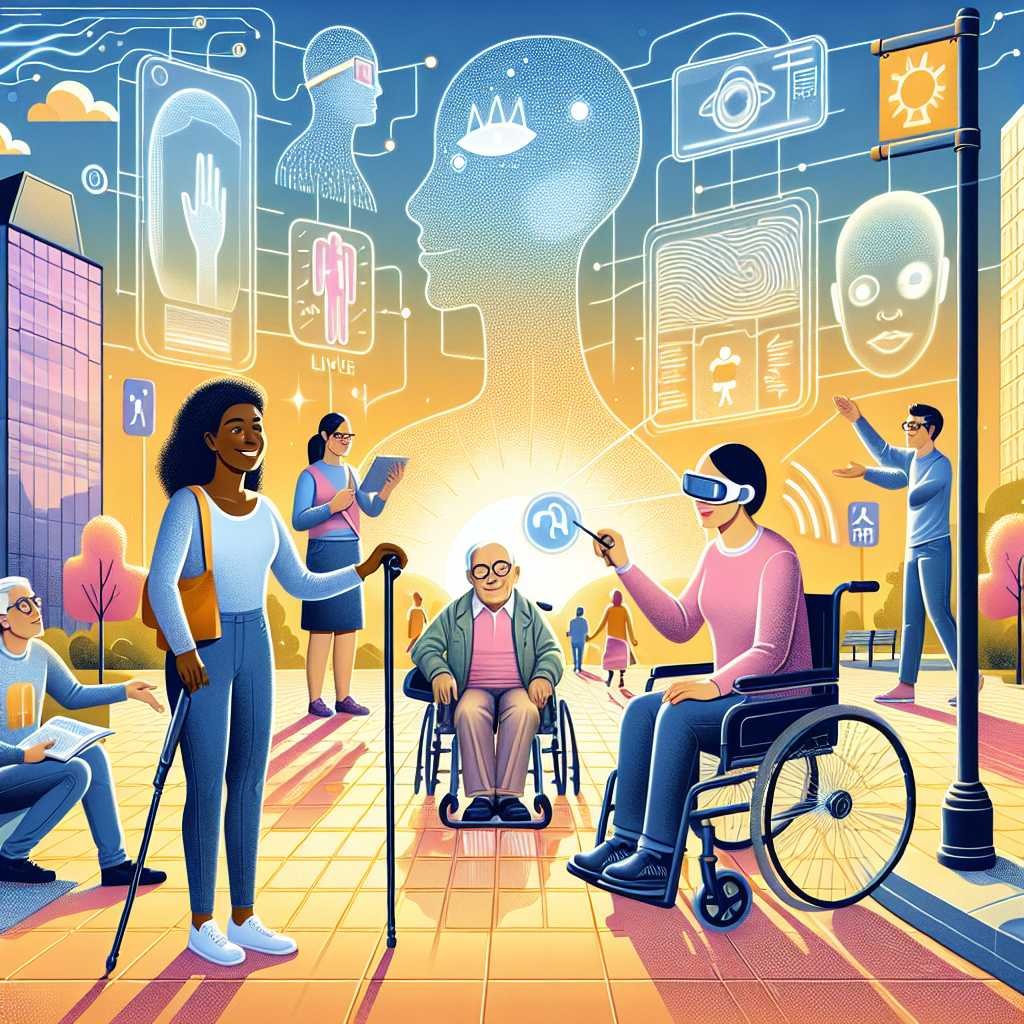
AFB Report: How AI Is Transforming Accessibility for People with Disabilities (and What’s Next)
If AI can describe a crosswalk to someone who can’t see it—and do it in real time—what else can it unlock? A new report from the American Foundation for the Blind (AFB), highlighted by ADA Southeast, says we’re on the cusp of a profound shift: machine learning and generative AI are already powering tools that make everyday life more navigable, workplaces more inclusive, and learning more personal for millions of people with disabilities.
But here’s the twist. The same systems can also marginalize, misinterpret, or even exclude—especially when biased data and opaque algorithms shape the experience. The AFB report reads like both a celebration and a cautionary tale. The opportunity is enormous. The stakes are, too.
This post unpacks the most important takeaways for product leaders, accessibility teams, policymakers, and advocates. We’ll cover the breakthroughs already changing lives, the risks that can derail progress, and the concrete steps to build AI that empowers everyone.
Why This Report Matters Now
We’ve hit an accessibility-AI inflection point. In just a few years, advances in multimodal models, on-device compute, and foundation models trained on massive datasets have shifted AI from “assistive add-on” to “everyday infrastructure.”
According to AFB’s analysis (as summarized by ADA Southeast):
- AI-powered wearables and apps are supporting safer, more independent navigation.
- Speech-to-text accuracy can now surpass 95% even in noisy environments.
- Predictive text and input optimization are reducing fatigue for people with motor disabilities.
- Personalized learning—powered by large language models (LLMs)—adapts explanations, reading levels, and formats in ways traditional tools haven’t matched.
- By 2030, disability-related unemployment could drop by 20% as AI-driven tools boost employability and workplace inclusion.
There’s momentum—and it’s measurable. But the report also warns of familiar pitfalls: facial recognition systems that misclassify darker skin tones; voice assistants that stumble over accents common in disabled communities; black-box models making consequential decisions without explanation. AFB’s throughline is clear: this next chapter must be designed for equity from the start.
The Breakthroughs: What AI Is Enabling Today
Real-Time Image Description and Scene Understanding
Generative vision models and mobile cameras are teaming up to turn the visual world into words. From describing currency and medication labels to identifying landmarks—and even reading social cues like facial expressions in limited contexts—AI is closing information gaps that once required a sighted intermediary.
- Multimodal systems can summarize scenes and answer contextual questions (“Where is the nearest door? Is this the red line platform?”).
- On-device processing reduces latency and offers greater privacy for sensitive tasks.
This is a leap beyond static OCR: it’s dynamic, contextual assistance at the moment of need.
Speech-to-Text That Works in the Real World
AFB notes accuracy rates surpassing 95% in noisy environments—an enormous gain for people who are Deaf or hard of hearing and for anyone who relies on live captioning to follow conversations, lectures, or meetings.
- Modern speech models handle background noise, multiple speakers, and domain-specific vocabulary better than ever.
- Assistive apps now provide live captions and transcripts across video calls, classrooms, and public settings, improving real-time participation.
Predictive Text and Motor Accessibility
For people with motor disabilities, every keystroke counts. Predictive text and AI-driven input optimization cut effort dramatically:
- Smart suggestions reduce typing load and correct errors early.
- Adaptive interfaces learn individual patterns—switch control setups, dwell times, or eye-tracking inputs—to speed up communication.
- Next-word prediction has matured from guesswork to genuinely personalized assistance.
Independent Navigation With Wearables and Apps
Computer vision, geolocation, and haptic feedback are converging in a new generation of mobility aids:
- Wearables can detect obstacles, signal safe crossings, and confirm destinations.
- Turn-by-turn instructions are supplemented by tactile cues, minimizing cognitive load and enhancing safety.
- Crowd-sourced mapping and AI inference fill in the “last 50 feet” problems traditional GPS misses—like identifying a specific doorway or elevator.
Personalized Learning With LLMs
Learning isn’t one-size-fits-all. LLMs are making personalization routine:
- Materials can be adapted to preferred reading levels or converted to multiple formats (plain language summaries, audio, braille-friendly structures).
- Chat-based scaffolding helps learners practice at their pace, with explanations tailored to cognitive or sensory needs.
- Educators can generate accessible lesson variations faster, keeping inclusion aligned with the curriculum.
These advances are more than features. They’re freedom: to study, work, travel, and participate without asking permission.
The Risks: Bias, Opacity, and Unequal Access
AFB’s warning is unambiguous: AI can widen the accessibility gap if we’re not careful.
Biased Training Data, Biased Outcomes
When datasets underrepresent people with disabilities—or reflect long-standing racial and gender imbalances—systems can fail precisely where reliability matters most:
- Facial recognition systems have historically misclassified darker skin tones at higher rates, a disparity widely documented in research like Gender Shades.
- Accessibility-relevant edge cases (like mobility aids, assistive devices, or atypical gait) are often missing from training data, degrading performance.
Accent and Dialect Bias in Voice Systems
Voice assistants still struggle with non-standard accents, speech disorders, or atypical prosody—barriers common in disabled communities. Without robust, inclusive speech datasets and targeted evaluation, error rates can remain stubbornly high. Initiatives like Mozilla Common Voice are critical, but they need broader, sustained support from industry.
Over-Reliance on Opaque Systems
Black-box models can be persuasive but wrong. When interfaces hide uncertainty, people may over-trust outputs—potentially dangerous in navigation, health, or financial contexts. AFB underscores the need for human oversight, confidence indicators, and clear escalation paths to a person when AI falls short.
Privacy and Security Concerns
Assistive AI often touches the most sensitive contexts: health, home, education, employment. Captured speech, images, and location data must be protected. Minimizing data collection, enabling local/on-device processing where feasible, and offering transparent consent and data use controls are table stakes.
What AFB Recommends: Inclusive Data and Strong AI Safety Frameworks
AFB’s call to action centers on building for equity from the ground up:
- Use inclusive datasets that reflect disability diversity, racial and gender diversity, and linguistic variation.
- Adopt regulatory frameworks and AI safety protocols that make inclusion non-negotiable.
- Prioritize universal design so accessibility is core to the product—not a patch.
These principles align with established standards and policy directions:
- The NIST AI Risk Management Framework offers a structured approach to govern risk, bias, and transparency across the AI lifecycle.
- The emerging EU AI Act sets obligations around data governance, documentation, and transparency—especially for higher-risk systems.
- The W3C Web Accessibility Initiative and WCAG 2.2 remain essential for digital product accessibility—and should be complemented by AI-specific evaluation protocols.
The Business Case: Accessibility-Optimized Models and a Changing Labor Market
AFB flags a surging demand for foundation models that are optimized for accessibility use cases—and major vendors are already moving:
- Microsoft is embedding accessibility tooling across its stack and supporting innovation through AI for Accessibility, with accessibility features increasingly available in Azure AI.
- Google’s multimodal Gemini family underscores how vision-language capabilities can make assistance more contextual and conversational.
AFB’s analysis projects a potential 20% reduction in disability-related unemployment by 2030, driven by inclusive hiring workflows, AI-enabled accommodations, and productivity tools that remove friction before it becomes exclusion.
What This Means for Employers and HR Tech
- AI-driven accommodations (e.g., live captioning, meeting summaries, personalized interfaces) can be standardized across roles.
- Skills-first hiring—supported by AI that de-emphasizes pedigree signals—can open doors, but requires vigilant bias audits.
- Procurement policies should require vendors to demonstrate accessible design, inclusive datasets, and ongoing bias testing.
A Collaboration Playbook: Tech, Policymakers, and Advocates
AFB emphasizes that no single stakeholder can solve accessibility in AI. Progress requires a coalition.
Co-Design With Lived Experience
- Recruit people with disabilities early and often—for discovery, prototyping, and evaluation.
- Compensate advisory councils and testers. Expertise is labor, not a volunteer nice-to-have.
- Include intersectional perspectives (disability + race + gender + language + age).
Build Accessibility Into Your Development Rituals
- Define accessibility acceptance criteria for each feature.
- Add assistive tech compatibility to your Definition of Done (e.g., screen reader workflows, voice control paths).
- Test with multiple ATs (JAWS, NVDA, VoiceOver, TalkBack), input methods, and cognitive load scenarios.
Document and Disclose
- Publish model cards and data statements describing training data composition, known limitations, and performance across user groups. See guidance from Model Cards and organizations like the Partnership on AI.
- Offer user-facing transparency: what’s automated, what’s human-reviewed, how errors are handled, and how to opt out.
Getting Practical: Steps Product Teams Can Take This Quarter
You don’t need a moonshot to start. You need a plan.
- Inventory critical user journeys – Identify top 10 tasks where AI could remove friction (navigation flows, forms, content comprehension). – Map assistive technologies used for those tasks.
- Establish inclusive data practices – Audit datasets for representativeness (disability types, accents, skin tones, devices). – Fill gaps with targeted collection in partnership with communities and ethical review boards.
- Build uncertainty into the UI – Show confidence scores or warnings when the model is uncertain. – Provide fast paths to human assistance and accessible error recovery.
- Create an accessibility eval harness for AI features – Test with real assistive technologies and diverse users. – Add benchmark scenarios for edge cases (low light, noisy audio, non-standard accents).
- Make privacy choices easy – Offer on-device options where possible. – Provide crystal-clear consent flows with plain language summaries, not legalese.
- Commit to continuous improvement – Log failure modes tied to accessibility, and prioritize fixes in sprints. – Share release notes that call out accessibility changes.
Emerging Patterns Worth Watching
- On-device AI for privacy and latency: As mobile chips get more capable, expect more real-time captioning, translation, and scene description to run locally—reducing data exposure.
- Multimodal assistance as default: Tools will blend text, audio, haptics, and visuals so users can choose what works best, moment by moment.
- Proactive assistance that respects autonomy: Instead of reacting to prompts, systems will anticipate needs (e.g., auto-enabling captions in noisy rooms) while remaining easy to override.
- Accessibility as a benchmark in model training: Expect “accessibility evaluation suites” to join accuracy and latency as first-class metrics for model quality.
How to Measure Equitable Impact
If you can’t measure it, you’ll miss it. Track:
- Accuracy by user group: disaggregate by disability, accent, device, and environment.
- Time to complete key tasks: e.g., how long it takes to submit a form using a screen reader vs. visually.
- Error recovery rate: how often users can self-correct without assistance.
- Opt-in rates for data sharing: segmented by assistive tech users; low trust signals privacy concerns.
- Support contact drivers: tag AI-related accessibility issues to inform roadmap prioritization.
Policy and Standards That De-Risk the Road Ahead
- Align your internal governance with the NIST AI RMF: map risks, assign owners, and verify mitigations.
- Track jurisdictional rules like the EU AI Act: documentation, data governance, and transparency requirements will shape enterprise AI.
- Meet (and exceed) WCAG 2.2 and publish accessibility statements that include AI-specific behaviors.
- Build vendor expectations into RFPs: require evidence of inclusive datasets, bias audits, and compatibility with assistive tech.
The 2030 Outlook: Two Possible Futures
- Bright path: Inclusive datasets, universal design, and transparent governance turn AI into an equalizer. Navigation becomes smoother, education more personalized, workplaces more flexible. Disability-related unemployment drops meaningfully, and accessibility is a baseline expectation—not a bonus.
- Risky path: Biased systems and black-box decisions erode trust, and accessibility becomes fragmented across tools and vendors. Productivity gains bypass those who could benefit most, widening inequities.
The difference? Intentionality. AFB’s report is a blueprint, but it’s also a mirror. Will we do the work?
Quick Wins for Organizations Getting Started
- Stand up an Accessibility + AI working group with executive sponsorship.
- Fund user research with disabled participants and publish summarized findings internally.
- Pilot captions-and-transcripts by default across meetings, events, and training.
- Add assistive tech testing to your CI/CD pipeline using real devices and emulators.
- Open a channel for users to flag AI accessibility issues (and close the loop with visible fixes).
Frequently Asked Questions
Q: What does “inclusive datasets” actually mean in practice?
A: It means your training and evaluation data reflect the diversity of real users—disability types, mobility aids, assistive technologies, accents, dialects, skin tones, devices, and environments. It also means documenting what’s missing and mitigating risks before deployment.
Q: How do we reduce accent bias in speech systems?
A: Collect and label speech from a wide range of accents and speech patterns (including disfluencies and atypical prosody), use targeted data augmentation, evaluate by subgroup, and retrain where gaps persist. Participate in open efforts like Mozilla Common Voice.
Q: Are LLMs replacing screen readers and other assistive tech?
A: No. LLMs augment, not replace, assistive technologies. The goal is layered support: reliable AT (like screen readers) plus AI enhancements (summaries, explanations, context) that users can opt into.
Q: What standards should teams follow for AI accessibility?
A: Start with WCAG 2.2 for interface accessibility, then add AI-specific governance via the NIST AI RMF. Use model cards and data statements to document limitations and performance for different user groups.
Q: How do we avoid over-reliance on AI in critical tasks?
A: Expose uncertainty in the UI, provide human assistance pathways, and bound autonomy (e.g., require confirmation for higher-risk actions). Monitor for automation bias with user testing and telemetry.
Q: What should go in an accessibility RFP for AI vendors?
A: Require: AT compatibility evidence; subgroup performance metrics; bias and privacy testing protocols; model/data documentation; ongoing evaluation plans; and clear incident response processes for accessibility regressions.
Q: Where can I learn more about the AFB findings?
A: Read ADA Southeast’s coverage here: AFB Report Spotlights Impact of AI for People with Disabilities. For broader accessibility resources, visit the W3C Web Accessibility Initiative.
The Bottom Line
AFB’s message is both hopeful and urgent: AI is already making the world more accessible—from real-time scene descriptions to captions that keep up in chaos. With the right data, design, and governance, the next five years could unlock unprecedented independence, inclusion, and opportunity. But if we ignore bias, opacity, and privacy, we risk building tools that help some and harm others.
The takeaway: bake accessibility into the AI lifecycle now. Co-design with people with disabilities, evaluate by subgroup, document your models, and be transparent about what AI can—and can’t—do. Do that, and you won’t just ship better products. You’ll help build a more equitable future.
Discover more at InnoVirtuoso.com
I would love some feedback on my writing so if you have any, please don’t hesitate to leave a comment around here or in any platforms that is convenient for you.
For more on tech and other topics, explore InnoVirtuoso.com anytime. Subscribe to my newsletter and join our growing community—we’ll create something magical together. I promise, it’ll never be boring!
Stay updated with the latest news—subscribe to our newsletter today!
Thank you all—wishing you an amazing day ahead!
Read more related Articles at InnoVirtuoso
- How to Completely Turn Off Google AI on Your Android Phone
- The Best AI Jokes of the Month: February Edition
- Introducing SpoofDPI: Bypassing Deep Packet Inspection
- Getting Started with shadps4: Your Guide to the PlayStation 4 Emulator
- Sophos Pricing in 2025: A Guide to Intercept X Endpoint Protection
- The Essential Requirements for Augmented Reality: A Comprehensive Guide
- Harvard: A Legacy of Achievements and a Path Towards the Future
- Unlocking the Secrets of Prompt Engineering: 5 Must-Read Books That Will Revolutionize You