
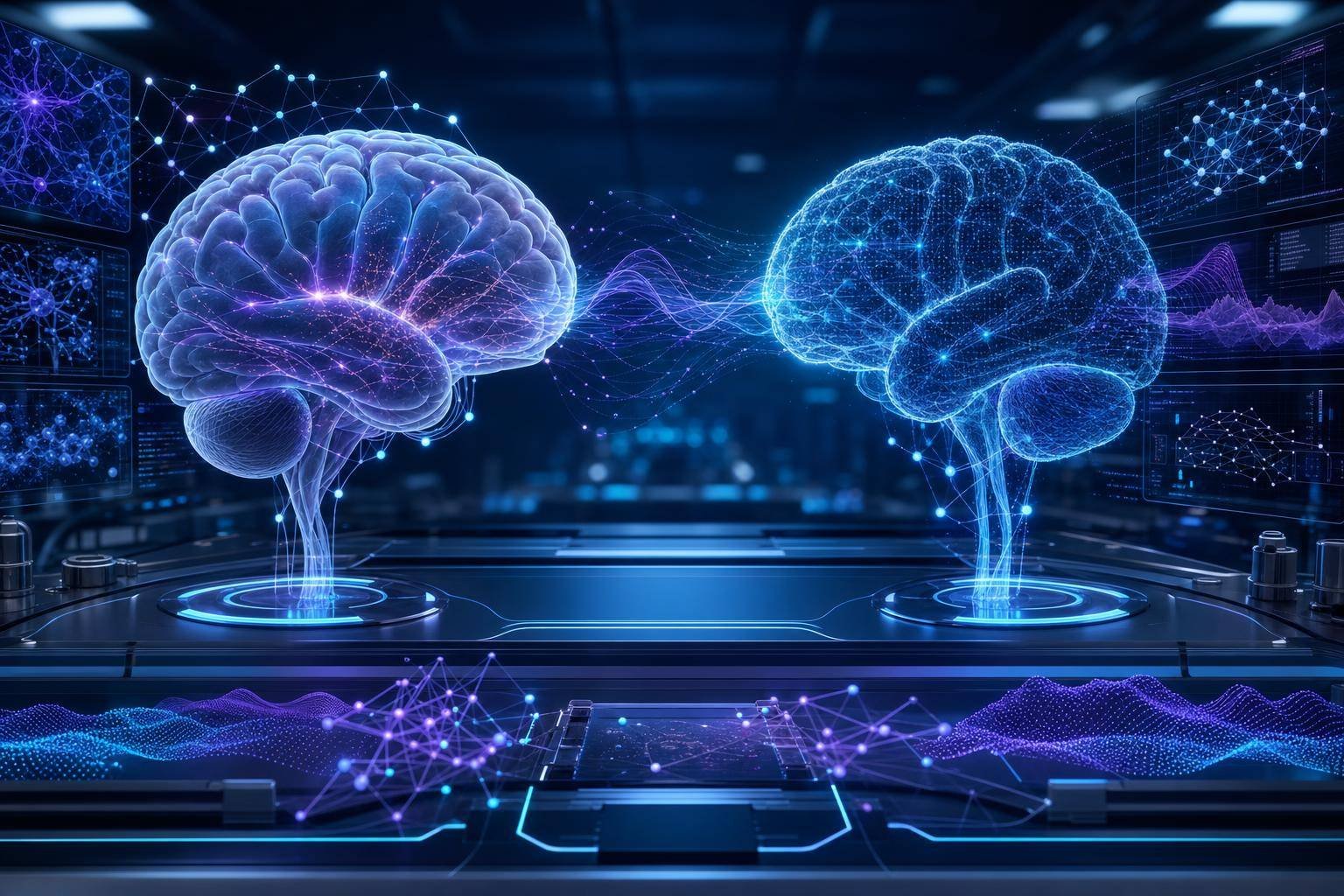
Emerging AI Trends for 2026: Neuro‑Aligned Models, Digital Twins of the Brain, and What Meta’s TRIBE v2 Signals
AI is moving closer to the brain—not just metaphorically, but mathematically. The most consequential emerging AI trend in 2026 is a decisive turn toward neuro‑aligned systems: models trained to predict, approximate, or interact with patterns of human neural activity. Meta’s TRIBE v2—pitched as a predictive foundation model and “digital twin” of human neural dynamics—encapsulates this shift and serves as a bellwether for what comes next.
Why this matters now: after years of generalized large language models, we’re entering an era of specialized foundation models, convergent sensing (neuroimaging, wearables, ambient computing), and higher‑stakes adaptation to the individual. With gains come risks: neural data is intimate, unique, and potentially identifying. The governance gap is real. Read on for a clear view of the five emerging AI trends behind TRIBE v2, what leaders can do today, and how to assess opportunities without drifting into surveillance or sci‑fi speculation.
1) Neuro‑Aligned AI: From Tokens to Thought Proxies
The core idea behind neuro‑aligned AI is simple to state and hard to execute: align machine representations with measurable correlates of human cognition. Meta’s TRIBE v2 is described as a predictive foundation model trained on large‑scale, multimodal neural and behavioral datasets to estimate patterns of brain activity in response to stimuli. It’s positioned for research in neuroscience, HCI, and potentially personalized education or mental‑health support—where safer, more adaptive interfaces could anticipate user needs without constant explicit commands.
Why this is different from “just another model”: – Target signal: Instead of optimizing solely on text or images, the model learns to predict neural responses (e.g., patterns observed via fMRI, MEG, EEG, or wearable signals). – Representation alignment: If internal model features track neural dynamics, downstream systems may adapt to users more fluidly—suggesting HCI that feels anticipatory rather than reactive. – Cross‑disciplinary validation: Advancements hinge on neuroscience datasets and methods, not only on scaling compute.
Recent research has shown that non‑invasive recordings can support surprisingly rich inferences. A 2023 study in Nature Communications demonstrated semantic reconstruction of continuous language from fMRI signals, indicating that machine learning can map brain activity to high‑level meaning with sufficient data and careful supervision. See “Semantic reconstruction of continuous language from non-invasive brain recordings” in Nature Communications for a high‑level reference to the underlying techniques and limits of non‑invasive decoding: Nature Communications paper on language decoding from fMRI.
For context on the broader scientific push, the United States’ NIH BRAIN Initiative continues to fund foundational tools and datasets aimed at measuring, understanding, and ultimately repairing brain circuits. Neuro‑aligned AI is emerging at the confluence of this scientific horsepower and industry‑scale modeling.
Practical examples on the near horizon: – Adaptive reading or learning interfaces that modulate difficulty when cognitive load spikes. – Accessibility features that infer “intent to click” via subtle neuro‑muscular signals for users with motor impairments. – Workload‑aware UX that tempers notifications when signals indicate fatigue or distraction.
Limits to watch: – Generalization across people is hard; brains are not interchangeable data points. Training on one cohort doesn’t guarantee performance elsewhere. – Measurement quality matters. Non‑invasive signals are noisy and low‑bandwidth compared with invasive recordings. – Interpretability remains a must. Predicting a neural pattern doesn’t mean explaining it.
2) The Digital Twin Extends to Biology—And to the Brain
“Digital twins” have long flourished in industrial systems: virtual replicas of an asset or process used for simulation, monitoring, and optimization. In 2026, that concept is expanding into biological domains—the most ambitious case being a digital twin of human neural activity. Meta frames TRIBE v2 as such a twin, a predictive proxy of how brains respond to stimuli across tasks.
In engineering, digital twins owe much of their value to structured sensors and well‑characterized physics. Brains are different. Anatomy, plasticity, and context introduce variability that complicates modeling. Still, the metaphor holds enough to be useful: if a model can reliably approximate certain neural response patterns, it could help scientists simulate interventions, test hypotheses in silico, or design more humane human‑computer interfaces.
For readers newer to the concept, IBM’s overview of twins offers a grounding in vocabulary and use cases outside biology: What is a digital twin? (IBM).
Ethical boundaries matter more here than in industrial settings: – Ownership: Who owns neural “shadow” models derived from your signals? – Consent: What counts as informed consent when the modeled system is your mind? – Secondary use: Will models built for research later fuel consumer profiling?
The Organization for Economic Co‑operation and Development has already flagged these issues at a policy level. The OECD’s Recommendation on Responsible Innovation in Neurotechnology lays out principles on safety, privacy, and agency. While non‑binding, it’s a useful anchor for institutional policy and compliance roadmaps.
3) Specialization of Foundation Models: Beyond One‑Size‑Fits‑All LLMs
TRIBE v2 also exemplifies a second trend: foundation models are fragmenting into specialized subclasses tailored to specific modalities, risk profiles, and scientific goals. Rather than force generalist LLMs to cover every use case, teams are building domain‑optimized architectures—vision‑language‑action stacks for robotics, code‑native models for software engineering, and now neuro‑centric models optimized for cognitive alignment.
Why specialization is accelerating: – Data constraints: Neural datasets are comparatively small and sensitive; architectures must squeeze more value per datapoint. – Evaluation: Success requires bespoke metrics (e.g., neural prediction accuracy, cross‑subject robustness), not standard NLP benchmarks. – Safety: High‑stakes domains (health, education, safety‑critical UX) require tighter guarantees and guardrails, nudging teams toward purpose‑built models.
Organizations should expect a mixed portfolio: a generalist LLM for broad reasoning, a specialized perception stack for sensory inputs, and research‑grade models to align interfaces with cognitive signals—each with distinct MLOps, governance, and evaluation pipelines.
4) Convergence: AI Meets Neuroimaging and Wearables
The fourth trend is the convergence of AI with neuroimaging and ambient sensing—fMRI and MEG for research; EEG, EMG, eye tracking, and photoplethysmography (PPG) for consumer‑grade inference. Non‑invasive doesn’t mean non‑sensitive: even low‑bandwidth signals can carry rich behavioral signatures when modeled over time.
Expect progress on three fronts: – Sensing: Better dry‑electrode EEG, wrist‑worn neural‑muscular decoding, and camera‑based micro‑gesture recognition feed higher‑quality features to models. – Modeling: Multimodal fusion layers combine text, vision, behavior logs, and neural proxies to estimate intent and cognitive state. – Experience: Interfaces that “get out of the way” by adapting content, modality, and pacing to user state.
In safety‑critical contexts, the bar is high. The U.S. FDA has issued guidance for brain‑computer interface devices used in clinical scenarios such as paralysis. Even if your product is non‑medical, studying regulatory expectations can improve your risk posture and validation plans: FDA guidance on implanted brain‑computer interface devices.
For workplace and consumer applications, privacy and agency—not just safety—become the gating factors. Signal‑driven adaptation must remain transparent and user‑controllable, with strict separation between research participation and any consumer‑level data use.
5) Governance Is Lagging the Tech—But Usable Frameworks Exist
While regulation specific to neural data is sparse, usable governance frameworks already exist for AI risk management, data protection, and responsible innovation:
- The NIST AI Risk Management Framework (AI RMF) provides a structured way to identify, measure, and mitigate AI risks across the lifecycle. It’s vendor‑neutral and increasingly recognized in enterprise RFPs.
- ISO’s ISO/IEC 23894:2023 Artificial intelligence — Risk management outlines terminology, processes, and controls that can be adapted for neuro‑aligned systems.
- Major AI labs and platforms publish principles that, while high‑level, can be operationalized with internal standards and audits: Google AI Principles and Microsoft Responsible AI principles.
On the data side, the European Union and national regulators already treat certain biometric and health signals as “special category” data subject to heightened protections. Even where law is ambiguous on neural signals, treating them as high‑risk by default is a sound baseline. For technical controls, ENISA’s practical guidance on pseudonymisation techniques and best practices can help teams design safer data pipelines.
Security leaders should also apply secure‑by‑design guidance to sensing and model pipelines, not just application code. CISA’s cross‑industry program remains a good, actionable reference: CISA Secure by Design.
Bottom line: while the specific “neuro” rulebook is still forming, you can anchor your program to established AI risk and data protection frameworks today, layering neuro‑specific controls as the ecosystem matures.
Applying These Trends: A Practical Playbook for Builders and Buyers
Neuro‑aligned systems are not plug‑and‑play. They require careful scoping, measurement strategy, and a higher bar for consent and privacy. Use the following staged approach to de‑risk pilots and avoid misplaced hype.
1) Define the problem and the signal you truly need – Start with a use case where a cognitive proxy is clearly beneficial: adaptive learning, hands‑free accessibility, or fatigue‑aware safety prompts. – Separate “nice to have” from “must have” signals. For many HCI tasks, high‑quality behavior logs and micro‑gestures may deliver 80% of the value with fewer privacy risks than direct neural data.
2) Choose the measurement stack based on constraints – Research prototypes: fMRI and MEG provide high spatial or temporal fidelity for model validation in lab conditions. – Applied pilots: EEG, EMG wearables, eye tracking, and combined physiological sensors are more practical for field use. – Measurement hygiene matters: Calibrate devices, reduce motion artifacts, and standardize tasks to improve signal‑to‑noise.
3) Data governance and consent by design – Treat neural data as high‑risk. Obtain explicit, specific consent, with clear downstream use limits and opt‑out paths. Provide per‑purpose on/off controls. – Minimize collection: log only what’s necessary; prefer on‑device processing and ephemeral buffers for raw signals. – Implement robust de‑identification and access controls; restrict re‑linkage and train staff on handling neural and derived features.
4) Model and architecture selection – For predictive twins like TRIBE‑style models, consider multimodal encoders that map stimuli and behavior to latent spaces paired with neural predictors. – Embed interpretability from the start: align model features with neuroscientific priors when feasible; use post‑hoc tools to analyze what the model is learning. – Evaluate with domain‑specific metrics: neural prediction error, cross‑subject generalization, robustness to sensor noise, and user‑level fairness.
5) Privacy‑preserving ML patterns – Federated learning for on‑device model updates where possible. – Trusted execution environments for sensitive training. – Explore differential privacy for aggregates; set conservative epsilon budgets; avoid DP if it meaningfully degrades safety‑critical performance without clear benefits.
6) Human factors and UX – Provide visibility and control: an always‑on indicator for sensing; a prominent pause/off switch; data dashboards that show what’s being captured and why. – Design for graceful degradation: if neural signals drop, the system should fall back to standard UI without penalizing the user. – Avoid manipulative personalization. Prioritize user goals (focus, learning, accessibility) over engagement tricks.
7) Security, testing, and fail‑safes – Treat sensors and ingestion endpoints as attack surfaces. Apply threat modeling to data flows, storage, and model APIs. – Red‑team against signal injection (e.g., artifacts that spoof attention or fatigue), model inversion, and membership inference. – Establish incident response playbooks for data exposure, misclassification in safety‑critical flows, and model drift.
8) Validation and oversight – Institutional review: if research‑adjacent, route through IRB‑like review even when not legally required. – Align with recognized frameworks: map controls and metrics to the NIST AI RMF and, where applicable, ISO/IEC 23894. – Document limitations and intended use. For anything touching health or education outcomes, plan third‑party audits and publish model cards.
Decision checkpoints for buyers: – Does the vendor collect raw neural data? If yes, where is it processed and stored, and for how long? – Can the product function effectively with less sensitive proxies? – What benchmarks and peer‑reviewed validations exist for their claims? – Is there a kill switch for sensing? Are logs exportable for audit? – Are updates and models signed and verifiable end‑to‑end?
Opportunities, Risks, and Real‑World Use Cases
Opportunities – Accessibility: People with limited mobility could use intent‑aware interfaces that reduce click friction and error rates. – Personalized learning: Cognitive‑state estimation can adjust pacing and modality, improving comprehension and retention. – Safety‑critical work: Fatigue detection and micro‑break nudges could reduce accidents in transportation or industrial settings when implemented transparently and consensually. – Research acceleration: Predictive twins streamline hypothesis testing and study design, potentially reducing the need for long scan sessions.
Risks – Privacy invasion: Neural data could reveal sensitive traits or states beyond the intended scope, especially when combined with other data. – Coercion and surveillance: Employer or platform pressure to share neuro‑signals for “performance optimization” is a red line. – Over‑trust: Users and leaders may conflate predictive alignment with understanding. A model that predicts neural patterns is not “reading thoughts.” – Bias and exclusion: Models trained on limited cohorts may not generalize, leading to reduced performance for underrepresented groups.
Real‑world examples to build today – A reading app that raises or lowers text complexity and switches to audio when sustained cognitive load is detected via eye tracking and pupil dilation, without collecting raw neural data. – A workstation assistant that spaces notifications based on inferred interruption cost, using keyboard/mouse dynamics and optional EEG—with an obvious “do not infer” toggle. – A rehab tool that pairs EMG and motion capture to coach micro‑movements, improving fine‑motor recovery without biomedical claims or permanent data storage.
Mistakes to Avoid With Neuro‑Aligned AI
- Treating neural data like ordinary telemetry. It isn’t. Elevate governance, consent, and minimization.
- Shipping “black box” features. Without user controls and explanations, adoption and trust collapse.
- Confusing lab demos with deployable products. fMRI‑based findings don’t translate one‑to‑one to wearables.
- Ignoring attack surfaces. Sensors, Bluetooth stacks, firmware update paths, and model endpoints are all in scope.
- Over‑promising mental‑health or cognitive claims. Unless you have clinical validation and approvals, stay within wellness/HCI boundaries.
What TRIBE v2 Tells Us About the Road Ahead
By positioning TRIBE v2 as a digital twin of human neural activity, Meta is signaling an intent to ground AI alignment in measurable brain dynamics. Expect ripple effects: – Benchmarks and datasets: More public benchmarks for neural prediction and cross‑subject generalization, likely with stricter access controls. – Cross‑disciplinary hiring: Teams will blend ML, cognitive neuroscience, and HCI. Product managers will need comfort with research norms and consent frameworks. – Tooling and platforms: MLOps will absorb sensor calibration, secure ingestion, and neuro‑specific validation pipelines.
These shifts will reshape how we think about explainability and alignment. Instead of purely philosophizing about “human values,” practitioners will increasingly engage with cognitive science—testing whether model internals map to interpretable, reproducible neural features and whether that mapping improves outcomes without sacrificing agency.
FAQ
What is a “digital twin of the brain” in AI? – It’s a predictive model designed to approximate certain patterns of brain activity in response to stimuli. It doesn’t replicate consciousness or “read thoughts,” but aims to forecast neural responses for research and interface design.
How is neuro‑aligned AI different from standard personalization? – Standard personalization relies on clicks and content history. Neuro‑aligned AI incorporates proxies of cognitive state (e.g., EEG, EMG, eye tracking) to adapt timing, modality, or difficulty with finer granularity and less manual input.
Is neural data protected under existing privacy laws? – Many jurisdictions treat health and biometric data as sensitive, which can encompass neural signals depending on context. In the absence of explicit neuro‑specific rules, treat neural data as high‑risk and apply stringent governance and consent.
Do I need fMRI to benefit from these trends? – No. While fMRI and MEG are valuable for research, practical products often rely on wearables or behavioral proxies. Start with the least invasive signal that meets your use case.
What frameworks can guide responsible deployment? – The NIST AI Risk Management Framework, ISO/IEC 23894, OECD’s neurotech recommendation, CISA’s Secure by Design, and enterprise principles like Google’s AI Principles and Microsoft’s Responsible AI principles are good starting points.
How accurate are non‑invasive neural predictions today? – Accuracy depends on the task, modality, participant, and model. Peer‑reviewed studies show promising results for specific decoding tasks in controlled settings, but field robustness and generalization remain active research areas.
Conclusion: Emerging AI Trends Point to Cognitive‑Aware Systems—Proceed With Precision
The most important emerging AI trends for 2026 converge on one idea: models that learn from and adapt to human cognition, not just content. Meta’s TRIBE v2, framed as a digital twin of neural activity, highlights how quickly research is moving toward neuro‑aligned AI and how much potential there is for better, more humane interfaces. But potential is not permission. Teams must pair scientific ambition with rigorous governance, privacy by design, and security that treats neural signals as among the most sensitive data they will ever handle.
Your next steps: – Pick a high‑value, low‑risk use case where cognitive proxies could materially improve outcomes. – Start with the least invasive signals that deliver value; design with visible controls and consent. – Anchor your program to recognized frameworks like the NIST AI RMF, and adopt secure‑by‑design practices throughout the sensing and modeling pipeline. – Invest in evaluation: measure not only accuracy but generalization, robustness, and user experience under real‑world conditions.
Done right, neuro‑aligned AI can make technology feel less like a demand on our attention and more like a partner in our work, learning, and daily life. The organizations that win in this phase won’t be the ones shouting the loudest about brain‑like AI—they’ll be the ones who translate these emerging AI trends into respectful, secure, and beneficial products people trust.
Discover more at InnoVirtuoso.com
I would love some feedback on my writing so if you have any, please don’t hesitate to leave a comment around here or in any platforms that is convenient for you.
For more on tech and other topics, explore InnoVirtuoso.com anytime. Subscribe to my newsletter and join our growing community—we’ll create something magical together. I promise, it’ll never be boring!
Stay updated with the latest news—subscribe to our newsletter today!
Thank you all—wishing you an amazing day ahead!
Read more related Articles at InnoVirtuoso
- How to Completely Turn Off Google AI on Your Android Phone
- The Best AI Jokes of the Month: February Edition
- Introducing SpoofDPI: Bypassing Deep Packet Inspection
- Getting Started with shadps4: Your Guide to the PlayStation 4 Emulator
- Sophos Pricing in 2025: A Guide to Intercept X Endpoint Protection
- The Essential Requirements for Augmented Reality: A Comprehensive Guide
- Harvard: A Legacy of Achievements and a Path Towards the Future
- Unlocking the Secrets of Prompt Engineering: 5 Must-Read Books That Will Revolutionize You