
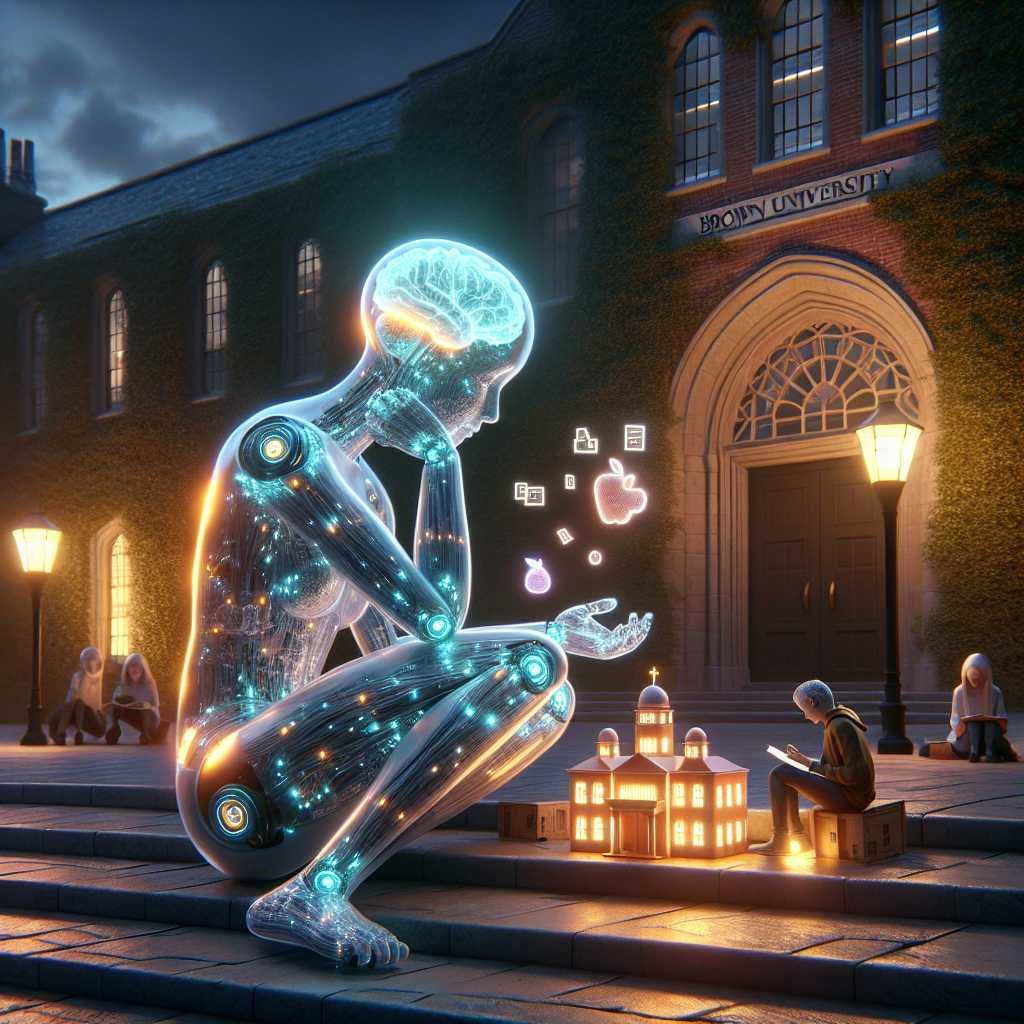
Do AI Language Models Understand the Real World? Brown University’s New Study Points to a Surprising “Yes” (At a Basic Level)
If you tell a chatbot, “A man is taller than the Eiffel Tower,” will it treat that as unlikely or flat-out impossible? And what if you say, “A man is taller than the surface area of Mars”? New research out of Brown University suggests that, under the hood, today’s large language models are doing more than parroting patterns from the internet—they’re building a kind of mathematical map of reality that separates the everyday from the absurd.
According to a study led by Ph.D. candidate Michael Lepori, even relatively modest language models (2+ billion parameters) can distinguish between four kinds of statements—commonplace, improbable, impossible, and nonsensical—by how their internal “brain states” (vector representations) arrange in space. The punchline: the distance between those vectors reliably tracks how humans judge what’s realistic. In other words, the geometry inside these models appears to encode something like causal constraints about the real world.
The team presented their findings at the International Conference on Learning Representations (ICLR) in Rio de Janeiro on April 25, adding fuel to a growing debate about whether modern AI has an emergent grasp of how the world works—or if it’s just sophisticated autocomplete. The evidence here leans toward the former, at least in a basic, mathematical sense.
Curious? Let’s unpack what Brown’s team found, how they tested it, why it matters, and what it definitely does not mean about AI “consciousness.”
For the full university news release, see Brown’s coverage: New research: AI models develop basic real-world understanding. For the conference, visit ICLR.
The Short Version: What Brown University’s Team Discovered
- Researchers probed several large language models (LLMs) to see if they internally represent the difference between everyday events and ones that are implausible, impossible, or outright nonsensical.
- They generated pairs of sentences across four categories:
- Commonplace: a normal scenario you might read in a newspaper.
- Improbable: highly unlikely, but not banned by physics.
- Impossible: violates physical or logical constraints (e.g., a person taller than a cruising airplane’s altitude).
- Nonsensical: mismatched units or categories (e.g., a person taller than the surface area of a planet).
- By comparing the hidden-layer vectors (the model’s internal representations) across these sentences, they found consistent clustering patterns. Commonplace statements grouped together, impossible ones grouped elsewhere, and so on.
- Crucially, the vector distances predicted how humans judge realism. When people rated a statement as 50/50 between “improbable” and “impossible,” models reflected that uncertainty internally, too—assigning roughly equal probabilities.
- The effect appears across multiple models with more than 2 billion parameters. That’s small by current standards, suggesting this capacity emerges earlier than many might expect.
- Bottom line: The models encode a rough, human-aligned sense of what the world allows.
This doesn’t mean LLMs are conscious, grounded in sensors, or infallible. But it does challenge the idea that they’re only sophisticated “stochastic parrots” regurgitating text patterns. For background on that critique, see “On the Dangers of Stochastic Parrots” (ACM link).
Peeking Under the Hood: How Do You Measure “Understanding” in an LLM?
When we ask if a model “understands” something, what we really mean is: can we detect stable, structured information about the world in its internal states? Brown’s team approached this with a few key steps.
From words to vectors: the hidden-language of LLMs
Modern LLMs map text to high-dimensional vectors at each layer. Think of these as coordinates in a hidden space where related ideas end up closer together. This isn’t new—word and sentence embeddings have been core to NLP for years (word embeddings explainer; representation learning). What’s notable here is what those vectors appear to represent: not just semantics, but gradations of real-world plausibility.
The experiment setup: four categories, fine-grained contrasts
The team created sentence pairs illustrating degrees of realism: – Commonplace: a person performing a typical action in a plausible setting. – Improbable: extreme, but possible (e.g., a record-breaking height, a freak accident). – Impossible: violates established physical limits (e.g., a human taller than a plane’s cruising altitude). – Nonsensical: apples-to-oranges comparisons (e.g., a height versus a surface area), where the units or categories simply don’t match.
They then measured how the model’s vectors for these sentences differed and clustered. The insight: if the model truly encodes real-world constraints, then: – Commonplace events should group apart from impossible ones. – Improbable should sit somewhere in between. – Nonsensical should break cleanly away because the comparison itself lacks meaning.
That’s exactly what the researchers observed.
Human judgments as the benchmark
To anchor the analysis, the team used human surveys rating statements as commonplace, improbable, impossible, or nonsense. Here’s where it gets especially interesting: when humans were split—say 50% judged a sentence as impossible and 50% as improbable—the models showed internal representations reflecting similar uncertainty. That is, the model’s probabilities for those categories were roughly balanced as well.
In short: LLMs aren’t just memorizing labels. Their internal geometry seems to mirror the fuzzy, graded way humans think about realism and causal constraints.
Why This Matters: Beyond Pattern Matching to World Models
Some critics argue that LLMs are little more than clever autocomplete engines. But if an LLM can internally separate plausible-from-impossible and reflect human uncertainty about border cases, something deeper is happening. It suggests the model builds an implicit world model—a compact set of constraints about what goes with what—that guides its predictions.
Here’s why that matters: – Better reasoning: If internal states encode physical limits and causal logic, models have a stronger scaffold for reasoning tasks. – Safer generation: Models might better avoid hallucinating impossible events or dangerous instructions if their hidden states flag implausibility. – Human alignment: Matching human uncertainty is a big deal. Real-world decision-making thrives on calibrated doubt; overconfidence ruins trust. A model whose internal space mirrors human hesitation is easier to align with real users. – Interpretability progress: If internal geometry correlates with realism judgments, we can probe and visualize that geometry for safety and interpretability—key goals in the field of mechanistic interpretability (overview of transformer circuits).
What “Understanding” Means—and What It Doesn’t
Let’s be precise about claims.
What this research supports: – LLMs learn a structured, mathematical representation that tracks real-world plausibility—often in ways that align with human judgments. – This representation shows up even in models with “only” a few billion parameters. – The model’s geometry exhibits gradations (e.g., improbable vs. impossible), not just binary classification.
What it does not claim: – Consciousness or subjective experience. – True grounding in sensorimotor reality. The models learn from text, not direct physical interaction. – Perfect reliability. Models still hallucinate and can be gamed with adversarial prompts. – Understanding in the human sense of meaning, intention, or purpose.
The fairest reading? These models acquire an emergent, mathematical understanding of certain real-world constraints—enough to sort nonsense from the plausible, and to calibrate uncertainty in a human-like way. That’s not full comprehension, but it’s more than mindless mimicry.
Practical Implications: Safer, Calibrated, More Interpretable AI
Here are a few places this kind of internal realism signal can help:
- Hallucination guardrails: Classifiers can tap into hidden-layer representations to flag impossible or nonsensical claims in real time, reducing harmful outputs in domains like medicine, finance, and law.
- Content moderation and policy enforcement: Internal plausibility features can detect fantastical, dangerous, or fabricated instructions before they hit the screen.
- Calibration and UX: Surfacing uncertainty with language like “unlikely,” “borderline impossible,” or “category mismatch” can set the right expectations for end users.
- Model debugging: If a model confuses improbable with impossible in certain domains (say, climate or astronomy), teams can pinpoint those regions of latent space and fine-tune or add targeted data.
- Education and tutoring: Tutors that can say “That’s improbable, here’s why,” or “This comparison is nonsensical due to unit mismatch,” can teach reasoning skills, not just content.
The Scaling Question: What About Trillion-Parameter Giants?
The Brown team points to a tantalizing next step: applying the same probes to today’s largest LLMs from organizations like OpenAI and Google DeepMind. Intuition suggests that as scale grows: – Boundaries between categories might become sharper and more consistent across domains. – Calibration could improve, especially on rare edge cases. – New failure modes may appear, including overconfident nonsense in underexplored corners of knowledge.
Either way, the methodology—using internal vector geometry to evaluate world knowledge—scales well. That makes it a promising lens on how “understanding” changes with model size and training diversity.
Try-It-Yourself Thought Experiments
You can get a feel for the categories the researchers used with a few mental tests:
- Commonplace:
- A nurse checks a patient’s chart during morning rounds.
- A student misses a bus on a rainy day.
- Improbable:
- A person grows to 2.8 meters (extremely tall, but not physically impossible).
- A tossed coin lands on its edge and stays there.
- Impossible (given current physics/biology):
- A human is taller than a commercial airplane’s cruising altitude (~10–12 km).
- A person runs 100 meters in 1 second.
- Nonsensical (category or unit mismatch):
- A person is taller than the surface area of Mars.
- The temperature of an idea is 40 miles per hour.
Notice the differences: – Improbable pushes extremes but doesn’t break laws. – Impossible violates constraints (like human physiology or speed of motion). – Nonsensical doesn’t even form a coherent comparison—units or categories don’t match.
If you’re building with LLMs, you can prompt models to rate plausibility on a scale and ask them to explain their reasoning. More interestingly, developers can inspect hidden states and train lightweight probes to predict plausibility directly from activations—an approach aligned with the Brown study’s focus on internal geometry.
Limitations and Open Questions
No study like this is the last word. A few caveats and next steps:
- Text-only learning: Without sensors or embodiment, models might misjudge physical intuition in out-of-distribution scenarios (e.g., fluid dynamics, edge-case materials).
- Dataset artifacts: Some plausibility signals may leak from textual patterns (e.g., phrases commonly associated with exaggeration or fiction) rather than grounded physics. Careful controls are essential.
- Adversarial prompts: Cleverly crafted sentences can coax models into confusing categories (e.g., mixing metaphor with measurement). How robust are these internal boundaries under attack?
- Domain specificity: Do the same clean separations appear in biology, economics, or ethics—domains where “impossible” is fuzzier?
- Multilingual effects: Are these internal boundaries consistent across languages and cultural corpora?
- Multimodal reasoning: When models see images or video, do their plausibility boundaries get sharper thanks to visual grounding?
Each of these represents a natural extension for future research—and fertile ground for building safer, more interpretable systems.
How Builders and Businesses Can Use This Now
- Instrument your models: Expose hidden-layer activations and train simple probes to predict plausibility categories. Use these as gating signals before generation.
- Calibrate output: Pair answers with a plausibility meter (e.g., Commonplace / Unlikely / Borderline Impossible / Nonsensical) and a short rationale.
- Policy hooks: Enforce stricter policy when the probe flags “impossible” or “nonsensical,” especially in safety-critical verticals.
- Evaluate uncertainty: Track how closely model uncertainty aligns with human judgments in your domain. Overconfident wrongness is more dangerous than humble uncertainty.
- Red-team for category drift: Stress-test your model with adversarial phrasing to ensure the improbable/ impossible boundary doesn’t crumble under pressure.
Key Takeaways
- Brown University researchers provide evidence that LLMs encode a basic, human-aligned sense of real-world plausibility inside their hidden representations.
- Even 2B+ parameter models separate commonplace, improbable, impossible, and nonsensical statements in their internal geometry.
- Vector distances correlate with human judgments, including cases where people themselves are split—models reflect that calibrated uncertainty.
- This is not “consciousness,” but it is more than rote pattern matching; it’s an emergent world-modeling capacity that can improve safety, interpretability, and trust.
- The approach opens a new window into how scale and training shape a model’s implicit grasp of causal constraints.
For more, read Brown’s announcement: AI models may encode real-world understanding.
FAQ
Q: Does this mean AI is conscious or “truly understands” like a human? A: No. The study shows that LLMs build internal structures that track real-world plausibility. That’s a form of mathematical understanding, not subjective awareness or lived experience.
Q: How can a model learn physics without sensors? A: Text contains a tremendous amount of indirect information about the world. By predicting what words come next millions or billions of times, models infer constraints embedded in language (e.g., heights, speeds, cause and effect). It’s secondhand, but surprisingly rich.
Q: What exactly are “vector representations” and “hidden layers”? A: As text flows through an LLM, each token is mapped to high-dimensional vectors at each layer. These vectors capture meaning and relations. Differences and distances between vectors (often measured by cosine similarity) reveal how the model organizes concepts internally.
Q: Why is the “nonsensical” category important? A: It tests whether the model notices category errors and unit mismatches—e.g., comparing a length to a surface area. This is critical for catching subtle mistakes in reasoning and measurement.
Q: Do bigger models do better? A: The study finds the effect already present in models with just over 2 billion parameters. It’s reasonable to expect sharper boundaries and better calibration in larger models, but that needs to be measured directly.
Q: Will this reduce hallucinations? A: Potentially. If systems can detect when a claim is impossible or nonsensical, they can avoid or correct those outputs. That said, hallucinations also stem from gaps in knowledge and pressure to produce fluent text—so multiple mitigations are needed.
Q: How could I replicate something like this? A: Generate sets of sentences across the four categories. Pass them through your model, extract hidden states from one or more layers, and compute distances or train a linear probe to classify plausibility. Compare results to human judgments collected via surveys.
Q: Does this conflict with the “stochastic parrots” critique? A: The findings don’t negate concerns about bias, safety, or data provenance. But they do show that LLMs can encode structured, human-aligned constraints about reality—suggesting more than mere rote mimicry is at work. For context on the critique, see the original paper (link).
Q: Where can I read more about the study? A: Start with Brown University’s news post: https://www.brown.edu/news/2026-04-22/artificial-intelligence-understanding-real-world. The work was presented at ICLR.
Q: Does this apply to multimodal models (text + images/video)? A: It’s a natural next step. Visual grounding could strengthen these plausibility boundaries, but specific results would need to be validated with similar probing techniques.
The Bottom Line
LLMs don’t have eyes, hands, or bodies—but Brown University’s new study shows they still pick up a basic, quantitative sense of what the world allows. Inside their hidden layers, they carve out a space where normal events cluster together, impossibilities peel away, and nonsense lives on its own island. That internal map doesn’t make them sentient, but it does make them more than parrots. And if we learn to read and leverage that map, we can build AI systems that are safer, more reliable, and just a bit closer to how people reason about reality.
Discover more at InnoVirtuoso.com
I would love some feedback on my writing so if you have any, please don’t hesitate to leave a comment around here or in any platforms that is convenient for you.
For more on tech and other topics, explore InnoVirtuoso.com anytime. Subscribe to my newsletter and join our growing community—we’ll create something magical together. I promise, it’ll never be boring!
Stay updated with the latest news—subscribe to our newsletter today!
Thank you all—wishing you an amazing day ahead!
Read more related Articles at InnoVirtuoso
- How to Completely Turn Off Google AI on Your Android Phone
- The Best AI Jokes of the Month: February Edition
- Introducing SpoofDPI: Bypassing Deep Packet Inspection
- Getting Started with shadps4: Your Guide to the PlayStation 4 Emulator
- Sophos Pricing in 2025: A Guide to Intercept X Endpoint Protection
- The Essential Requirements for Augmented Reality: A Comprehensive Guide
- Harvard: A Legacy of Achievements and a Path Towards the Future
- Unlocking the Secrets of Prompt Engineering: 5 Must-Read Books That Will Revolutionize You