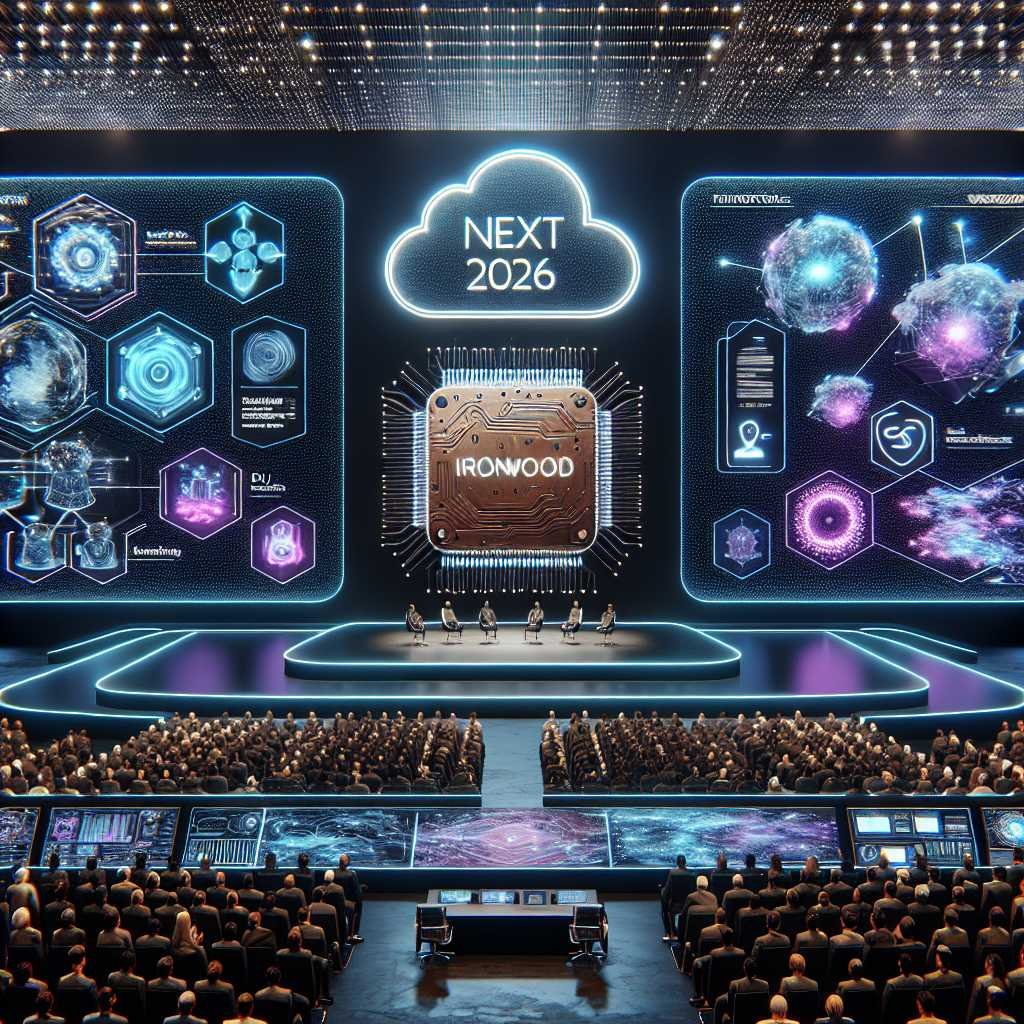
Google Cloud Next 2026 Ushers in the Agentic AI Era: Ironwood TPUs, A2A Protocol, and Workspace Studio Take Center Stage
What happens when AI agents stop being demos and start becoming the infrastructure of work? At Google Cloud Next 2026 in Las Vegas, that question wasn’t hypothetical anymore. Google unveiled a full stack for the “agentic” era—spanning silicon, protocols, and productivity tools—explicitly targeting enterprise-grade deployment where costs, governance, and interoperability determine winners.
According to reporting from The Next Web, the headline reveals were big: Ironwood, Google’s seventh-generation TPU designed for inference economics at scale; the A2A protocol for standardizing agent-to-agent communication (already adopted by 150 organizations); Workspace Studio to embed agents directly into day-to-day productivity; and Project Mariner, pushing multimodal agents toward real-world interaction. Add an eye-popping commitment from Anthropic—up to one million Ironwood units—and the narrative is clear: Google aims to build the default platform for enterprise AI agents.
Here’s what it means, why it matters, and how to prepare your organization to capitalize on it.
The short version: why this is a turning point
- Training isn’t the bottleneck anymore—deployment is. Up to 80% of AI lifecycle costs are now in inference. Google is going straight at that with custom silicon and tightly integrated software.
- Agents are moving from cool demos to audited, governed, interoperable systems. The new A2A protocol and Workspace Studio make that realistic inside large organizations.
- Competition is heating up. OpenAI’s Operator reportedly scores 87% on complex browser tasks and has 40% enterprise revenue through partners like Cognizant and CGI, while Anthropic’s Claude marketplace and Model Context Protocol (MCP) show real developer momentum. Google is countering with an integrated, cost-optimized stack.
If you’ve been waiting for a credible path to agentic AI at enterprise scale—with cost controls, compliance hooks, and productivity lift—Google just set the bar.
What Google announced at Cloud Next 2026
Per The Next Web:
- Ironwood TPU (7th gen): 4.6 petaFLOPS per chip, with 9,216-chip superpods delivering 42.5 exaFLOPS. Anthropic committed to up to one million Ironwood units, setting up favorable inference economics compared to retail Nvidia GPU pricing.
- A2A protocol: Standardizes agent-to-agent communication across clouds and tools; already adopted by 150 organizations to build interoperable agent ecosystems.
- Workspace Studio: A unified layer to deploy agents inside Google Workspace apps, automating workflows from email triage to spreadsheet analytics to cross-app orchestration.
- Project Mariner: Advances multimodal, real-world-capable agents building on Gemini foundations—a bid to move beyond text and browser tasks into vision, speech, and environment-aware interactions.
- Enterprise emphasis: Google is staking its claim on readiness for scale—governance, cost control, and fleet-level deployment—over “consumer-first” experimentation.
- Live demos: Agents autonomously tackled complex tasks, beating human benchmarks in both speed and accuracy—reinforcing a shift toward measurable business impact.
Why this matters: the agentic shift is real—and it’s economic
Enterprises don’t adopt technology because it’s novel; they adopt it when it’s useful, governable, and cost-competitive. Consider three shifts converging right now:
1) From training to deployment – The majority of AI spend has moved to inference—serving predictions, running tools, handling context windows, and coordinating multi-agent workflows. – That favors vertically integrated stacks where hardware, runtime, and software are tuned for throughput and latency.
2) From chatbots to agents – Agents plan, decide, and act across systems. That means APIs, tools, memory, and orchestration become first-class citizens. – Governance matters: provenance, audit logs, role-based permissions, and safety rails are indispensable.
3) From siloed apps to interoperable ecosystems – The winning model lets agents collaborate across vendors, clouds, and tools. Protocols—not monoliths—will define the next wave of AI platforms.
Google’s Ironwood TPUs, A2A protocol, and Workspace Studio form a coherent response to those shifts. Add Project Mariner for multimodal reach and you have a layered strategy aimed at enterprise adoption, not just cool demos.
Ironwood TPUs: built for inference-heavy agents
The Ironwood spec line is designed to get attention: 4.6 petaFLOPS per chip, scaling to superpods with 9,216 chips and 42.5 exaFLOPS. But the business story is more important: a meaningful cut in cost per token, per action, and per agent workflow.
- Why custom silicon matters now:
- Inference dominates costs as agents run continuously and handle large context windows.
- Custom interconnects and memory bandwidth can lower latency and improve utilization for real-time tools.
- Tight hardware–software co-design (e.g., optimized schedulers, model compilers, and runtime fusion) unlocks throughput and TCO wins that general-purpose GPUs struggle to match.
- Anthropic’s commitment:
- A pledge of up to one million Ironwood units isn’t just a supply story; it’s a demand signal from one of the top foundation model providers.
- The implication: Ironwood economics are compelling enough to anchor major inference workloads, potentially undercutting retail GPU alternatives for enterprise agent services.
- What to watch:
- Benchmark transparency: expect aggressive comparisons on cost per 1,000 tokens, energy per inference, and long-context latencies.
- Capacity guarantees: can Google meet surging demand without the allocation friction common to hot accelerators?
- Ecosystem support: libraries, compilers, and debugging tools determine developer experience and real-world utilization.
If you’ve been haunted by unpredictable GPU pricing, Ironwood could be the lever that makes agent-scale pilots economically viable—and keeps them viable at rollout.
The A2A protocol: a common language for agent-to-agent communication
Interoperability is the Achilles’ heel of early agent stacks. Without common standards, enterprises face vendor lock-in, brittle integrations, and duplicated governance. Google’s A2A protocol aims to standardize how agents discover, message, delegate, and validate work across platforms.
- What A2A standardizes:
- Agent identity, capabilities, and permissions (who can do what)
- Messaging formats, intents, and error handling
- Delegation and handoff semantics (task assignment, result verification)
- Observability hooks (telemetry, provenance, audit logs)
- Adoption matters:
- With 150 organizations already on board, A2A is positioned to become a lingua franca for cross-cloud, cross-vendor agent ecosystems.
- This complements (and will likely compete with) efforts like Anthropic’s Model Context Protocol (MCP), which standardizes tool and data access for models and agents. Where MCP focuses on tool integration and context, A2A focuses on inter-agent coordination. Expect bridges to emerge.
- Why it’s a big deal for enterprises:
- Freedom to compose ecosystems—choose the best agents by function, not by vendor.
- Centralized governance—policy and audit can sit above vendor-specific runtime details.
- Future-proofing—protocol-level investments tend to outlast any one model or tool fad.
If your AI strategy hinges on “best-of-breed” components, A2A could be the missing piece that keeps complexity manageable.
Workspace Studio: agents where work actually happens
Most agent demos break when they meet the messy reality of enterprise workflows—email threads, Docs redlines, spreadsheet pivots, calendar warfare, CRM and ERP data, compliance flags. Workspace Studio meets that reality head-on.
- What it brings:
- Embedded agents in Gmail, Docs, Sheets, Slides, and Meet—automating from inbox triage to analysis and reporting.
- Cross-app orchestration—agents that can read a brief in Docs, pull data into Sheets, generate Slides, and schedule a review in Calendar, all with policy-aware access.
- Governance-first design—admin controls, audit trails, and rules for data residency, retention, and access inherit from Workspace.
- Practical examples:
- Sales ops: parse inbound RFP emails, extract requirements into Sheets, match to product SKUs, draft compliant responses in Docs, and route for legal review.
- Finance: ingest vendor invoices from Gmail, reconcile line items in Sheets with ERP data, flag anomalies, and prep a monthly close deck in Slides.
- Support: summarize escalations from email and chat, pull related KB articles, propose fixes, and file tickets with full lineage captured.
- Why this is sticky:
- Agents contained to familiar tools lower change management costs.
- Policy inheritance from Workspace reduces governance lift.
- Measurable productivity gains arrive in months, not years.
For many orgs, Workspace Studio will be the first agent deployment that actually sustains adoption beyond a proof-of-concept.
Project Mariner: from text to real-world, multimodal agents
Beyond text and browser automation, Project Mariner pushes agents toward multimodal competence—vision, audio, and environment-aware interaction—building on Gemini’s foundations. That unlocks broader categories of work:
- Field ops: agents that interpret images or video from inspections, flag defects, and generate structured reports.
- Healthcare admin: transcribe and structure patient interactions, reconcile codes, and draft documentation with provenance.
- Retail: analyze shelf images for out-of-stocks, project demand, and trigger restocking workflows.
As multimodal performance and tool grounding improve together, agents graduate from “assistants” to co-workers that can reason across channels and contexts.
The competitive backdrop: Operator and Claude raise the bar
Google’s moves are a direct response to a hotly contested landscape:
- OpenAI’s Operator:
- Reportedly scores 87% on complex browser tasks—evidence that autonomous tool use and planning are maturing.
- Enterprise traction is real, with 40% of revenue attributed to businesses and partnerships via Cognizant and CGI, putting feet on the ground for large deployments. Learn more about OpenAI at openai.com.
- Anthropic’s Claude Marketplace and MCP:
- MCP has reached 10,000 servers and 97 million SDK downloads—real developer adoption for standardizing tool access and context.
- The marketplace approach accelerates vertical agents and toolchains with community momentum. See MCP details on GitHub.
Google’s bet is that an integrated hardware-software stack—plus enterprise-native integration via Workspace and protocols like A2A—wins where cost, control, and interoperability matter most.
Economics and TCO: the crux of enterprise agent adoption
If 80% of lifecycle cost now lives in inference, then the AI platform that optimizes throughput per dollar at acceptable latency wins. Key angles to evaluate:
- Cost per action (CPA): not just tokens—measure dollars per successful end-to-end task, including tool calls and retries.
- Latency SLOs: sub-second steps are often required for chained planning and real-time handoffs in workflows like approvals or customer chat.
- Utilization: autoscaling agents in response to business demand and time-of-day patterns keeps utilization high and costs predictable.
- Observability and control: the faster you can debug a misbehaving agent (prompt drift, tool misfires), the less you spend on unproductive runs.
Ironwood aims to improve CPA; A2A aims to reduce integration overhead; Workspace Studio slashes change-management tax. Together, they present a credible TCO story—especially in enterprises already standardized on Google Cloud and Workspace.
What this means for regulated industries
Agentic AI has struggled to clear regulatory bars. Google’s enterprise emphasis could help:
- Data governance: Workspace-native policies for access, retention, and DLP provide a baseline. Expect similar controls for A2A-mediated traffic and agent logs.
- Auditability: protocol-level telemetry and Workspace audit trails make lineage and review practical.
- Isolation and residency: enterprises need clarity on region-level inference guarantees and isolation for sensitive workloads—watch for Google to formalize options.
Industries likely to benefit earliest: – Financial services: KYC/AML case prep, portfolio alerts, reconciliations, and controls testing. – Healthcare administration: prior auth, coding, follow-ups, and document assembly with traceability. – Public sector: permit processing, benefits administration, and triage with auditable decision paths.
How to get started: a pragmatic enterprise roadmap
1) Identify agent-suitable workflows – Look for multistep, rules-informed tasks tied to existing systems (email, docs, tickets, ERP/CRM). – Prioritize high throughput, high handle-time activities (RFPs, invoice processing, case research).
2) Decide on your interoperability story – Pilot A2A for cross-agent delegation and governance. – If you already use MCP-based tools, plan for bridges or dual support.
3) Build a secure agent substrate – Standardize on a credentials broker; never prompt-inject raw secrets. – Instrument everything: traces, tool results, error codes, and guardrail outcomes.
4) Start inside Workspace Studio – Contain your first agents to Gmail/Docs/Sheets/Slides/Meet where policies and audit are native. – Define explicit guardrails: what the agent can read, edit, send, and schedule.
5) Engineer for cost control – Set per-agent budgets and timeouts. – Use caching where safe (retrieval answers, static analysis) and batch non-urgent runs.
6) Establish evaluation and red-teaming – Define “task done” metrics, not just model scores. Track success rates, rework, and human overrides. – Run adversarial tests: prompt injection, tool poisoning, and data exfiltration attempts.
7) Expand to cross-vendor ecosystems – Use A2A to connect specialized agents (e.g., legal, finance, marketing) regardless of vendor. – Maintain central governance: consistent policy, logging, and review.
Risks and realities to watch
- Vendor lock-in vs. performance: custom silicon brings gains—and switching costs. Protocols like A2A mitigate, but plan exit ramps.
- Safety vs. autonomy: the more agents act, the more you need strong constraints, simulations, and approval workflows.
- Tool brittleness: browser automation and flaky APIs can tank CPA; invest in tool health checks and graceful fallbacks.
- Shadow agents: without centralized policy, teams will spin up unsanctioned agents. Provide approved patterns early to channel demand safely.
Sample enterprise KPIs for agent programs
- Business outcomes: cycle time reduction (%), cost per case, SLA adherence, backlog burn-down.
- Quality: human-rework rate, policy-violation rate, factual error rate, customer CSAT/DSAT impact.
- Efficiency: cost per completed task, cache hit rate, average tool-call count per success.
- Reliability: success rate by scenario, latency percentiles, incident MTTR.
- Governance: audit coverage, explainability availability, approval bypass incidents.
How Google’s stack compares at a glance
- Ironwood vs. general GPUs: better alignment to inference economics, potentially lower cost per action; consider ecosystem maturity and portability.
- A2A vs. ad-hoc APIs: higher upfront design, lower long-term integration pain; improved governance and discovery.
- Workspace Studio vs. custom app embeds: faster time-to-value in common workflows; trade-offs in ultimate customization vs. enterprise controls.
- Project Mariner vs. text-only agents: broader task reach with multimodal reasoning; requires stronger guardrails and evaluation.
Real-world industry scenarios
- Banking KYC investigations
- Intake: emails and documents parsed in Gmail/Drive.
- Analysis: agents extract entities into Sheets, cross-reference internal systems.
- Decision support: generate a risk summary in Docs with citations.
- Governance: all steps logged; sensitive data masked based on policy.
- Manufacturing quality control
- Intake: images/videos from inspections processed by multimodal agents.
- Triage: anomalies flagged, tickets filed with supplier references.
- Reporting: auto-generated compliance packets in Slides/Docs for audits.
- Cost: Ironwood-driven inference keeps per-inspection costs predictable.
- Healthcare revenue cycle
- Intake: denials ingested from payer portals.
- Reasoning: agents map denial codes, fetch clinical documentation, draft appeals.
- Compliance: PHI handling enforced via Workspace policies and A2A scoping.
- Outcomes: reduced days in A/R, fewer write-offs.
Action checklist for the next 90 days
- Audit top 10 workflows by handle time and rework rate.
- Stand up a small A2A pilot connecting two agents from different vendors.
- Launch one Workspace Studio agent automating a contained, auditable flow (e.g., RFP intake).
- Define agent budgets, SLOs, and evaluation harnesses; wire up observability.
- Run a red-team exercise focused on prompt injection and tool tampering.
- Draft a data governance addendum for agent telemetry and logs.
- Prepare an executive dashboard tracking CPA, success rate, and quality metrics.
FAQs
Q: What is Ironwood and why should I care? A: Ironwood is Google’s seventh-generation TPU optimized for inference at scale. With 4.6 petaFLOPS per chip and superpods hitting 42.5 exaFLOPS, it targets lower cost per agent action. For enterprises, that can make sustained agent deployments economically feasible where GPU pricing often isn’t.
Q: How does A2A compare to Anthropic’s Model Context Protocol (MCP)? A: MCP standardizes how models/agents access tools and context; A2A focuses on how agents talk to and coordinate with each other. They’re complementary: MCP for tool integration, A2A for inter-agent orchestration. Expect bridges between them.
Q: Can I mix agents from different vendors with A2A? A: That’s the goal. A2A is designed to be cloud- and vendor-agnostic so you can compose best-of-breed agents under consistent governance and observability.
Q: What makes Workspace Studio different from previous Workspace AI features? A: Studio isn’t just a “smart compose” layer—it’s a framework for embedding full agents into Gmail/Docs/Sheets/Slides/Meet with cross-app orchestration and admin-grade controls. It’s built for end-to-end workflows, not just drafting assistance.
Q: Does Ironwood mean GPUs are obsolete for AI? A: No. GPUs remain strong for training and general-purpose workloads. Ironwood’s pitch is better inference economics for large-scale, latency-sensitive agent workloads. Many enterprises will run hybrid fleets based on workload mix.
Q: How do I control agent risks in regulated industries? A: Use policy inheritance in Workspace, require A2A-scoped permissions, enforce human-in-the-loop approvals for sensitive actions, and log everything with provenance. Establish an evaluation harness and run regular red-team testing.
Q: What’s the fastest way to prove value? A: Start with a contained, rule-heavy workflow inside Workspace (e.g., invoice processing, RFP intake). Measure cost per action, cycle time, and rework before/after. Scale once you hit target thresholds.
Q: Where can I learn more? A: Check the original coverage on The Next Web, explore Google Cloud product updates at cloud.google.com, and review Anthropic’s MCP on GitHub. For OpenAI’s enterprise offerings, visit openai.com.
The takeaway
Google Cloud Next 2026 didn’t just ship features—it shipped an argument: the agentic era will be won by those who master inference economics, interoperability, and enterprise-grade integration. Ironwood tackles cost, A2A tackles ecosystem sprawl, Workspace Studio tackles real workflows, and Project Mariner expands the frontier to multimodal, real-world tasks.
If you’re serious about operationalizing AI agents, the playbook is getting clearer: pick interoperable standards, deploy inside governed surfaces, measure cost per outcome, and scale what works. With Anthropic’s bet on Ironwood and early adoption of A2A, the center of gravity for enterprise agents just shifted—decisively—toward an integrated, hardware-aware, protocol-driven future.
Discover more at InnoVirtuoso.com
I would love some feedback on my writing so if you have any, please don’t hesitate to leave a comment around here or in any platforms that is convenient for you.
For more on tech and other topics, explore InnoVirtuoso.com anytime. Subscribe to my newsletter and join our growing community—we’ll create something magical together. I promise, it’ll never be boring!
Stay updated with the latest news—subscribe to our newsletter today!
Thank you all—wishing you an amazing day ahead!
Read more related Articles at InnoVirtuoso
- How to Completely Turn Off Google AI on Your Android Phone
- The Best AI Jokes of the Month: February Edition
- Introducing SpoofDPI: Bypassing Deep Packet Inspection
- Getting Started with shadps4: Your Guide to the PlayStation 4 Emulator
- Sophos Pricing in 2025: A Guide to Intercept X Endpoint Protection
- The Essential Requirements for Augmented Reality: A Comprehensive Guide
- Harvard: A Legacy of Achievements and a Path Towards the Future
- Unlocking the Secrets of Prompt Engineering: 5 Must-Read Books That Will Revolutionize You