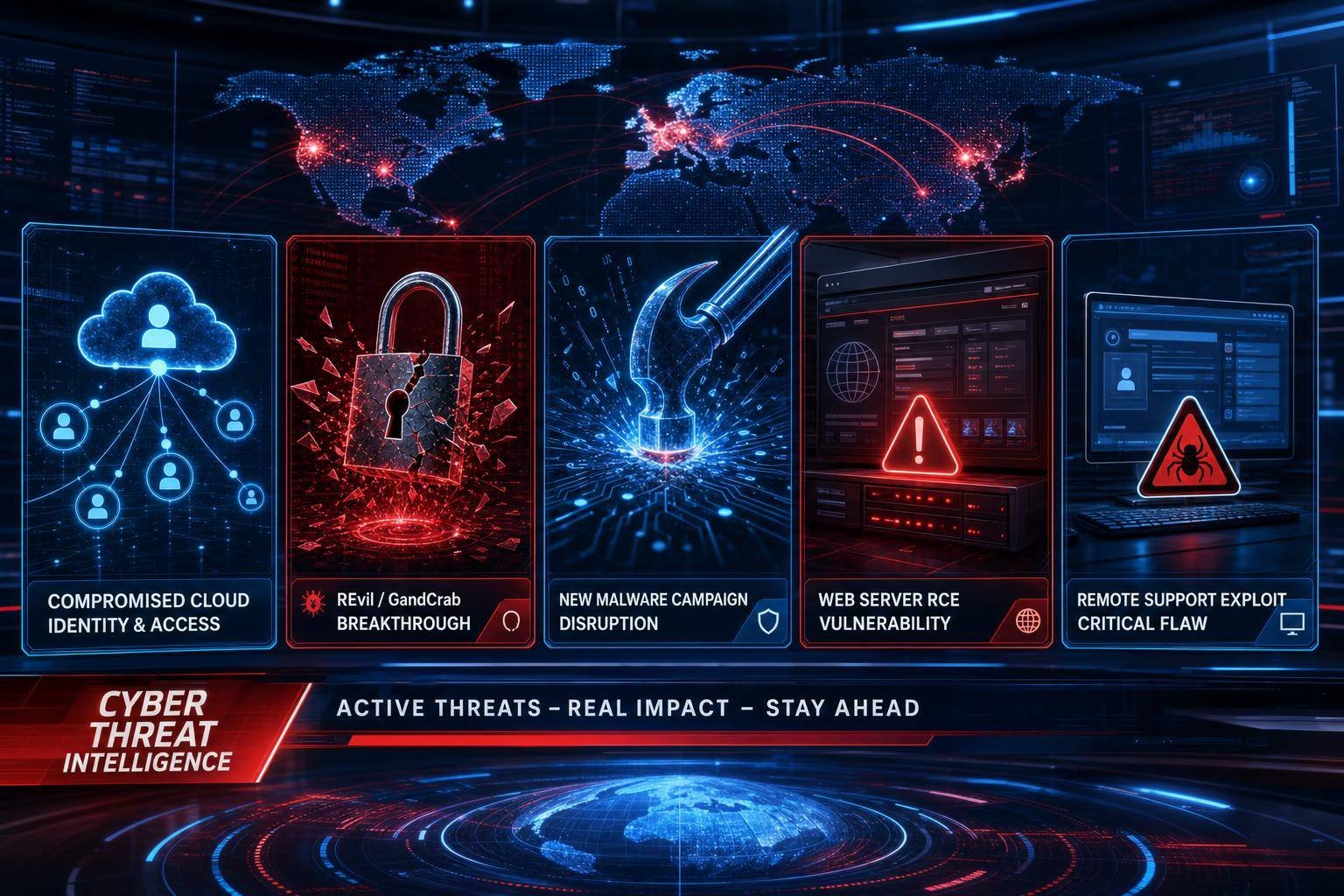
Top 5 Cybersecurity News Stories (May 1, 2026): Entra ID Agent Takeover Risk, REvil/GandCrab Breakthrough, BlueHammer Malware, nginx-ui RCE, and ScreenConnect CVE-2024-1708
Cybersecurity didn’t take a holiday. The biggest headlines this week concentrate on identity security failures, ransomware pressure, endpoint blind spots, vulnerable admin surfaces, and abused remote access. That’s not a coincidence. Attackers are optimizing for whatever gives them the most leverage in the least time—often by chaining an identity misstep with a single exposed admin tool to jump across entire networks.
This roundup breaks down the top five cybersecurity stories for May 1, 2026, with clear, practical actions you can take now. If you manage Microsoft environments, run nginx-based infrastructure, or rely on remote access tools, these developments demand attention. Expect a deeper dive into the technical how-and-why, and an implementation-oriented playbook you can hand to your team today.
Why these five stories matter right now
- Identity remains the new perimeter. A flaw in Microsoft’s Entra ID Agent reportedly allowed service principal takeover, granting attackers a clean path into high-privilege roles—often without triggering basic MFA controls.
- Ransomware is not slowing down. Germany’s BKA identifying leaders of REvil and GandCrab underscores the sustained, organized nature of big-game hunting crews and the value of victim reporting to fuel cases.
- Endpoint protection can be turned against you. The BlueHammer malware family targets Microsoft Defender to persist and hide, showing that “EDR bypass” is now table stakes for advanced operators.
- Web admin panels are still low-hanging fruit. The MCPwn vulnerability in nginx-ui is actively exploited for remote code execution (RCE), a reminder that convenience layers around critical infrastructure need the same rigor as the core service.
- Over-privileged remote tools keep fueling breaches. CISA added ConnectWise ScreenConnect CVE-2024-1708 to the Known Exploited Vulnerabilities catalog due to ongoing ransomware abuse, pushing organizations to patch or disconnect now.
If these patterns look familiar, they should. They’re the same attack paths defenders have warned about for years—but amplified by automation, crimeware-as-a-service, and AI-assisted reconnaissance and exploitation. The good news: the countermeasures are known, measurable, and actionable.
1) Microsoft Entra ID Agent flaw enabled service principal takeover
What happened
A patched vulnerability in the Microsoft Entra ID Agent reportedly enabled malicious users to take over service principals—identities used by applications and automation—to escalate privileges in Microsoft 365 and Azure tenants. In practice, that means an attacker could co-opt a non-human identity and use its permissions to assign roles, read mailboxes, modify configurations, or move laterally into cloud resources.
Service principals are central to modern identity architectures, driving CI/CD, integrations, and background tasks. They often hold broad permissions because they need to run unattended. That’s why takeovers are so dangerous: they bypass human authentication flows and can operate invisibly. For background on how service principals work and why their governance is critical, see Microsoft’s documentation on application objects and service principals.
Organizations using Microsoft’s hybrid or synchronization agents should confirm they’re on the latest version. If you use cloud sync or hybrid identity features, review Microsoft’s guidance on Entra Cloud Sync to ensure your agents update reliably and logs are forwarded to your SIEM.
Why it matters
- Silent privilege escalations: Compromised service principals can add app roles, consent to new permissions, or modify directory settings—often without MFA prompts.
- Supply chain risk: Attackers target service principals integrated with deployment pipelines to seed malicious code or flip infrastructure state.
- Persistence: App registrations and credentials can be long-lived and overlooked in standard user access reviews.
This is a Zero Trust moment. NIST’s SP 800-207 on Zero Trust Architecture emphasizes identity-driven policy and continuous verification. Service principals must be treated as first-class identities with explicit, least-privilege controls, continuous monitoring, and just-in-time elevation where feasible.
What to do now
- Patch all Entra/identity agents immediately and verify version baselines across all servers.
- Inventory service principals and app registrations. Validate verified publishers, owners, and consented permissions against known application catalogs.
- Rotate credentials and secrets for any app identities associated with the vulnerable agent. Consider moving to managed identities to reduce secret sprawl.
- Enforce conditional access policies for workload identities where supported, constrain scopes, and block interactive sign-ins for non-human accounts.
- Enable privileged access workflows (e.g., PIM) for any role assignments performed by automation.
If you have Microsoft Graph access, use it to enumerate service principals and check for anomalous owners or newly consented permissions. Microsoft’s service principal resource documentation is a good starting point for building governance scripts.
2) Germany’s BKA identifies suspected leaders of REvil and GandCrab ransomware groups
What happened
Germany’s Federal Criminal Police Office (BKA) announced it has identified individuals believed to be key figures behind the REvil and GandCrab ransomware operations and linked them to more than 130 attacks within Germany. While judicial processes will take time, attribution and naming leaders are important steps that often precede arrests, extraditions, and financial seizures.
Ransomware persists because it’s profitable, resilient, and modular. Crews recruit affiliates, buy or rent zero-days and access, and leverage bulletproof hosting and cryptocurrency mixers. Every high-impact case adds intelligence to the global picture and can deter would-be affiliates.
Why it matters
- Deterrence and disruption: Public findings can fracture affiliate relationships, undermine trust inside RaaS ecosystems, and encourage more victims to report.
- Insurance and compliance: Law enforcement interest often correlates with stronger obligations on reporting and disclosure; CISOs should refresh playbooks accordingly.
- Intelligence feedback loop: Victim reporting improves defense. When defenders and authorities share TTPs, indicators, and infrastructure data, takedowns accelerate.
Not sure where your organization fits in? ENISA’s annual threat overview provides a sober assessment of trends, techniques, and sector-specific exposure. Review the ENISA Threat Landscape to calibrate controls against modern ransomware tradecraft. For U.S. guidance on incident response and best practices, CISA’s StopRansomware hub centralizes advisories, playbooks, and training.
What to do now
- Test your ransomware tabletop with legal, PR, IR, and leadership—assume data theft and extortion.
- Validate offline and immutable backups for critical systems. Measure restore times.
- Monitor for initial access vectors favored by affiliates: RDP/SSH exposure, vulnerable remote tools, and phish-to-VPN routes.
- Segment high-value assets and restrict service account lateral movement.
3) BlueHammer malware targets Microsoft Defender to persist and steal data
What happened
BlueHammer is being actively deployed to Windows environments with a focus on evading or misusing Microsoft Defender protections. Attackers tamper with security settings, abuse Defender’s trust decisions, or exploit process injection to persist and exfiltrate data while staying below EDR detection thresholds.
Why it matters
Modern EDR is strong, but adversaries know how to: – Disable or degrade protections (“impair defenses”) – Abuse legitimate tools (LOLBin usage) – Tamper with telemetry pipelines – Create trusted processes that mask malicious behavior
Two resources are worth bookmarking. Microsoft’s documentation on Defender for Endpoint explains capabilities and hardened configurations (e.g., tamper protection, ASR rules). For attacker techniques, MITRE ATT&CK’s entry on T1562: Impair Defenses outlines common strategies for weakening endpoint and network security tooling.
What to do now
- Enforce Tamper Protection for Defender across all devices. Verify via device compliance reports.
- Enable Attack Surface Reduction (ASR) rules in block mode for core protections (e.g., blocking credential theft and office macro abuse). Stage in audit mode first to tune exceptions.
- Lock down Defender exclusions. Audit who can add them and how they’re reviewed.
- Push EDR sensor health metrics to your SIEM. Alert on coverage gaps, outdated signatures, or devices missing sensor heartbeats.
- Collect and hunt on high-risk events: real-time protection disabled, signature updates failing, process injection anomalies, suspicious PowerShell or WMI usage.
4) MCPwn vulnerability in nginx-ui exploited for remote code execution
What happened
Attackers are exploiting a flaw dubbed “MCPwn” in nginx-ui—an administrative web interface used to manage nginx configurations—to achieve remote code execution. Because nginx-ui directly touches reverse proxy and web server settings, successful exploitation provides a powerful pivot into internal systems and sensitive traffic flows.
Even if you don’t use nginx-ui specifically, the lesson is universal: management layers for production services are high-value targets. They must be isolated, authenticated, and patched as rigorously as the core service. For foundational context on nginx behavior and directives, see the nginx official documentation. To evaluate systemic risks such as open admin panels, default credentials, and unsafe config inheritance, OWASP’s Security Misconfiguration guidance provides a practical checklist.
Why it matters
- Pathway to crown jewels: RCE on a host sitting in front of application traffic can expose session cookies, JWTs, API keys, and internal endpoints.
- Config tampering: Attackers can insert malicious rewrite rules, disable TLS, or stealthily redirect traffic to phishing proxies.
- Lateral movement: From a compromised reverse proxy, it’s often one hop to app servers or storage.
What to do now
- Patch nginx-ui immediately. If an update isn’t available, take it off the public internet. Restrict access to a dedicated admin VLAN or bastion.
- Require SSO with MFA for all admin interfaces. Avoid local accounts; centralize identity and audit trails.
- Enforce allowlists for management IPs. Block admin ports at the edge; use VPN-based access.
- Scan for exposure. Use external attack surface tools to confirm that management endpoints aren’t open to the world.
- Validate nginx configs. Check for unexpected includes, server blocks, or proxy_pass targets that don’t match baselines. Monitor for config file changes with integrity tooling.
5) CISA adds ConnectWise ScreenConnect CVE-2024-1708 to the KEV catalog
What happened
The U.S. Cybersecurity and Infrastructure Security Agency (CISA) added ConnectWise ScreenConnect CVE-2024-1708 to the Known Exploited Vulnerabilities (KEV) Catalog, citing widespread exploitation by ransomware crews. KEV inclusion signals that exploitation is active in the wild and that U.S. federal agencies—and by extension, all enterprises—should patch or mitigate on an urgent timeline.
Vendors often publish detailed remediation steps and patch versions. ConnectWise maintains a central repository of advisories and updates on its Security Bulletins page. If you self-host ScreenConnect, you should validate version parity and consider temporarily disabling internet exposure until fully remediated.
Why it matters
- Remote access as an attack multiplier: A single vulnerable RMM instance can give attackers hands-on-keyboard control across fleets.
- Ransomware operator favorite: Affiliates regularly scan for these services, drop loaders, disable EDR, and deploy encryptors within minutes.
- Compliance and liability: When KEV-listed flaws are left unaddressed, regulators and insurers may view incidents as avoidable.
What to do now
- Patch ScreenConnect immediately. If patching is non-trivial, disconnect the service from the internet while you stage updates.
- Rotate credentials and revoke all tokens. Investigate session histories for anomalous logins or odd hours.
- Tighten access: IP allowlists, MFA enforcement, role-based permissions, and session recording.
- Monitor for known indicators of compromise. Hunt for lateral movement post-access (e.g., PsExec usage, credential dumping, domain controller probes).
A practical defense playbook you can run this week
The five stories cluster around a few control themes. Use this section as your short-term action plan and assign owners.
1) Patch velocity and exposure reduction
- Prioritize KEV-listed vulnerabilities and vendor-labeled “actively exploited” flaws. Track time-to-patch as a KPI.
- External services: Inventory and patch internet-facing systems first (VPNs, RMM, web admin panels). If patching will exceed 48–72 hours, place them behind temporary access controls or disconnect temporarily.
- Automate scanning and verification. Confirm closure with rescans, not just CMDB status.
2) Harden identity, especially non-human identities
- Inventory service principals, app registrations, automation accounts. Validate ownership and purpose against an approved catalog.
- Enforce least privilege for app permissions; remove tenant-wide consents where possible. Use just-in-time elevation for rare admin tasks.
- Rotate secrets; move to managed identities where supported to eliminate passwords/keys.
- Block interactive logins for non-human accounts. Alert on any interactive attempt using a service principal.
- Log and review consent events and directory role assignments weekly.
3) Raise the floor on endpoint and EDR security
- Turn on Tamper Protection and ensure it cannot be disabled without strong approval gates.
- Move ASR rules from audit to block in phases. Start with rules that block credential theft, Office macro abuse, and script-based attacks.
- Rationalize exclusions: no wildcards, limit by hash or exact path, and document business justification with expiry dates.
- Monitor EDR sensor health. Alert on agents that are stale, disabled, or failing to report.
- Hunt for defense impairment events and suspicious lateral movement tools (e.g., remote service creation, WMIExec patterns).
4) Lock down admin layers and management surfaces
- Remove public exposure of admin UIs (nginx-ui, Kibana, Jenkins, Grafana, RMM consoles). Place behind VPN and SSO with MFA.
- Use IP allowlists and conditional access for all management interfaces.
- Enforce change control and integrity monitoring on configuration files (.conf, YAML, systemd units). Alert on unexpected edits.
- Require session recording and just-in-time elevation for privileged actions on production systems.
5) Remote access and RMM tool hygiene
- Standardize on one or two vetted tools; remove “shadow” remote access utilities.
- Enforce MFA, short session lifetimes, re-auth for privilege escalation, and full audit logging.
- Remove local admin rights from remote tools where possible. Use strictly scoped roles.
- Segment management networks. RMM servers should not have flat reachability to production databases or domain controllers.
6) Detection and incident response readiness
- Validate your incident response plan against ransomware and identity compromise scenarios. Align with NIST’s Computer Security Incident Handling Guide (SP 800-61).
- Pre-build playbooks and KQL/SQL queries to hunt for:
- New app consents and service principal owner changes
- Defender tamper events and policy downgrades
- Suspicious PowerShell, WMI, and PsExec execution
- Unusual egress from reverse proxies and RMM servers
- Run a 60-minute “hot wash” drill: practice isolating a host, disabling an app registration, rotating a secret, and revoking a token.
7) Metrics that matter to the board
- KEV time-to-patch: median and 90th percentile
- MFA coverage, especially for admins and service accounts
- Number of internet-exposed admin surfaces and mean time-to-close exposure
- EDR coverage and tamper protection adoption
- Mean time to detect and contain identity-related anomalies
How this week’s news maps to Zero Trust
- Identity is your control plane: Enforce continuous verification for humans and workloads. Apply conditional policies to non-human identities where feasible.
- Assume breach at endpoints: Configure EDR to withstand tampering and monitor continuously for impairment attempts.
- Minimize attack surface: Remove public exposure of admin tools. Layer access controls—network, identity, and device trust.
- Strong patch governance: Treat KEV and actively exploited flaws as emergency changes, not routine tickets.
- Continuous learning loop: Feed intelligence from incidents (yours and others) into control tuning and training.
Zero Trust is not a product; it’s a way of making these decisions consistently and measurably. NIST’s SP 800-207 remains the north star for aligning architecture and operations with that mindset.
Frequently asked questions
What is a service principal, and why is it risky if compromised?
A service principal is a non-human identity used by apps and automation to access resources. If attackers take it over, they can use its permissions to change configurations, read data, or assign roles—often without MFA prompts or user interaction—making detection harder.
How urgent is it to patch KEV-listed vulnerabilities like ScreenConnect CVE-2024-1708?
Treat KEV-listed vulnerabilities as emergency patches. CISA flags them because exploitation is happening now. If you can’t patch immediately, disconnect the service from the internet and apply compensating controls until updates are complete.
How do attackers “bypass” Microsoft Defender?
Common tactics include disabling protections, adding broad exclusions, injecting into trusted processes, and abusing signed binaries. Harden with Tamper Protection, ASR rules in block mode, strict exclusion policies, and continuous monitoring for defense-impairment events.
What’s the safest way to run tools like nginx-ui or other web admin panels?
Do not expose them to the public internet. Put them behind VPN and SSO with MFA, restrict by IP allowlists, apply least privilege, and monitor for configuration changes. Patch promptly and prefer vendor-supported, actively maintained tools.
What metrics should I use to track identity risk?
Track the number of privileged roles, frequency of role assignments, app consent events, service principals with tenant-wide permissions, and the percentage of workload identities using managed identities instead of static secrets.
Does Zero Trust stop ransomware?
Zero Trust reduces blast radius and shortens dwell time by enforcing least privilege, continuous verification, and segmentation. It doesn’t eliminate risk, but it turns likely catastrophes into contained incidents when implemented well.
Final takeaways: No downtime for defenders—even on holidays
The top 5 cybersecurity news stories this week draw a clear map of where adversaries are winning: identity gaps in Microsoft ecosystems, ransomware that never quits, EDR tampering, exposed admin panels, and over-trusted remote access tools. The countermeasures are not exotic. Patch aggressively—especially KEV items. Treat service principals as first-class identities. Lock down endpoint protections against tampering. Pull admin UIs off the public internet. And tighten remote access with MFA, segmentation, and auditing.
Start with a 7-day sprint: – Close all KEV-listed and actively exploited patches. – Inventory and harden service principals; rotate secrets and remove unnecessary consents. – Turn on Defender Tamper Protection and ASR rules where feasible. – Remove public exposure for admin UIs and RMM tools; enforce SSO and allowlists. – Run a ransomware-focused incident response drill.
Cyber risk compounds when basic controls slip. Reverse that compounding by executing the fundamentals with speed and discipline. Your next breach prevention likely lives in one of this week’s top 5 cybersecurity news stories—act before attackers chain them together.
Discover more at InnoVirtuoso.com
I would love some feedback on my writing so if you have any, please don’t hesitate to leave a comment around here or in any platforms that is convenient for you.
For more on tech and other topics, explore InnoVirtuoso.com anytime. Subscribe to my newsletter and join our growing community—we’ll create something magical together. I promise, it’ll never be boring!
Stay updated with the latest news—subscribe to our newsletter today!
Thank you all—wishing you an amazing day ahead!
Read more related Articles at InnoVirtuoso
- How to Completely Turn Off Google AI on Your Android Phone
- The Best AI Jokes of the Month: February Edition
- Introducing SpoofDPI: Bypassing Deep Packet Inspection
- Getting Started with shadps4: Your Guide to the PlayStation 4 Emulator
- Sophos Pricing in 2025: A Guide to Intercept X Endpoint Protection
- The Essential Requirements for Augmented Reality: A Comprehensive Guide
- Harvard: A Legacy of Achievements and a Path Towards the Future
- Unlocking the Secrets of Prompt Engineering: 5 Must-Read Books That Will Revolutionize You