Cybersecurity Report 2026: 70% of U.S. Infrastructure Compromised and QR Code Phishing Surges 146% — What It Means and What to Do Now
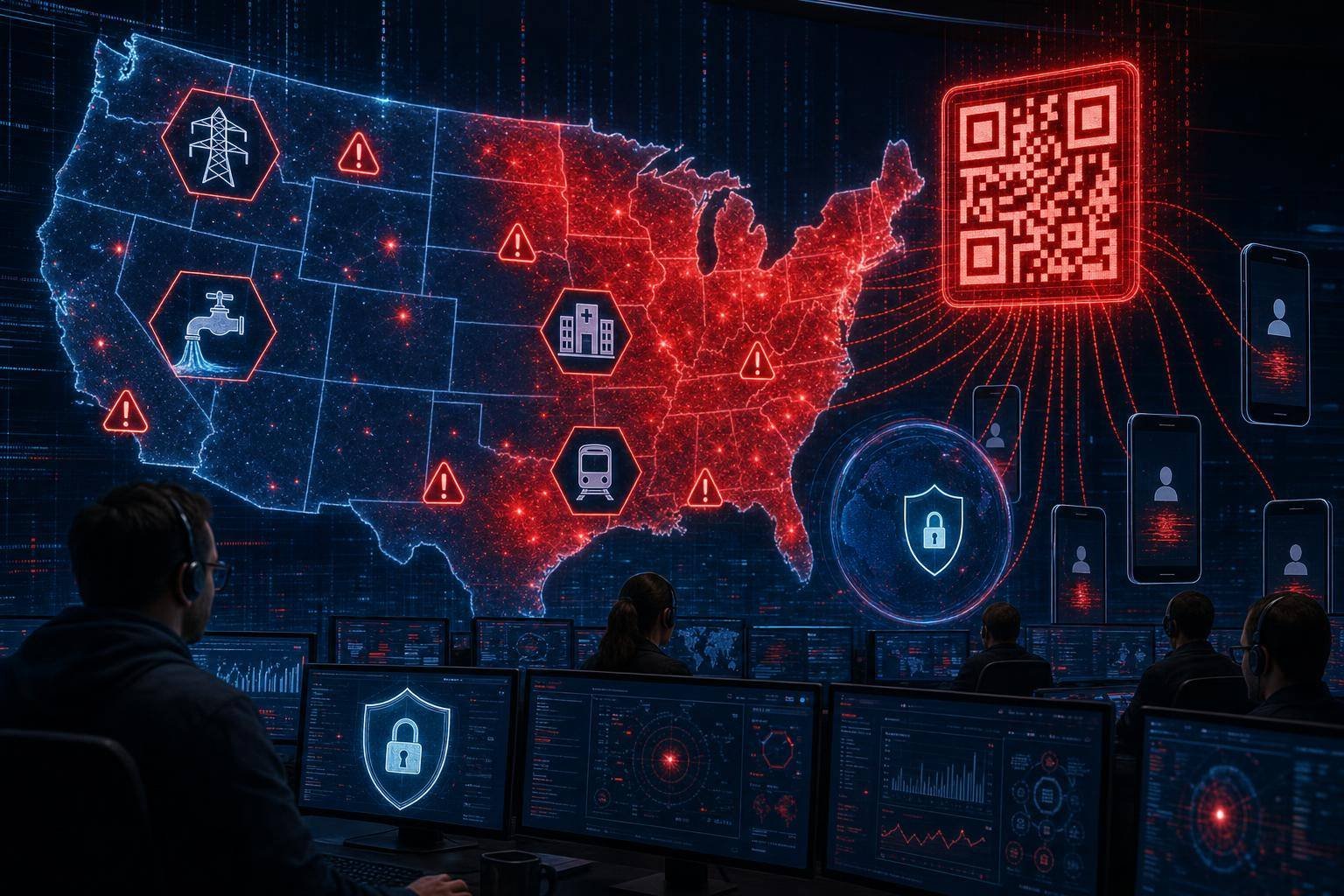
A new cybersecurity report, released May 1, 2026, signals a sobering reality: an estimated 70% of U.S. infrastructure has been compromised, while QR code phishing (often called “quishing”) has jumped 146%. Even if you view those figures as directional rather than definitive, the direction is impossible to ignore. Cyber risk has outpaced incremental defenses, and certain attack vectors are now engineered to bypass the very controls many organizations still rely on.
The briefing also points to high-consequence fallout, including the Chime Financial class-action litigation tied to a major data breach, and argues that traditional cloud-first postures may be insufficient for the most sensitive data. For security leaders and operators, the message is not panic—it’s prioritization. This article translates the report’s headlines into specific, actionable steps for CISOs, IT leaders, and founders charged with protecting people, revenue, and critical services.
You’ll find clear definitions of what “70% compromised” could mean in practice, how quishing evades controls, when to consider air-gapped infrastructure over cloud, and a practical playbook for the next 90 days, 12 months, and 24 months. Expect implementation detail, not platitudes.
Inside the 2026 Cybersecurity Report: What “70% Compromised” Really Means
When a cybersecurity report says “70% of U.S. infrastructure has been compromised,” it’s easy to assume every system is thoroughly breached. Reality is more layered—and more instructive.
Compromise ranges from: – Latent exposure (unpatched, internet-facing services and credentials for sale) – Partial footholds (stolen tokens, unmanaged endpoints, shadow IT assets) – Full breach (adversary persistence, lateral movement, data exfiltration, or operational disruption)
In other words, the “70%” signal can reflect a spectrum of adversary advantage—misconfigurations, exploitable vulnerabilities, weak identity boundaries, API sprawl, and flat networks. Consider how often known, exploitable vulnerabilities remain unpatched for months; CISA’s Known Exploited Vulnerabilities Catalog shows just how many widely used products are actively targeted.
Even without the exact methodology behind the 70% figure, multiple independent sources align with the direction of travel: widespread phishing, identity misuse, and misconfigurations are driving breaches faster than organizations can contain them. Reports like the Verizon Data Breach Investigations Report consistently show social engineering and credential abuse among top initial access vectors, reinforcing that compromise is often identity-centric rather than strictly malware-driven.
For executives, the key takeaway is not the headline number—it’s the operational readiness implied by it: – Can your team detect initial access rapidly? – Are you strong in identity governance and session hygiene? – Is lateral movement constrained by segmentation and just-in-time access? – Do you have a credible, repeatable recovery plan that assumes an attacker already has a foothold?
These are the questions that separate cosmetic controls from resilience.
Why QR Code Phishing (Quishing) Is Surging 146%—and Bypassing Traditional Controls
Quishing is not new, but attackers have professionalized the tactic. Here’s why it’s working: – It’s out-of-band. Users often receive a QR code in email or on a printed sign and scan it on a personal phone, sidestepping secure email gateways and desktop EDR. – It funnels to mobile. Mobile browsers may lack enterprise-grade URL rewriting, safe browsing enforcement, or isolation your desktops have. – It’s trusted by habit. QR codes feel innocuous and time-saving, so users let down their guard and expect fast, low-friction workflows. – It’s easy to stage. Attackers embed QR codes that redirect to credential harvesters or fake MFA prompts, exploiting brand trust and urgency.
The tactic has been on law enforcement’s radar for years; the FBI’s Internet Crime Complaint Center warned about malicious QR codes directing victims to credential theft and payment fraud as early as 2022 (IC3 PSA). Today’s campaigns are more tailored, often spoofing internal tools, cloud login pages, parcel delivery notices, parking systems, and meeting links.
Where traditional anti-phishing controls break down: – Email filtering sees an image, not the URL target. – URL scanners don’t fire until the code is scanned—often on BYOD devices outside control. – MFA fatigue and push-based approvals can be socially engineered via mobile-first flows. – Security awareness training under-emphasizes QR-specific telltales and out-of-band risk.
Defense demands a mobile-aware, human-aware model. More on that below.
Cloud Security vs. Air-Gapped Infrastructure: Which, When, and Why
The report’s recommendation to consider physical, air-gapped infrastructure for highly sensitive data will raise eyebrows in cloud-forward organizations. It’s a nuanced call, not a blanket indictment of cloud. Modern cloud offers mature controls, but the threat model and operating discipline must match the sensitivity of the data and the blast radius of a breach.
When air-gapped or physically segregated infrastructure may be justified: – You maintain crown-jewel data sets whose exposure would cause existential harm. – Regulatory or national security requirements mandate strict offline protections. – Your threat model includes supply chain attacks against cloud control planes or identity providers. – You need deterministic, offline recoverability that cannot be disrupted via networked paths.
When cloud remains the right default: – Your team has strong identity and access management (IAM) discipline, enforced least privilege, key management, and continuous monitoring in place. – Your risk profile does not justify the cost and complexity of operating offline systems. – You rely on modern SDLC, IaC, and ephemeral environments to reduce drift and attack surface.
A hybrid outcome is often optimal: keep the majority of workloads in well-architected cloud environments with zero trust principles (see NIST’s SP 800-207 Zero Trust Architecture), while isolating mission-critical data paths behind strong physical and logical segmentation. This can include: – Offline backups following 3-2-1-1-0 principles (3 copies, on 2 types of media, 1 offsite, 1 offline/immutable, 0 unrecoverable errors from regular testing) – Keys managed by hardware security modules (HSMs) or external key managers with strict separation – Dedicated, non-internet-connected enclaves for sensitive analytics or cryptographic operations – Tight egress controls, brokered access patterns, and just-in-time secrets
The point is not “cloud bad, air-gap good.” It’s aligning control strength with data sensitivity and adversary capability.
From Breach to Courtroom: The Business and Legal Reality
The report highlights the Chime Financial breach and ensuing class-action litigation. Regardless of company specifics, the broader pattern is clear: the financial, legal, and reputational consequences of a breach have escalated. Consumer harms, regulatory scrutiny, and shareholder actions increasingly follow material incidents.
A few implications for leadership teams: – Materiality assessment must be rapid and defensible. Your legal, security, and communications teams need a playbook for incident triage and disclosure readiness. – Preparedness is discoverable. Training, tabletop exercises, and vendor oversight are visible in litigation and audits. – Controls must be empirically tested. Claims of “industry standard security” fall flat without evidence of continuous validation, red teaming, and measurable outcomes. – Data governance is non-negotiable. Mapping data flows, retention, and deletion reduces breach surface and post-incident penalties.
Above all, security is now a business discipline with board-level accountability. Investment should reflect exposure, not tradition.
A Practical Playbook: 90-Day, 12-Month, and 24-Month Actions
Here’s a sequenced plan you can start immediately. Adjust for sector, size, and existing maturity.
90 days: Contain the obvious, close the doors – Patch the known-bad first. Cross-reference your asset inventory with CISA’s Known Exploited Vulnerabilities and prioritize internet-facing systems and identity providers. – Harden identity fast. Enforce phishing-resistant MFA (FIDO2/WebAuthn) for administrators and high-risk roles; rotate and minimize long-lived tokens and service principals. – Quishing awareness sprint. Issue a one-page, high-visibility guide about scanning risks; add banners to emails with images containing QR codes; update your incident reporting flow to include “QR suspicious” as a category. – Email posture upgrade. Enforce SPF, DKIM, and DMARC with policy; quarantine or reject unauthenticated domains; apply URL rewriting and pre-click analysis where possible. – Visibility on endpoints and mobile. Ensure EDR on corporate endpoints is actually deployed and reporting; begin MDM enrollment push for BYOD accessing sensitive apps; enforce OS and browser updates. – Backup verification. Test offline/immutable backup restore times for critical systems; fix gaps immediately. – Tabletop a quishing-led breach. Simulate a mobile-first credential compromise leading to cloud console access; pressure-test your detection and containment.
12 months: Raise the floor, contain lateral movement – Network and identity segmentation. Implement role-based, just-in-time access; restrict east-west pathways; use PIM/PAM for admin accounts. – Cloud security posture management. Continuously validate IaC baselines, least privilege policies, and encryption; gate deployments with policy-as-code. – Zero trust milestones. Move from implicit trust to continuous verification across users, devices, and workloads; map progress to NIST SP 800-207. – Secure SaaS and shadow IT. Apply SSO for sanctioned apps; discover orphaned or duplicate SaaS; enforce data loss prevention (DLP) policies for high-risk data. – Advanced email/QR defenses. Deploy heuristics or computer-vision-based detection for QR codes in emails; route detected QR content through safe preview services. – IR program uplift. Modernize your incident response plan per NIST SP 800-61; clarify decision rights; pre-approve outside counsel and DFIR retainers.
24 months: Resilience, not just prevention – Data-tiered architectures. Physically and logically isolate crown jewels; introduce one-way data diodes or tightly controlled brokers where needed. – Continuous purple teaming. Map detections to MITRE ATT&CK and run iterative adversary emulations; close gaps quickly, then re-test. – Supply chain verification. Expand SBOM intake, dependency scanning, and code signing; validate vendor access and incident SLAs. – Recovery at scale. Build automation for account resets, key rotations, and environment rebuilds; budget for failover exercises. – Culture and incentives. Tie security outcomes to leadership KPIs; celebrate early reporting of suspicious behavior; adopt blameless postmortems.
The Quishing Defense Stack: Tools, Training, and Technical Controls
Quishing prevention requires aligned controls across people, process, and tech. Build a layered stack with the following components.
People – Brief with specifics. Use real examples of QR phish your org has seen; highlight mobile risks, domain lookalikes, and fake parking or delivery messages. – Behavioral commitments. Company-wide pledge: never scan a QR to access payroll, benefits, or admin consoles; never approve MFA prompts post-QR without verifying source. – Quick-report habit. Make it one tap to report suspicious QR or mobile login prompts; reward early reporting.
Process – Verified alternatives. Publish safe, bookmarked URLs for critical services; instruct employees to type or use approved password manager links. – Out-of-band verification. For any QR leading to payment or credential entry, require a second factor of business verification (e.g., Slack/Teams confirmation from an internal directory contact). – Incident playbooks. Add “QR phishing suspected” as a trigger with steps for session invalidation, device check, and password reset sequencing.
Technology – Email and collaboration security. Detect and flag images containing QR codes; rewrite discovered QR destinations; add warning banners for external senders. – Mobile device management (MDM). Enforce OS patching, managed browser use, and safe browsing; restrict “open-in” behaviors to managed apps; monitor risky profiles. – Identity protections. Prefer phishing-resistant MFA (security keys); enforce conditional access (device health, location, risk score); enable token binding where supported. – Endpoint and network. EDR on desktops and laptops; lightweight mobile threat defense on phones; DNS filtering to block known-bad domains; isolate high-risk browsing. – Domain controls. Aggressive takedown of lookalike domains; DMARC enforcement at p=reject; monitor brand abuse. – Analytics and detections. Alert on suspicious mobile-first logins (new device, impossible travel, TOR exit nodes); score anomalous consent grants to OAuth apps.
Useful references for building training and technical baselines include OWASP’s Phishing Defense Cheat Sheet and MITRE ATT&CK’s Phishing technique (T1566), which can be mapped to your detections and response procedures.
Detection and Response Upgrades That Match Today’s Threats
Prevention buys you time. Detection and response determine whether an intrusion becomes a headline. Anchor your IR function to defensible frameworks and measurable practices.
- Incident response fundamentals. NIST’s SP 800-61 remains a gold standard for incident handling lifecycle: preparation, detection and analysis, containment, eradication and recovery, and post-incident activity.
- Telemetry that matters. Centralize identity (IdP logs, admin actions), endpoint (EDR), network (NDR/DNS), and cloud control plane logs into SIEM/XDR with retention keyed to your threat model and regulatory requirements.
- Faster triage. Use playbooks and SOAR to automate enrichment—who is the user, device health, last known IP geolocation, MFA posture—so analysts decide with context in under five minutes.
- ATT&CK-driven detection. Build and test detections mapped to common attacker behaviors (initial access, persistence, privilege escalation). Iterate with purple team exercises until true positive rates rise and alert fatigue falls.
- Crisis communications. Pre-draft internal and external communications that cover credential resets, service continuity, and regulatory notifications; rehearse with executives twice a year.
High-performing IR programs share one trait: they learn in public (inside the company). They publish weekly security notes, celebrate near-misses, and track “mean time to learning” as obsessively as “mean time to detect.”
Metrics That Matter: From Vanity to Value
Ditch vanity metrics like “phishing emails blocked.” Use outcome-oriented measures aligned to risk reduction.
- Time to patch known exploited vulnerabilities (internet-facing): target < 7 days
- Time to revoke compromised sessions and reset high-risk credentials: target < 60 minutes
- Percentage of privileged accounts using phishing-resistant MFA: target 100%
- Ratio of blocked vs. reported quishing attempts: increase the reported share over time as awareness rises
- Backup restore time for top 10 critical systems: measured quarterly, target within RTO
- Percentage of endpoints and mobile devices with enforced EDR/MDM baselines: target > 95%
- Coverage of ATT&CK techniques with validated detections: continuously increase
To benchmark costs and gains, consult industry studies like IBM’s Cost of a Data Breach Report for average breach impacts and drivers of cost reduction such as automation and IR preparedness.
Mistakes to Avoid When Responding to This Cybersecurity Report
- Over-indexing on awareness alone. Training without technical enforcement (MDM, identity controls) leaves gaps attackers exploit.
- Treating cloud or air-gap as ideology. Choose architectures based on data criticality, not fashion.
- Relying on push-based MFA. Upgrade to phishing-resistant factors; attackers script MFA fatigue at scale.
- Ignoring BYOD. If mobile devices touch sensitive workflows, bring them under policy or restrict access.
- Skipping real recovery drills. Restoring backups in a tabletop is not the same as rebuilding prod under time pressure.
- Thinking “we’re too small.” Attackers automate. Small businesses are hit because controls are weaker and payments are faster.
Threat Intelligence, Prioritization, and Continuous Readiness
Threat intelligence only adds value if it drives action. Prioritize intelligence that informs your patching, identity protections, and detections. For example, if actors are exploiting a specific RMM tool or VPN, respond with concrete steps: isolate, patch, rotate credentials, add detections, and validate with a red team.
Keep an eye on regional and sector-specific advisories. CISA’s Shields Up remains a useful aggregation point for escalated geopolitical or sector alerts, while ENISA’s threat trend work helps contextualize long-term shifts across techniques and targets (ENISA threat trends overview).
Most importantly, tie intelligence to sprints. At the beginning of each two-week cycle, choose the top three high-impact actions informed by current threats and ship them with full QA and documentation.
FAQ
What is quishing, and how is it different from regular phishing? – Quishing uses QR codes to direct victims to malicious sites or fake login flows. It often bypasses email filters because the destination URL is embedded in an image and is typically accessed via a mobile device outside enterprise controls.
How can I verify a QR code is safe before scanning? – Prefer typing a known URL or using a saved bookmark. If you must scan, use a managed device with a secure browser, inspect the resolved domain carefully, and avoid entering credentials or payment info from QR links unless verified out-of-band.
Are air-gapped systems always safer than cloud? – Not always. Air-gapped systems reduce remote attack paths but introduce operational complexity and maintenance risk. Well-architected cloud with zero trust, strong identity, and continuous validation can be highly secure. Choose based on data sensitivity and threat models.
We’re a small business. What’s the minimum effective set of defenses? – Patch internet-facing systems quickly; enforce MFA (prefer hardware keys for admins); enable EDR on endpoints; adopt a reputable email security service; perform offline backups and test restores; train staff specifically on QR code scams and reporting.
Which frameworks should we align to? – Start with the CIS Critical Security Controls v8 for prioritized basics, use NIST SP 800-61 for incident handling, and adopt NIST SP 800-207 for zero trust principles. Map detections and defenses to MITRE ATT&CK to validate coverage.
How do we measure whether phishing training is working? – Track reporting rates of simulated and real phishing attempts, time-to-report, and reduction in click-throughs. Correlate training outcomes with technical metrics like increased use of bookmarks and reduced credential resets post-campaign.
Conclusion: Turning a Stark Cybersecurity Report into a Playbook for Action
The 2026 cybersecurity report’s headline—70% of U.S. infrastructure compromised and a 146% surge in QR code phishing—should prompt urgent, not frantic, action. Treat the “70%” as a wake-up call that passive defenses and half-measures can’t match adversaries who optimize for mobile, identity, and speed. For quishing specifically, assume your email gateway isn’t catching what matters—because users are scanning on phones.
Your path forward is clear: – Harden identity with phishing-resistant MFA and session controls. – Enforce mobile-aware protections via MDM and managed browsers. – Detect and disrupt out-of-band phishing with QR-specific controls and training. – Prioritize known exploited vulnerabilities and segment to contain lateral movement. – Build hybrid resilience: cloud where it shines, physically isolated enclaves for true crown jewels. – Institutionalize response readiness with NIST-aligned playbooks and ATT&CK-driven detections.
Cybersecurity reports are only as useful as the decisions they catalyze. Start with the 90-day actions, commit to the 12-month upgrades, and aim for 24-month resilience. Make this the moment your organization moves from hoping it won’t be targeted to operating as if it already has—and winning anyway.
Discover more at InnoVirtuoso.com
I would love some feedback on my writing so if you have any, please don’t hesitate to leave a comment around here or in any platforms that is convenient for you.
For more on tech and other topics, explore InnoVirtuoso.com anytime. Subscribe to my newsletter and join our growing community—we’ll create something magical together. I promise, it’ll never be boring!
Stay updated with the latest news—subscribe to our newsletter today!
Thank you all—wishing you an amazing day ahead!
Read more related Articles at InnoVirtuoso
- How to Completely Turn Off Google AI on Your Android Phone
- The Best AI Jokes of the Month: February Edition
- Introducing SpoofDPI: Bypassing Deep Packet Inspection
- Getting Started with shadps4: Your Guide to the PlayStation 4 Emulator
- Sophos Pricing in 2025: A Guide to Intercept X Endpoint Protection
- The Essential Requirements for Augmented Reality: A Comprehensive Guide
- Harvard: A Legacy of Achievements and a Path Towards the Future
- Unlocking the Secrets of Prompt Engineering: 5 Must-Read Books That Will Revolutionize You