AI Update (May 2026): OpenAI Ads in ChatGPT, GPT‑5.5 Instant, Agentic Assistants, Apple Model Choices, and U.S. Security Stress Tests
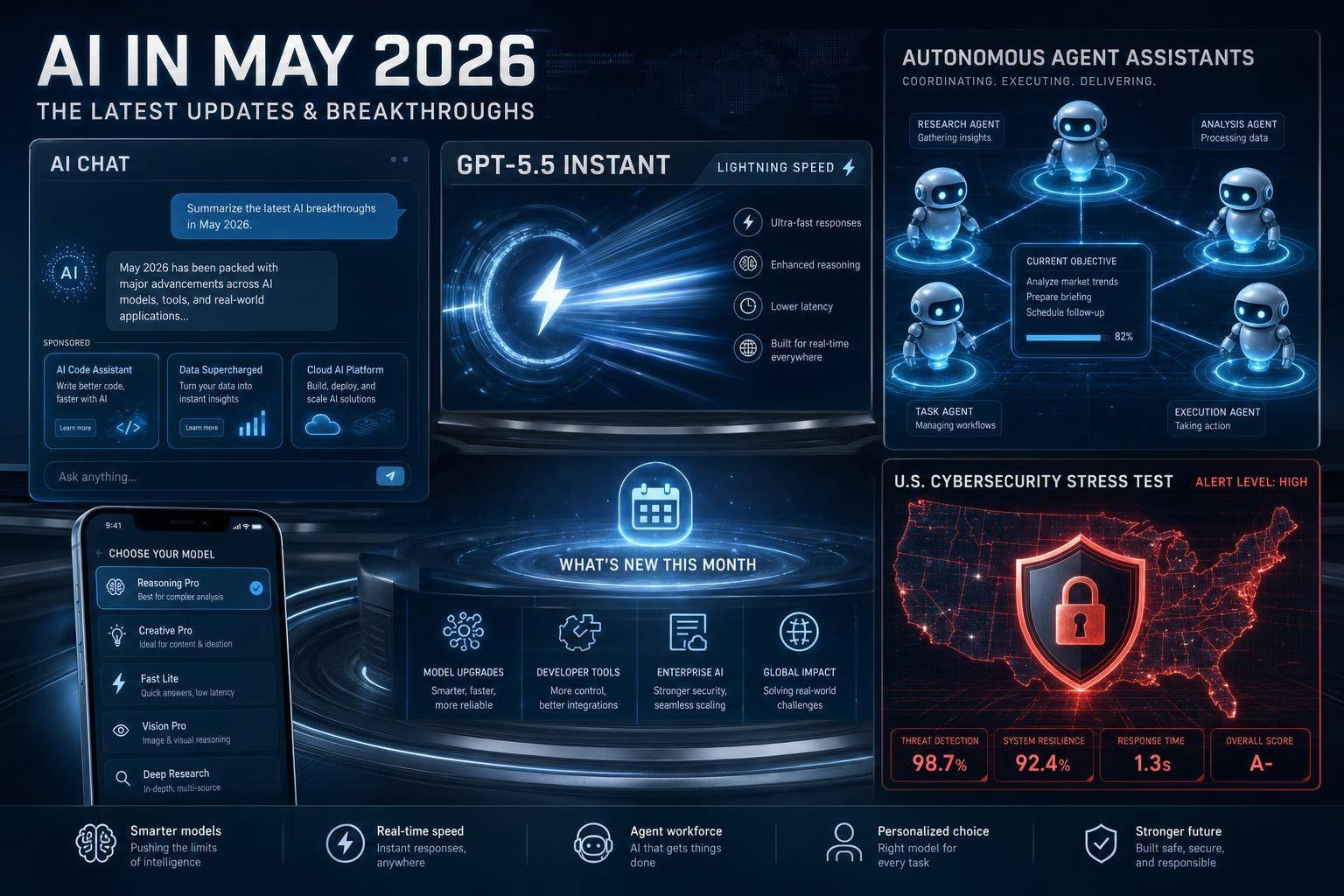
Commercialization, autonomy, and oversight are colliding in generative AI. The past week’s AI update saw OpenAI turn ChatGPT into an ad platform, shipped a faster default model with deeper personalization, and intensified the industry push into agentic systems. Meanwhile, Apple is reportedly preparing model choice as a first‑class feature, and the U.S. government is scaling stress tests of unreleased frontier systems.
For builders, security leaders, and digital strategists, the signal is clear: AI’s product layer is moving faster than most organizations’ risk controls. This analysis breaks down what changed, why it matters, and how to act now to capture value without inheriting avoidable security, privacy, and compliance debt.
OpenAI’s Self‑Serve Ads in ChatGPT: A New Conversion Engine—And New Controls to Build
OpenAI’s rollout of a self‑serve advertising platform directly inside ChatGPT reframes the assistant as an interactive, intent‑rich ad surface. Advertisers can build and optimize campaigns via an Ads Manager—effectively buying conversational placements and using the model’s understanding of user context to shape creative and calls to action. OpenAI reportedly targets multi‑billion‑dollar ad revenue this year and far more by 2030, which suggests this is not an experiment but a core business pillar.
Security and risk implications arrive immediately:
- Conversation‑level targeting and personalization mean more sensitive data can flow through ad decisioning. Data minimization, purpose limitation, and retention boundaries are not “nice‑to‑haves”—they’re the only way to make this tenable at scale.
- Prompt injection and content manipulation now intersect with paid media. If an agent uses tools or external context to tailor an ad response, adversarial content could nudge the model to output misleading or non‑compliant creative.
- Brand safety isn’t only about content adjacency; it’s about model behavior. Guardrail bypasses, tool abuse, or jailbreak attempts can yield outcomes incompatible with ad disclosures or regulatory requirements.
Foundational steps for marketing and security teams evaluating ChatGPT ads:
- Map your data. Define exactly what first‑party data could inform targeting, how it enters the assistant, and which systems (or partners) can access it downstream. Align with the NIST AI Risk Management Framework to classify risks by context and impact, and assign owners for each risk treatment plan.
- Enforce policy controls. Confirm alignment with platform rules before launching any creative or automations. OpenAI’s Usage Policies provide a baseline for acceptable content, safety categories, and enforcement signals that your compliance team should internalize.
- Add adversarial testing to pre‑launch checks. Ask red teamers to craft prompts and tool chains that elicit policy‑breaking ad output, deceptive claims, or privacy leaks. Test “worst‑case” user intents: vulnerable populations, restricted industries, and jurisdiction‑specific restrictions.
- Instrument for post‑launch observability. Log prompts, responses, policy triggers, and user flags. Treat high‑risk segments as if they were payments flows: rate‑limit, review, and quarantine unusually high‑variance outputs.
- Prepare escalation runbooks. Define when to pause campaigns, how to rotate creative or models, and how to communicate user‑facing issues. Adversarial incidents are content incidents; they deserve incident response rigor.
Bottom line: the ad surface is powerful precisely because it’s contextual and dynamic. That same dynamism raises abuse risk and compliance complexity. Bring security into the briefing room early.
GPT‑5.5 Instant Becomes Default: Accuracy and Personalization with Bigger Blast Radius
OpenAI also shipped GPT‑5.5 Instant as ChatGPT’s default model, optimizing for speed, improved accuracy, and personalization. Two shifts deserve attention:
- Deeper context handling. The model uses past chats, uploaded files, and data from connected services (e.g., email or cloud storage integrations) more effectively. That should improve follow‑through on multi‑step tasks, reduce redundant clarification, and raise response quality.
- Reduced hallucinations in selected scenarios. OpenAI indicates material reductions in erroneous outputs under high‑stakes conditions. Depending on your use case, this could enable more automation in workflows that previously required heavy human verification.
Personalization and context depth are force multipliers—but they widen the blast radius when something goes wrong. Practical implications:
- Data access becomes policy, not convenience. Tighter scope management for third‑party connectors is mandatory. If you connect Gmail or Drive, audit OAuth scopes, enforce least privilege, and prefer read‑only where possible. Google’s OAuth 2.0 Scopes documentation is an essential reference for engineering teams wiring up email or file integrations.
- Sensitive data can leak across sessions and tools. Robust session isolation and clear user controls for “memory” must be enabled—and communicated. Where feasible, disable cross‑session memory for regulated workflows or implement separate “personas” with distinct storage.
- Hallucination reduction is not a guarantee. Keep human‑in‑the‑loop (HITL) for irreversible or regulated actions. Define confidence thresholds and require evidence (citations, retrieved documents, or tool outputs) before the model can proceed.
- Attackers will target memory and tools. Prompt injection, toolchain hijacking, and untrusted retrieval sources can quietly shift behavior over time. Calibrate detection for subtle behavior drift, not just loud jailbreak strings.
To help engineering and security teams speak the same language, treat model personalization as a data governance feature. Apply the NIST Privacy Framework to map data flows, individual expectations, and control effectiveness—and build opt‑outs that are real, not rhetorical.
The Agentic Turn: Meta’s Autonomous Assistants and the New Attack Surface
Meta is reportedly trialing a highly agentic assistant (powered by its Muse Spark model), internally testing an agent called “Hatch,” and experimenting with agentic shopping on Instagram. Regardless of brand specifics, this trend is widespread: assistants that plan, call tools, browse, purchase, book, and coordinate across devices with minimal human supervision.
What shifts with agentic systems:
- Tool‑rich environments. The agent gains function‑calling abilities to interact with calendars, payments, email, admin panels, APIs, and operating system hooks. Each tool adds permissions, secrets, and state that can be abused.
- Long‑horizon autonomy. Multi‑step plans introduce chain‑level risk. A harmless step today can stage a harmful outcome tomorrow, after more context has been accumulated or permissions quietly expanded.
- Cross‑boundary execution. Agents hop from app to app and device to device. The security boundary is no longer a single app sandbox; it’s the mesh of every connector, datastore, and third‑party API the agent can reach.
Common failure modes to anticipate:
- Prompt injection via content sources (web pages, PDFs, emails) that instruct the agent to exfiltrate data or invoke sensitive tools.
- SSRF‑style behavior when agents can fetch internal resources or call internal APIs via browsers or connectors.
- Over‑permissioned tool wrappers that allow state‑changing operations without adequate intent verification.
- Covert data flows as agent “memories” accumulate sensitive context that later bleeds into unrelated tasks.
Start with a threat model that’s purpose‑built for AI systems. The OWASP Top 10 for LLM Applications is a practical primer for developers, and MITRE ATLAS catalogs real‑world adversary behaviors against ML systems. Use both to define test cases before you trust an agent with real actions.
Control recommendations for agentic architectures:
- Tooling least privilege. Each tool wrapper gets granular scopes and rate limits. Separate read from write; require explicit secondary confirmation for financial or destructive actions.
- Policy‑as‑code for actions. Gate high‑risk tool invocations behind verifiable preconditions (e.g., “two human approvals,” “ticket present in queue,” “amount < $X”). Log and sign decisions.
- Content provenance signals. Prefer trusted sources with authenticity markers. Treat untrusted content (the open web, user uploads) as adversarial by default; run sanitization and adversarial filters.
- Memory governance. Put time‑to‑live (TTL) on stored context; tag PII or secrets and auto‑purge. Provide UI for users to inspect and delete memory segments.
- Replay‑safe design. Idempotency keys, CSRF‑like protections for tool calls, and anti‑automation checks for actions executed on third‑party sites.
Agents will be the growth frontier across consumer and enterprise apps. Designing for failure upfront is the cheapest path to useful autonomy.
Apple’s Model Choice: Data Routing, On‑Device vs Cloud, and Trust Boundaries
Apple is reportedly preparing to let users select third‑party models (e.g., from Google or Anthropic) to power “Apple Intelligence” features across iOS, iPadOS, and macOS. If Apple executes, “model choice” becomes a mainstream UX pattern—not just a developer knob in pro tools.
Key design and security questions for a multi‑model world:
- Routing logic. Which model handles which tasks? By what criteria—cost, latency, safety profile, modality, or user preference? How are fallbacks decided under load or failure?
- Data jurisdiction and retention. On‑device inference vs. cloud inference makes a material difference. Apple has invested in privacy‑preserving compute primitives like Private Cloud Compute; teams must articulate when data leaves the device, where it lands, and how it’s retained or audited.
- Safety envelope differences. Different model providers have different safety policies, red‑teaming depth, and abuse handling. That variability becomes an enterprise risk if users or apps can arbitrarily switch providers.
- Transparency. Users need clear, inspectable signals about which model is in use, the data sent, and why a route was chosen. Without this, trust and accountability degrade quickly.
Controls to consider if (or when) you support model choice in your own products:
- Central routing policy. Build a “router” service with enforceable policies for data classification and model eligibility. For example, “Regulated PHI never leaves the device; finance data only to provider A; creative drafting allowed on provider B.”
- Capability mapping. Maintain a live registry of model capabilities and safety constraints. Disallow high‑risk tools when the selected model lacks specific guardrails or eval performance.
- Provider due diligence. Evaluate vendors using consistent security and safety criteria, including incident response SLAs, model transparency, red team practices, and adherence to recognized standards. Apple’s Platform Security documentation is a good exemplar of the level of detail to expect about device‑level protections.
- End‑user controls. Expose per‑model toggles for data sharing, memory, and log retention. Make the privacy “receipt” as plain as a cookie banner—but far more informative.
Model plurality is inevitable. The winners will be those who can make it safe, legible, and performance‑aware without overwhelming users or developers.
Government Stress Testing of Frontier Models: Enterprise Lessons from the State
The U.S. government is reportedly expanding stress testing of unreleased frontier models from OpenAI, Anthropic, Google DeepMind, Microsoft, and xAI, focusing on cybersecurity, biosecurity, and misuse. Government scientists are probing systems for the ability to circumvent safeguards and for the potential to help compromise external systems. Translation: safety evaluation is maturing from marketing bullet to institutional practice.
Useful public references for enterprises building their own eval programs:
- NIST’s U.S. AI Safety Institute (AISI) aims to standardize testing, red‑teaming, and measurement approaches; track its evolving guidance and the AISI Consortium roadmap for signals on where testing is headed. See the AISI homepage for research updates and testbed information.
- CISA’s Secure by Design initiative frames how builders should shift left on security, including AI‑specific considerations like model misuse, supply chain risk, and secure defaults.
- Model providers’ safety commitments. For example, OpenAI’s Preparedness focus and Anthropic’s Responsible Scaling Policy describe how vendors intend to evaluate extreme risks as capabilities scale.
How to apply this posture inside your organization:
- Create a formal AI red team. Separate from product QA, with a charter to test misuse, prompt injection, tool abuse, and cross‑tenant data leakage. Tie findings to a gating process so launches can be blocked or conditioned until risks are mitigated.
- Standardize evals. For every task category you deploy (summarization, code generation, RAG, decision support, agents), define metrics and test suites: accuracy, refusal quality, jailbreak resistance, data leakage probability, and action safety.
- Simulate adversaries. Adopt MITRE ATLAS behaviors, run continuous prompts sourced from real‑world jailbreak communities (curated and sanitized), and use synthetic adversarial data to keep detectors sharp.
- Treat AI safety as runtime, not only buildtime. Evals and red teaming are necessary but insufficient. You also need live monitoring, killswitches, and emergency model downgrades when abuse spikes.
Government scrutiny will only increase. Aligning with emerging standards isn’t just compliance; it’s resilience.
A Practical 30‑60‑90 Day Playbook to Operationalize AI + InfoSec
You don’t have to rebuild your entire stack to get safer, smarter with AI in the next quarter. Use this staged plan to align velocity with control.
Days 1–30: Inventory, Policy, and Quick Wins
- Build the map:
- Catalog where AI is in use: vendors (ChatGPT, Claude, Gemini, Copilot), internal prototypes, shadow IT.
- Trace data flows: what leaves your tenant, what’s stored, what’s kept in “memory,” and who has access.
- Establish a baseline policy:
- Define permitted and prohibited use cases, data classification rules for prompts and outputs, and model‑specific constraints (e.g., “no PII to public models”).
- Publish a short “AI Safety Checklist” for employees.
- Quick technical controls:
- Turn on memory controls and retention limits where available.
- Force OAuth least privilege on all AI connectors; audit OAuth scopes for email/file tools.
- Configure logging for prompts/responses on high‑risk workflows.
- Start light‑touch evals:
- For top three AI workflows, define acceptance criteria: accuracy floors, safety refusal quality, sensitive data handling.
Days 31–60: Tooling, Evals, and Agent Guardrails
- Introduce a prompt/response firewall:
- Pattern‑match for jailbreaking attempts, PII leakage, and policy violations. Route suspect cases to HITL review.
- Harden agent tools:
- Audit every tool wrapper for scope and side effects.
- Add “confirm” flows for money movement, external communications, destructive system actions.
- Enforce rate limits and idempotency.
- Build a basic eval harness:
- Implement automated test prompts for jailbreaks, toxic content, and data leaks for each release.
- Track metrics over time; regressions block deployment.
- Red team sprints:
- Assign a cross‑functional red team (security, product, legal) to attack one critical AI feature. Document findings and patch within the sprint.
Days 61–90: Governance, Routing, and Incident Response
- Stand up an AI routing service:
- Centralize model selection. Apply policies for data classification, task type, and provider constraints (e.g., geofencing). Log model usage for audits.
- Formalize governance:
- Align to NIST AI RMF functions (Govern, Map, Measure, Manage). Create a standing AI risk review board.
- Incident response for AI:
- Define severity levels for AI incidents (e.g., hallucinated medical advice, PII leakage, financial misaction).
- Write runbooks for containment: pause flows, switch models, purge memory, inform users/regulators.
- Report and educate:
- Publish quarterly AI risk reports to leadership: usage, incidents, mitigations, roadmap.
- Train builders on the OWASP LLM Top 10 and run hands‑on workshops.
By day 90, you’ll have a pragmatic control plane that scales with product ambitions.
Business Use Cases to Pursue Now—With Guardrails
Plenty of value is on the table today if you pair it with sane constraints.
- Conversational ads and merchandising:
- Use GPT‑5.5 Instant for creative iteration and real‑time A/B ideas; gate final copy via policy checks.
- Convert customer intents into product bundles with an agent that only has read access to your catalog and pricing APIs.
- Sales ops acceleration:
- Summarize calls/emails and draft follow‑ups; restrict CRM writes to “suggested updates” that require rep confirmation.
- RAG over battlecards and proposals; keep the retrieval index free of PII, contract secrets, or anything with export restrictions.
- Support triage:
- Classify tickets, detect security‑relevant ones, propose responses. Require HITL approval for escalations or account changes.
- Auto‑generate knowledge base updates from resolved tickets; double‑review before publishing.
- Secure coding copilots:
- Pair model suggestions with static analysis and dependency checks. Reject insecure patterns and require citations to docs for sensitive APIs.
Each use case should have an explicit risk register entry, acceptance criteria, and kill conditions. That discipline accelerates safely.
Measurement: What to Track Beyond Accuracy
Traditional ML KPIs are insufficient for agentic and conversational systems. Add these:
- Safety refusal quality: How often and how well the system declines unsafe requests without frustrating legitimate users?
- Jailbreak/abuse detection rate: Percentage of adversarial attempts correctly flagged before harm.
- Data leakage rate: Frequency of sensitive tokens appearing in outputs when they shouldn’t (measure via canary tokens and red team prompts).
- Action correctness: For agents, end‑to‑end task success rate and false‑positive “success” where unintended actions were taken.
- Memory hygiene: Percentage of memory entries with TTL, percentage of PII tagged, and mean time to purge on request.
- Governance SLAs: Time from red team finding to mitigation; percent of launches with passing eval scores.
These metrics create a feedback loop that’s legible to executives and operational for builders.
Strategic Takeaways for Leaders
- Productization is outrunning policy. ChatGPT ads and default personalization raise your upside—and your exposure. If marketing and security aren’t paired now, they will be after the first incident.
- Agents are not “just another integration.” They are execution layers. Treat tool permissions, routing, and memory as high‑value assets with explicit controls.
- Model plurality will be normal. Prepare your routing, provider governance, and user transparency now. Apple’s approach will set expectations across the ecosystem.
- Government stress tests are a leading indicator. Borrow methods, align to standards, and build evals into your SDLC. It’s cheaper to pass your own tests than to fail someone else’s.
- Trust is compounding. Precise controls, candid disclosures, and measurable safety performance are brand advantages—especially as AI touches regulated or high‑stakes domains.
FAQ
Q1: What is the biggest new security risk from ChatGPT’s self‑serve ads? A: The combination of conversational context and paid messaging creates new vectors for prompt injection and policy‑breaking outputs. Treat ad creative and placements as dynamic code paths that require adversarial testing, strict data minimization, and runtime monitoring.
Q2: Does GPT‑5.5 Instant’s improved accuracy eliminate the need for human review? A: No. Accuracy improvements reduce error rates, but irreversible or regulated actions still require human‑in‑the‑loop or additional evidence checks. Use confidence thresholds and enforce proof (citations, retrieved docs, or tool logs) before executing sensitive steps.
Q3: How do I secure an agent that can use tools like email and payments? A: Enforce least privilege per tool, add confirmation flows for financial or destructive actions, log and sign all tool invocations, and apply content provenance checks. Build policy‑as‑code gates and monitor for behavior drift over time.
Q4: If Apple enables model choice, should enterprises allow employees to pick any model? A: Not without guardrails. Implement a central routing policy with provider eligibility based on data classification, safety properties, and jurisdiction. Offer choice within safe bounds and disclose when data leaves the device.
Q5: How can we start an AI red team without big budgets? A: Begin with a small cross‑functional group. Use public resources like OWASP LLM Top 10 and MITRE ATLAS to script attacks, prioritize your highest‑impact workflows, and set “blocker” criteria for launch. Scale up as you demonstrate value.
Q6: What standards are most useful to align with right now? A: NIST’s AI Risk Management Framework for governance, CISA’s Secure by Design for secure defaults, and provider safety commitments (e.g., OpenAI Preparedness, Anthropic RSP) to benchmark vendor expectations.
Conclusion: This AI Update Signals a Maturity Test—Build the Control Plane Now
This week’s AI update highlights a pivotal turn: generative AI is becoming a primary channel (ads in ChatGPT), a default work companion (GPT‑5.5 Instant), a semi‑autonomous operator (agentic systems), and a target of formal state‑level testing. The opportunity curve is steep—and so is the accountability curve.
Treat AI risk like you treat payments, identity, or production deployments: with explicit policies, measurable controls, and real‑time observability. Align to recognized frameworks, harden agents with least privilege and policy‑as‑code, and make model choice safe and transparent. If you invest now in an AI control plane, you can move faster with fewer surprises—capturing the commercial upside while staying within your security, privacy, and compliance guardrails.
Discover more at InnoVirtuoso.com
I would love some feedback on my writing so if you have any, please don’t hesitate to leave a comment around here or in any platforms that is convenient for you.
For more on tech and other topics, explore InnoVirtuoso.com anytime. Subscribe to my newsletter and join our growing community—we’ll create something magical together. I promise, it’ll never be boring!
Stay updated with the latest news—subscribe to our newsletter today!
Thank you all—wishing you an amazing day ahead!
Read more related Articles at InnoVirtuoso
- How to Completely Turn Off Google AI on Your Android Phone
- The Best AI Jokes of the Month: February Edition
- Introducing SpoofDPI: Bypassing Deep Packet Inspection
- Getting Started with shadps4: Your Guide to the PlayStation 4 Emulator
- Sophos Pricing in 2025: A Guide to Intercept X Endpoint Protection
- The Essential Requirements for Augmented Reality: A Comprehensive Guide
- Harvard: A Legacy of Achievements and a Path Towards the Future
- Unlocking the Secrets of Prompt Engineering: 5 Must-Read Books That Will Revolutionize You