Top AI News Daily Brief (May 10, 2026): Nvidia’s AI Compute Signals, OpenAI’s Real‑Time Voice Leap, and Google’s Defense Dilemma
AI’s center of gravity continues to shift toward the stack’s extremes: at one end, GPU supply, networking, and data-center design; at the other, consumer-grade experiences like natural, real-time voice that move AI from novelty to utility. In between sits a growing tension over who shapes the rules when AI meets state power.
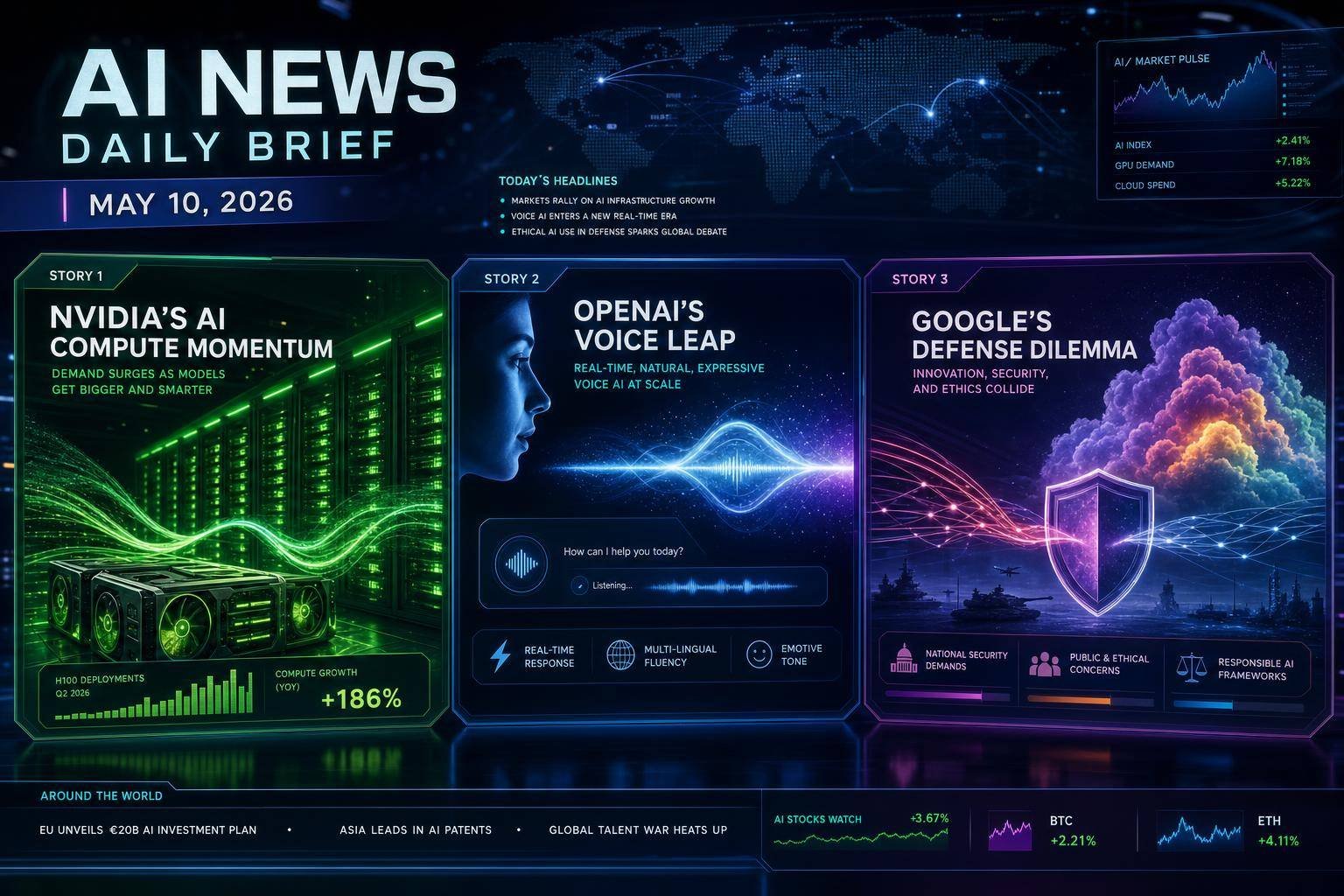
This Top AI News Daily Brief matters because it bundles three signals that consistently move strategy: Nvidia’s roadmap cues for compute buyers and builders, OpenAI’s push into GPT-5-class real-time voice models that could reshape assistants and call centers, and Google employees pressing leadership to decline a classified defense AI contract—an ethical and governance debate likely to reverberate across boardrooms and policy circles.
Expect practical takeaways. We break down what this means for procurement, engineering, security, and governance—and how to adapt roadmaps within the next 30–90 days.
Top AI News Daily Brief: Why these three stories anchor the week
- Nvidia’s CEO Jensen Huang teased another inflection in AI hardware and supply. Even without full segment details, the signal is clear: investors and builders are still indexing on GPUs, networking, and data-center throughput as the gating factors for model progress and margin expansion.
- OpenAI launched GPT-5-class real-time voice models. Real-time multimodal orchestration is crossing a threshold where assistants can “see, hear, and talk” with low latency. That unlocks service automation and on-device experiences—but heightens risks of voice impersonation, fraud, and agentic misuse.
- Google is facing internal pressure from hundreds of employees to reject a classified military AI deal. The episode highlights growing internal governance friction: when, how, and under what constraints should foundational AI companies work with defense agencies?
Below, we unpack implications, with a focus on infrastructure choices, product design patterns, risk controls, and governance moves that leaders can execute now.
Nvidia’s AI infrastructure moment: why chips still run the show
Every year, software abstractions improve. Every six to 12 months, hardware realities reassert themselves. It’s still true: capacity, interconnects, and memory bandwidth determine what’s possible for training and inference at scale.
The short list of truths investors and builders live with
- Supply is strategy. For frontier and near-frontier workloads, the ability to secure multi-quarter GPU allocations, networking gear, and power/cooling envelopes remains a competitive moat. This is as much a logistics and facilities problem as it is a chip problem.
- Networking and memory are first-class bottlenecks. NVLink topologies, InfiniBand/RoCE, and high-bandwidth memory define training efficiency and inference density. When models go sparse or mixture-of-experts, fabric matters as much as FLOPS.
- Cadence compels consolidation. Each new platform generation compresses TCO for the incumbents who can migrate fastest. Expect more consolidation in AI-native SaaS as hardware cycles punishes those who can’t amortize quickly.
For context on Nvidia’s current data-center trajectory, see the company’s official materials around its latest platform family, including the NVIDIA Blackwell platform overview. While specific 2026 announcements will vary, the pattern is consistent: more memory, faster interconnects, and better software tooling driving utilization.
On the benchmarking front, performance claims are best triangulated with community results like MLCommons’ MLPerf benchmark suites, which—while not perfect proxies for your workloads—offer directional signals on training and inference efficiency across hardware and software stacks.
Compute planning: the work that actually moves the needle
- Right-size the training vs. inference split. Many enterprises over-provision for training and under-invest in serving infrastructure and caching. The ROI often lies in inference efficiency, token-level latency SLOs, and dynamic batching.
- Treat networking and cooling as first-class citizens. If you’re going on-prem or colo, involve facilities engineering early. Liquid cooling, power delivery, and row-level airflow will determine real-world utilization far more than a slide of theoretical TFLOPS.
- Make portability real. Plan for a multi-cloud and multi-colo future. Use container and orchestration standards designed for accelerators. Consider hardware partitioning (e.g., Nvidia MIG for A100/H100-class GPUs) to better match model serving footprints with fluctuating demand; Nvidia’s MIG documentation explains how to carve a GPU into independent instances safely.
- Double down on observability. GPU scheduling, kernel-level hotspots, and network contention rarely show up in app logs. Use profiling and telemetry at the accelerator and fabric levels. Tie utilization and p95 latency back to cost-per-request so you’re not optimizing blind.
- Stop chasing singularity-grade models for every task. Domain-specialized fine-tunes and distilled models, coexisting with a few premium endpoints, will hit the cost-latency-quality frontier that keeps margins healthy.
OpenAI’s GPT-5-class real-time voice: assistants grow up
If text-only chatbots were AI’s demo phase, real-time voice is its service phase. The leap is not just quality—it’s orchestration. Low-latency streaming ASR, TTS with expressive prosody, simultaneous tool calls, and multimodal grounding mean assistants that can do things while they speak.
OpenAI’s move to launch GPT-5-class real-time voice models is strategically significant because it connects high-end reasoning to live conversations. Developers can expect patterns similar to what earlier real-time APIs introduced: streaming inputs/outputs, event-driven tool use, and aggressive latency budgets. For a technical flavor of how these systems are wired, see OpenAI’s Realtime API documentation, which covers WebRTC-based connectivity, event streams, and server-side tools.
On the transport side, most real-time assistants rely on WebRTC’s low-latency channels for audio ingress/egress and data. If you’re new to the stack, Mozilla’s MDN WebRTC API guide is a practical primer on peer connections, codecs, and security considerations.
Why real-time voice is different from “chat with voice”
- Latency is part of UX quality. Users can tolerate 500–800 ms round-trip in a call. Beyond that, the interaction feels “laggy” and brittle. That forces tight budgets across ASR, reasoning, and synthesis, often in parallel.
- Barge-in and turn-taking are design primitives. The assistant must handle interruptions gracefully, adjust context, and avoid getting “stuck” mid-utterance.
- Multimodal grounding controls hallucinations. Letting the assistant “see” the screen, parse forms, or read tool responses in real time keeps interactions anchored to state, not just conversation.
- Tool use is live. The agent can query databases, schedule appointments, or trigger workflows mid-conversation. This changes the risk model: you’re no longer protecting just chat logs—you’re protecting actions.
Enterprise use cases that cross the threshold
- Contact center augmentation and containment. Instantly summarize, route, and handle Tier 1/2 issues; escalate with clean handoffs and full context packs. Tie quality to metrics like containment rate, customer effort score, and p95 handle time.
- Field operations and screenless workflows. Voice-driven checklists, parts ordering, and diagnostics while hands are busy—useful in logistics, manufacturing, and healthcare settings.
- Assistive and accessibility scenarios. Speaker diarization and personalized vocabularies can make services more inclusive, as long as privacy and consent are engineered in.
- Internal productivity. Scheduling, expense capture, IT helpdesk, and routine approvals benefit from conversational shortcuts if integrated into the systems of record.
Security and abuse risks rise with capability
Real-time voice is also a real-time risk surface. Voice cloning, impersonation, and agentic misuse will track capability gains unless guarded by policy and controls.
- Fraud and impersonation. Sophisticated vishing and “CEO voice” scams are cheap to stage. The availability of expressive TTS plus low-latency orchestration removes friction for attackers. For high-level mitigation guidance, align controls with the NIST AI Risk Management Framework, which maps risk identification, measurement, and mitigation across the AI lifecycle.
- Synthetic media and misinformation. Watermarking for audio is still immature and brittle against compression and re-recording. Content provenance can help at the source where you own the pipeline; evaluate the C2PA content credentials specification for embedding provenance in media you generate.
- Caller ID and channel trust. STIR/SHAKEN standards are improving caller authentication across telecom rails, but they’re not universal. Treat inbound voice as untrusted unless layered with out-of-band verification and liveness tests.
- Prompt injection and tool misuse. When agents act, an adversarial prompt can become a transaction. Harden with allowlists, constrained tool schemas, and audit trails. The [OWASP Top 10 for LLM applications] guidance—while evolving—captures common pitfalls such as prompt injection, sensitive data exposure, and insecure plugin toolchains.
- Defender hygiene. Educate staff on modern deepfake and voice-fraud TTPs. CISA curates practical checklists and awareness materials; see CISA’s overview on deepfakes and synthetic media to help structure training and playbooks.
Operationally, treat your voice assistant like a payment processor: least privilege on tools, runtime policy enforcement, deterministic controls around money movement and data access, and continuous monitoring for anomalous sequences.
Google’s defense dilemma: employees, ethics, and strategy
A letter from 600+ employees urging CEO Sundar Pichai to reject a classified military AI contract underscores a recurring conflict: how to reconcile commercial opportunity, national security partnerships, and stated AI principles—especially under classification that limits internal transparency.
This isn’t new territory for big tech. In 2018, Google employees pushed back on Project Maven, precipitating the publication of the company’s AI Principles. If you haven’t revisited them, Google’s AI Principles still set a widely cited bar on “socially beneficial,” “avoid creating or reinforcing bias,” “be accountable,” and a refusal to pursue technologies causing overall harm. The live question is how those principles map onto classified engagements where harm/benefit tradeoffs are harder to assess publicly.
Defense agencies, for their part, have matured their governance playbooks. The U.S. Department of Defense maintains a Responsible AI program and policy stack that attempts to standardize safety, accountability, and auditability. For reference, review the DoD’s Responsible AI resources, which outline principles and implementation pathways across acquisition and operations.
Three takeaways for AI leaders:
- Governance must survive classification. If you work with sensitive customers, establish an internal review function with cleared representatives, pre-negotiated red lines (e.g., explicit prohibitions on autonomous targeting), and contractual transparency mechanisms.
- Employees are stakeholders in AI risk. Transparent, repeatable processes to evaluate deals against principles can retain talent and reduce reputational risk. Absent that, ad hoc decisions will leak into the press and erode trust.
- Expect more—not fewer—public-private frictions. As frontier models creep toward strategic infrastructure (power systems, logistics, cyber defense), the expectation that tech firms pick sides will intensify.
How to operationalize today’s brief: a 30-60-90 day action plan
Translate signals into concrete moves across infrastructure, product, security, and governance.
0–30 days: Quick wins and risk hygiene
- Infrastructure
- Lock in short-term compute needed for planned experiments and pilots. Don’t over-commit on unproven workloads; maintain optionality with on-demand or reserved cloud GPU lots.
- Baseline inference latency and cost per request for your current assistants; identify top three hotspots.
- Product
- Prototype a real-time voice interaction for a single, bounded use case (e.g., password reset or returns). Use WebRTC for low-latency transport and measure interruption handling (“barge-in”) quality.
- Security
- Update your social engineering and fraud playbooks with a voice deepfake scenario. Add out-of-band verification for financial approvals and sensitive requests.
- Stand up logging and audit trails for any agent tool use. Build an allowlist; avoid raw natural language calling arbitrary functions.
- Governance
- Draft a one-page policy on defense and public-sector engagements. Define your principles, red lines, and review committee membership.
31–60 days: Build for scale and reliability
- Infrastructure
- Evaluate inference architectures that mix premium endpoints for complex tasks with distilled/fine-tuned models for the 80% path. Model routing can drop costs without gutting quality.
- Instrument GPU and network observability; set p50/p95 SLOs for token generation latency and streaming jitter.
- Product
- Integrate contextual grounding: screen capture, form parsing, and tool results that the assistant can “see” and reference in speech.
- Add structured summaries post-call (JSON outputs) for CRM logging and QA.
- Security
- Implement liveness and challenge-response for sensitive voice flows. Require a secondary factor for high-risk actions.
- Align with the NIST AI Risk Management Framework for a common language with auditors and partners.
- Governance
- Run your first “deal review” tabletop. Simulate evaluating a sensitive customer contract against your principles. Produce a redacted decision memo template.
61–90 days: Optimize and communicate
- Infrastructure
- Decide on your next 2–3 quarter compute strategy: reserved cloud capacity, colo with liquid cooling, or a hybrid. If running Nvidia hardware, validate whether techniques like MIG partitioning improve utilization for your serving mix.
- Product
- Move from pilot to production for one voice assistant use case. Define clear business metrics: containment rate, CSAT, resolution time, and cost per successfully handled interaction.
- Security
- Adopt content provenance for media you produce using AI (e.g., C2PA content credentials) and publish a brief Trust & Safety page on your website describing safeguards.
- Governance
- Publish an annual AI Responsibility report: principles, risk controls, red-team highlights, and a high-level summary of sensitive engagements reviewed.
Technical design notes for real-time voice assistants
Build teams benefit from a shared mental model of the architecture and its tradeoffs.
- Audio ingress/egress
- Use Opus-encoded streams over WebRTC data channels for low-latency, robust audio transport. See MDN’s WebRTC API guide for transport and security fundamentals.
- Implement echo cancellation, VAD (voice activity detection), and jitter buffers to smooth variable network conditions.
- ASR + NLU
- Prefer streaming ASR that exposes partial hypotheses; feed interim text to the planner for overlapping reasoning when latency budgets are tight.
- Maintain custom vocabularies and entity lists for domain terms, SKUs, and proper nouns.
- Reasoning and tool use
- Constrain tools with typed schemas and explicit policies. The agent should never get free-form shell or SQL access; wrap queries in vetted parameterized statements.
- Cache frequent tool responses and static knowledge with a time-to-live; call tools only when freshness is required.
- TTS with prosody control
- Prioritize expressive synthesis but gate first-use. For sensitive brands, require human review and voice owner consent before deploying voices in production.
- Expose a “speak slowly” and “explain” mode to accommodate different user preferences and accessibility needs.
- Safety wraps
- Use allowlists, guardrails, and structured output validation. Adopt adversarial testing (prompt injection, tool misuse) pre-release; map results to a simple severity rubric and remediation plan.
- Log everything the agent saw, decided, and did, with correlation IDs. Redact PII at the edge where possible.
For developers using OpenAI’s stack, the Realtime API docs offer implementation patterns for low-latency voice and event-driven tool use. Complement vendor docs with neutral security frameworks like [OWASP’s guidance for LLM applications] and CISA’s deepfake and synthetic media resource library for security playbooks and training materials.
Balancing opportunity and risk: strategy pointers for leadership
- Don’t wait for perfect compliance before you ship something valuable. Start with low-risk voice flows that carry clear business value and limited downside. Prove ROI, then layer on complexity.
- Recognize that infrastructure decisions are cultural decisions. If you choose on-prem GPUs, you’ve chosen to build a team that can run a modern data center. Staff accordingly.
- Publish your red lines and enforce them. Whether it’s defense work, surveillance tech, or high-risk applications, clarity reduces internal churn and external speculation.
- Measure what matters: not model scores in isolation, but end-to-end outcomes (latency, cost, containment, resolution, and satisfaction) tied to business goals.
- Educate continuously. Fraud actors iterate; so should your defenses. Make awareness of voice impersonation and deepfakes part of routine security culture.
Mistakes to avoid
- Treating voice assistants like IVR 2.0. Static trees and rigid scripts won’t cut it. Design for interruptions, context switching, and multimodal grounding.
- Shipping tools without guardrails. An agent with “book travel,” “issue refunds,” or “change account details” needs strong policy enforcement, not vibes.
- Ignoring provenance because it’s “unsolved.” Content authenticity at scale is hard, but adopting standards like C2PA where you control the pipeline is a pragmatic start.
- Overfitting to one hardware generation. Architect for churn. Assume your stack will straddle multiple GPU generations and clouds.
- Under-communicating principles internally. Vacuum breeds rumor. Publish how you evaluate sensitive work; create channels for staff to raise concerns.
Frequently asked questions
Q: What is the practical difference between a “real-time voice model” and a chatbot with TTS/ASR bolted on? A: Real-time voice models are optimized for low-latency, turn-taking, interruption handling, and parallel tool use while speaking. They integrate streaming ASR, planning, and synthesis as a single orchestrated loop, instead of sequentially transcribing, reasoning, and reading out.
Q: How can I reduce latency in a voice assistant without sacrificing quality? A: Stream everything. Use partial ASR hypotheses, start TTS on high-confidence tokens, and perform speculative decoding. Cache tool outputs aggressively and route only high-complexity turns to larger models. Set p50/p95 SLOs and profile across the entire pipeline.
Q: Are voice deepfakes detectable in real time? A: Detection is improving but unreliable at scale and in the wild. Treat detection as one layer, not the foundation. Combine liveness checks, out-of-band verification, transaction limits, behavioral analytics, and user education. Reference frameworks like the NIST AI RMF and CISA’s deepfake resources when building controls.
Q: How should we think about on-prem vs. cloud for AI compute in 2026? A: Match to workload volatility and governance needs. Cloud accelerators provide flexibility for experimentation and bursty demand. On-prem or colo can win on steady-state economics and data control if you can operate at high utilization. Many end up hybrid, with inference closer to users and training concentrated where capacity and power are available.
Q: What governance steps are expected if we work with defense or sensitive public-sector customers? A: Publish principles, define red lines, form a review committee (with clear escalation paths), and maintain auditable decision memos. Align with customer-side frameworks like the DoD’s Responsible AI program and your own internal risk policies.
Q: Which standards or specs should we consider for content authenticity? A: Evaluate the C2PA specification for content credentials and provenance tagging where you control the generation pipeline. Combine with clear disclosure and, when applicable, visible UI indicators that a voice is synthetic.
The bottom line: today’s Top AI News Daily Brief and what to do next
This Top AI News Daily Brief points in one direction: AI is embedding into both the physical constraints of data centers and the human cadence of voice. Nvidia’s signals reaffirm that hardware strategy—supply, networking, and utilization—still gates frontier progress. OpenAI’s GPT-5-class real-time voice models mark an inflection where assistants can converse and act in the flow of work, not just chat. And Google’s defense dilemma reminds leaders that governance is no longer an afterthought; it is a capability you need to build.
What to do next: – Lock in a pragmatic compute plan for the next two quarters and instrument your inference SLOs. – Ship one low-risk, high-value real-time voice assistant with strong guardrails and observability. – Publish or refresh your AI principles and review process—especially for sensitive sectors.
Push forward, deliberately. Align hardware bets with business outcomes. Build voice experiences that feel natural, safe, and useful. Govern sensitive opportunities with clarity. Do this, and the signals from today’s Top AI News Daily Brief become durable advantages rather than headlines that pass you by.
Discover more at InnoVirtuoso.com
I would love some feedback on my writing so if you have any, please don’t hesitate to leave a comment around here or in any platforms that is convenient for you.
For more on tech and other topics, explore InnoVirtuoso.com anytime. Subscribe to my newsletter and join our growing community—we’ll create something magical together. I promise, it’ll never be boring!
Stay updated with the latest news—subscribe to our newsletter today!
Thank you all—wishing you an amazing day ahead!
Read more related Articles at InnoVirtuoso
- How to Completely Turn Off Google AI on Your Android Phone
- The Best AI Jokes of the Month: February Edition
- Introducing SpoofDPI: Bypassing Deep Packet Inspection
- Getting Started with shadps4: Your Guide to the PlayStation 4 Emulator
- Sophos Pricing in 2025: A Guide to Intercept X Endpoint Protection
- The Essential Requirements for Augmented Reality: A Comprehensive Guide
- Harvard: A Legacy of Achievements and a Path Towards the Future
- Unlocking the Secrets of Prompt Engineering: 5 Must-Read Books That Will Revolutionize You