Pacing Model Development for Cyber-Critical AI: A Defense-in-Depth Playbook for Frontier Safety
As advanced AI systems begin to materially influence cybersecurity—both for defense and potential offense—the way we build, evaluate, and ship models has to change. The stakes are no longer theoretical. Models that can write, audit, and execute code, orchestrate tools across networks, and optimize complex attack chains have crossed into what many leaders now call cyber-critical capabilities.
OpenAI’s recent strategy shift foregrounds this reality: as models approach frontier performance in cyber-relevant tasks, development moves from “move fast” to “pace deliberately,” with stronger isolation, monitoring, and gating. For technology leaders, security architects, and AI researchers, the message is clear. If your models can alter the cyber balance, your engineering environment becomes part of your threat surface—and you need a plan to harden it.
This article lays out that plan. We define cyber-critical capability, translate defense-in-depth into concrete controls for AI R&D, and offer a pragmatic operating model that aligns with modern guidance from standards bodies and major labs. Expect actionable steps, architectural patterns, and a roadmap you can use now.
What “Cyber-Critical Capabilities” Means—and Why It Changes the Rules
Cyber-critical capabilities are model behaviors that can materially affect cybersecurity outcomes at scale. Unlike general productivity features, these capabilities have dual-use potential: they can fortify defenses or help defeat them. When a model crosses certain thresholds, the model, its training data, and its surrounding toolchain become high-value targets.
Common indicators that a model is entering the cyber-critical zone: – High competence in generating and executing code across languages and platforms – Ability to autonomously triage, chain, and correct multi-step actions using tools – Reliability in reproducing known exploit classes given contextualized inputs – Skill in reconnaissance, privilege escalation planning, and lateral movement simulation – Proficiency at detecting, evading, or subverting common defenses in controlled tests
None of these alone is decisive. But together—especially when amplified by tools and network access—they warrant pacing model development: adjusting release timelines, tightening access, and escalating safeguards until controls demonstrably keep risk within tolerance.
For context, see standards and frameworks that increasingly recognize AI-specific security risks, such as the NIST AI Risk Management Framework and the OWASP Top 10 for LLM Applications. These resources translate long-standing security principles into AI-era specifics.
OpenAI’s Pacing Strategy: Defense-in-Depth for Frontier Models
OpenAI’s public framing offers a blueprint for the industry: as models approach critical-level cyber capabilities, development must integrate with robust cybersecurity engineering, not run parallel to it. In short: pace model development.
Key elements highlighted in OpenAI’s pacing model development post: – Workload isolation: sandbox anything that executes model-generated or untrusted code, including auxiliary tools that handle model outputs. – Network isolation: segment high-risk experiments and frontier tasks from broader infrastructure with strict egress and trust boundaries. – Hardening the research environment: minimize shared services, reduce standing privileges, tighten identity controls, and enhance logging. – Continuous security testing: automated, model-driven probing of workload and network boundaries to validate isolation and detect regressions. – Tiered safeguards and access: the highest-capability models (e.g., Astra and cyber-focused systems) run under the strictest controls and limited release conditions.
The headline idea is less about any one control and more about posture: treat the model as a potential source of systemic cyber risk and design your R&D ecosystem accordingly. Pacing is not just a policy lever; it’s an engineering discipline.
Translating Defense-in-Depth to AI R&D: The Technical Controls
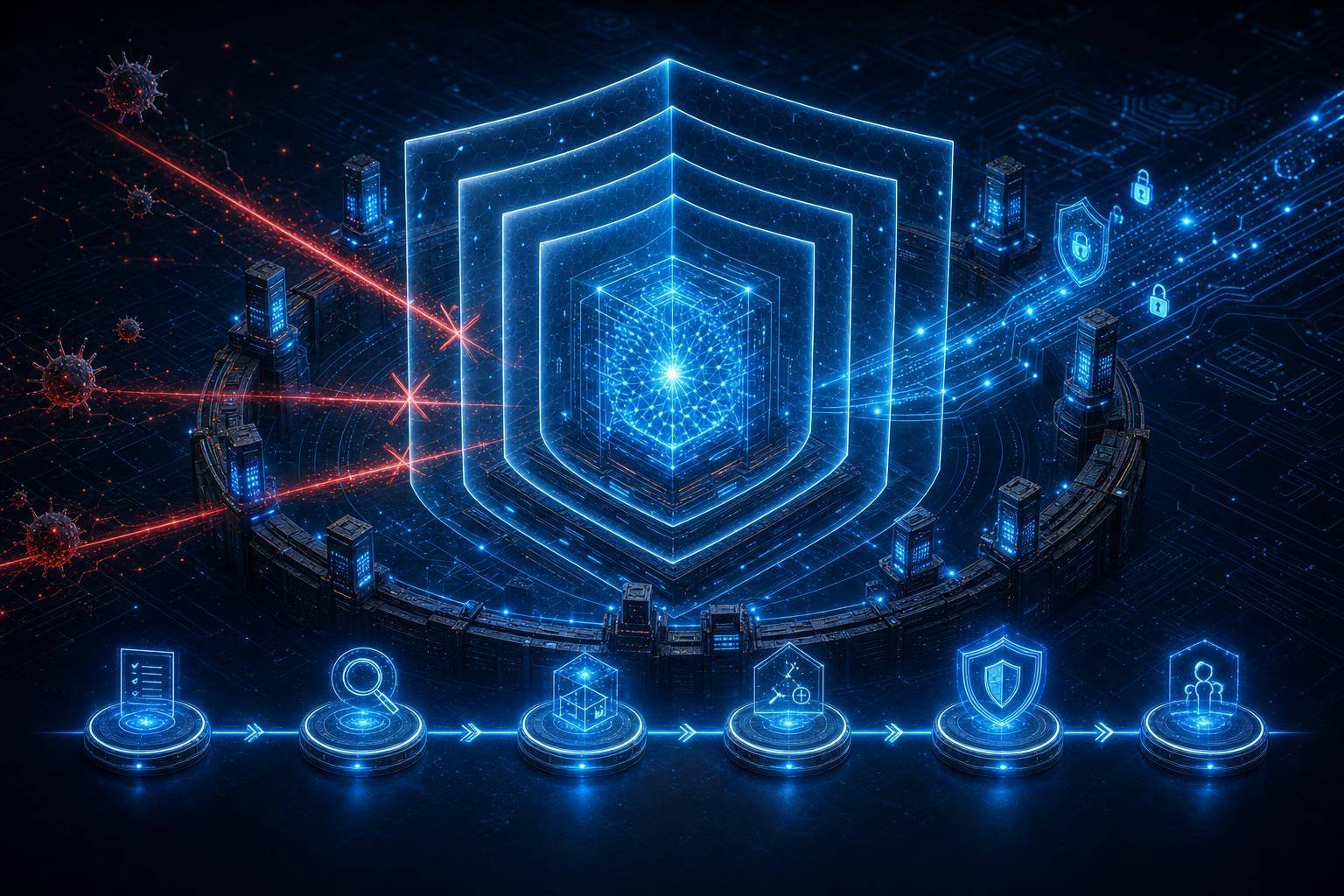
Defense-in-depth works when layers overlap—so if one fails, others still stand. Applied to AI R&D, the most critical layers are workload isolation, network isolation, trust boundaries, logging/telemetry, and continuous testing. Here’s what that looks like in practice.
Workload Isolation: Sandboxes as the Default
Any workload that runs or transforms untrusted inputs—including model-generated code—should be sandboxed by default. This extends to: – Code execution tools (e.g., Python, shell, compilers, interpreters) – Model function-calling handlers and agent frameworks – Data transformation pipelines (formatters, parsers, converters) – Evaluation harnesses that ingest adversarial prompts or test corpora
Practical moves: – Use multiple isolation primitives: containers within microVMs (e.g., Firecracker), gVisor-style user-space kernels, and process-level sandboxing. – Set tight seccomp, AppArmor/SELinux profiles; mount filesystems read-only; drop Linux capabilities by default. – Lock execution environments to immutable images; ban dynamic package installs at runtime. – Enforce strict resource quotas (CPU, memory, storage) and kill-switches on anomalous behavior.
This reduces blast radius if model-generated code tries to escape its bounds—intentionally or by accident.
Network Isolation: Assume the Internet Is an Adversary
Even a well-boxed process becomes dangerous with broad network egress. Network isolation for frontier R&D means: – Default-deny egress from high-risk workloads; explicitly allow only required endpoints. – No lateral movement: isolate sandboxes from internal networks; broker any necessary access through audited proxies. – Use service mesh or microsegmentation for traffic policy enforcement and identity-aware routing. – Inspect egress (DNS and TLS SNI where lawful and appropriate) for anomaly detection; consider deception endpoints for canary-triggered alerts.
NIST’s zero-trust guidance offers a conceptual backbone for this approach. See NIST SP 800-207 on Zero Trust Architecture for design patterns that translate well to AI research environments.
Remove Shared Services and Reduce Standing Privileges
Shared services and persistent admin rights are common failure points. Harden your environment by: – Decomposing shared services into per-tenant or per-experiment instances where feasible. – Using just-in-time access and ephemeral credentials via a privileged access management (PAM) system. – Enforcing strict separation of duties (SoD) between model trainers, infrastructure operators, and security auditors. – Requiring hardware-backed keys for all human and service identities; rotate secrets automatically. – Versioning and attestations for datasets, model artifacts, evaluation harnesses, and runtime images.
This sharpens trust boundaries and curbs the risk of a single compromised component amplifying across the estate.
Logging, Telemetry, and Tamper-Evident Records
You cannot pace what you cannot see. For cyber-critical work: – Centralize logs for identity events, workload execution, network traffic, artifact access, and evaluation results. – Use write-once (WORM) or tamper-evident storage for critical trails; hash-chain key artifacts and link to policy gates. – Correlate across layers: link a model run to its data version, sandbox ID, network policy, and operator identity. – Build real-time alerts on egress anomalies, policy downgrades, and unexpected tool invocation patterns.
Google’s Secure AI Framework (SAIF) emphasizes visibility and verifiable controls across AI supply chains—principles that map directly to this telemetry layer.
Continuous Security Testing: Automated and Adversarial
Security testing should be continuous, multi-modal, and partly automated with adversarial models: – Red-team sandboxes: fuzzing, syscall probing, deserialization tests, and resource exhaustion scenarios. – Attack-path simulation: chain workloads and network segments to test egress brokers and trust boundaries. – Model-driven probing: use capable models under strict supervision to generate adversarial inputs targeting your defenses. – Canary policies: embed benign traps (“try to call an unknown IP”) to validate blocks and alerting paths.
Leverage community knowledge bases like MITRE ATLAS to design realistic adversarial tests targeting AI-specific components and interactions.
Pacing as a Product and Governance Function
Pacing is not only an engineering problem. It is also a product and governance function that decides who gets access to which capabilities under what conditions. Done well, it allows useful progress while constraining risk growth.
Capability Tiers and Access Gates
Define capability tiers tied to safeguards: – Tier 0: No code execution or networked tool use. Lowest risk. – Tier 1: Limited code execution in local sandboxes; no egress. – Tier 2: Tool use with constrained egress to vetted services; mandatory telemetry and rate limits. – Tier 3: High-capability models with potential cyber-critical behaviors; strictest isolation, restricted access, pre-approval for experiments, and live oversight.
Gate movement between tiers on evaluation evidence and security sign-off. Models that cross a cyber-critical threshold remain in higher tiers even if only parts of their behavior are relevant.
Evaluation-Driven Release and Rollback
Release pacing should hinge on evaluation: – Maintain a security eval suite: exploit reproduction, privilege escalation planning, evasive behavior, social engineering resistance in tool-use contexts, and jailbreak robustness. – Require passing grades for promotion; codify automatic rollback triggers on telemetry signals and post-release findings. – Pair evaluations with structured red-teaming and model interpretability where feasible to detect dual-use hot spots.
The NIST AI RMF provides governance scaffolding for documenting risks, controls, and decision rationales over a model’s lifecycle.
Specialized Oversight for Tool-Using Models
When models orchestrate tools—especially in reinforcement learning or agentic loops—oversight needs to reach inside the process: – Record intermediate steps and tool invocations for audit and forensic reconstruction. – Apply policy constraints in the action loop (forbidden commands, rate-limited operations, pre-execution approvals). – Use guard models or deterministic filters to flag risky action plans before execution. – Consider supervised environments for high-risk training (e.g., mentors or reviewers for escalations, consistent with privacy and ethics constraints).
These measures aim to catch risk before it becomes an incident.
Align With Industry Safety Levels
Formal safety levels are emerging in the industry to normalize pacing. For example, Anthropic’s Responsible Scaling Policy ties capability thresholds to safeguards and oversight expectations. Even if you adopt a different taxonomy, define explicit levels and the controls each requires. Consistency matters for both internal clarity and external accountability.
Building the Hardened AI Research Environment
Below is a reference architecture for hardening AI R&D where cyber-critical capabilities may emerge.
Identity, Secrets, and Artifact Supply Chain
- Hardware-backed identity (WebAuthn or equivalent) for humans and services
- Ephemeral tokens with least privilege; no long-lived credentials in code
- Attested artifact pipeline: signed datasets, signed training images, signed model artifacts
- Policy-as-code for data and capability entitlements, reviewed and versioned
Compute and Execution Isolation
- Per-experiment namespaces with dedicated sandbox pools
- Container-in-VM or microVM stacks for untrusted code; immutable base images
- Enforced control groups (cgroups) and syscall filtering; read-only roots
- Outbound-only brokered connections; no inbound traffic to sandboxes
Network Controls and Egress Brokering
- Default-deny network policy at workload and namespace levels
- DNS policy with domain allowlists; TLS SNI inspection where compliant
- Token-based, logged access to approved services (data storage, model registries, evaluation endpoints)
- Deception infrastructure and honey endpoints for early detection
Observability and Response
- Correlation across identity, workload, and network events; per-run audit bundles
- Real-time anomaly detection; pre-defined kill switches for egress or compute
- Incident response runbooks for model misbehavior and boundary breaches
- Post-incident reviews with evidence-linked improvements to policy gates
Frameworks like CISA’s Secure by Design offer practical guidance for engineering organizations to bake security into development and operations, which maps neatly to these AI-specific layers.
Continuous Red Teaming With and Against AI
Red teaming should be an always-on function. In a cyber-critical context, this becomes a hybrid effort: – Humans probe strategy and design flaws that automation misses. – Automated systems (including capable models in safe sandboxes) generate diverse, adversarial inputs and scenario chains at scale. – Blue team instrumentation captures every attempt, classifies it, and feeds improvements back into policies, isolation, and model alignment.
Design tests that mirror real attacker goals: – Data exfiltration from restricted training sets through subtle prompt interactions – Sandbox escape via language-specific runtime quirks – Egress policy bypass using covert channels (e.g., DNS queries) – Latent tool-seeking behavior: attempts to install packages or call system tools not in the allowlist – Use of social-engineering style prompts to co-opt human operators or weaker guard models
Anchor your test catalog to known TTPs using references like MITRE ATLAS, and refresh the suite whenever you upgrade tooling, change isolation boundaries, or observe new incidents in the wild.
Practical Implementation: A 90-Day Playbook
If your organization is developing models that may approach cyber-critical capabilities, here is a staged plan.
Days 0–30: Establish Baselines and Stop the Bleeding
- Inventory: catalog all model training and evaluation workloads; identify code execution and tool-using components.
- Quick wins: flip high-risk workloads to immutable images; switch default network egress to deny; set strict resource quotas.
- Secrets: remove long-lived credentials from repos; enforce hardware-backed MFA; rotate keys.
- Logging: centralize identity and workload logs; tag runs with experiment IDs for correlation.
Days 31–60: Build Guardrails and Policy Gates
- Sandboxing: deploy container-in-VM for untrusted code paths; apply syscall filters and read-only mounts.
- Egress brokering: implement DNS allowlists and token-gated, audited access to approved services.
- Access tiers: define capability tiers; restrict top-tier access to named personnel and approved experiments.
- Evaluation suite: stand up baseline cyber capability tests; require passing thresholds for promotion to higher tiers.
Days 61–90: Automate, Test, and Formalize Pacing
- Model-driven adversarial testing: add automated generators to probe sandbox and egress boundaries in CI.
- Policy-as-code: implement change control with peer review for isolation and network rules; attach to artifacts via signed manifests.
- Incident response: create runbooks for model misbehavior and boundary breaches; test kill switches.
- Governance: codify promotion gates, rollback criteria, and audit procedures; align with NIST AI RMF.
From here, institutionalize a cadence: monthly red-team sprints, quarterly control reviews, and pre-release security sign-offs for any model showing growth in cyber-relevant evaluations.
Common Mistakes to Avoid
- Treating model evaluations as a one-off event instead of a running control
- Allowing “temporary” exceptions that become permanent backdoors
- Over-relying on a single isolation primitive (e.g., containers without hardened kernels)
- Broad network egress “for convenience,” especially to general internet or internal networks
- Mixing low- and high-trust workloads on shared services without strict tenancy and logging
- Skipping post-incident learning because an escape was “only simulated”
Realistic Scenarios: Applying Pacing to Everyday AI Work
Scenario 1: A code-assistant with shell tool use – Risk: Model-generated commands run in developer terminals, with access to internal repos. – Pacing response: Route all commands through a sandboxed executor with read-only checkout of repos; default-deny egress; provide a safe file drop for proposed patches; require explicit human approval for any network operation; log all tool plans and executions.
Scenario 2: A vulnerability triager integrated with a CI/CD pipeline – Risk: The model suggests patches that get executed during build steps; potential supply chain compromise. – Pacing response: Enforce immutable build images; separate suggestion generation from execution; verify diffs with signed approvals; run tests in isolated runners with no credentials; gate production merges behind evaluation checks.
Scenario 3: A red-team helper model for internal security – Risk: Capable of generating exploit chains; could be abused or exfiltrate sensitive patterns. – Pacing response: Restrict access to security staff; run in isolated research VPCs with no corporate lateral access; log prompts/completions with tamper-evident storage; pre-populate evaluation queries; block arbitrary egress and external package fetches.
These scenarios show pacing is not about blocking progress; it’s about channeling capability through safe pathways.
How This Aligns With Broader Industry Moves
Organizations across the ecosystem are converging on principles that support pacing: – Zero trust networking and identity-first controls (NIST SP 800-207) – Secure-by-design, shifting left on architectural decisions (CISA Secure by Design) – Secure AI supply chains with verifiable controls (Google SAIF) – AI-specific threat modeling and TTPs (MITRE ATLAS) – Safety levels tied to capability thresholds (Anthropic Responsible Scaling Policy) – Application-layer risks for LLM systems (OWASP LLM Top 10)
OpenAI’s public commitment to pace model development as cyber-critical capabilities emerge sits squarely within this trajectory and raises the bar for engineering rigor across the field. You can review their approach at OpenAI’s pacing model development post.
FAQ
What is a “cyber-critical” AI capability? – Any model behavior that could meaningfully alter cybersecurity outcomes—defensive or offensive—at scale. Think reliable code execution, exploit synthesis in controlled settings, tool-chained operations with planning, or evasion skills. When present, they trigger stricter safeguards and paced releases.
How is workload isolation different from network isolation? – Workload isolation confines what code can do on a host: filesystem, syscalls, privileges, and resources. Network isolation controls where a workload can communicate: default-deny egress, allowlists, and segmentation to prevent lateral movement. You need both.
What evaluations matter before releasing powerful models? – Security-oriented evals that probe exploit reproduction, privilege escalation planning, boundary testing, jailbreak robustness, and action-loop safety for tool-using models. Pair these with red teaming and continuous telemetry to catch regressions.
Can we safely use agentic or tool-using models in production? – Yes, with constrained tools, sandboxed execution, explicit allowlists, tight egress, robust logging, and human approval for sensitive actions. Record intermediate plans and enforce policy checks before executing high-impact steps.
How does pacing relate to compliance frameworks? – Pacing operationalizes risk management from AI and security standards (e.g., NIST AI RMF, zero trust, secure-by-design) into model-specific gates and controls. It helps demonstrate due diligence for high-capability systems.
What’s the minimal viable setup for small teams? – Immutable sandbox images for any code execution, default-deny network egress, centralized logging, hardware-backed MFA, and a simple capability tiering policy. Add automated adversarial tests as soon as possible.
The Bottom Line: Pace Model Development to Manage Cyber Risk
Frontier AI doesn’t just change products; it changes your threat model. When models approach cyber-critical capabilities, your R&D environment becomes part of your security perimeter, and your release process becomes a risk control. Pacing model development—isolating workloads, isolating networks, reducing standing privileges, logging deeply, and testing continuously—lets you unlock value without letting risk outrun your controls.
Start today by inventorying where model-generated code executes, flipping those paths into hardened sandboxes, and defaulting network egress to deny. Establish capability tiers and attach promotion gates backed by evaluations and red-teaming. Align those steps with modern frameworks from NIST, CISA, and others to keep your documentation and decisions defensible.
The organizations that win with frontier AI will look less like fast-moving labs and more like resilient engineering companies—shipping powerful systems at the speed of assurance. That’s what pacing model development for cyber-critical capabilities is all about.
Discover more at InnoVirtuoso.com
I would love some feedback on my writing so if you have any, please don’t hesitate to leave a comment around here or in any platforms that is convenient for you.
For more on tech and other topics, explore InnoVirtuoso.com anytime. Subscribe to my newsletter and join our growing community—we’ll create something magical together. I promise, it’ll never be boring!
Stay updated with the latest news—subscribe to our newsletter today!
Thank you all—wishing you an amazing day ahead!
Read more related Articles at InnoVirtuoso
- How to Completely Turn Off Google AI on Your Android Phone
- The Best AI Jokes of the Month: February Edition
- Introducing SpoofDPI: Bypassing Deep Packet Inspection
- Getting Started with shadps4: Your Guide to the PlayStation 4 Emulator
- Sophos Pricing in 2025: A Guide to Intercept X Endpoint Protection
- The Essential Requirements for Augmented Reality: A Comprehensive Guide
- Harvard: A Legacy of Achievements and a Path Towards the Future
- Unlocking the Secrets of Prompt Engineering: 5 Must-Read Books That Will Revolutionize You