Cybersecurity and AI Predictions for 2026: Six Shifts Reshaping Defense, Identity, and Digital Trust
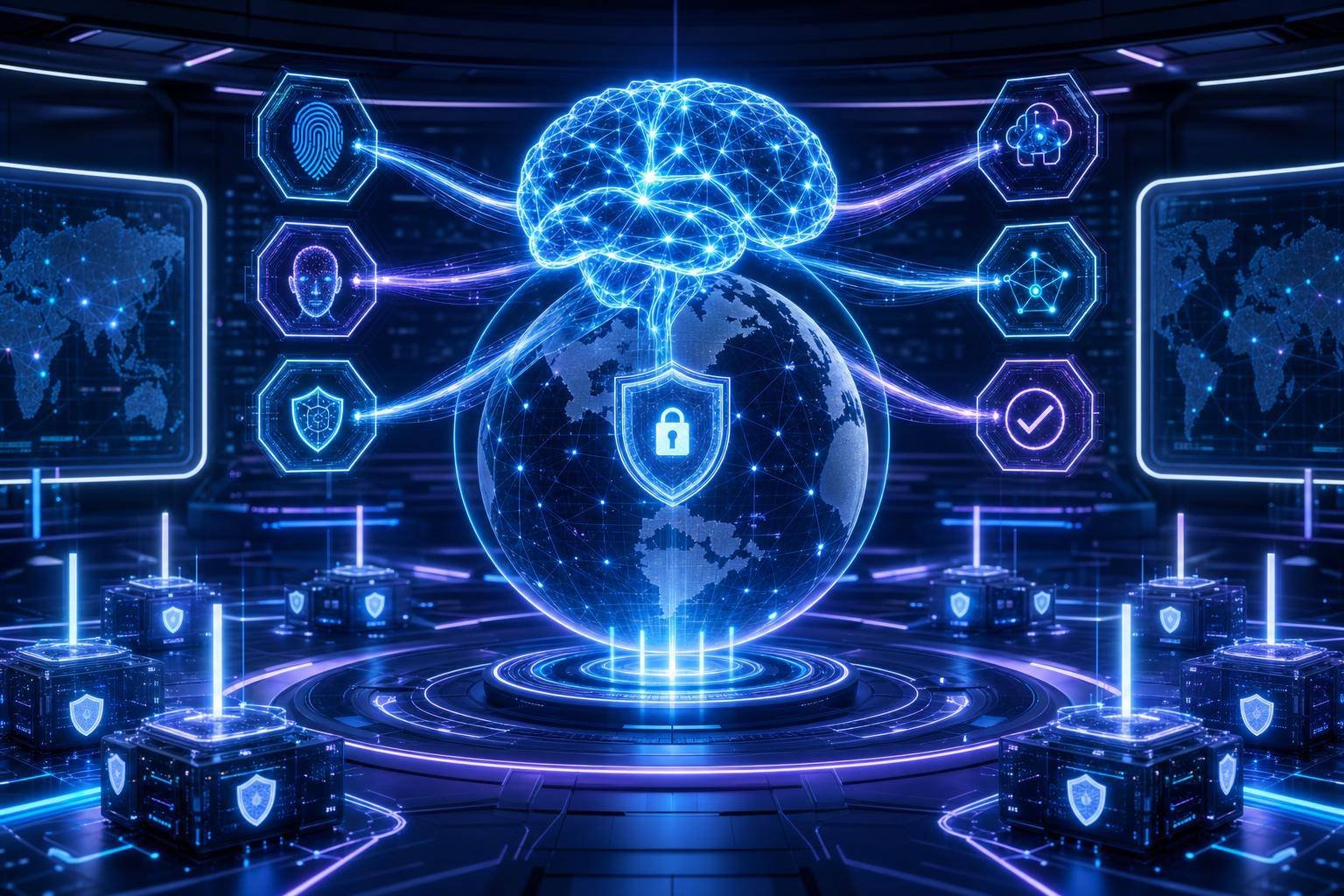
AI has moved from peripheral tool to primary actor in security operations—and in cybercrime. By 2026, the winners will be the organizations that operationalize AI safely, harden identity and trust systems, and modernize detection and response for machine-speed threats.
This forward look synthesizes what practitioners are already seeing and what’s next: the rise of AI-generated vulnerabilities, increasingly autonomous defense, hyper-personalized fraud, deepfake-driven trust erosion, identity as the control plane, and model supply-chain security. Expect practical frameworks, examples, and an action plan you can start now.
The 2026 Inflection: Why Cybersecurity and AI Predictions Matter
AI changed the tempo of cyber operations. Offensively, it lowers the barrier to entry for high-quality phishing, accelerates vulnerability discovery, and streamlines exploit development. Defensively, it is compressing mean time to detect and respond, enriching telemetry, and making sense of overwhelming signal.
Two realities define 2026: – Attackers will scale precision and speed with AI, pressuring manual and legacy controls. – Defenders who embed AI safely and deliberately—governed, observable, and constrained—will reclaim ground.
To navigate both, treat security and AI as one program. Use established security standards to govern AI systems and data, including the NIST AI Risk Management Framework. Then align operations to the predictions below.
Prediction 1: AI-Generated Vulnerabilities Will Increase—And Be Found Faster
Security researchers and adversaries are already using generative and analytical models to accelerate bug discovery. By 2026, expect: – Program analysis augmented by LLMs to triage code, generate proof-of-concept inputs, and guide fuzzers toward high-risk paths. – More practical exploit chains as models help stitch together misconfigurations, weak crypto choices, and deserialization flaws across microservices and APIs. – A larger, faster-moving vulnerability pipeline that strains patch cycles.
Why it matters – Vulnerability research becomes more efficient for everyone. That widens the gap between organizations with automated testing and secure SDLC rigor and those relying on periodic scans. – The long tail of “hard-to-reach” issues—logic bugs, authZ footguns, data leakage across tenants—becomes reachable at scale.
What to watch – Signs that your dependency graph is your biggest attack surface: third-party SDKs and AI plugins, model-serving frameworks, and data connectors. – Faster PoCs after advisories drop, shrinking safe patch windows.
Defense moves – Shift-left at scale with semantic code scanning and continuous fuzzing. Pair traditional SAST/DAST with code property graphs and dataflow analysis. GitHub’s CodeQL documentation is a practical place to start for queryable code analysis. – Prioritize memory-safe languages where possible and isolate unsafe components with strict sandboxing. Microsoft’s security team has laid out a practitioner’s case for memory safety and its impact on vulnerability classes; see the MSRC perspective in “Why Memory Safety is Important” (MSRC blog). – Shorten mean time to remediate through coordinated disclosure runbooks, pre-approved emergency change windows, and feature flags that allow rapid-disable of risky components.
Prediction 2: Autonomous Cyber Defense Agents Will Graduate From Pilot to Production
AI copilots in the SOC are evolving from summarizers to task-oriented agents. In 2026, you’ll see: – AI agents that auto-triage noisy alerts, enrich with context, and draft containment actions for analyst approval. – Over-the-shoulder remediation for common incidents: password resets, token revocations, isolating endpoints, and blocking indicators across control planes. – Measured autonomy with guardrails: explicit action whitelists, policy constraints, and full auditability.
Why it matters – The math of modern telemetry demands automation. AI boosts analyst throughput, improves consistency, and reduces fatigue-driven errors. – Coverage improves for “boring but critical” hygiene that often slips: expiring certificates, stale admin tokens, dormant but privileged service accounts.
What to watch – The difference between assistive AI (recommendations) and autonomous workflows (actions). Move deliberately from approval-based to policy-driven autonomy. – Clear mappings between observed tradecraft and your detection content. MITRE’s ATT&CK remains the lingua franca for normalizing behaviors and validating detection coverage.
Defense moves – Treat AI agents as high-privilege software robots. Apply least privilege, rotation of secrets, and step-up approvals for high-impact actions. – Instrument everything. Require event sourcing for agent decisions, model prompts and responses, and human overrides—then feed that into incident postmortems and model improvement. – Keep an incident handling backbone. AI doesn’t replace process. Anchor operations in the NIST Computer Security Incident Handling Guide (SP 800-61r2) and explicitly define where and how agents participate.
Prediction 3: Hyper-Personalized Social Engineering Will Outpace Legacy Awareness Training
By 2026, generative AI will make targeted phishing, vishing, and vendor fraud dramatically more convincing: – Messages will mirror internal tone, slang, and formatting based on public signals and leaked content. – Voice clones will turn “please rush payment” into an urgent-sounding call from a known leader. – Context-aware payloads will reference current projects, invoices, and org charts.
Why it matters – Human verification becomes harder in the moment. “Looks right to me” is no longer a control. – Business Email Compromise (BEC) tactics extend into multi-channel, multi-modal social engineering with improved hit rates.
What to watch – Abuse of collaboration platforms beyond email—chat, project tools, and ticketing systems. – Synthetic identities and supplier impersonation aligned with quarter-end, M&A, or crisis moments.
Defense moves – Institutionalize out-of-band verification for high-risk actions: vendor bank changes, gift card purchases, wire transfers, and privileges elevation. Publish the only acceptable methods company-wide. – Build a culture of pause. Reward “I slowed down and checked” behaviors as much as speed. – Tune training to 2026 realities: simulate phone- and video-based prompts, not just email; teach employees to verify intent, not just inspect logos or grammar. – Track threats systematically. ENISA’s annual Threat Landscape offers structured trends and mitigations you can bake into playbooks.
Prediction 4: Deepfakes Will Force Content Authenticity and Verified Workflows
As voice and video synthesis become nearly indistinguishable from authentic media, manual verification will falter. Expect: – Incident response friction when “proof” arrives via plausible but fake audio or video. – Procurement and finance workflows targeted by convincing executive videos requesting exceptions. – Higher legal, PR, and safety stakes in crisis moments.
Why it matters – Trust becomes a design problem. Organizations must prove authenticity, not assume it. – Teams that don’t redesign verification will experience more fraud, slower decisions, and internal confusion during incidents.
What to watch – Selective-frame and background-consistent deepfakes that pass cursory visual checks. – Misuse of older, real assets (e.g., past keynotes) edited to create “new” directives.
Defense moves – Adopt cryptographic provenance. Pilot content credentials under the C2PA standard so approved devices and apps can sign assets and consumers can verify provenance. See the C2PA specifications for implementation details. – Require dual-signature or multi-party approval for high-value instructions that arrive via media. – Maintain a “single source of truth” playbook: authoritative channels for executive directives, incident updates, and vendor communications, with fallback pathways when channels are compromised. – Train responders on synthetic media handling: how to preserve evidence, assess authenticity signals, and avoid knee-jerk reactions.
Prediction 5: Identity Is the Control Plane—With Passkeys, Continuous Auth, and Zero Trust by Default
Perimeter-only thinking is obsolete. In 2026: – Phishable factors fade in favor of passkeys and FIDO2-compatible hardware-backed authentication. – Continuous and risk-based authentication leverage device posture, network context, and behavior analytics. – Authorization becomes fine-grained and dynamic, with attribute-based policies applied per request.
Why it matters – If attackers can’t convincingly steal or replay credentials, many social-engineering campaigns lose ROI. – The blast radius of compromised accounts shrinks under least privilege and just-in-time access.
What to watch – “MFA fatigue” workarounds and push bombing replaced by prompts that are either cryptographically bound to origin or eliminated with bound passkeys. – Service account and machine identity sprawl as automation expands—often overlooked and overprivileged.
Defense moves – Align to Zero Trust principles to reduce implicit trust in networks and sessions. NIST’s SP 800-207 Zero Trust Architecture is the baseline for design decisions. – Upgrade to phishing-resistant factors: platform passkeys, hardware security keys, or device-bound biometrics; remove SMS and voice as primary factors for admins and finance. – Enforce conditional access policies tying resource access to device health, geolocation anomalies, and workload identity attestation. – Reference NIST’s Digital Identity Guidelines (SP 800-63B) for authenticator lifecycle, assurance levels, and federation best practices.
Prediction 6: Model and Data Supply Chains Become a First-Class Security Domain
AI brings new dependencies: base models, fine-tunes, embeddings, vector stores, plugins, and data pipelines. In 2026: – Prompt injection, data exfiltration via tools, and unauthorized function calls become common failure modes in production apps. – Model provenance, dataset integrity, and malicious package risks (inference-time and training-time) require software supply-chain rigor. – Red teaming shifts left into LLMOps and MLOps, not just pre-launch exercises.
Why it matters – Traditional AppSec controls aren’t enough. LLMs can be coaxed into violating business logic, leaking secrets, or executing harmful tools if guardrails are weak. – Subtle data poisoning can degrade model quality or introduce targeted backdoors.
What to watch – Third-party connectors and tools used by AI agents that can perform sensitive actions without granular permissions. – Shadow AI: unvetted models, prompts, or datasets used in critical workflows.
Defense moves – Treat LLM applications as their own threat class. The OWASP Top 10 for LLM Applications provides concrete patterns and mitigations, including prompt injection, data leakage, and insecure output handling. – Practice adversarial testing using established knowledge bases. MITRE’s ATLAS catalogs adversary behaviors against ML systems and helps structure test plans. – Build provenance into the pipeline: model cards, dataset documentation, signed artifacts, SBOMs for AI components, and versioned prompts and retrieval configurations. – Constrain tool use. Require explicit, parameterized tool contracts; validate and sanitize model outputs; enforce allowlists and rate limits for high-impact actions.
A 12-Month Action Plan to Operationalize These Predictions
You don’t need a moonshot project. Sequence pragmatic moves that compound.
1) Establish AI security governance – Define an AI risk committee spanning security, data, legal, and product. – Map your AI inventory: models (hosted and SaaS), datasets, prompts, plugins, and business processes they touch. – Adopt a baseline framework for risk and assurance (for example, the NIST AI Risk Management Framework) and tailor it to your context.
2) Harden identity and access – Mandate phishing-resistant MFA for admins, finance, and executives within 90 days; plan passkey rollout org-wide. – Implement just-in-time elevation and time-bound tokens for privileged tasks; rotate stale service account credentials. – Instrument workload and machine identities with the same rigor as human identities.
3) Upgrade verification for high-risk workflows – Codify out-of-band verification for payments, vendor bank changes, and data exports; publish escalation trees. – Pilot content authenticity (C2PA) for executive video messages and public-facing media. – Add “trust but verify” banners in collaboration tools for content from external or unverified sources.
4) Modernize detection and response with AI—safely – Start with assistive automation: alert enrichment, correlation, and priority scoring; log everything an agent does. – Move to approval-gated autonomous actions for low-risk, high-volume tasks (e.g., isolate endpoint on known malware hash). – Tie detections to ATT&CK techniques and run monthly exercises to validate end-to-end response across people, process, and AI agents.
5) Secure your AI application stack – Apply the OWASP LLM Top 10 during design reviews; add gates to CI/CD for prompt, tool, and RAG changes. – Sandbox tools and connectors used by AI agents; enforce strict scopes and input/output validation. – Create an AI red team charter; schedule pre-release and continuous red teaming for critical AI services.
6) Scale secure SDLC against AI-accelerated bugs – Add semantic code analysis and coverage-guided fuzzing to repos with high-risk languages or internet exposure. – Prioritize remediation SLAs by exploitability and business criticality; empower product teams with auto-generated patches and code review checklists. – Develop a standing emergency patch procedure with business sign-off for downtime.
7) Prepare for synthetic media incidents – Train your IR team on synthetic media playbooks: triage steps, verification techniques, legal/PR coordination, and evidence handling. – Pre-record and escrow crisis communication templates signed via your authenticity system so you can quickly counter fakes. – Monitor for brand impersonation and executive likeness abuse on public platforms.
8) Upskill your teams – Run tabletop exercises that simulate AI-augmented attacks: vendor fraud with deepfake voice, agent misconfiguration causing data exfiltration, or fast-moving vuln exploitation. – Offer role-specific training: AppSec on LLM risks, SOC on agent oversight, finance on verification, and comms/legal on synthetic media.
Tools and Techniques Worth Evaluating in 2026
- Phishing-resistant authentication: hardware security keys, enterprise passkey platforms with recovery workflows.
- Content authenticity: C2PA-compatible media capture tools and verifiers; internal dashboards to verify provenance.
- AI-aware AppSec: prompt management platforms, LLM firewall/policy layers, retrieval monitors for sensitive data exposure, and tool sandboxing frameworks.
- SOC automation: policy-constrained runbooks, AI copilots with event sourcing, and reinforcement learning from human feedback to improve triage quality.
- Secure coding: code property graph analyzers (e.g., CodeQL), fuzzers, and dependency health tooling with exploitability signals.
Mistakes to Avoid
- Treating AI as a bolt-on. Governance, identity, data, and detection must adapt in concert.
- Over-automating without guardrails. Always define scopes, approvals, and audits for AI agents.
- Assuming deepfake detectors will save you. They’re one signal, not a control. Redesign your workflows.
- Leaving machine identities unmanaged. Automation multiplies secrets; protect and rotate them.
- Ignoring LLM-specific risks during design. Traditional input validation isn’t enough; you must model agent behaviors and tool misuse.
FAQ
What are the biggest AI-driven cyber threats in 2026? – Hyper-personalized social engineering, AI-accelerated vulnerability discovery, deepfake-enabled fraud, and LLM application risks like prompt injection and tool misuse.
How should smaller organizations respond without large budgets? – Focus on identity hardening (passkeys), out-of-band verification for payments, basic SOC automation (enrichment and correlation), and vendor risk management for any AI tools in critical workflows.
Are deepfake detectors reliable enough for decisions? – They can help, but they’re not sufficiently reliable to be a sole control. Treat them as advisory and backstop decisions with cryptographic provenance and process-based verification.
What metrics should CISOs track to gauge AI defense maturity? – Time to verify high-risk requests, percentage of users on phishing-resistant MFA, coverage of AI agent actions with auditability, detection coverage mapped to ATT&CK, and mean time from advisory to patch for critical assets.
How can teams reduce the risk of AI-generated zero-days being exploited? – Increase automated testing (semantic analysis and fuzzing), prioritize memory safety and isolation, tighten external exposure of high-risk services, and maintain an emergency patch playbook with business alignment.
Which frameworks guide secure AI development and operations? – Use security fundamentals (secure SDLC, Zero Trust, incident handling) and apply AI-specific guidance such as AI risk management frameworks and LLM application best practices. Combine both in your design reviews and governance.
The Bottom Line: Turning Cybersecurity and AI Predictions for 2026 Into Advantage
2026 will reward teams that treat AI as both capability and risk surface. Expect more AI-generated vulnerabilities, aggressive social engineering, deepfake confusion, and attacks on your AI stack. Counter by hardening identity, adopting content authenticity, operationalizing safe autonomy in the SOC, and securing models and data like any other critical supply chain.
Start with what you control: phishing-resistant authentication, process redesign for verification, AI-aware AppSec, and automated detection tied to ATT&CK. Use proven frameworks—Zero Trust, incident handling, AI risk management—to keep ambition grounded in discipline. If you pace these moves over the next 12 months, you won’t just survive the shift—you’ll set the standard for resilient, AI-enabled defense.
Discover more at InnoVirtuoso.com
I would love some feedback on my writing so if you have any, please don’t hesitate to leave a comment around here or in any platforms that is convenient for you.
For more on tech and other topics, explore InnoVirtuoso.com anytime. Subscribe to my newsletter and join our growing community—we’ll create something magical together. I promise, it’ll never be boring!
Stay updated with the latest news—subscribe to our newsletter today!
Thank you all—wishing you an amazing day ahead!
Read more related Articles at InnoVirtuoso
- How to Completely Turn Off Google AI on Your Android Phone
- The Best AI Jokes of the Month: February Edition
- Introducing SpoofDPI: Bypassing Deep Packet Inspection
- Getting Started with shadps4: Your Guide to the PlayStation 4 Emulator
- Sophos Pricing in 2025: A Guide to Intercept X Endpoint Protection
- The Essential Requirements for Augmented Reality: A Comprehensive Guide
- Harvard: A Legacy of Achievements and a Path Towards the Future
- Unlocking the Secrets of Prompt Engineering: 5 Must-Read Books That Will Revolutionize You