Baidu ERNIE 5.1 vs DeepSeek‑V4‑Pro: Reported Benchmark Gains, Lower Inference Cost, and Enterprise‑Grade Security
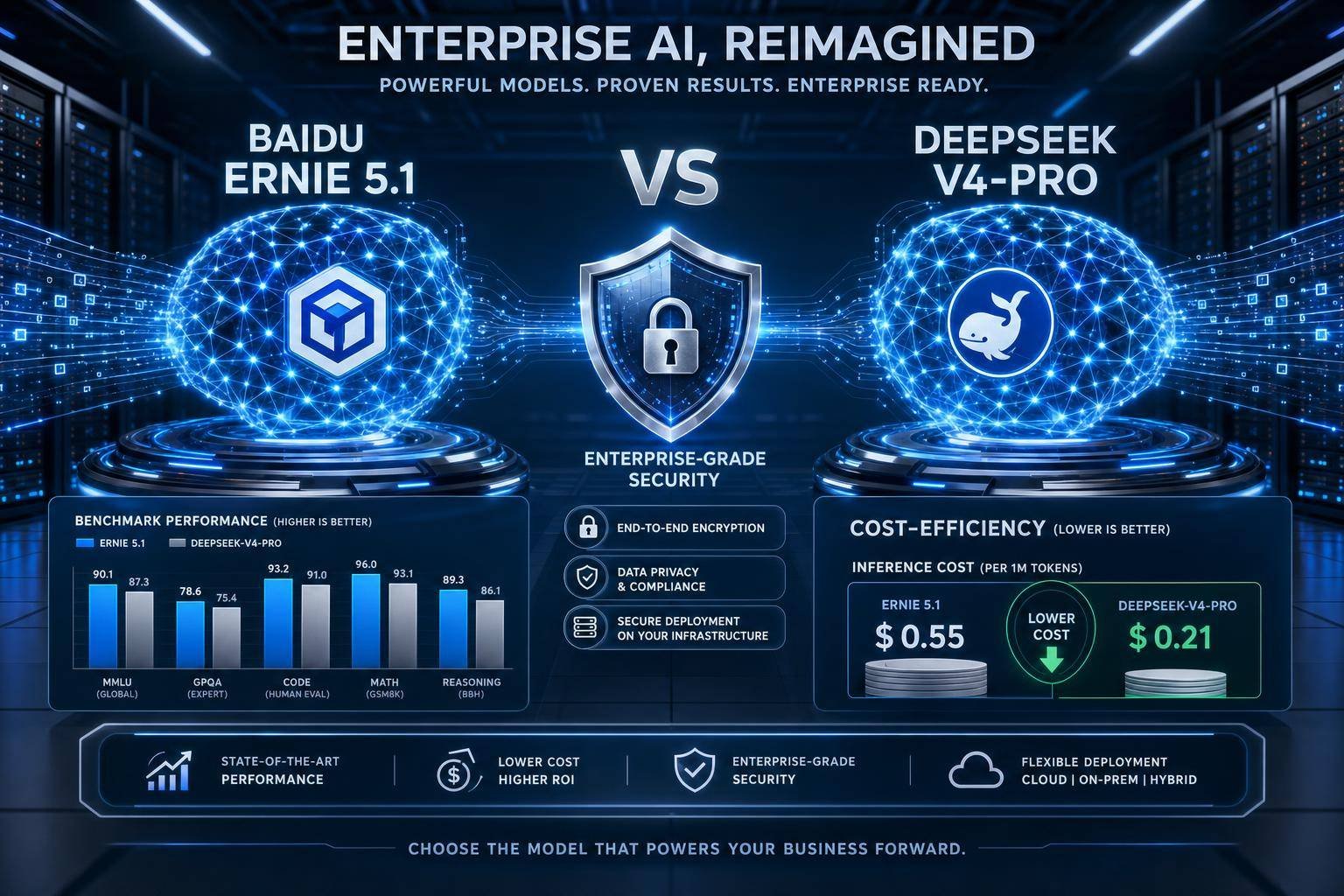
Baidu is positioning ERNIE 5.1 as a high‑performance, lower‑cost foundation model that can serve both consumer and enterprise AI workloads across Chinese and global markets. The company reports that ERNIE 5.1 surpasses DeepSeek‑V4‑Pro on several standard benchmarks while improving throughput and reducing per‑token inference cost.
Why this matters now: cost‑to‑performance is becoming the defining constraint for production AI, and security assurances are increasingly a procurement gate rather than a checkbox. If Baidu’s claims hold in real‑world conditions, ERNIE 5.1 could give teams building customer service, automation, and code assistance a compelling price/performance option—with deployment controls designed for regulated environments.
This analysis breaks down what’s new in ERNIE 5.1, how to read “outperforms at lower cost” claims without getting burned by benchmark theater, and what Baidu is offering around safety, red‑teaming, and compliance. You’ll also find practical guidance for evaluating fit, designing a secure deployment, and avoiding common mistakes that derail enterprise AI rollouts.
What ERNIE 5.1 Brings to the Table
Baidu describes ERNIE 5.1 as a general‑purpose large language model (LLM) with notable improvements in reasoning, coding, and multilingual tasks, achieved through architectural optimizations, curated pre‑training corpora, and advanced instruction tuning. It’s also framed as more hardware‑efficient than prior ERNIE releases, enabling higher throughput and lower per‑token cost.
While Baidu’s technical blog provides the topline results, the broader significance is that ERNIE 5.1 targets dual priorities that matter to CIOs and CISOs: predictable performance at scale and credible safety/compliance controls for sensitive data scenarios.
Architectural optimizations and hardware efficiency
Baidu cites “architectural optimizations” and “more efficient hardware footprint,” which generally correspond to a set of techniques widely used to drive down inference cost and latency:
- Runtime graph optimizations that fuse operations and reduce memory movement
- Quantization (e.g., 8‑bit/4‑bit) to compress weights and improve cache residency, often with minimal quality loss when done carefully
- Speculative decoding and efficient sampling to reduce end‑to‑end token generation time
- KV‑cache management strategies for long contexts and batched workloads
- Mixed precision and kernel autotuning to match GPU hardware characteristics
These are the kinds of improvements adopted in modern inference stacks such as NVIDIA TensorRT‑LLM, where careful kernel fusion, quantization, and batching deliver step‑function gains in throughput and cost. While Baidu doesn’t list which specific optimizations it uses, the reported results—higher throughput and lower per‑token cost—are consistent with systems‑level advances of this type.
Instruction tuning, coding, and multilingual coverage
ERNIE 5.1 reportedly posts gains on coding tasks, general knowledge benchmarks, and Chinese‑language exams while remaining competitive on English tasks. That pattern aligns with robust instruction tuning on multilingual corpora and curated code data, plus targeted reinforcement learning that tightens up reasoning behavior and output format control.
For context, academic and community benchmarks like MMLU (Massive Multitask Language Understanding) cover broad knowledge domains but are sensitive to training data exposure, prompting, and evaluation harness quality. Strong multilingual performance often reflects more than raw parameter count; it’s the interplay of data quality, tokenization choices, and post‑training alignment.
Interpreting the “Outperforms at Lower Cost” Claim
Claims of benchmark wins should be treated as directional rather than definitive without third‑party replication. Differences in prompt format, decoding parameters, and evaluation harnesses can swing results meaningfully. The key is not whether ERNIE 5.1 tops a leaderboard in isolation, but whether it delivers better end‑to‑end utility on your tasks at a price you’re willing to pay.
Two framing questions help cut through noise:
1) Are the benchmark deltas large enough to matter in application context? A few percentage points on MMLU might not change outcomes for complex workflows with retrieval augmentation and tool use.
2) Do the cost claims hold under your traffic shape? Throughput and latency under batchy, bursty, or long‑context loads often look different from marketing runs.
A disciplined approach is to combine common benchmarks with application‑specific evaluations and user studies. Projects like Stanford CRFM’s HELM emphasize holistic evaluation—quality, robustness, efficiency, and safety—rather than single‑number leadership. Treat vendor claims as a starting point, then test under your constraints.
Cost and performance metrics that actually matter
When you design your evaluation harness, measure beyond “cents per 1K tokens.” Useful comparative metrics include:
- End‑to‑end latency at P50/P95/P99 for representative prompts and contexts
- Throughput (tokens/sec/GPU) and stability under concurrent load
- Cost per successful task completion (not per token), including retries and guardrail overhead
- Hallucination rate and severity by scenario (e.g., factual QA vs. coding)
- Refusal consistency for disallowed prompts and jailbreak attempts
- Degradation under long contexts and multi‑step tool use or retrieval flows
- Variability across languages and domains relevant to your users
If your workloads are spiky, also measure cold‑start behavior. If they’re steady‑state, focus on sustained concurrency and GPU utilization. If most tasks are short prompts, you’ll care more about decoder latency than context window performance. Right‑size your test harness to your reality.
Security, Safety, and Compliance Positioning in ERNIE 5.1
Baidu emphasizes security and trust as differentiators for enterprise adoption: an enhanced safety pipeline aligned with Chinese regulatory requirements, granular controls to configure model behavior for internal policies, and deployment options that keep sensitive data inside a trusted boundary.
This moves the conversation from “can the model answer questions” to “can we deploy it at scale without violating policy or creating new attack surface.” Framed this way, ERNIE 5.1’s pitch maps to requirements increasingly formalized by regulators and standards bodies. For example, the NIST AI Risk Management Framework encourages organizations to identify and manage AI risks across design, development, deployment, and operation. Positioning safety controls as configurable policy, not just hardcoded behavior, aligns well with that guidance.
On the engineering side, Baidu highlights:
- Policy‑driven content filtering and refusal behavior
- Controls to disable training on customer prompts/outputs
- API, virtual private cloud (VPC), and on‑prem deployment options
- Built‑in monitoring that can detect and rate‑limit suspicious usage
For CISOs, that menu makes ERNIE 5.1 easier to map onto existing governance processes and data classification schemes. It also supports a “defense in depth” posture that has become table stakes for AI platforms. The CISA Secure by Design guidance, for instance, underscores the expectation that vendors ship with robust defaults and that customers can enforce least‑privilege and strong telemetry.
Guardrails, red‑teaming, and abuse resistance
Baidu reports extensive red‑teaming for cybersecurity misuse, from phishing to malware generation to bypassing network defenses. It claims the model is tuned to refuse direct requests for cyberattack assistance and that back‑end monitoring can detect and rate‑limit suspicious patterns.
Those measures are necessary but not sufficient. LLMs face evolving attack categories—prompt injection, data exfiltration via tools, indirect jailbreaks through retrieved content—that require continuous testing and layered mitigations. The OWASP Top 10 for LLM Applications is a practical reference for teams building on any foundation model. It calls out threats such as model denial of service, insecure output handling, and supply‑chain vulnerabilities in model plugins.
Translating that into an ERNIE 5.1 deployment means:
- Put pre‑filters and post‑filters around the model, not just inside it
- Sanitize user inputs and retrieved content to resist injection
- Enforce output handling rules (e.g., do not execute tool calls blindly)
- Build rate‑limiting and anomaly detection at the API gateway level
- Document refusal policies and handle appeals/overrides via human review
Baidu’s refusal training and back‑end monitoring are positives. Your job is to integrate them into an end‑to‑end control plane that accounts for your data, your users, and your threat model.
Practical Enterprise Use Cases and Integration Patterns
Based on Baidu’s positioning and typical enterprise demand, ERNIE 5.1 is likely to see early adoption in:
- Customer service: multilingual support triage, summarization, and agent assist
- Office automation: drafting, compliance‑checked communications, meeting notes
- Developer productivity: code explanation, small refactors, test generation
- Knowledge work: retrieval‑augmented Q&A over internal documents
To translate those into production wins, pair the foundation model with the right systems patterns:
- Retrieval‑augmented generation (RAG) to anchor outputs in trusted sources and reduce hallucinations. If your team is new to RAG, Microsoft’s architectural overview of retrieval‑augmented generation patterns provides a useful mental model for vector stores, chunking, and grounding.
- Role and policy prompts that define tone, legal constraints, and escalation rules
- Tool use for deterministic actions (e.g., ticket creation, database lookups), with strict validation and audit logging
- Caching and prompt templates to control cost and improve consistency
- Human‑in‑the‑loop review for outputs with regulatory, legal, or safety impact
ERNIE 5.1’s on‑prem and VPC options are particularly relevant for finance, healthcare, and public sector teams with strict data localization or retention rules. If you must keep prompts and outputs inside your regulated boundary and prohibit vendor training on your data, those deployment modes are non‑negotiable.
Cybersecurity Considerations and Best Practices for Deploying ERNIE 5.1
Treat every LLM deployment as a software supply chain with dynamic behavior. Build controls at each layer:
1) Threat modeling and policy definition – Identify sensitive functions (e.g., code generation, network queries) and who can invoke them – Define refusal policies for security‑sensitive topics; document escalation paths – Map data classification to model access (e.g., PII never leaves VPC/on‑prem)
2) Data protection and privacy – Tokenize or redact sensitive fields before prompts when feasible – Use instance‑level encryption, isolated secrets management, and short‑lived credentials – Disable vendor training on your data if policy requires; log and verify setting effectiveness
3) Prompt and tool safety – Sanitize inputs and retrieved content against prompt injection – Strictly validate tool outputs and enforce allowlists for actions – Avoid free‑form code execution; use sandboxes and resource quotas
4) Evaluation and red‑teaming – Build an evaluation harness that includes jailbreak and injection tests – Track refusal consistency and false positives/negatives for security prompts – Maintain a corpus of known‑bad prompts to regression‑test new model versions
5) Observability and incident response – Capture structured logs for prompts, responses, tool calls, and policy decisions – Monitor for anomalies (sudden token spikes, repeated refusals, signature attack prompts) – Practice playbooks for output‑based incidents (e.g., incorrect legal advice sent to a customer)
6) Governance and external alignment – Align internal controls with recognized frameworks like the ENISA AI Threat Landscape and the Google Secure AI Framework (SAIF) to strengthen audits and board reporting
ERNIE 5.1’s built‑in monitoring and rate‑limiting are a foundation, not a ceiling. Use them, then add your own controls at gateways, service meshes, and application layers.
Comparing ERNIE 5.1 with DeepSeek and Qwen: Strategic Fit
The Chinese LLM market is evolving rapidly, with Baidu (ERNIE), DeepSeek, and Alibaba (Qwen) vying for enterprise mindshare. If you’re comparing ERNIE 5.1 to DeepSeek‑V4‑Pro and Alibaba’s Qwen series, prioritize the following dimensions:
- Fitness for your tasks: coding style alignment, retrieval behavior, multilingual nuance
- Total cost of ownership: unit pricing, caching effectiveness, context window efficiency
- Deployment options: API regions, VPC/on‑prem support, data residency, SLAs
- Security and compliance: refusal controls, auditability, monitoring, policy enforcement
- Ecosystem: SDKs, tool integrations, documentation in your team’s working languages
- Support and roadmap: upgrade cadence, enterprise support responsiveness
For the Qwen family, Alibaba provides strong open‑source models and documentation through its official channels (e.g., Qwen on GitHub). If you prefer a hybrid stack—vendor APIs for some workloads and open‑weights models for others—evaluate how ERNIE 5.1 fits alongside your chosen open models and whether your orchestration layer can route requests based on task, cost, and sensitivity.
Bottom line: don’t chase a single leaderboard. Build a multi‑model strategy with traffic steering, cost controls, and shared guardrails, then give each model a fair shot under your constraints.
Implementation Playbook: From Pilot to Production in 60–90 Days
A structured rollout will tell you quickly whether ERNIE 5.1’s reported performance and cost advantages translate into business value in your environment.
Phase 1: Scoping (Week 1–2) – Choose one or two high‑leverage use cases (e.g., agent assist, internal knowledge QA) – Define “quality” in measurable terms (accuracy, latency, refusal precision) – Establish security boundaries (data classes allowed, deployment mode, logging)
Phase 2: Build the evaluation harness (Week 2–3) – Curate a representative prompt set and gold answers; include multilingual examples if relevant – Add adversarial prompts (injection, jailbreak attempts) and define pass/fail criteria – Instrument cost, latency, and refusal telemetry
Phase 3: Technical pilot (Week 3–6) – Integrate ERNIE 5.1 via API, VPC, or on‑prem, depending on data sensitivity – Implement RAG where grounding is needed; tune chunking, retrieval, and prompts – Add input/output filters, tool validators, and structured logging – Run A/B tests against your incumbent model(s) for quality and cost
Phase 4: Red‑team and compliance review (Week 5–7) – Conduct security testing aligned to OWASP LLM risks; verify rate‑limiting and monitoring – Validate “no training on customer data” settings if required by policy – Document DPIAs/PIAs and records of processing, if applicable
Phase 5: Limited production and feedback loops (Week 7–9) – Roll out to a small cohort with human review – Track KPIs: resolution time, escalation rate, CSAT, cost per resolved case – Iterate on prompts, retrieval, and filters; tune caching and batching for cost
Phase 6: Scale (Week 9+) – Expand user base; enforce SLOs and error budgets – Add budget guards (max tokens per request, daily spend caps) – Plan for model versioning, regression testing, and rollback protocols
Throughout, maintain an evaluation diary—prompt variants, failures, mitigations—so handoffs between platform, security, and product teams stay crisp.
Mistakes to Avoid
- Benchmark myopia: choosing a model on a single metric and then discovering it underperforms on your actual mix of tasks
- Unbounded prompts: letting context windows bloat cost without measurable quality gains
- Over‑reliance on system prompts: trying to encode policy in natural language rather than enforce it with code and gates
- Thin logging: discovering post‑incident that you lack prompt/response/tool telemetry to reconstruct events
- “Set and forget” safety: not re‑testing refusals and jailbreak resilience after each model update
- Ignoring localization: deploying a multilingual model without region‑appropriate terminology, styles, and regulatory nuance
Frequently Asked Questions
Q: Does ERNIE 5.1 really outperform DeepSeek‑V4‑Pro? A: Baidu reports wins on several benchmarks, along with lower inference cost. Treat those as directional until you validate on your workloads. Build a side‑by‑side evaluation with your prompts, languages, and latency constraints.
Q: Is ERNIE 5.1 suitable for English‑language applications? A: Baidu positions it as competitive on English tasks with strong performance in Chinese. Many teams will find it viable for English, but results will vary by domain and style. Run an A/B with your content and tone requirements.
Q: Can we prevent ERNIE 5.1 from learning from our data? A: Baidu offers options to disable training on customer prompts and outputs, especially in VPC/on‑prem deployments. Confirm the setting contractually, test with canary prompts, and audit logs to ensure no unexpected data egress.
Q: How do we reduce hallucinations in production? A: Use retrieval‑augmented generation to ground responses, constrain output formats, validate tool results, and add human review for high‑risk tasks. Measure hallucination rate and severity; adjust prompts, retrieval quality, and filters iteratively.
Q: What security controls should we enable first? A: Start with rate‑limiting and anomaly detection at the API gateway, input/output filtering, strict tool validation, and comprehensive logging. Align your controls to frameworks such as NIST AI RMF, OWASP LLM Top 10, and CISA Secure by Design.
Q: What if our workload requires strict data residency? A: Favor VPC or on‑prem deployments and keep vector stores and prompts inside your boundary. Disable vendor training on your data, encrypt at rest and in transit, and ensure region‑locked infrastructure and support SLAs.
Should You Bet on ERNIE 5.1 Now?
ERNIE 5.1 aims squarely at the two questions that determine enterprise AI adoption: can it match or beat the best models on real tasks, and can you deploy it securely under regulatory and budget constraints? Baidu’s narrative—reported benchmark gains over DeepSeek‑V4‑Pro, lower inference costs, configurable safety, and private deployment options—ticks the right boxes for a serious evaluation.
The prudent path is clear. If your portfolio includes customer support, office automation, or code assistance—especially with Chinese‑language requirements—put ERNIE 5.1 into a time‑boxed pilot. Compare it against your incumbents under a shared harness that measures quality, latency, refusal behavior, and cost per successful task. Integrate defense‑in‑depth controls informed by NIST AI RMF and the OWASP Top 10 for LLM Applications. If ERNIE 5.1 delivers the promised cost/performance while meeting your security and compliance bar, you’ll have a compelling new option for scaled deployment.
To get started, review Baidu’s official materials for ERNIE 5.1 and plan a 60‑ to 90‑day pilot with clear success criteria, robust guardrails, and strong observability. The teams that operationalize these disciplines—rather than chasing single‑number leaderboard wins—will turn ERNIE 5.1’s reported advantages into durable business results.
Discover more at InnoVirtuoso.com
I would love some feedback on my writing so if you have any, please don’t hesitate to leave a comment around here or in any platforms that is convenient for you.
For more on tech and other topics, explore InnoVirtuoso.com anytime. Subscribe to my newsletter and join our growing community—we’ll create something magical together. I promise, it’ll never be boring!
Stay updated with the latest news—subscribe to our newsletter today!
Thank you all—wishing you an amazing day ahead!
Read more related Articles at InnoVirtuoso
- How to Completely Turn Off Google AI on Your Android Phone
- The Best AI Jokes of the Month: February Edition
- Introducing SpoofDPI: Bypassing Deep Packet Inspection
- Getting Started with shadps4: Your Guide to the PlayStation 4 Emulator
- Sophos Pricing in 2025: A Guide to Intercept X Endpoint Protection
- The Essential Requirements for Augmented Reality: A Comprehensive Guide
- Harvard: A Legacy of Achievements and a Path Towards the Future
- Unlocking the Secrets of Prompt Engineering: 5 Must-Read Books That Will Revolutionize You