
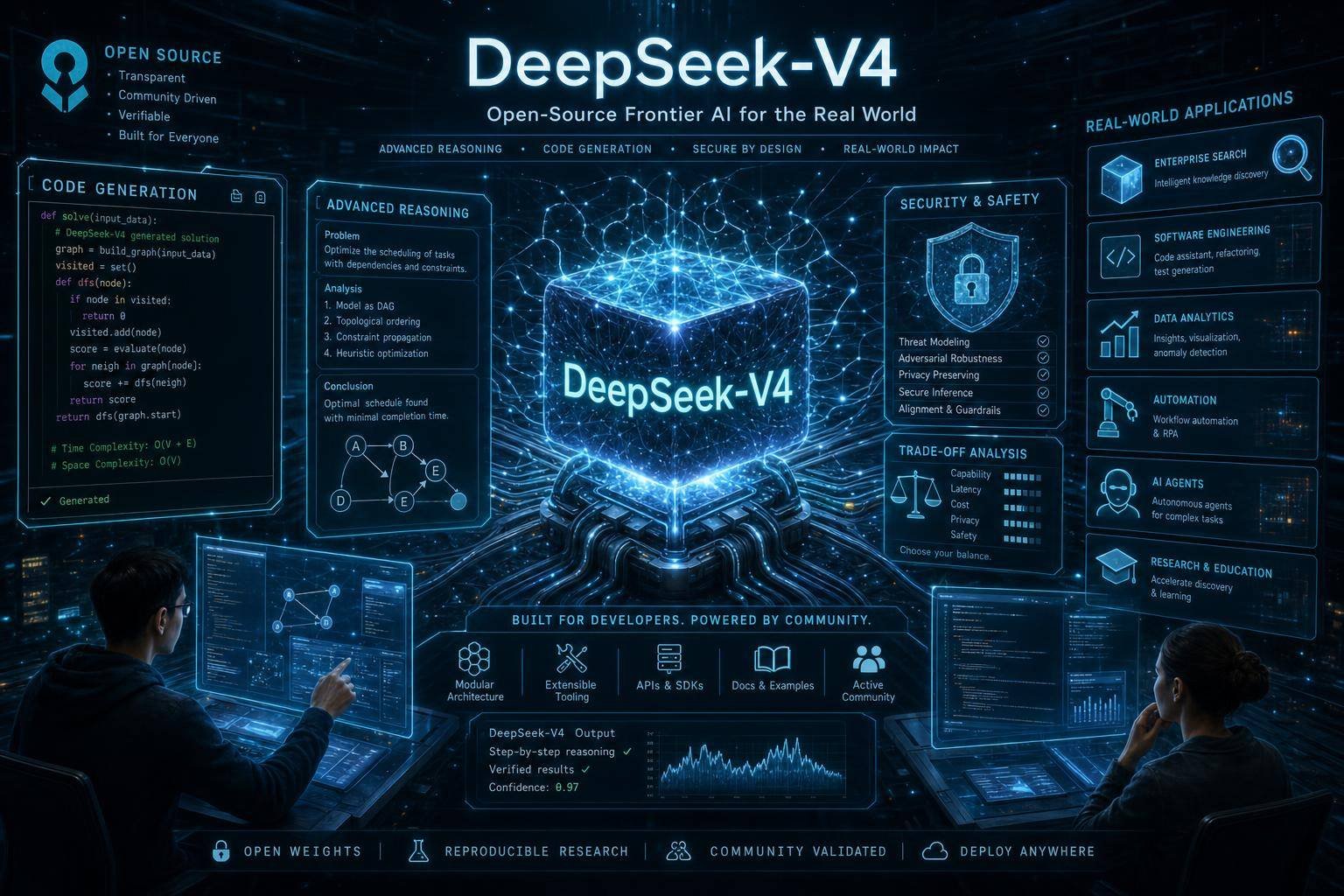
DeepSeek‑V4: Open Frontier AI for Advanced Reasoning and Coding—Capabilities, Security Trade‑offs, and Real‑World Use Cases
DeepSeek has released DeepSeek‑V4, an open frontier‑class model positioned for advanced reasoning, complex coding, and multilingual understanding. It ships as downloadable weights and via a hosted API under a permissive license that allows commercial use and fine‑tuning—while urging adopters to apply responsible‑use safeguards. For engineering, research, and security teams evaluating powerful open models as alternatives to closed systems, this is a pivotal moment.
Why it matters now: long‑context capabilities, credible benchmark performance, and open weights shift control toward builders. Organizations get stronger autonomy over cost, latency, and data governance—along with bigger responsibility for safety, compliance, and operational rigor. This piece unpacks what DeepSeek‑V4 offers, where it fits against proprietary frontier models, and how to deploy it securely for real business value.
What DeepSeek‑V4 is—and where it aims to compete
DeepSeek‑V4 is described as a next‑generation model optimized for:
- Advanced reasoning (multi‑step logic, planning, and tool use)
- Complex coding (reading, refactoring, and generating larger codebases)
- Multilingual understanding and translation
- Long‑context inputs spanning large repositories, research corpora, or multi‑document legal files
DeepSeek provides both open weights and a managed API, acknowledging different operational realities: some teams need a hardened, hosted endpoint; others prefer private, on‑prem or VPC deployments for sovereignty, predictable cost, or sensitive data handling. The company emphasizes robust benchmark results across reasoning, MMLU, coding, and translation, with particular strength in extended‑context reasoning. See the official release for capabilities, licensing, and safety guidance: DeepSeek‑V4 release announcement.
Unlike closed models that enforce fixed safety policies, open‑weights releases put deeper control in the hands of adopters. That’s a double‑edged sword: you can tailor the model to your workflow and risk posture, but you also assume responsibility for guardrails, monitoring, and ongoing evaluation.
Under the hood (conceptually): what to expect from an open frontier‑class model
While the training recipe for DeepSeek‑V4 isn’t fully public, its stated strengths imply several design goals typical of frontier‑class LLMs:
- Pretraining breadth and depth. Strong performance on exams (e.g., MMLU), code tasks, and multilingual translation typically signals very large, diverse corpora, careful tokenization, and curriculum strategies that preserve multilingual signals and code structures.
- Long‑context handling. Extended input windows let the model ingest entire repositories, lengthy legal briefs, or multi‑paper literature reviews without aggressive chunking. Expect useful behaviors like: following cross‑file references, maintaining variable and state consistency across long ranges, and tracking argument structure in complex briefs.
- Instruction following and tool use. Finely tuned refusal behavior, improved chain‑of‑thought controls, and stable function‑calling schemas often accompany advanced reasoning claims. Tool use can unlock accurate retrieval, precise structured outputs, and safer code changes—if you wrap it with policy and permissions.
- Multilingual coding and reasoning. Cross‑lingual alignment plus robust code tokens can yield strong performance in languages beyond English and across frameworks, CLIs, and APIs—useful for global teams and diverse codebases.
Even with a capable base model, practical performance comes down to how you orchestrate prompts, tools, retrieval, and guardrails. Open‑weights access lets you experiment with prompt templates, adapters, filters, and fine‑tunes that closed APIs may not allow.
Open vs. closed frontier models: the real trade‑offs
Open frontier models like DeepSeek‑V4 promise:
- Control: self‑host, pin versions, and tune behavior without vendor throttles.
- Cost and latency: optimize inference stacks, GPUs, batch sizes, and KV caching.
- Data governance: keep sensitive data in controlled environments; avoid external logging.
- Transparency and research: inspect weights, experiment with safety, and benchmark freely.
But you take on:
- Security and safety burden: build and maintain your own filters, abuse monitoring, and red‑team programs.
- Operational complexity: MLOps for models, prompt libraries, data pipelines, retrievers, and evaluation harnesses.
- Compliance diligence: DPIAs, model documentation, and audit‑ready controls for regulated use cases.
- Support trade‑offs: no turnkey SLA for safety; you own updates, mitigations, and regression tracking.
Organizations with mature engineering and security functions often welcome these trade‑offs. Others may prefer a hosted API until they can staff and standardize secure AI operations.
Security, safety, and compliance implications of DeepSeek‑V4
DeepSeek acknowledges dual‑use concerns in releasing a strong open model with refusal behaviors for cybercrime‑enabling prompts. Yet open weights inherently give end‑users more control. That control can be misused or can be harnessed responsibly—depending on your deployment discipline.
A practical framing is to align your governance and controls to recognized guidance such as the NIST AI Risk Management Framework. NIST’s focus on mapping, measuring, managing, and governing AI risks dovetails with what open‑weights adopters must do: define intended use, set risk thresholds, engineer safeguards, and continuously evaluate.
Common LLM‑specific risks and failure modes
- Prompt injection and instruction hijacking: user‑ or document‑borne instructions override your system policy.
- Jailbreaks and safety filter evasion: adversarial phrasing elicits disallowed outputs.
- Data leakage and exfiltration: the model reveals secrets from prompts, tools, or retrieved context.
- Model overreach in automation: agents take unintended actions due to ambiguous tool permissions.
- Training/inference supply chain risks: tampered weights, poisoned adapters, or compromised plugins.
- Evaluation gaps: models appear safe in thin tests but fail under realistic adversarial probes.
For practical coverage of application‑level risks and mitigations, refer to the OWASP Top 10 for LLM Applications. It offers a shared vocabulary to align engineering, product, and security teams on what to test and how to harden.
Adversary models and TTPs
To go deeper on attack surfaces and tactics, MITRE’s adversarial ML knowledge base can help structure your red‑teaming and detection engineering. See MITRE ATLAS for threat scenarios, techniques, and mitigations relevant to AI systems, including model manipulation and abuse of tool integrations.
A secure‑by‑design playbook for deploying DeepSeek‑V4
Below is a step‑by‑step approach blending ML engineering best practices with security controls appropriate for open frontier‑class models.
1) Decide your hosting strategy
- Hosted API (DeepSeek‑managed)
- Pros: reduced ops/safety overhead, quicker pilots, elastic scaling.
- Cons: less control over model internals, networked data path, vendor rate limits, and policy constraints.
- Self‑hosted (on‑prem or private cloud)
- Pros: full control of versions and policies, data stays local, potential cost optimization at scale.
- Cons: you own uptime, performance tuning, patching, and safety guardrails.
Hybrid patterns are common: start with API for rapid validation; migrate high‑value or sensitive workloads to self‑hosting once your MLOps and security posture mature.
2) Secure your AI supply chain
- Verify sources: download weights and adapters from official, signed locations; record checksums and versions.
- Lock dependencies: pin container images, CUDA/toolchains, inference servers, and libraries.
- Maintain an SBOM for the AI stack: models, adapters, tokenizers, embeddings, plugins, and guardrails components.
- Enforce code review and scanning for all orchestration logic (agents, tools, routers).
- Apply principle of least privilege across storage buckets, model registries, and CI/CD runners.
- Align your internal standards to secure‑by‑design fundamentals, as promoted by CISA’s Secure by Design.
3) Layered guardrails and content controls
No single filter suffices. Combine multiple controls, each with a narrow scope and clear fail‑closed behavior:
- System prompts with explicit policy. State what the model must and must not do. Reinforce policy at the tool layer (e.g., “never execute without a dry‑run”).
- Domain‑specific classifiers. Pre‑ and post‑model classifiers to flag malware requests, PII handling, or policy‑violating content.
- Pattern filters and DLP. Detect and redact keys, secrets, and regulated data types before model exposure.
- Safety‑tuned adapters. Fine‑tune or apply LoRA adapters that bias refusals or calibrate outputs for your domain.
- Function and tool whitelists. Permit only specific, audited actions. Add explicit consent gates for sensitive operations.
- Structured output schemas. Use function calling and JSON schemas to constrain outputs; reject or re‑ask on schema violations.
- Guardrails frameworks. Evaluate specialized packages for conversational policies, topic blocking, and tool permissions. For example, see NVIDIA NeMo Guardrails documentation for policy‑driven runtime orchestration.
4) Prompt injection and context isolation
- Isolate untrusted context. Treat retrieved documents, user uploads, and web pages as adversarial. Use separator tokens and clear instruction hierarchies that deprioritize user content over system policy.
- Don’t let data write instructions. Sanitize HTML/Markdown; strip or neutralize meta‑instructions embedded in files.
- Approve tools, not prompts. Bind prompts to audited tool functions with strict input validation and output sanitization.
- Contain effects. Use sandboxes and ephemeral credentials for any code execution or external actions.
- Study vendor and community guidance on injection patterns and defenses. Microsoft’s overview on prompt injection threats and mitigations is a practical primer: Microsoft learn: prompt injection.
5) Data governance and privacy
- Default to no retention. Don’t store prompts or outputs unless you need them for debugging or evaluation; then minimize and protect.
- Redaction at ingress. Strip PII/secrets before they hit the model; re‑attach downstream if necessary under strict controls.
- Encryption in transit and at rest. Protect model artifacts, logs, and eval datasets.
- Segmentation and RBAC. Isolate environments and restrict who can call which models with what tools.
- Human‑in‑the‑loop for sensitive decisions. Require approvals for actions that touch production systems, finance, or legal.
6) Evaluation, red teaming, and regression testing
- Build eval suites that reflect your tasks: coding fixes, repository‑wide refactors, translation fidelity, legal reasoning with citations, or SOC triage summaries.
- Include safety and misuse tests: attempts to elicit disallowed instructions, code that embeds exploits, or data exfiltration hints.
- Stress‑test long‑context behavior: cross‑file consistency, reference tracking, and resistance to context poisoning.
- Track quality, safety, and latency regressions on model or prompt changes; treat prompts as code.
- For practical safety testing approaches, see OpenAI’s safety best practices and adapt to your stack.
7) Monitoring, abuse detection, and incident response
- Telemetry: log requests and responses with privacy‑preserving sampling and hashing; track tokens, response types, and guardrail trigger rates.
- Anomaly detection: watch for spikes in disallowed topics, unusual tool calls, or outbound data volumes.
- Abuse controls: per‑user and per‑app rate limits; risk‑adaptive throttling on suspicious sessions.
- Incident process: playbooks for model rollbacks, adapter removal, key rotation, and prompt hotfixes.
8) Documentation, transparency, and governance
- Purpose and limitations: document intended uses, known failure cases, and unsafe domains.
- Model card: record provenance, versions, context limits, and safety procedures. For structure and rationale, see the research on Model Cards for Model Reporting.
- Policy alignment: map controls to internal standards and external frameworks (e.g., NIST AI RMF; ISO 27001 for info security; SOC 2 if relevant).
- RACI: make it clear who approves adapters, who ships prompts, who triages incidents, and who signs off on eval results.
DeepSeek‑V4 for engineering, research, and security: concrete use cases
DeepSeek‑V4’s long‑context and coding strengths enable a range of high‑leverage workflows. Here are patterns that balance ambition with control.
Software engineering at repository scale
- Large‑scale code comprehension. Ask questions across an entire repository without brittle chunking, maintain awareness of cross‑file dependencies, and surface refactor targets.
- Guided refactors. Combine DeepSeek‑V4 with a tool that proposes diffs, then route diffs through CI, unit tests, SAST, and human review. Never push changes directly from model output.
- Secure code reviews. Use DeepSeek‑V4 to scrutinize untrusted PRs for dependency confusion, insecure deserialization, or injection patterns; hand results to reviewers as augmentations—not auton merges.
- Test generation. Seed unit tests and property‑based tests, but gate merges on deterministic runners and coverage thresholds.
- Integrate code scanning. Pair model‑assisted fixes with static analysis (e.g., GitHub CodeQL documentation) and secret scanners to prevent regressions.
Risk tips: – Treat generated code as untrusted until it passes CI and reviewer checks. – Keep a hard line between read‑only analysis and write privileges. Use isolated service accounts and ephemeral credentials for any automation.
Security operations and threat analysis
- Triage assistant. Summarize alerts and logs, propose likely root causes, and translate detection rules between syntaxes—then require analyst confirmation.
- Playbook drafting. Generate incident response steps for known classes of issues; store them as templates to improve over time.
- Threat intel synthesis. Ingest multi‑source reports to produce concise analyst notes and hypotheses, with citations to raw intel.
Risk tips: – Prevent data exfiltration via tool calls. Never allow the model to fetch external URLs in SOC contexts unless routed through a controlled retriever with allowlists and caching. – Waterfall approvals for containment actions; do not let the model quarantine hosts or revoke credentials without human confirmation.
Research and legal analysis
- Literature reviews with source management. Provide full texts as context, ask for structured summaries, and enforce citation schemas. You can pair this with a retriever to maintain up‑to‑date evidence.
- Multi‑document legal comparisons. Request redline‑style summaries of differences across versions or across jurisdictions; require the model to quote source text passages for verification.
Risk tips: – For high‑stakes interpretations, use dual‑model verification (two different models reviewing each other’s outputs) and sample human spot‑checks.
Global support and multilingual collaboration
- Ticket translation and enrichment. Translate bug reports, user feedback, and runbooks while preserving code blocks and log artifacts.
- Code comments and docs localization. Use structured prompts that protect code tokens and require consistent glossary usage across languages.
Enterprise automation with tool use
- Data pipeline orchestration. Let the model draft SQL or data transforms, but run only in sandboxed environments with labeled datasets and quotas.
- Controlled agents for back‑office tasks. Permit read‑only queries into CRMs or ERPs; block write operations or require explicit human approval gates.
Risk tips: – Nail down instruction hierarchy: system policy > tool policy > user instructions. Enforce runtime checks when escalations are requested.
Measuring ROI and engineering performance
To defend an open‑model investment, measure what matters across quality, safety, and economics.
Quality and productivity – Task‑level accuracy: human‑rated or rubric‑based scoring on your canonical tasks (bug fixes, doc synthesis, detection rule translations). – Coding metrics: pass@k on your private challenge sets, diff acceptance rates, defect rates post‑merge. – Long‑context outcomes: success at cross‑repo reasoning, correct references across distant files. – Human time saved: minutes shaved off triage, review, and documentation flows.
Safety and reliability – Guardrail trigger rates and true‑positive/false‑positive balance. – Jailbreak resistance and prompt injection resilience in red‑team drills. – Leakage prevention: rate of detected and blocked secrets/PII exposures. – Incident MTTR for model rollbacks or prompt fixes.
Performance and cost – End‑to‑end latency: P50/P95/P99, especially for long contexts and multi‑tool flows. – Throughput and GPU utilization if self‑hosting; queueing under load. – Cost per successful task vs. baselines (manual or closed‑model pipelines).
Operational maturity – Evaluation coverage: % of high‑risk flows with automated tests and regression suites. – Documentation completeness: model cards, adapter/version lineage, and changelogs. – Governance adherence: approval SLAs for prompt/model changes, incident drills completed.
How DeepSeek‑V4 reshapes the open frontier conversation
The DeepSeek‑V4 release will intensify debate on openness versus control in frontier AI. Advocates see advantages for democratized access, independent safety research, and reduced dependence on a few vendors. Skeptics worry about dual‑use risks and the diffusion of near‑state‑of‑the‑art capabilities into threat actor toolkits.
Both views can be true. The path forward looks less like “open vs. closed” and more like “open when governed.” Open‑weights models can be part of a safer ecosystem if adopters apply robust controls, and if model publishers invest in transparency, tooling, and community standards. Expect increasing emphasis on model documentation, red‑team reporting, and responsible‑use guidance embedded in releases—aligned with frameworks like NIST AI RMF and with practical secure‑by‑design engineering.
Frequently asked questions
Q1: What is DeepSeek‑V4? A: DeepSeek‑V4 is an open frontier‑class AI model focused on advanced reasoning, complex coding, multilingual understanding, and long‑context processing. It’s available as downloadable weights and via a hosted API, with a permissive license that allows commercial use and fine‑tuning subject to safety requirements.
Q2: How does DeepSeek‑V4 compare to proprietary models like OpenAI’s or Anthropic’s? A: The company positions V4 as competitive on reasoning, coding, and multilingual tasks, with strong long‑context behavior. The practical trade‑offs are control versus convenience: open weights provide customization and data sovereignty; closed APIs provide managed safety and operational simplicity. Your choice should reflect risk tolerance, compliance needs, and engineering capacity.
Q3: Can I self‑host DeepSeek‑V4 securely? A: Yes—if you implement layered safeguards: supply‑chain verification for weights, strict RBAC, encryption, DLP/redaction, prompt‑injection defenses, domain‑specific content filters, structured outputs, continuous evaluation, and abuse monitoring. Consider starting with a pilot in a sandbox before moving to production.
Q4: Does DeepSeek‑V4 include safety guardrails? A: The release notes indicate built‑in refusal behaviors for harmful prompts. However, with open weights, determined users might attempt to circumvent or retrain away guardrails. Organizations should add their own content filtering, monitoring, and access controls to meet their policies and compliance obligations.
Q5: What are the best starting use cases? A: High‑leverage, lower‑risk augmentations: repository‑scale code comprehension, test generation gated by CI, SOC alert summarization with human review, literature synthesis with citation requirements, and multilingual documentation workflows.
Q6: What about licensing and commercial use? A: DeepSeek states a permissive license that allows commercial use and fine‑tuning, aligned with responsible‑use requirements. Review the official release and any accompanying license terms before deployment to confirm allowed uses for your scenario.
Conclusion: The opportunity—and obligation—of DeepSeek‑V4
DeepSeek‑V4 brings frontier‑class reasoning, coding, and long‑context capabilities to the open‑weights world. For teams ready to assume responsibility for safety and operations, it’s a compelling foundation for secure, high‑impact workflows: repository‑scale code intelligence, multilingual research synthesis, and human‑in‑the‑loop automation.
To unlock value safely, treat deployment as a disciplined engineering program: align to recognized frameworks, build layered guardrails, red‑team thoroughly, and measure outcomes across quality, safety, and cost. If you do, DeepSeek‑V4 can serve as a powerful, flexible engine for real‑world productivity—on your terms, in your environment, and at your chosen risk posture. Then iterate: refine prompts, adapters, and policies as you learn, and keep your model governance current as the open frontier advances.
Discover more at InnoVirtuoso.com
I would love some feedback on my writing so if you have any, please don’t hesitate to leave a comment around here or in any platforms that is convenient for you.
For more on tech and other topics, explore InnoVirtuoso.com anytime. Subscribe to my newsletter and join our growing community—we’ll create something magical together. I promise, it’ll never be boring!
Stay updated with the latest news—subscribe to our newsletter today!
Thank you all—wishing you an amazing day ahead!
Read more related Articles at InnoVirtuoso
- How to Completely Turn Off Google AI on Your Android Phone
- The Best AI Jokes of the Month: February Edition
- Introducing SpoofDPI: Bypassing Deep Packet Inspection
- Getting Started with shadps4: Your Guide to the PlayStation 4 Emulator
- Sophos Pricing in 2025: A Guide to Intercept X Endpoint Protection
- The Essential Requirements for Augmented Reality: A Comprehensive Guide
- Harvard: A Legacy of Achievements and a Path Towards the Future
- Unlocking the Secrets of Prompt Engineering: 5 Must-Read Books That Will Revolutionize You