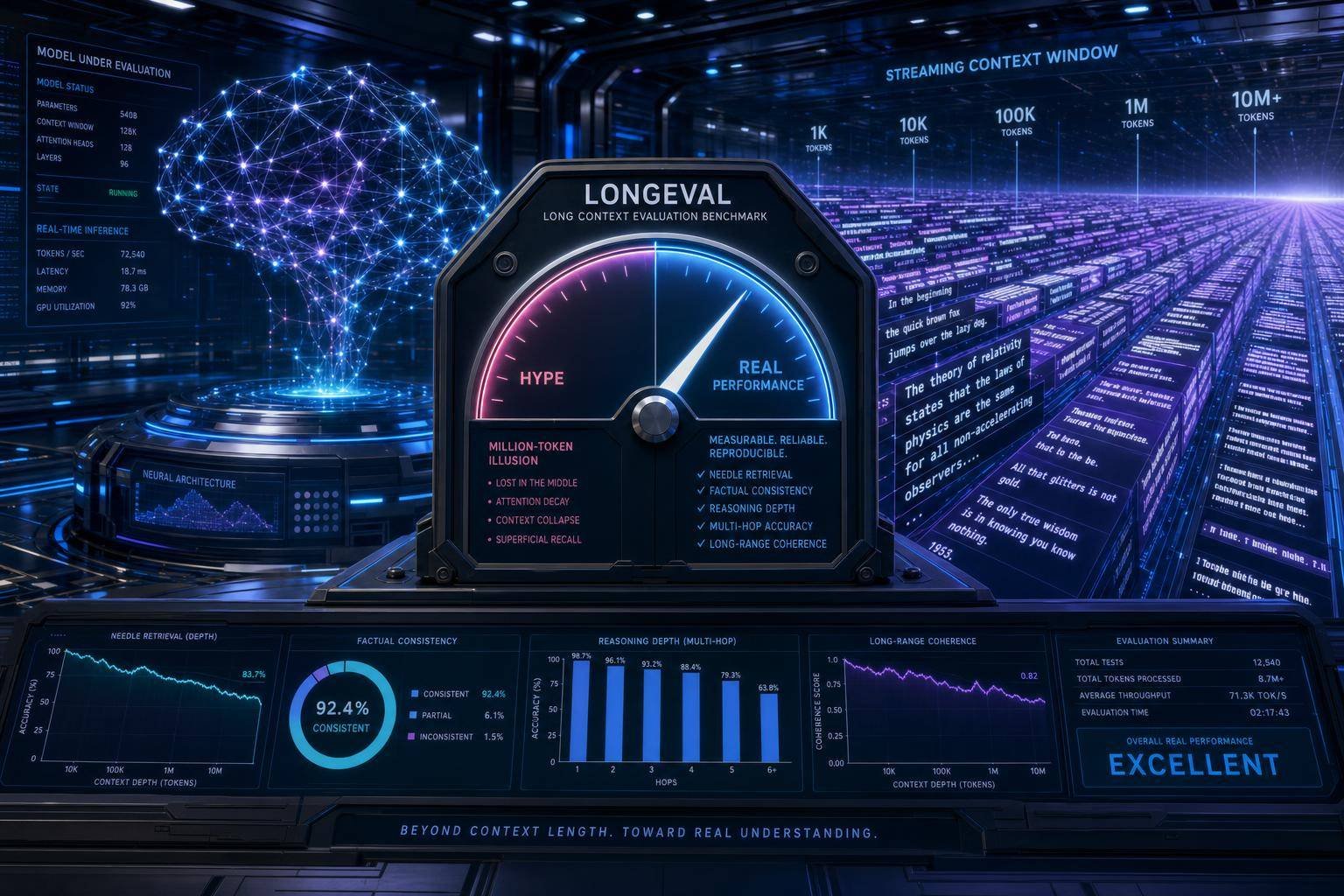
LongEval: The Ultra‑Long‑Context LLM Benchmark Separating Million‑Token Hype from Real Performance
Large language models now advertise context windows measured in hundreds of thousands or even millions of tokens. That promise—drop entire books, codebases, or compliance manuals into the prompt and get precise, reasoned answers—has enormous appeal. It also risks overpromising. As more vendors tout “million‑token” capabilities, buyers need proof that models can actually retrieve, reason, and remain coherent across sprawling inputs.
Epoch AI’s newly announced LongEval benchmark tackles that gap. It focuses squarely on ultra‑long‑context behavior: retrieving specific facts buried in book‑length documents, tracking entities across sprawling narratives, and executing multi‑step reasoning over complex technical manuals—even when important evidence is surrounded by distractors or adversarial content. For teams building AI systems around extensive documents and records, LongEval offers a reality check: which models truly use long context well, and at what cost?
Below, we unpack what LongEval measures, why long context is technically challenging, how to read benchmark results alongside cost and latency, and practical guidance for deploying long‑context LLM workflows in production. Whether you’re evaluating GPT‑5, Claude 4.5, Gemini 2.5 Pro, or retrieval‑augmented stacks, the goal is the same: replace marketing with measurable, operationally sound decisions.
What LongEval actually measures (and why it matters)
LongEval is designed for an era when “just give the model more tokens” seems like an easy fix—and often isn’t. Epoch AI frames the benchmark to answer a set of hard, operationally relevant questions.
- Can the model retrieve precise facts from book‑length documents? Needle‑in‑a‑haystack tasks stress whether the model can locate a specific clause, footnote, or variable definition buried in long text without drifting into plausible‑sounding fabrications.
- Can it track entities across sprawling narratives? Entity resolution and state‑tracking test whether the model keeps consistent references across thousands of lines—crucial for summarizing long investigations, following requirements across standards, or reviewing multi‑author specs.
- Can it perform multi‑step reasoning over long technical manuals? Many tasks require assembling information scattered across a manual: a definition early in a chapter, an exception two sections later, and a procedure appendix near the end.
- Is it robust to distractors and adversarial content? In realistic environments, relevant facts are interleaved with noise (logs, comments, legacy text) and sometimes adversarial instructions. LongEval includes robustness tests to expose whether the model is easily misled when the correct evidence is present but camouflaged.
Epoch AI reports baseline results for leading long‑context models (including native long‑context LLMs and retrieval‑augmented systems) and finds substantial variance: some models struggle to maintain coherence or recall over very long inputs, while others handle selective retrieval but falter at multi‑step reasoning deep inside the context. That variability is exactly why a focused benchmark is needed.
For background on broader LLM evaluation, it’s helpful to compare LongEval’s scope with established suites like Stanford’s HELM, which surveys many capabilities but doesn’t specialize in ultra‑long contexts. LongEval complements such efforts by zeroing in on what actually breaks as context windows stretch.
The technical reality of million‑token context
The promise of million‑token context has rapidly moved from research labs into vendor marketing. Google highlighted this shift with the Gemini 1.5 series and its 1‑million‑token context window, while OpenAI and Anthropic publish model families and documentation that emphasize expanding context and better long‑document understanding (OpenAI model docs, Anthropic developer docs).
But the engineering reality is unforgiving. Traditional transformer attention scales quadratically with sequence length. Doubling the context does not double the compute; it can quadruple it. That affects both cost and latency. Techniques like FlashAttention optimize memory and speed, but don’t erase the fundamental scaling pressure.
Three practical consequences follow:
1) Position bias and “lost in the middle” effects Multiple studies, including “Lost in the Middle,” show that models often prioritize information near the beginning or end of long sequences, degrading on evidence placed in the middle of the context. See: Lost in the Middle: How Language Models Use Long Context. This has direct implications for prompt design and retrieval strategies.
2) State management and memory footprints Inference with very long contexts stresses the key‑value (KV) cache; memory usage can balloon as windows grow. Libraries counter with paged KV caches and streaming attention, but throughput still drops as sequences lengthen. If your application depends on real‑time responses, long contexts impose a serious latency trade‑off.
3) Retrieval vs. brute‑force long context You can either: – feed everything to the model (native long context), or – retrieve only the most relevant chunks (RAG), or – use a hybrid (shorter native context plus retrieval).
Long context seems simpler, but in practice, selective retrieval often wins on accuracy, cost, and latency—especially beyond 100–200k tokens. Retrieval also lets you augment with structured data, version control, and per‑query evidence selection.
Architectures that blur the line—such as state‑space models, segment recurrence, or retention mechanisms like the Retentive Network (RetNet)—hint at more scalable long‑sequence processing. But for most enterprises today, the real‑world choice is between careful RAG pipelines and selectively using long context for edge cases.
Inside LongEval: tasks, metrics, and robustness
While the full LongEval documentation provides task details, you can think about its coverage in three categories:
- Factual retrieval at scale Example: “From Chapter 12 of a 400‑page manual, extract the exact conditions that void warranty coverage, and cite the page and subsection.” This stresses position sensitivity and extraction precision, not just general gist.
- Entity tracking and narrative coherence Example: “Across an 800‑page case file, track the status of Project Orion, identifying which budget line items were approved and when they changed.” This tests continuity and consistent outputs over long horizons.
- Multi‑step compositional reasoning with distractors Example: “Given a multi‑chapter standard and its appendices, determine whether a hypothetical system is compliant, highlighting each clause used to form the conclusion.” This combines retrieval, chain‑of‑thought (or hidden reasoning), and distractor resistance.
The benchmark also includes adversarial injections and near‑duplicate distractors, because real corpora are messy: logs, comments, superseded policies, and misformatted tables confound naive prompting. LongEval encourages separating raw task accuracy from robustness‑with‑noise accuracy to avoid overly rosy conclusions.
On the metrics side, expect position‑aware accuracy (e.g., head/middle/tail recall), entity consistency scores, and measures of compositional reasoning under noise. For retrieval‑augmented models, interpret results with and without the retriever to distinguish model‑internal long‑context usage from external indexing.
How to read LongEval scores without fooling yourself
Benchmark numbers are only useful if they map to operational reality. When comparing LongEval results across models and configurations, consider:
- Position sensitivity: If a model excels when answers are near the start or end but collapses in the middle, you’ll need careful chunking and citation strategies. The “Lost in the Middle” finding frequently shows up in practice.
- Robustness deltas: Gap between clean and noisy/adversarial test sets is a better predictor of production behavior than clean‑set accuracy alone. If distractors tank performance, plan for tighter retrieval filters and stronger citations.
- Cost and latency: A model that scores slightly higher while running 4× slower on million‑token inputs may not be viable for live workflows. Epoch AI’s release includes guidance on interpreting scores relative to context and compute budgets.
- Window utilization vs. RAG benefit: If a native long‑context model barely outperforms a strong RAG baseline at a far higher cost, the retrieval path is likely better. Conversely, if your domain requires reasoning across entire narratives (where retrieval might miss latent dependencies), a larger window can justify itself.
- Generalizability: Compare LongEval results to broader evaluations like HELM and your domain‑specific tests. LongEval is a complement, not a replacement, for reasoning, coding, and safety benchmarks.
Above all, avoid optimizing for the leaderboard without mirroring your real‑world distribution of inputs—document length, noise level, update cadence, and latency constraints.
When to use million‑token context vs. retrieval (and how to blend them)
Use native long context when: – Evidence is globally distributed in ways retrieval may miss (e.g., literary analysis, cross‑chapter narratives, sequential investigative logs). – You need deterministic, position‑dependent parsing (e.g., page‑exact legal citations from a sealed document snapshot). – You can afford higher compute and latency for specific, high‑value tasks.
Use retrieval‑augmented generation (RAG) when: – Knowledge is sparse and local (e.g., policy clauses, API references, troubleshooting steps). – Corpora update frequently and you need current evidence. – You must control cost/latency and provide citations reliably.
Use a hybrid design when: – You need short‑range precision with occasional long‑range coherence. Example: keep a 64k–200k native context for local reasoning plus a retriever feeding focused, cited passages; reserve full‑document ingestion for edge cases triggered by confidence or coverage checks.
Practical tip: You can imitate “virtual long context” with hierarchical retrieval—first summarizing large sections offline, then retrieving both raw passages and their summaries at query time. This often beats naive million‑token prompts on both quality and cost.
Practical setup: building a LongEval‑ready workflow
The benchmark ships with open‑source evaluation tools, dataset documentation, and score interpretation guidelines. Here’s a pragmatic way to bring similar discipline into your stack—even if you’re not adopting LongEval wholesale.
1) Define your document reality – Corpus shape: average and p95/p99 document sizes; update frequency; noise/distractor prevalence. – Task taxonomy: extraction, Q&A with citations, compliance reasoning, entity tracking, change detection. – Latency budgets: batch/offline vs. interactive SLAs.
2) Establish baselines – Short‑context baseline: A strong 8k–32k model with RAG for reference. – Long‑context baseline: The same or similar model at 128k–200k or higher, with and without RAG.
3) Adopt position‑aware test cases – Place equivalent signals at start/middle/end of documents to expose position bias. – Include distractors and adversarial content interleaved with ground truth.
4) Measure the right metrics – Accuracy with explicit citations. – Robustness delta (clean vs. noisy). – Tokenized cost and latency per query. – Throughput at concurrency levels you expect in production.
5) Iterate on retrieval and chunking – Try semantic chunking with overlaps tuned to your domain (e.g., section‑ or clause‑aware splitting for legal/standards content). – Test summary‑augmented retrieval: store both the raw span and a short machine‑generated synopsis; retrieve both. – Evaluate re‑ranking: pair a fast retriever with a strong reranker to prune distractors before generation.
6) Optimize prompts and position – Put critical instructions and task schema at the top and bottom. Given mid‑sequence degradation, sandwiching can help. – Ask for page/section citations and disallow unsupported claims; grade outputs automatically.
7) Track cost realism – Monitor context length distributions in production logs. – Set alerting for runaway prompts and fallback to retrieval when contexts exceed a sensible cap.
8) Governance and safety – Add prompt‑injection canaries and content policy checks. – Log evidence used per answer for auditability.
If you want to standardize your evaluation setup, consider complementing LongEval’s tools with open frameworks like OpenAI Evals, and keep your security posture aligned with the OWASP Top 10 for LLM Applications.
Implementation patterns that work at scale
- Retrieval first, long‑context second Default to retrieval for most queries. Detect low‑confidence or cross‑section questions and escalate to long‑context flows only when necessary. This keeps the median cost and latency low.
- Hierarchical memory Use multi‑level summaries (document → section → paragraph). Retrieval selects both summaries and raw chunks, giving the model an outline before diving into specifics.
- Streaming and windowed attention For interactive experiences over long documents, split the session into manageable windows and carry forward only the minimal state needed (e.g., extracted entities, active hypotheses). This outperforms monolithic million‑token prompts for most UX flows.
- Evidence‑first prompting Show the model exactly what it should consider, with clear citation requirements. Make the “answer only from evidence” rule explicit. Penalize unsupported claims in automated grading.
- Guardrails and verifiable outputs For compliance and policy tasks, prefer outputs that are mechanically checkable: clause IDs, page numbers, or pointer chains. Use post‑hoc verifiers to cross‑validate claims against the retrieved spans.
Security, privacy, and governance in long‑context LLMs
Ultra‑long context multiplies your attack surface and data exposure. Treat it as a security and governance feature from day one, not an afterthought.
- Prompt injection and adversarial noise The longer the input, the more chances an attacker has to sneak in malicious instructions. Scan and sanitize inputs. Maintain strict instruction hierarchies, and treat retrieved content as untrusted. The OWASP LLM Top 10 is a practical checklist.
- Data minimization by design Don’t feed entire repositories or policy archives if you only need five sections. Minimization reduces cost, latency, and leakage risk.
- Access control and redaction Apply the same entitlements that guard your source systems. Redact or mask sensitive fields before they enter prompts. Long contexts make accidental inclusion of secrets more likely.
- Auditability Log which passages the model saw and which it cited. For regulated workflows, require references and store them with the output. Align with your organization’s AI risk posture and frameworks like the NIST AI Risk Management Framework.
- Supply‑chain and model selection risk If you’re testing multiple vendors, standardize your evaluation corpus and harness. Avoid mixing apples and oranges (e.g., one model with retrieval, the other without). Document each setup so audit and incident response teams can reconstruct behavior.
Vendor claims vs. measurable capabilities
Many vendor announcements reference raw context size as a headline feature. That isn’t wrong—it’s a meaningful capability ceiling—but it can obscure three more important questions:
- Utilization: Does the model actually use the extra window effectively (especially mid‑sequence), or does accuracy plateau?
- Stability: Does performance degrade gracefully as you add noise, or does it fall off a cliff?
- Economics: Does the extra window deliver net value at your SLA and budget?
Benchmarks like LongEval force those questions into the open. For example, Google’s Gemini 1.5 posts impressive context specs; Anthropic and OpenAI maintain documentation and model catalogs that detail context limits. Epoch AI’s LongEval announcement adds the missing dimension: can models retrieve and reason under realistic, noisy, document‑scale conditions?
A buyer’s checklist for long‑context LLM decisions
Use this quick diagnostic when evaluating long‑context solutions:
- Document profile:
- What is your p90/p99 document size?
- How often do documents change?
- How noisy or adversarial is the text?
- Task profile:
- Do you need citations, exact quotes, or clause IDs?
- Is reasoning local (one section) or global (across many chapters)?
- Performance targets:
- Latency SLA (p95)?
- Per‑query budget?
- Required accuracy on clean vs. noisy inputs?
- Architecture choice:
- RAG baseline meets targets?
- Long‑context model materially improves accuracy on your hardest cases?
- Hybrid gives the best trade‑off?
- Governance:
- Evidence logging and auditability built in?
- Injection defenses applied to all untrusted text?
- Evaluation suite mirrors your production data distribution?
If you can’t answer these cleanly, resist the urge to pay for larger windows until your retrieval and evaluation hygiene improve.
What LongEval means for researchers and platform teams
For researchers, LongEval offers a consistent way to probe position sensitivity, robustness under distractors, and compositional reasoning at scale. It can also stress‑test new memory architectures or attention variants. For example, pairing LongEval with work on efficient attention (e.g., FlashAttention) or retention mechanisms (RetNet) can surface where algorithmic gains translate—or fail to translate—into end‑to‑end task wins.
For platform teams, LongEval encourages a holistic evaluation workflow: cost, latency, accuracy, and robustness form a single decision surface. Aligning routine regressions to this surface makes it easier to justify upgrades, vendor swaps, or architectural shifts.
Frequently asked questions
What is LongEval in one sentence? – LongEval is a benchmark suite from Epoch AI that evaluates how well large language models retrieve, track, and reason over ultra‑long contexts—think hundreds of thousands to millions of tokens—under realistic noise and adversarial conditions.
Do I need million‑token context windows to benefit from LongEval? – No. Even if you use 64k–200k windows or RAG, LongEval’s position‑aware and robustness‑focused tasks help you understand where your system breaks and how to fix it.
Is a bigger context window always better than retrieval? – Not usually. Bigger windows increase cost and latency and don’t guarantee better use of mid‑sequence information. Strong retrieval and chunking often outperform brute‑force long prompts for most enterprise tasks.
How should I compare LongEval results across vendors? – Look at accuracy with citations, position sensitivity (head/middle/tail), robustness deltas (clean vs. noisy), and cost/latency. Favor models or architectures that maintain performance under noise within your SLA and budget.
Does LongEval replace broader benchmarks like HELM or coding tests? – No. It complements them by focusing on ultra‑long‑context behavior. Combine LongEval with broader suites (e.g., HELM) and your domain‑specific tests.
What security steps matter most for long‑context deployments? – Treat all retrieved text as untrusted, implement injection defenses per OWASP LLM Top 10, minimize data passed to prompts, enforce access controls, and log evidence for audit and incident response.
The bottom line on LongEval and ultra‑long‑context LLMs
The age of million‑token marketing is here. The age of million‑token reliability is not guaranteed. Epoch AI’s LongEval makes that gap measurable. By testing retrieval, entity tracking, and multi‑step reasoning across book‑length inputs—and doing so under distractors and adversarial noise—LongEval helps teams separate headline claims from operational capability.
For most organizations, the winning recipe pairs disciplined retrieval with selectively applied long context, supported by evidence‑first prompts, robust chunking, and position‑aware evaluation. If you adopt LongEval’s mindset—even if not the exact suite—you’ll make better decisions about when to pay for bigger windows, how to keep latency in check, and where to invest in robustness work that actually moves business metrics.
Next steps: – Review Epoch AI’s LongEval announcement for tooling and documentation. – Inventory your document and task profiles; build position‑aware, noise‑tolerant tests. – Baseline a strong RAG system and a long‑context model side by side; measure accuracy, robustness, cost, and latency. – Align security and governance to the OWASP LLM Top 10 and the NIST AI RMF.
Ultra‑long‑context LLMs are powerful—but only when they can truly use the context you give them. LongEval is a timely benchmark to hold that promise accountable and guide practical, high‑trust deployments.
Discover more at InnoVirtuoso.com
I would love some feedback on my writing so if you have any, please don’t hesitate to leave a comment around here or in any platforms that is convenient for you.
For more on tech and other topics, explore InnoVirtuoso.com anytime. Subscribe to my newsletter and join our growing community—we’ll create something magical together. I promise, it’ll never be boring!
Stay updated with the latest news—subscribe to our newsletter today!
Thank you all—wishing you an amazing day ahead!
Read more related Articles at InnoVirtuoso
- How to Completely Turn Off Google AI on Your Android Phone
- The Best AI Jokes of the Month: February Edition
- Introducing SpoofDPI: Bypassing Deep Packet Inspection
- Getting Started with shadps4: Your Guide to the PlayStation 4 Emulator
- Sophos Pricing in 2025: A Guide to Intercept X Endpoint Protection
- The Essential Requirements for Augmented Reality: A Comprehensive Guide
- Harvard: A Legacy of Achievements and a Path Towards the Future
- Unlocking the Secrets of Prompt Engineering: 5 Must-Read Books That Will Revolutionize You