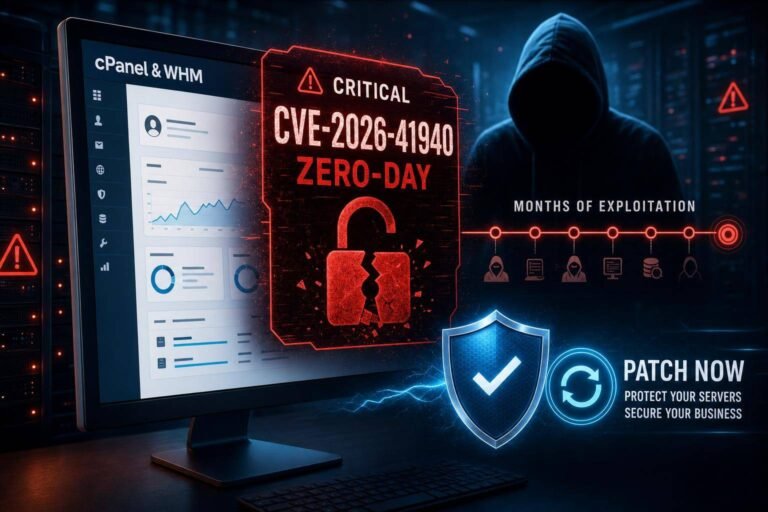
CVE-2026-41940: The Critical cPanel & WHM Authentication Bypass (Zero‑Day) and How to Respond Now
What if a single malformed HTTP header could silently turn any stranger on the internet into root on your cPanel server? That’s not a hypothetical. For roughly two months, attackers did exactly that—no passwords, no 2FA prompts, no foothold required.
The zero‑day now tracked as CVE-2026-41940 allowed remote attackers to bypass cPanel & WHM authentication entirely and “promote” themselves to a fully authenticated root session. The exploit abused CRLF injection in an HTTP header to inject arbitrary session properties—enough to impersonate an administrator at the highest privilege level. According to reporting from Indusface, exploitation was observed as early as February 23, 2026; cPanel issued an emergency patch on April 28, 2026; and even after that, an estimated 44,000 IPs continued probing and exploiting unpatched hosts.
If you manage cPanel servers—or your organization relies on vendors who do—this one deserves your full attention. Below is a clear, practical guide to what happened, why it matters, and what you should do next.
Note: This article focuses on defender guidance and does not include exploit code or step‑by‑step abuse instructions.
What is CVE-2026-41940?
CVE-2026-41940 is a critical authentication bypass vulnerability in cPanel & WHM that allows unauthenticated, remote attackers to gain root-level access. The flaw centers on CRLF injection (carriage return + line feed) used to smuggle arbitrary session properties via a malformed HTTP header. In successful attacks, the application falsely “accepts” the attacker as a fully authenticated root user—without credentials or prior access.
Key points based on public reporting from Indusface: – Vulnerability class: Authentication bypass via CRLF injection and session property injection – Impact: Unauthenticated root access (complete system takeover) – Exposure window: Actively exploited since approximately February 23, 2026 – Patch: Emergency fix released by cPanel on April 28, 2026 – Scale: cPanel/WHM manages infrastructure for tens of millions of domains worldwide – Exploitation activity: Approximately 44,000 IPs observed actively exploiting (post‑patch availability) – Risk: Critical for hosting providers, managed service providers (MSPs), and any organization with cPanel-managed servers
Source: Indusface report
Why this zero‑day is different (and dangerous)
Most hosting environments use cPanel/WHM as a daily driver for provisioning, DNS, email, SSL management, backups, and more. That means: – A successful compromise is not “just a website defacement”; it’s end‑to‑end control of the server and everything it manages. – Trust cascades. With root, attackers can pivot to other internal services, poison DNS, intercept mail, install web shells, steal secrets from backups, tamper with cron jobs, and harvest credentials. – Visibility is hard. If the attacker is “logged in” as a legitimate root session, logs may look superficially normal. Traditional detections that focus on failed authentication or brute force simply won’t fire.
And because this was an active, widely exploited zero‑day for weeks before a patch existed, many organizations were compromised long before defenders had any clue what to look for.
A quick timeline
- Around February 23, 2026: In-the-wild exploitation begins (per Indusface).
- February–April 2026: Zero‑day window; widespread exploitation without reliable detection guidance.
- April 28, 2026: cPanel releases an emergency patch.
- Post‑patch: Attack activity remains elevated, with roughly 44,000 IPs observed scanning and exploiting unpatched systems.
If your servers were internet‑exposed and unpatched during that window—and especially if they remained unpatched after April 28—you should assume compromise until you prove otherwise.
How the authentication bypass works (at a high level)
At its core, CVE-2026-41940 is a logic flaw driven by how cPanel & WHM handled certain HTTP headers. By abusing CRLF injection, an attacker could smuggle unexpected data that altered session state. In practice, that meant injecting arbitrary session properties so the application “believed” the session belonged to an authenticated root user.
Important clarifications: – No credentials are required. – It works remotely over HTTP(S). – It bypasses normal authentication checks, so 2FA or strong passwords are not sufficient mitigations on their own. – Because it manipulates session state, resulting activity may appear as if a legitimate admin is logged in.
If you want to go deeper on the underlying class of bug, OWASP has a good explainer on CRLF injection and how header and response parsing can be subverted: OWASP: CRLF Injection
Who is affected?
- Any internet‑reachable cPanel & WHM installation that was not patched promptly after April 28, 2026.
- Hosting providers and MSPs are at especially high risk given the multiplier effect across customer accounts.
- Organizations in regulated industries (finance, healthcare, government) face elevated compliance and breach‑notification exposure due to the breadth of access gained by attackers.
If your vendors, partners, or third‑party developers manage cPanel instances for you, your organization may be affected even if you don’t directly operate cPanel servers yourself.
What attackers can do with root on cPanel
With root on a cPanel host, an adversary can: – Create or hijack privileged system and cPanel/WHM accounts – Exfiltrate databases, site content, backups, SSL/TLS private keys, and API tokens – Modify DNS zones, email routing, and SPF/DKIM/DMARC to conduct phishing and BEC campaigns – Plant web shells and persistence (cron jobs, rc scripts, sudoers changes, SSH key drops) – Tamper with or disable logging and security tooling – Pivot laterally into adjacent infrastructure
This is complete system compromise. Treat it as such in your incident response planning.
Are you affected? Quick checks to triage risk
- Was any cPanel/WHM interface (e.g., WHM, cPanel ports) accessible from the public internet between February 23 and the date you patched? Risk: High.
- Did you delay patching after April 28, 2026? Risk increases significantly the longer you remained unpatched.
- Do you see unusual admin logins or sessions at odd hours or from unfamiliar IP ranges? Risk: High.
- Have you observed configuration drift you can’t explain (new privileged users, changed DNS/mail settings, unexpected cron jobs)? Risk: High.
Note: Absence of evidence is not evidence of absence—especially for an auth bypass that can blend in with “normal” admin activity.
Immediate actions: What to do right now
1) Patch cPanel & WHM immediately – Apply the emergency fixes released on April 28, 2026 (or any subsequent superseding updates). – Use the WHM interface to upgrade to the latest build for your update tier, or run your standard cPanel update process. – After updating, restart relevant services to ensure new handlers are active.
2) Restrict management plane exposure – Temporarily gate WHM and cPanel interfaces behind VPN, zero trust access, or IP allowlists. – Disable direct internet access to management ports where feasible. – Enforce TLS for all management access.
3) Assume breach if you were exposed pre‑patch – Begin incident response: contain, investigate, eradicate, recover. – Snapshot systems for forensics before making sweeping changes (where operationally feasible). – If you discover indicators of compromise, plan for credential rotations and a clean rebuild.
4) Rotate secrets and credentials – Rotate root and admin passwords, SSH keys, API tokens, database credentials, and mail server creds. – Reissue SSL/TLS certificates if you suspect key exposure.
5) Increase logging and visibility – Centralize and preserve logs (web server, cPanel/WHM access logs, auth logs, service logs). – Enable detailed logging and ship to a secure, write-once destination (SIEM, log archive).
6) Notify stakeholders – Inform leadership and affected teams; coordinate downtime for patching and investigations. – If you are a provider, communicate transparently with customers and set clear expectations on timelines and remediation steps.
Helpful resources: – cPanel security advisories: https://cpanel.net/security/ – Indusface analysis of CVE-2026-41940: https://www.indusface.com/blog/cve-2026-41940-cpanel-auth-bypass/ – CISA Known Exploited Vulnerabilities Catalog: https://www.cisa.gov/known-exploited-vulnerabilities-catalog
Detection: What to look for (defender-focused)
Because CVE-2026-41940 can produce sessions that look “legitimate,” focus on behavior and context:
- Unusual admin activity
- Admin actions outside normal maintenance windows
- Session origins from geographies/IP ranges that don’t match your team
- Rapid “click-paths” performing high‑impact changes (DNS, mail, account creation)
- Log anomalies
- Requests with malformed or suspicious HTTP headers
- Odd user agent strings correlated with privileged actions
- Service restarts or configuration changes without a corresponding approved change ticket
- Persistence and privilege artifacts
- New privileged cPanel/WHM accounts or groups
- Unknown SSH keys added to root or service accounts
- Unfamiliar cron jobs, startup scripts, or scheduled tasks
- Modified sudoers configuration
- Lateral movement and exfil
- Unexpected outbound connections to VPS hosts, bulletproof infrastructure, or anonymization networks
- Data staging in temporary directories, compressed archives appearing in unusual paths
- Sudden spikes in egress traffic
If you operate EDR or NDR tooling, build detections that correlate privileged WHM/cPanel actions with network origins and timing patterns that don’t align to your runbooks.
Forensic and incident response guidance
If you suspect compromise: – Preserve evidence – Take system snapshots and export relevant logs to immutable storage. – Maintain a clean chain of custody for regulatory or legal follow‑ups.
- Scope and contain
- Isolate affected hosts from the network or restrict to investigation VLANs.
- Identify shared credentials, mounts, or automation that could have cascaded access.
- Eradicate and recover
- Remove unauthorized users, keys, and persistence mechanisms.
- Rebuild from known‑good images where feasible—particularly if core system integrity is in doubt.
- Validate DNS/mail integrity and reissue any secrets that may have been exposed.
- Post‑incident hardening
- Close management interfaces to the public internet.
- Implement multi‑layered authentication (even though this bypassed auth, layers still reduce blast radius for other classes of attacks).
- Improve logging coverage and alerting on high‑risk actions.
Hardening cPanel & WHM against future auth bypasses
No single control is perfect, but layered defenses can drastically reduce risk:
- Network exposure
- Place WHM and cPanel behind VPN or a zero trust gateway.
- Use IP allowlisting for management endpoints.
- Disable unused services and ports; prefer HTTPS only.
- Access controls
- Enforce strong, unique credentials and hardware-backed MFA for all admin accounts.
- Separate duties: use lower-privilege accounts for routine tasks and reserve root for break‑glass procedures.
- Regularly audit user and key inventories; auto-expire unused access.
- Application security controls
- Deploy a WAF with up‑to‑date rules (e.g., OWASP Core Rule Set) to add a “virtual patch” layer for input anomalies.
- Rate-limit or throttle sensitive endpoints to reduce automated probing.
- System hygiene
- Keep cPanel & WHM on supported update channels; apply security updates promptly.
- Automate baseline audits: file integrity monitoring, CIS benchmarks, and configuration drift detection.
- Centralize and retain logs long enough to investigate slow‑burn intrusions.
- Segmentation and blast-radius reduction
- Isolate cPanel servers from critical internal systems.
- Use separate credential domains for hosting vs. corporate infrastructure.
- Limit outbound internet access from management hosts to what’s strictly necessary.
- Backups and recovery
- Maintain tested, offline/immutable backups.
- Practice restoration drills so you can rebuild quickly if root-of-trust is lost.
Can a WAF or “virtual patch” help?
Yes—with caveats. A WAF cannot “fix” a code defect, but it can: – Detect and block malformed HTTP headers and suspicious sequences consistent with CRLF abuse – Provide emergency coverage while you patch – Offer telemetry on ongoing exploit attempts targeting your infrastructure
However: – Treat WAF rules as a stopgap, not a substitute for the vendor patch. – Validate that your WAF is actually inspecting the management plane traffic in front of WHM/cPanel (many environments bypass WAF for admin interfaces).
For more on CRLF injection and generic mitigations: OWASP: CRLF Injection
The supply‑chain angle: Hosting providers and MSPs
If you’re a provider: – You may be the single point of failure for hundreds or thousands of customer environments. – Proactively notify customers, even if you have no confirmed compromises. – Provide clear guidance on patch status, what logs you’re reviewing, and what customers should monitor on their side (DNS, mail, credential rotations). – Consider offering assisted IR and forensics for affected tenants.
If you’re a customer of a provider: – Ask for written confirmation of patch timing (date/time/time zone). – Request a summary of log reviews and findings specific to your accounts. – Coordinate credential rotations and certificate reissuance as needed.
Communication and compliance
Because this vulnerability yields full root access, many regulated organizations may have reportable events if compromise is confirmed: – Work with legal and compliance to determine obligations (and timing) under applicable laws and contracts. – If personal data, financial information, or protected health information could have been accessed, prepare notifications aligned to regulatory requirements. – Maintain detailed records of patching timelines, investigative steps, and remediation actions.
Transparency builds trust—especially if you’re a provider. Share what you know, what you don’t know, and what you’re doing to close the gaps.
What if you can’t patch immediately?
- Reduce exposure today
- Gate WHM/cPanel behind VPN/IP allowlists.
- Block management ports at the edge firewall from the public internet.
- Add virtual patching
- Enable a WAF in front of management interfaces and apply strict rules for malformed headers and suspicious patterns.
- Monitor continuously
- Tighten alerts on admin actions, configuration changes, and outbound traffic.
Then schedule emergency maintenance to apply the official patch at the earliest possible window.
Frequently Asked Questions (FAQ)
Q: Does strong authentication (password policies, MFA) block this attack? – A: Not reliably. CVE-2026-41940 bypasses authentication entirely by manipulating session state. Keep strong auth, but don’t rely on it as a fix for this issue.
Q: If I patched after April 28, 2026, am I safe? – A: You’re protected against new exploitation, but if your server was exposed before patching, you still need to investigate for signs of prior compromise. Patch plus forensics is the right combo.
Q: How do I confirm my cPanel & WHM instance is patched? – A: Update to the latest release available for your update tier through WHM or your standard server update process. Verify the update completed successfully and consult cPanel’s official advisories for guidance on versions containing the fix: https://cpanel.net/security/
Q: Should I rotate certificates and keys? – A: If compromise is suspected, yes. Assume secrets on the host (SSL/TLS keys, API tokens, SSH keys, database credentials) could be exposed and rotate accordingly.
Q: Can a firewall alone stop this? – A: A network firewall can reduce risk by blocking public access to management ports. A WAF can help filter malicious HTTP traffic. Neither replaces the vendor patch, but they reduce exposure while you remediate.
Q: What logs should I review? – A: Start with cPanel/WHM access logs, web server logs, auth logs, and service logs (mail, DNS, database). Look for unusual admin actions, odd source IPs/agents, and configuration changes without tickets. Preserve logs externally for integrity.
Q: Is this in the CISA KEV catalog? – A: Check the current status here: https://www.cisa.gov/known-exploited-vulnerabilities-catalog. Given confirmed in‑the‑wild exploitation, it may be listed.
Q: We use a hosting provider—what should we ask them? – A: Ask when they patched (exact date/time/time zone), whether your tenants were internet‑exposed during the zero‑day window, what indicators they’ve reviewed, and whether they recommend credential/key rotations for your environment.
Q: Does this affect all cPanel versions? – A: Impact varies by version and build. The safest path is to apply the latest vendor updates released on and after April 28, 2026, and follow cPanel’s advisory for your tier. When in doubt, patch and restrict access.
Bottom line: Patch now, hunt for compromise, and lock down the management plane
CVE-2026-41940 is one of those rare, worst‑case vulnerabilities: unauthenticated, remote, and full root. Attackers exploited it freely for weeks before a fix was available, and mass scanning continues even after patch release. If you run cPanel & WHM—or depend on a provider who does—treat this as a top‑tier incident.
- Apply the latest cPanel & WHM updates immediately.
- Assume breach if you were exposed during the zero‑day window; investigate thoroughly.
- Restrict access to management interfaces and strengthen layered defenses.
- Rotate credentials and keys where compromise can’t be ruled out.
- Communicate transparently with stakeholders and customers.
A single malformed header should never be a skeleton key to your infrastructure. Patch, verify, and harden so it won’t be next time.
Discover more at InnoVirtuoso.com
I would love some feedback on my writing so if you have any, please don’t hesitate to leave a comment around here or in any platforms that is convenient for you.
For more on tech and other topics, explore InnoVirtuoso.com anytime. Subscribe to my newsletter and join our growing community—we’ll create something magical together. I promise, it’ll never be boring!
Stay updated with the latest news—subscribe to our newsletter today!
Thank you all—wishing you an amazing day ahead!
Read more related Articles at InnoVirtuoso
- How to Completely Turn Off Google AI on Your Android Phone
- The Best AI Jokes of the Month: February Edition
- Introducing SpoofDPI: Bypassing Deep Packet Inspection
- Getting Started with shadps4: Your Guide to the PlayStation 4 Emulator
- Sophos Pricing in 2025: A Guide to Intercept X Endpoint Protection
- The Essential Requirements for Augmented Reality: A Comprehensive Guide
- Harvard: A Legacy of Achievements and a Path Towards the Future
- Unlocking the Secrets of Prompt Engineering: 5 Must-Read Books That Will Revolutionize You