Midnight Signal AI (May 2, 2026) Recap: Grok 4.3 Custom Voices, Anthropic Safety Gains, OpenAI Pricing, EU AI Act Enforcement, and NVIDIA’s Next‑Gen Chips
The latest Midnight Signal AI episode lands at a pivotal moment: generative AI is moving from clever demos to core infrastructure. According to the May 2, 2026 show, xAI’s Grok 4.3 introduced custom voices and deeper real‑time context, Anthropic shipped new guardrails for agentic AI, OpenAI adjusted API pricing to accelerate developer adoption, the EU AI Act entered its enforcement phase, and NVIDIA teased more efficient training silicon. That’s a week that shifts product roadmaps, compliance strategies, and cost models all at once.
If you build, buy, or secure AI systems, the signals here are clear. Expect more human‑like assistants, tighter safety defaults for autonomous workflows, measurable price pressure on model usage, and real regulatory teeth. This recap unpacks what changed, why it matters, and how to translate the news into concrete next steps for consumers, startups, and enterprises.
Midnight Signal AI: What changed this week and why it matters
Midnight Signal AI spotlighted five developments shaping near‑term AI adoption:
- xAI’s Grok 4.3 gained custom voices for more immersive interactions, plus GNews‑powered context to keep outputs grounded in fresh information.
- Anthropic updated Claude’s safety systems to reduce edge‑case risks in agentic behaviors and tool use.
- OpenAI adjusted API pricing, nudging developers to integrate AI more deeply and cost‑effectively.
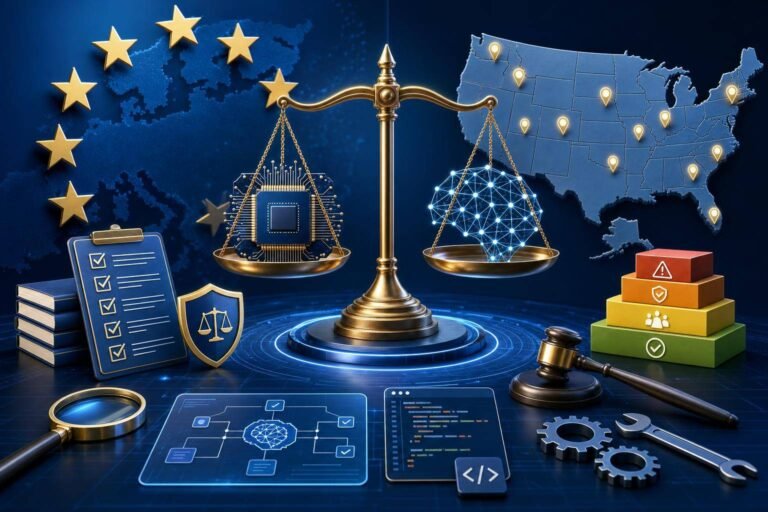
- The EU AI Act moved from headlines to enforcement, with fines for non‑compliant foundation models and high‑risk deployments.
- NVIDIA announced next‑generation training chips poised to improve performance‑per‑watt and total cost of ownership.
Implications for practitioners: voice becomes a first‑class interface; autonomy grows but within narrower safety bounds; model selection and cost engineering become board‑level levers; and compliance is now a launch‑blocking checklist, not a nice‑to‑have.
xAI Grok 4.3: Custom voices, real‑time context, and the new human interface
According to the episode, xAI’s Grok 4.3 release shipped “custom voices,” meaning the model can speak in distinct, user‑defined styles and potentially replicate voices with consent. Combined with tighter real‑time context via GNews integration, Grok inches closer to a perpetually current, conversational companion.
For builders, the shift matters less for novelty and more for conversion: multimodal, human‑sounding assistants lower friction, increase trust, and shorten task completion time. For security leaders, custom voices heighten both authenticity and attack surface.
xAI’s trajectory has emphasized high‑context reasoning and responsiveness. While the podcast highlights new capabilities, readers should track official updates from xAI’s engineering blog for release details, responsible use policies, and platform integration patterns.
Custom voices: use cases and guardrails that actually work
High‑value use cases emerge immediately:
- Customer support and success: branded voice agents that match tone and pacing across product lines; escalation to humans remains clear.
- Education: differentiated delivery for language learning, with voice styles that adjust to student age, culture, and reading level.
- Accessibility: natural speech output tailored to user preferences, improving usability for people with low vision or reading disabilities.
- Productivity: voice‑driven scheduling, research summaries, and drafting with far lower cognitive load than text.
Risks, and how to tame them:
- Consent and provenance: if you support voice replication, you need explicit, revocable consent and traceable provenance for generated audio. Require documented proof of ownership for any source voice and watermark generated output for downstream tracing.
- Impersonation and fraud: voice cloning can supercharge social engineering. The U.S. Federal Trade Commission has warned about AI‑enabled voice cloning scams. Defenses include out‑of‑band verification steps and user education at onboarding.
- Biometric confusion: some organizations treat voice as a biometric factor. Distinguish “synthetic voice UI” from “voice biometrics for auth.” Never rely on generated voice for authentication or KBA.
Design tips:
- Always‑on disclaimers: short, plain‑language voice and text indicators that the assistant is AI‑generated.
- Safety toggles: per‑tenant controls for voice styles, geographic restrictions, and data retention.
- Immutable audit trails: log prompts, response audio hashes, and system decisions to support investigations and compliance queries.
GNews‑style integration: real‑time context without real‑time chaos
The episode calls out GNews integration to keep Grok current. Whether you use news feeds, proprietary databases, or internal wikis, the principle remains: retrieval‑augmented generation (RAG) improves factuality and recency when it’s designed with safety.
- Source hygiene: whitelist feeds, enforce schema validation, and store fetch‑time cryptographic hashes so you can prove what content was seen and when.
- Injection resistance: live content increases prompt injection risk. Apply content sanitization and robust system prompts, and use an allowlist of tool/function calls. The OWASP LLM Top 10 is a practical catalog of failure modes to test against.
- Risk management: align your pipeline with the NIST AI Risk Management Framework so you can evidence hazard identification, mapping, measurement, and governance.
Anthropic’s Claude safety updates: agentic AI without the edge cases
The podcast highlights Anthropic’s safety upgrades for Claude, focused on agentic behaviors—planning, tool use, and multi‑step execution. In practice, this points to tighter refusal criteria, improved tool‑use alignment, and better handling of compound instructions where subtle misinterpretations can cause big problems.
What this unlocks:
- Structured autonomy: letting agents plan multi‑step workflows with less human babysitting, especially for data processing, analysis, and routine IT tasks.
- Lower incident frequency: safer defaults reduce the need for complex policy scaffolding, particularly useful for SMBs that lack AI safety staff.
- Cleaner SOC integration: fewer high‑severity anomalies from agent mistakes create less alert fatigue.
How to use it well:
- Constrain the action space: even “safer” agents should operate in sandboxes with least‑privilege credentials, time‑boxed tasks, and tool allowlists.
- Build test rigs: create adversarial and real‑world eval suites to validate that agent policies behave as intended before going live.
- Track model specs: detect safety regressions on version bumps. Anthropic’s work on Constitutional AI remains a useful mental model for designing policies you can audit.
OpenAI API pricing adjustments: what it means for builders
Midnight Signal AI reports that OpenAI adjusted pricing in ways that encourage broader developer adoption. Pricing changes are not just a footnote; they reshape the build‑vs‑buy equation, influence model choice, and define unit economics for startups.
What to expect in practice:
- Model stratification sharpens: developers will mix “good‑enough” small models for routine tasks with larger, reasoning‑heavy models for complex jobs. Routing frameworks matter.
- Caching and distillation get priority: with lower prices, it becomes viable to over‑generate drafts and then distill into cheaper models for production inference.
- Throughput beats raw speed: concurrency limits and batch APIs will drive lower latency at scale more than model clocks.
Action items:
- Build a price/perf dashboard: track cost per successful task, not per token. Align alerts with budget thresholds and product KPIs.
- Abuse budget control: spend on retrieval quality, prompt engineering, and output verification—not only model capacity.
- Read the fine print: metering, rate limits, caching rules, and content policy enforcement. Start at the official OpenAI pricing page and document assumptions in your runbooks.
EU AI Act enforcement starts: compliance moves from theory to practice
The episode flags a big shift: enforcement of the EU AI Act begins, with fines for non‑compliant large language models and deployments in regulated contexts. Even for non‑EU companies, this is de facto global policy because vendors don’t want per‑region forks.
Key obligations to track:
- Transparency and technical documentation: providers of general‑purpose AI must supply detailed model info, capabilities, limitations, and usage policies. See the European Commission’s overview of the Artificial Intelligence Act.
- Risk management and post‑market monitoring: continuous assessment of risks, drift, and incidents, with documented mitigations and reporting channels.
- High‑risk system requirements: if your use case falls into high‑risk categories (e.g., employment, education, critical infrastructure), expect rigorous conformity assessments and record‑keeping.
Practical guidance:
- Map your inventory: create a canonical registry of all models in use, their training sources, intended use, and third‑party dependencies. Keep it evergreen.
- Align with security baselines: ENISA’s guidance on AI cybersecurity challenges is a strong complement to legal requirements. Review the ENISA AI cybersecurity challenges report.
- Appoint an AI compliance lead: cross‑functional by design (legal, security, data, product). Make them accountable for incident handling and regulatory communications.
NVIDIA’s next‑gen training chips: efficiency, cost curves, and roadmaps
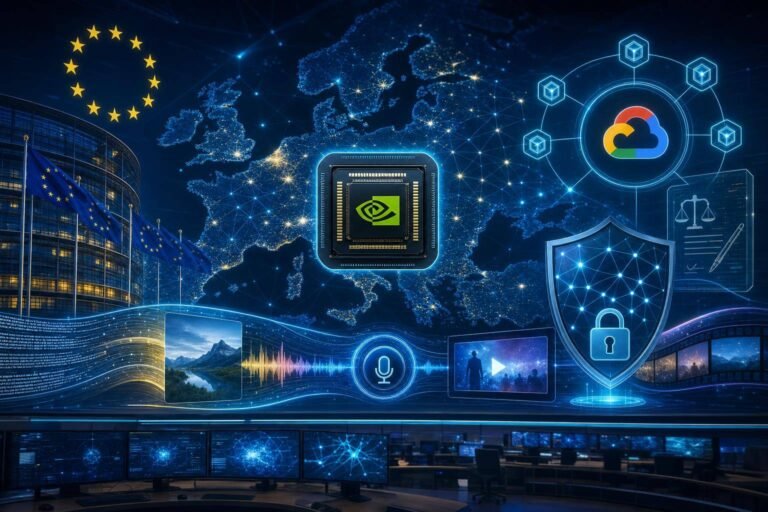
NVIDIA’s teaser of next‑gen training silicon signals the next step down the cost curve. Expect higher memory bandwidth, better interconnects, and quantization‑friendly compute that boosts both training and inference economics.
Why it matters now:
- Model refresh cycles accelerate: reduced training costs make it feasible to retrain or finetune more often, shrinking time‑to‑improvement for domain‑specific models.
- Inference gets cheaper: architectures like Blackwell (announced in 2024) emphasized transformer acceleration and memory efficiency; more of that benefits high‑throughput inference too. Reference NVIDIA’s Blackwell architecture overview for context on the trajectory.
- Build vs. rent calculus shifts: as cloud providers roll out new GPUs, on‑prem buyers revisit total cost of ownership—including energy, cooling, and staffing.
Planning tips:
- Capacity hedging: use cloud for burst training and specialized experiments; anchor predictable workloads in reserved instances or on‑prem clusters.
- Software stack readiness: ensure your inference servers and compilers (Triton, TensorRT, vLLM) are primed to exploit new hardware features on day one.
- Mixed precision and quantization: build evaluation suites for 8‑bit and 4‑bit quantization so you can seize efficiency gains without silent accuracy regressions.
Practical playbooks: turn this week’s AI news into advantage
Translate announcements into action with these targeted playbooks.
Voice UI rollout checklist (for Grok‑style custom voices)
- Consent, provenance, and policy
- Explicit capture of consent and purpose for any voice replication.
- Immutable logs linking generated audio to source materials and prompts.
- Short disclosures in audio and text that the assistant is AI‑generated.
- Security and abuse prevention
- Disallow voice‑based authentication; route sensitive actions to secure channels.
- Implement content watermarking and tamper‑resistant telemetry.
- Provide a “Report Impersonation” workflow with fast takedown.
- Evaluation and monitoring
- Test for accent bias and speech intelligibility across demographics.
- Monitor for jailbreak prompts requesting disallowed impersonations.
- Maintain a rollback plan for voice models and styles.
- Standards alignment
- Align controls with the NIST AI Risk Management Framework.
- Educate users drawing on guidance like the FTC’s alert on voice cloning scams.
Agent safety controls (for Anthropic‑style updates)
- Constrain the agent: hard allowlist of tools and data scopes, no shell or network by default.
- Sandboxes everywhere: containerized execution with network egress policies and write‑only output directories.
- Timeouts and budgets: cap tokens, steps, and wall‑clock time per task; alert on cap breaches.
- Guardrail prompts + validators: pair system prompts with deterministic validators for PII, policy violations, and dangerous actions.
- Red team with checklists: cover the OWASP LLM Top 10 regularly; document findings and fixes.
API cost optimization (for OpenAI pricing shifts)
- Model routing: send easy tasks to smaller, cheaper models; reserve top‑tier models for reasoning‑heavy or high‑risk outputs.
- Caching and reuse: cache embeddings, RAG chunks, and common prompts; layer in a semantic cache for near‑duplicate queries.
- Prompt budgets: keep system prompts lean, prune seldom‑used tools, and enforce max output tokens based on task norms.
- Streaming and early‑exit: stream partial results to the UI; allow users to stop when they’ve seen enough.
- Batch the boring parts: roll up similar tasks (e.g., classification) into batched calls during off‑peak windows.
EU AI Act readiness (for enforcement now in play)
- Inventory and classification: tag each AI system by use case, risk level, and user base.
- Data lineage: document datasets, licenses, and consent pathways; maintain a change log for retraining and finetunes.
- Transparency artifacts: publish model cards, intended use, known limitations, and human‑in‑the‑loop controls.
- Incident response: pre‑define thresholds for “AI incident,” responsible contacts, and regulator notification steps guided by the EU AI Act overview.
- Third‑party oversight: demand attestations from vendors; include security and compliance SLAs in contracts. ENISA’s AI cybersecurity guidance can inform checklists.
Infrastructure planning (for NVIDIA’s next‑gen chips)
- Capacity model: estimate training/inference demand in FLOPs and memory bandwidth; revisit quarterly.
- Portability: avoid hardware lock‑in by standardizing on inference servers and deployment patterns that support multiple accelerators.
- Benchmark honestly: measure end‑to‑end latency and cost per completed task, not synthetic tokens/sec.
- Quantization readiness: validate 8‑bit and 4‑bit flows for your top tasks; track accuracy deltas and user‑perceived quality.
Security and privacy considerations you can’t skip
Real‑time context and custom voices are great for usability—and great for attackers. Raise your baseline.
- Prompt injection and tool abuse: any system that reads live content is vulnerable. Apply strict system prompts, tool allowlists, and output verification. The OWASP LLM Top 10 offers a field‑tested starting point.
- Synthetic media and social engineering: voice replication increases the impact of phishing and BEC. Train users and partners and provide high‑friction checks for sensitive actions. Consider threat intel from sources like MITRE ATLAS to map adversary techniques against AI systems.
- Data provenance: embed content hashes and signed metadata in your RAG store; record attribution in outputs where possible.
- Privacy and retention: minimize retention windows for audio and transcripts; segregate PII; enable data deletion workflows and per‑tenant encryption keys.
- Posture reviews: quarterly audits that cover data flows, third‑party dependencies, and model versioning, mapped to the NIST AI RMF.
What it means for consumers and the future of work
Midnight Signal AI framed these updates with a consumer lens: assistants that sound like people you trust, answers that reflect what just happened, and safer automation behind the scenes.
- For consumers: expect more capable personal assistants that can summarize your inbox, book travel by voice, and answer questions with context from current events—while more apps clearly label AI voices and provide report‑abuse buttons.
- For frontline teams: retail associates, field service technicians, and healthcare staff will lean on voice‑first copilots that surface procedures and capture notes hands‑free.
- For knowledge workers: faster research, drafting, and meeting synthesis, with model choice and cost controls increasingly embedded in productivity suites.
- For IT and security: fewer agent misfires if safety updates hold up, but more vigilance needed around real‑time data ingestion and deepfake‑driven threats.
- For leadership: compliance and cost become durable competitive advantages. Companies that document model behavior, control spend, and move fast on safer interfaces will compound gains.
FAQ
Q: What is the headline takeaway from the May 2, 2026 Midnight Signal AI episode? A: AI is getting more natural (custom voices), safer in autonomy (agentic guardrails), cheaper to build with (pricing shifts), more regulated (EU AI Act enforcement), and more efficient to run (next‑gen chips). That combination accelerates real deployments.
Q: Are custom AI voices safe to deploy in customer support? A: Yes, if you implement consent, clear disclosure, anti‑impersonation controls, and robust logging. Avoid using voice for authentication and provide human escalation paths.
Q: How do OpenAI pricing changes affect model selection? A: They encourage a tiered approach: route routine tasks to smaller models and reserve larger models for complex reasoning. Pair with caching, batching, and streaming to cut costs.
Q: What does EU AI Act enforcement mean for startups outside the EU? A: If you serve EU users or rely on EU‑regulated vendors, you’ll feel it. Expect documentation requirements, risk management, and transparency obligations to become standard in contracts and due diligence.
Q: Will NVIDIA’s new chips matter for small teams? A: Indirectly, yes. As clouds adopt new GPUs, inference gets cheaper and faster for everyone. You benefit through lower latency and cost in the services you use.
Q: How should I secure agents that read live web or news content? A: Sanitize inputs, enforce tool allowlists, set strict timeouts and cost caps, validate outputs, and test against common attacks such as prompt injection using frameworks like the OWASP LLM Top 10.
Conclusion: The Midnight Signal AI week that nudged AI into the everyday
The May 2, 2026 Midnight Signal AI episode underscored a shift from novelty to necessity. Grok 4.3’s custom voices make interfaces feel human. Anthropic’s safety upgrades calm the rough edges of agentic automation. OpenAI’s pricing resets the business case for deeper AI integration. The EU AI Act’s enforcement turns principles into penalties. NVIDIA’s next‑gen chips keep the cost curve bending down.
Your next moves are clear: pilot voice interfaces with strong consent and disclosure, tighten agent guardrails and evals, implement price/performance routing, stand up an AI compliance program aligned to the EU AI Act, and ready your stack for the next GPU wave. Do this well, and the opportunities—more natural assistants, safer autonomy, and stronger reliability—will outweigh the risks. And keep listening to Midnight Signal AI; the signals arriving weekly now are the roadmaps teams will follow for the next year.
Discover more at InnoVirtuoso.com
I would love some feedback on my writing so if you have any, please don’t hesitate to leave a comment around here or in any platforms that is convenient for you.
For more on tech and other topics, explore InnoVirtuoso.com anytime. Subscribe to my newsletter and join our growing community—we’ll create something magical together. I promise, it’ll never be boring!
Stay updated with the latest news—subscribe to our newsletter today!
Thank you all—wishing you an amazing day ahead!
Read more related Articles at InnoVirtuoso
- How to Completely Turn Off Google AI on Your Android Phone
- The Best AI Jokes of the Month: February Edition
- Introducing SpoofDPI: Bypassing Deep Packet Inspection
- Getting Started with shadps4: Your Guide to the PlayStation 4 Emulator
- Sophos Pricing in 2025: A Guide to Intercept X Endpoint Protection
- The Essential Requirements for Augmented Reality: A Comprehensive Guide
- Harvard: A Legacy of Achievements and a Path Towards the Future
- Unlocking the Secrets of Prompt Engineering: 5 Must-Read Books That Will Revolutionize You