Federal Database Misconfiguration Exposed Healthcare Providers’ Social Security Numbers: What the Trump Administration Incident Signals About Government Data Security
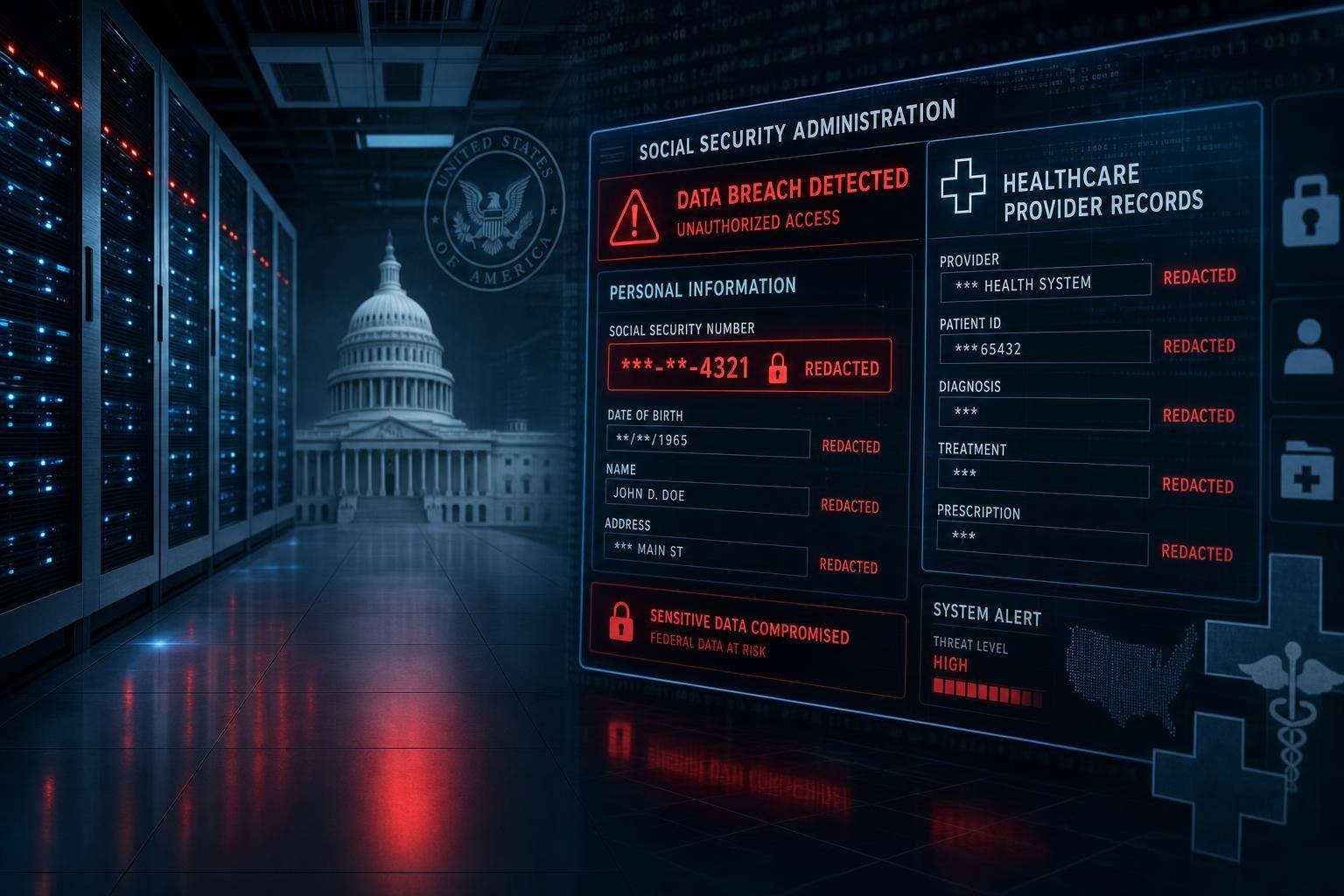
Reports surfaced on May 2, 2026 that a federal database tied to internal healthcare policy work inadvertently exposed Social Security Numbers (SSNs) and other personally identifiable information (PII) for numerous healthcare providers. According to security firm Secmentis, the database—reportedly connected to interagency work and lacking proper authentication—was publicly accessible, placing doctors, nurses, and allied health professionals at risk of identity theft, targeted phishing, and fraud.
The exposure appears to have stemmed from routine but high-impact misconfiguration errors: missing access controls, inadequate identity and access management (IAM), and insufficient auditing. The event echoes persistent government data handling lapses seen in earlier breaches such as the 2015 Office of Personnel Management (OPM) incident, which remains a defining example of the consequences of weak federal cybersecurity practices.
This piece explains what appears to have gone wrong, what risks providers and agencies now face, and what a credible mitigation path looks like. For healthcare organizations, federal program administrators, and security leaders in regulated sectors, it’s a case study in how to operationalize zero trust, fix IAM at the root, and build durable safeguards against data exposure.
What Happened—and Why It Matters Now
Per Secmentis’ report, the incident centers on a government-run database meant for internal policy tracking that was exposed to the open internet with weak or missing authentication. The dataset reportedly included provider names, credentials, and SSNs—high-value PII that can be immediately weaponized for identity fraud, synthetic identity creation, and high-credibility phishing aimed at both individuals and institutions. While there’s no confirmed evidence yet of exploitation, the window of exposure matters; even short-lived public access to sensitive data leaves a long tail of risk.
The timing matters for another reason: federal agencies are halfway through multi-year modernization efforts to adopt zero trust, strengthen logging, and standardize IAM across environments. When a misconfiguration still surfaces at this level—especially one touching SSNs—it highlights the gap between written policy and enforceable, automated controls. It’s a reminder that frameworks and memos do not protect data by themselves; secure defaults, continuous validation, and “break-glass” detection do.
The Anatomy of a Government Data Exposure
Incidents like this rarely hinge on a single mistake. Instead, they reflect layers of technical and process failure:
- Authentication missing or ineffective. A database can become public if access control lists (ACLs) or network policies are misapplied, or if an admin deploys a service with default “allow” rules.
- Public exposure pathways. Cloud object storage, search clusters (e.g., Elasticsearch), or API gateways can be left open to the world if “block public access” or network segmentation is not enforced.
- IAM drift and privilege creep. Excessive service account permissions and ad hoc exceptions become brittle over time, leading to unintended exposure.
- Weak secrets management. Credentials stored in code repos, wikis, or CI logs can open doors to sensitive data.
- Gaps in detection and logging. If CloudTrail-like logs, SIEM ingest, and egress analytics aren’t tuned and reviewed, organizations miss the early signs that something is wrong.
For federal programs handling PII, these are not merely best practices; they’re table stakes. The NIST SP 800-53 Rev. 5 controls catalog lays out access control (AC), audit and accountability (AU), identification and authentication (IA), and risk assessment (RA) requirements that exist precisely to prevent such exposures. And the NIST Digital Identity Guidelines (SP 800-63) detail how to prove, bind, and manage identities to limit who can view or manipulate sensitive data.
Why PII like SSNs is a Unique Risk Multiplier
SSNs are durable identifiers. Once compromised, they cannot be rotated like a password or API key. Attackers use SSNs to:
- Open accounts and lines of credit (identity theft)
- Construct “synthetic” identities that pass checks
- Create highly credible spear-phishing pretexts
- Pass KYC checks at certain institutions
- Target specific professions (e.g., physicians) with licensure or DEA registration scams
For healthcare providers, the risks are amplified. Attackers can combine SSNs with professional data to pursue tax fraud, manipulate claims, or tailor ransomware social engineering to organizations with high operational pressure and low tolerance for downtime. Even if the database is taken down quickly, harvested data persists on attacker infrastructure.
Parallels and Lessons from Prior Breaches
The federal sector has hard-won experience here. The OPM cybersecurity incidents underscored systemic weaknesses in asset inventory, credential safeguards, and incident response—lessons that spurred modernization. But exposures still recur when:
- Security controls are policy-on-paper rather than enforced through automation
- Legacy systems or urgent policy projects bypass change management
- Environments span multiple clouds or on-prem with inconsistent guardrails
- Log review is reactive, not continuous, and alerts lack clear owners
Frameworks alone can’t prevent drift. Organizations need technical guardrails that make the secure path the easy path: non-negotiable baselines, hardened templates, and service control policies that block public exposure by default.
The Strategic Security Gaps: Where Controls Likely Failed
While details are still emerging, the incident as described aligns with several classic failures:
- Public accessibility not blocked by default – In cloud object storage, “Block Public Access” must be forced at account and bucket levels. AWS documents this explicitly for S3; see Block Public Access. – Similar baseline controls exist for managed databases, search clusters, and Kubernetes ingress controllers.
- Incomplete zero trust implementation – Zero trust is not a memo; it’s continuous identity verification, policy-based access, and segmentation. The federal model is detailed in NIST SP 800-207 Zero Trust Architecture and operationalized by the CISA Zero Trust Maturity Model. If a sensitive system was reachable without strong auth, zero trust was not effectively implemented.
- Weak identity governance and secrets management – Service accounts and interagency access should be tightly scoped and monitored. NIST’s Digital Identity Guidelines emphasize proofing, binding, and lifecycle management—areas that often degrade without a central authority.
- Cryptographic controls not anchored to policy – Encryption at rest and in transit help, but cannot compensate for public exposure. OWASP categorizes these failures under A02:2021 Cryptographic Failures, where data is readable to unintended parties because of weak or misapplied controls.
- Alerting and egress monitoring gaps – Even with a misconfiguration, strong egress analytics and anomaly detection should flag large downloads or unrecognized clients touching sensitive stores.
Risks for Providers and Healthcare Infrastructure
Even without confirmed exploitation, risk modeling should assume worst-case exposure:
- Identity theft and financial fraud: SSNs enable credit applications and tax refund fraud. Providers should consider placing fraud alerts or freezes and using IdentityTheft.gov as a primary remediation resource.
- Spear-phishing and account takeover: Personalized lures may target hospital credentials, EHR access, or licensing portals.
- Claims and benefits fraud: PII could be used to submit fraudulent claims or redirect reimbursements.
- Regulatory and reputational damage: Healthcare organizations connected to the data may face scrutiny over third-party risk and HIPAA-adjacent responsibilities. While SSNs alone are not protected health information, provider PII can intersect with regulated data flows. See the HIPAA Security Rule from HHS for security expectations around ePHI—often implemented alongside broader PII controls.
For the federal stewards of the system, second-order risks include loss of public trust, legal exposure, and operational challenges if threat actors pivot from PII theft to disruptive attacks on health sector partners.
Immediate Actions: What Affected Providers Should Do
If you are a healthcare provider who may be impacted:
- Place a fraud alert or consider a credit freeze with major bureaus.
- Use IdentityTheft.gov to create a personalized recovery plan, especially for tax or credit issues.
- Enable multi-factor authentication (MFA) on email, hospital SSO, licensing boards, and financial accounts.
- Treat unexpected calls or emails purporting to be from federal agencies with scrutiny. Independently verify the source through official channels.
- Review bank, credit card, and insurance statements for unfamiliar activity.
- If you’re a practice owner or administrator, brief your staff and update your phishing training with examples referencing professional credentials and SSNs.
Providers should also ask the responsible agency for clear breach notifications, credit monitoring support, and transparency on remediation.
Immediate Actions: What Responsible Agencies Must Do
A credible response should include:
- Takedown: Immediately revoke public access and isolate the system.
- Log preservation and review: Secure logs, then review for access patterns, exfiltration attempts, and suspicious clients.
- Independent forensics: Engage third-party investigators to reconstruct timelines and assess data access.
- Notification and support: Promptly notify affected providers with clear guidance and available services (e.g., credit monitoring).
- Regulatory liaison: Coordinate with oversight bodies and IGs to ensure compliance and transparent reporting.
- Threat hunting: Monitor for impersonation, phishing campaigns, and unusual account activity targeting providers or downstream systems.
The agency should publicly commit to deploying mandatory guardrails across similar systems—and demonstrate proof through audits and independent validation.
A 30-60-90 Day Government Remediation Roadmap
Thirty days: Stabilize and close gaps – Implement enforced “deny by default” at the network edge for all sensitive systems. – Require MFA for all privileged accounts and service access. – Inventory all databases, APIs, and object stores that house PII; validate their access policies. – Centralize logging and ensure retention; ship to a SIEM or data lake with alerting tuned for egress anomalies. – Stand up an incident microsite with FAQs, notification timelines, and remediation resources.
Sixty days: Institutionalize zero trust and IAM hygiene – Roll out identity federation with step-up authentication for sensitive data access. – Enforce least privilege and time-bound access via just-in-time (JIT) workflows. – Deploy service control policies and resource-level guardrails in cloud accounts to block public exposure patterns (e.g., public ACLs, open security groups). – Implement sensitive data discovery and classification across stores; tag SSNs and related PII. – Map controls to NIST SP 800-53 baselines and document control ownership and evidence.
Ninety days: Automate and audit – Codify guardrails as code: baseline templates, policy-as-code, and CI checks that fail unsafe changes. – Adopt a zero trust reference design aligned to NIST SP 800-207 and the CISA Zero Trust Maturity Model; publish an implementation roadmap. – Conduct red team exercises focusing on misconfiguration, open storage, and credential theft. – Launch quarterly access recertifications and automatic revocation of stale privileges. – Commission an external audit and publish a summary of findings and mitigations.
Technical Controls That Would Have Prevented or Limited This Exposure
This incident underscores a focused set of safeguards that should be mandatory anywhere SSNs are present.
1) Block public access by default – Cloud object storage: Enforce account-level “block public access,” SCPs, and continuous monitoring. For example, AWS provides Block Public Access controls—equivalents exist in other clouds. – Managed databases and search: Require VPC/private endpoints, mutual TLS, and approved ingress only. – API gateways: Require OAuth2/OIDC with claims-based authorization and rate limiting.
2) Strengthen identity and authentication – Adopt phishing-resistant MFA (FIDO2/WebAuthn) for admins and high-risk access. – Enforce identity proofing and lifecycle management per NIST 800-63 Digital Identity Guidelines. – Use service identities with narrow scopes; prohibit hard-coded credentials and rotate secrets automatically.
3) Encrypt and tokenize sensitive data – Encrypt data at rest with KMS/HSM-backed keys and strict key policies. – Use application-layer encryption or format-preserving tokenization for SSNs; drastically reduce where raw values can exist. – Monitor for plaintext SSNs via DLP and data classification.
4) Segment and minimize blast radius – Network segmentation by sensitivity; no direct internet exposure. – Just-in-time access via privileged access management (PAM) to limit persistence of high-risk roles. – Break-glass procedures with robust monitoring and approvals.
5) Audit, detect, and respond quickly – Centralize audit logs (access, auth, key usage, egress) with immutable storage and alerting. – Correlate anomalies (e.g., large reads of SSN fields) and trigger automated containment. – Align detection to CISA’s Cross-Sector Cybersecurity Performance Goals.
6) Governance and secure SDLC – Treat guardrails as non-negotiable baselines; infrastructure-as-code pipelines should fail unsafe changes. – Security champions embedded with policy teams; changes require peer review and automated checks. – Regular tabletop exercises that simulate misconfiguration and public data exposure.
Mistakes to Avoid When Handling PII in Government and Healthcare
- Relying on “security through obscurity.” If a system is on the internet, assume it will be found and probed.
- Assuming encryption at rest is a silver bullet. If the database is publicly readable, data can be downloaded in plaintext through the application.
- Allowing exceptions to become defaults. Temporary openings must have time-bound justifications and automatic closure.
- Skipping data minimization. If a system doesn’t need raw SSNs, don’t store them. Tokenize; truncate; or replace with unique internal IDs.
- Treating policy as compliance theater. Map controls to verifiable evidence and test them under realistic failure scenarios.
How Enterprises Can Apply These Lessons Today
Even beyond the federal sphere, this incident is a wake-up call.
- Build an “exposure kill switch.” One command or runbook should instantly block public access across storage, databases, and edge services.
- Make sensitive stores event-driven. Any configuration change that affects access on a PII-bearing resource should emit an event that triggers validation and, if unsafe, rolls back.
- Reward secure defaults. Provide ready-to-use, pre-approved templates that make the secure path the fastest path.
- Score systems on “exploitability,” not just CVE count. Publicly reachable assets containing SSNs get the highest risk score; remediation is measured in hours, not weeks.
- Test like an adversary. Routine checks for open ports, anonymous access, and data exfiltration pathways should be part of continuous assurance.
Regulatory Oversight and the Policy Conversation
High-profile exposures involving Social Security Numbers inevitably fuel calls for tighter oversight. There is already a federal push toward zero trust via OMB memoranda and cross-agency strategies, but translating policy into measurable control strength remains uneven. Two constructive directions:
- Evidence-based compliance: Attach artifacts to controls—policy-as-code snippets, audit logs, and automated test results. Avoid checkbox attestations.
- Public accountability: When feasible, publish after-action reports and maturity roadmaps. Transparency builds trust and helps other agencies learn quickly.
While HIPAA primarily governs patient information, healthcare-adjacent PII in federal systems warrants HIPAA-grade discipline. The HHS HIPAA Security Rule offers a useful, if not directly mandated, benchmark for safeguards around confidentiality, integrity, and availability.
A Tactical Checklist for Leaders
Security leaders can use this condensed checklist to assess exposure risk today:
- Inventory: Do we have a live map of all data stores containing SSNs or equivalent PII?
- Access posture: Can any of those be accessed from the public internet? Are public ACLs globally blocked?
- Identity: Is access authenticated with phishing-resistant MFA and least-privilege roles?
- Data handling: Are SSNs tokenized where possible? Where do raw SSNs still exist—and why?
- Alerting: Would we detect large downloads or anomalous queries involving SSNs within minutes?
- Response: Could we revoke all public exposure paths in one hour or less?
- Assurance: Do we test these assumptions with automated checks in CI/CD and periodic red teaming?
Frequently Asked Questions
Q: What does a “publicly accessible database” actually mean? A: It means the system could be reached over the internet without proper authentication or network restrictions. In practice, that often looks like an open storage bucket, a database with a public endpoint, or an API missing authorization checks.
Q: Is encryption at rest enough to protect SSNs? A: No. Encryption at rest protects against physical media theft or unauthorized access to storage layers, not against a misconfigured application or database that serves plaintext data to anyone who can connect. You need strong authentication, authorization, and segmentation.
Q: How can agencies prevent this kind of exposure in the future? A: Enforce deny-by-default at the perimeter, require phishing-resistant MFA, implement zero trust access, tokenize SSNs, and use automated guardrails that block public exposure at the platform level. Align controls to NIST SP 800-53 and NIST SP 800-207, and validate continuously.
Q: What should affected healthcare providers do right now? A: Consider placing a fraud alert or credit freeze, enable MFA on critical accounts, monitor financial and insurance statements, and create a recovery plan via IdentityTheft.gov. Be alert for spear-phishing referencing your credentials or SSN.
Q: Does HIPAA apply to this incident? A: HIPAA regulates protected health information (PHI). Provider SSNs and professional PII may not be PHI on their own, but organizations handling both PHI and PII often implement HIPAA-grade safeguards across data classes. The HIPAA Security Rule remains a strong benchmark for security controls.
Q: What are common technical pitfalls that lead to public data exposures? A: Public ACLs on storage, open database endpoints, missing or weak authentication, hard-coded credentials, and lack of automated policy checks. OWASP’s A02:2021 Cryptographic Failures also covers misuse of encryption that leaves data readable in practice.
The Bottom Line: Turn This SSN Exposure into a Security Inflection Point
The reported Trump Administration incident—where a misconfigured database exposed healthcare providers’ Social Security Numbers—should be treated as a forcing function to modernize data protection. The lesson is not new, but it is urgent: sensitive identifiers demand zero trust access, tokenization, strict least privilege, and platform-level guardrails that make unsafe configurations impossible to deploy.
For affected providers, immediate personal risk mitigation—credit protection, MFA, vigilance for targeted scams—matters. For agencies and healthcare leaders, the path forward is disciplined and measurable: implement deny-by-default, harden IAM with phishing-resistant MFA, instrument robust logging and egress analytics, and prove control efficacy through automation and independent audit. Reference frameworks exist—NIST SP 800-53, NIST SP 800-207, the CISA Zero Trust Maturity Model, and HIPAA Security Rule guidance—but they must be operationalized as code and continuously verified.
Public trust depends on it. So does the practical ability to keep the nation’s healthcare infrastructure safe from identity fraud, targeted phishing, and ransomware. The next best step is the concrete one you can measure today—starting with shutting every public door to SSNs and proving they’ll stay shut.
Discover more at InnoVirtuoso.com
I would love some feedback on my writing so if you have any, please don’t hesitate to leave a comment around here or in any platforms that is convenient for you.
For more on tech and other topics, explore InnoVirtuoso.com anytime. Subscribe to my newsletter and join our growing community—we’ll create something magical together. I promise, it’ll never be boring!
Stay updated with the latest news—subscribe to our newsletter today!
Thank you all—wishing you an amazing day ahead!
Read more related Articles at InnoVirtuoso
- How to Completely Turn Off Google AI on Your Android Phone
- The Best AI Jokes of the Month: February Edition
- Introducing SpoofDPI: Bypassing Deep Packet Inspection
- Getting Started with shadps4: Your Guide to the PlayStation 4 Emulator
- Sophos Pricing in 2025: A Guide to Intercept X Endpoint Protection
- The Essential Requirements for Augmented Reality: A Comprehensive Guide
- Harvard: A Legacy of Achievements and a Path Towards the Future
- Unlocking the Secrets of Prompt Engineering: 5 Must-Read Books That Will Revolutionize You