
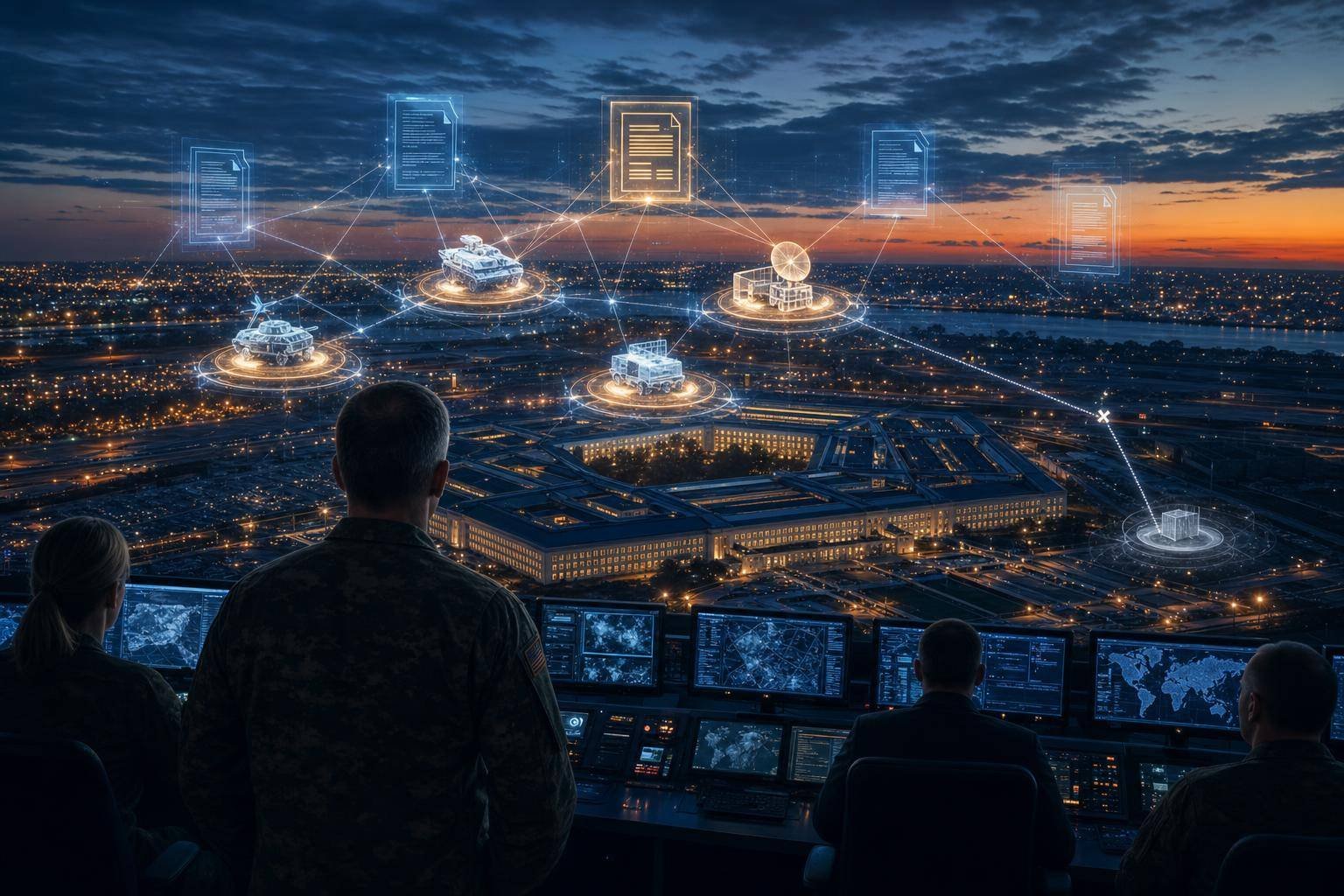
Pentagon AI procurement deals: Who won, why Anthropic was left out, and what it means for defense AI
The Pentagon just moved decisively to scale artificial intelligence across U.S. defense systems—signing AI procurement deals with Amazon Web Services, Google, Microsoft, Nvidia, OpenAI, SpaceX, and the venture-backed newcomer Reflection AI. One conspicuous omission: Anthropic, sidelined after being flagged as a supply chain risk by the administration in February 2026.
This isn’t a routine vendor shuffle. These agreements are a strategic bet that the private sector’s foundation models, cloud infrastructure, chips, and secure communications can be adapted to high-side networks and contested environments. They also signal sharper lines in AI governance: resilience and supply chain trust now sit beside accuracy and safety as gating criteria for national-security AI.
Below, we break down what these Pentagon AI procurement deals likely cover, how integration into classified environments works in practice, why Anthropic’s absence matters, and what defense and enterprise leaders should do next to adopt AI securely and effectively.
What the Pentagon AI procurement deals actually cover
While contract specifics are classified or not yet public, the vendor mix reveals the technical building blocks the Department of Defense (DoD) intends to standardize:
- Cloud compute at multiple impact levels: AWS, Microsoft, and Google provide hyperscale compute and storage, with U.S. public sector offerings aligned to FedRAMP High and DoD SRG IL4–IL6 enclaves. See AWS GovCloud (US), Microsoft Azure Government, and Google Cloud Assured Workloads.
- Foundation models and AI services: OpenAI provides access to general-purpose models via partners or secure service tiers; “bring-your-own-model” is also common via each cloud’s marketplace and managed ML stacks. Reflection AI—flush with capital—likely targets custom models and workflows tailored to defense mission profiles.
- Accelerated hardware and on-prem/hybrid AI: Nvidia’s data center stack (e.g., DGX, HGX, networking, and CUDA software) underpins both cloud and on-prem deployments that can operate air-gapped for classified workloads. See the NVIDIA DGX platform.
- Secure communications and edge connectivity: SpaceX’s secure satellite services and launch capabilities bolster comms for edge inference and distributed operations, especially where terrestrial networks are degraded or denied.
Together, these threads point to a hybrid, multi-level AI posture: commercial clouds for lower-side development and experimentation; dedicated government regions for sensitive but unclassified or controlled workloads; and on-prem or special-access enclaves for IL6 and beyond.
How these pieces fit together
Expect three major integration patterns:
- Public-to-private pipeline for model lifecycle – Train and experiment with unclassified data in GovCloud or equivalent. – Push distilled or adapter-based variants (e.g., LoRA, PEFT) to high-side networks. – Synchronize approved artifacts via controlled cross-domain solutions (CDS) and rigorous change control.
- Classified RAG over foundation models – Keep the model weights static and host them inside the enclave. – Build retrieval-augmented generation (RAG) pipelines that query classified corpora, with strong data governance and content filters. – Log and audit prompts, retrievals, and completions to support oversight and investigations.
- Edge inference with resilient comms – Run compact models on tactical compute (GPU/CPU/accelerators) at the edge. – Sync parameters or knowledge via intermittent satellite links. – Use model ensembles and policy gating to mitigate hallucinations and adversarial inputs when disconnected.
Why Anthropic is absent: supply chain risk and AI governance
Anthropic’s exclusion traces to its designation as a supply chain risk earlier this year. In defense acquisition, that label isn’t rhetorical—it triggers risk-based procurement controls that can block or delay awards even when tech performance is strong.
This highlights a broader shift: AI “safety” has expanded from model behavior into full-spectrum supply chain security. Key dimensions include:
- Ownership, control, and influence (OCI) risks
- Data residency and data lineage for training and fine-tuning
- Insider threat and contractor vetting
- Model and software bill of materials (SBOM) provenance
- Third-country dependencies in chip design, fabrication, or toolchains
- Exploit exposure in the AI/ML stack and MLOps pipeline
For context on the security lens shaping these calls, DoD and federal guidance increasingly anchor to frameworks like the NIST AI Risk Management Framework and the DoD’s Zero Trust Strategy. On the supply chain front, (and more broadly in federal practice) risk management aligns with NIST’s enterprise SCRM guidance and parallel controls embedded in acquisition policy.
The political layer matters, but the operational logic is straightforward: the Pentagon is prioritizing vendors it can accredit quickly across impact levels, embed in hybrid architectures, and continuously assess for risk. That can temporarily squeeze high-performing players that can’t clear the supply chain bar under current criteria—even if their models excel in benchmarks.
The mission payoff—and the limits—of defense AI
The selection signals where DoD expects near-term value:
- Intelligence triage and analyst co-pilots: Summarizing ISR feeds, fusing HUMINT and OSINT, flagging anomalies.
- Cyber defense augmentation: LLM-assisted investigation, reverse engineering helpers, automated hunting playbooks.
- Logistics and sustainment: Predictive maintenance, routing and supply recommendations, demand forecasting.
- Training, simulation, and planning: Scenario generation, red team adversary modeling, wargame after-action analysis.
- C2 decision support: Structured brief generation from multi-domain inputs; not automated command—augmented staff work.
But value doesn’t absolve limits:
- Hallucination and overconfidence: Even top models fabricate details under pressure; governance and workflow design must assume fallibility.
- Adversarial exposure: Prompt injection, data poisoning, model theft, and fine-tuning abuse are now part of the threat model; see MITRE ATLAS and the OWASP Top 10 for LLM Applications.
- Classification boundary friction: Moving models and data across impact levels is slow by design; teams must plan for lead times and policy reviews.
- Edge constraints: Power, bandwidth, and compute scarcity at the tactical edge require model compression, distillation, and careful latency trade-offs.
- Human system integration: If outputs don’t map cleanly to operator workflows or doctrine, adoption will stall, regardless of model quality.
Inside the integration: from cloud to air-gapped enclaves
Strictly speaking, there is no one-size-fits-all “AI stack for classified.” Instead, think in layers and controls.
Cloud foundations and impact levels
- Use hyperscalers’ U.S. government regions for development and test with unclassified and CUI data. Reference architectures and services vary:
- AWS GovCloud (US)
- Microsoft Azure Government
- Google Cloud Assured Workloads
- Isolate projects per mission with strict identity and access control, KMS-backed encryption, and VPC/VNet egress policies.
- Prepare artifacts for high-side promotion with cryptographic signing, SBOMs, and model cards documenting evaluation and limitations.
High-side deployment
- Run models inside IL6 or SAP/SAR enclaves on GPU clusters or specialized appliances (e.g., Nvidia-powered systems).
- Ingest classified corpora via controlled pipelines with data loss prevention (DLP), content labeling, and lineage capture.
- Enforce guardrails: policy-based content filters, allow/deny lists, and retrieval scopes.
- Bake in auditable logging for prompts/completions, retrievals, and system actions—stored in append-only or WORM storage to support oversight.
Edge inference and comms
- Deploy small/quantized models onto ruggedized edge compute; plan for survivability and intermittent links.
- Use resilient transport (e.g., SATCOM, HF, or mesh) for parameter updates; prefer asynchronous protocols and store-and-forward patterns.
- Enforce tamper resistance on devices; remote attestation and secure boot help validate integrity post-contact.
Security and assurance: the new AI “authority to operate”
Defense AI will live or die by how well it’s secured. Three streams should be non-negotiable.
1) Secure-by-design AI engineering
Adopt engineering practices now codified in public guidance:
- Follow the joint CISA/NCSC Secure AI System Development Guidelines for threat modeling, secure coding, and ML pipeline hardening.
- Use the NIST AI RMF to align governance across mapping, measurement, management, and oversight.
- Integrate the OWASP Top 10 for LLM Applications into design reviews and red-team playbooks.
2) Red-teaming and model evaluations
- Test against adversarial behaviors cataloged in MITRE ATLAS.
- Run structured evals for hallucination, injection resilience, toxic output, and data exfiltration risk.
- Measure utility with mission-specific tasks and ground truth—not only generic benchmarks.
3) Zero Trust around the AI surface
- Treat the model as an untrusted compute surface within a Zero Trust fabric—segment, authenticate, authorize, and continuously verify.
- Align network and identity with the DoD’s Zero Trust Strategy.
- Instrument comprehensive observability: prompt/response telemetry, feature store access, retrieval events, and policy enforcement logs.
Program-office playbook: how to buy and deploy AI that works
Here’s a practical sequence that defense program managers, CIOs, and integrators can use to turn contracts into outcomes.
1) Define the mission outcome first
- Document the decision or workflow you want to accelerate—e.g., “Reduce ISR triage time by 40% while increasing correct prioritization.”
- Decide where humans remain in the loop and where the system can act autonomously within doctrine.
2) Choose the deployment tier
- Unclassified experimentation: Use government cloud regions, synthetic data, or sanitized corpora.
- Controlled but not classified ops: Gate via assured workloads and strong segmentation.
- Classified ops: Plan for on-prem/air-gapped with replicated services and constrained dependencies.
3) Pick the model strategy
- Off-the-shelf foundation models: Fastest to value for summarization, Q&A, translation, and code assistance.
- Fine-tuning or adapters: Required when mission language, acronyms, or domain nuance dominates.
- Small specialized models: Ideal for edge inference or tightly-scoped classification.
- Ensemble approach: Combine retrieval, rules, and multiple models to boost reliability.
4) Architect for safety and resilience
- Retrieval-augmented generation with curated, labeled corpora.
- Content filters and policy gates pre/post-generation.
- Rate-limits, context-length management, and safety overrides to mitigate prompt injection.
- Canary prompts and continuous probes to detect drift or compromised guardrails.
5) Build security in from day one
- Threat-model the ML pipeline and data stores; enumerate attack surfaces and mitigations.
- Harden model packaging and deployment; sign artifacts and verify at runtime.
- Apply least-privilege to every component, including the model runtime, vector stores, and feature stores.
- Establish incident response procedures specific to AI (e.g., rollback contaminated weights, revoke embeddings, quarantine vector indices).
6) Validate, accredit, and iterate
- Pre-fielding: Run mission-anchored evals with red and blue teams; record limitations in model cards and risk registers.
- Accreditation: Prepare artifacts for ATO with traceable tests, SBOMs, and continuous monitoring plans.
- Post-fielding: Instrument metrics that matter—precision/recall on mission tasks, time-to-resolution, analyst satisfaction, false positive/negative rates.
7) Negotiate contracts for agility, not just cost
- Insist on exit ramps: data portability, model portability (where feasible), and clear IP boundaries for your fine-tunes and adapters.
- Balance consumption pricing vs. reserved capacity for predictable spend under surge.
- Lock in SLAs for latency, uptime, and incident response; clarify support for classified deployments.
The vendor roles in brief (and what to demand from each)
- AWS, Microsoft, Google: Demand hardened reference architectures for Gov regions, blueprint stacks for RAG and fine-tuning, and documented pathways to replicate services in high-side enclaves. Validate controls with third-party attestations aligned to defense standards.
- Nvidia: Secure a roadmap for on-prem acceleration (DGX/HGX or equivalents), validated software containers, and playbooks for quantization/distillation to hit edge targets.
- OpenAI: Push for enterprise security guarantees, robust content filters, and model transparency sufficient for defense risk assessments. When routing via a cloud partner, align data-handling and logging across both layers.
- SpaceX: Focus on assured availability under contested conditions, latency/jitter profiles for AI synchronization, and end-to-end encryption posture for sensitive payloads.
- Reflection AI: Demand maturity signals—secure SDLC, red-team results, supply chain disclosures, and a support model that can handle accreditation and audits.
Risks to manage: lock-in, overreliance, and policy whiplash
- Lock-in and concentration risk: Model and cloud monopolies can stall innovation and inflate costs. Mitigation: use open interfaces, standard vector DBs, and containerized deployments that can move across clouds and on-prem.
- Overreliance on generative outputs: LLM confidence can mask errors; ensure human verification where the cost of a miss is high.
- Data governance drift: Shadow datasets and embeddings leak quickly; enforce data catalogs, access reviews, and retention controls.
- Policy whiplash: Shifting supply chain designations or export controls can flip vendor eligibility. Maintain a multi-vendor bench and pre-approved alternatives to swap in with minimal disruption.
Market implications: consolidation at the top, opportunity at the edge
The Pentagon’s move accelerates consolidation among hyperscalers, chipmakers, and model providers with the scale and compliance muscles to deliver across classification levels. But it also opens seams where startups can thrive:
- Mission-specific tooling: Red-teaming, eval harnesses, and policy enforcement layers tailored to defense workflows.
- Data engineering for classified: Ingestion, labeling, and RAG curation that respects access controls and lineage.
- Edge model optimization: Compression, distillation, and hardware-aware runtimes for fielded systems.
- Human-machine teaming UX: Interfaces and orchestration that actually fit how operators plan and fight.
If you’re a smaller vendor, the playbook is clear: partner with a prime, align to government reference architectures, and invest early in security posture, documentation, and accreditation readiness.
What to watch next
- Accreditation patterns: Look for reusable ATO templates and validated stacks from each cloud partner and integrator.
- Model transparency norms: Expect more rigorous demands for evals, safety docs, and red-team results in classified contexts.
- Replicator-style procurement velocity: If the deals shorten the distance from demo to fielding, the initiative will be judged a success.
- Edge AI breakthroughs: Practical wins for on-device inference under intermittent comms will set the bar for real-world utility.
- Policy recalibration: Supply chain risk designations can change; watch for re-evaluations and appeals that may reshape the vendor field.
Frequently asked questions
How do these Pentagon AI procurement deals relate to existing cloud contracts like JWCC?
They’re complementary. Cloud contracts provide compute and storage across classification levels, while these AI-focused deals aim to streamline access to models, accelerators, and AI services—plus integration support—on top of that infrastructure.
Can classified networks really use commercial LLMs?
Yes, but typically as self-hosted deployments within air-gapped enclaves or as managed services in dedicated government regions that meet DoD impact levels. Dev/test often happens on lower-side networks, with approved artifacts promoted to high-side environments.
Is Anthropic permanently excluded from Pentagon work?
Supply chain risk designations are policy decisions that can be revisited. Today’s deals move forward without Anthropic; future eligibility depends on how risk concerns are addressed and re-assessed.
Are open-source models viable for defense use?
They can be, especially for edge inference and tightly-scoped tasks. The tradeoffs include model quality, maintenance burden, and accreditation overhead. Many programs blend open and proprietary models behind a common orchestration layer.
What’s the biggest technical risk to watch in defense AI deployments?
Adversarial exploitation—prompt injection, data poisoning, model theft, and covert data exfiltration—combined with hallucinations that operators mistake for fact. Mitigate with layered guardrails, RAG over trusted corpora, robust red-teaming, and human-in-the-loop checkpoints for high-stakes decisions.
Conclusion: The real test of the Pentagon AI procurement deals starts now
The Pentagon AI procurement deals put the core components of modern AI—cloud, models, accelerators, and secure comms—on contract with vendors that can operate at national-security scale. The upside is meaningful: faster analyst workflows, sharper cyber defense, smarter logistics, and better planning support. The catch is that the hard work now shifts to integration, accreditation, and operationalization inside high-side networks and contested environments.
Success will come from disciplined engineering and governance: Zero Trust around AI surfaces, secure-by-design ML pipelines, rigorous model evals, and human-machine teaming that respects doctrine and workload reality. Program offices should lock in multi-vendor flexibility, build repeatable ATO paths, and measure outcomes that matter to the mission.
Done well, these Pentagon AI procurement deals will shrink the gap between the state of the art and the state of the practice—delivering AI that’s not just impressive in a demo, but reliable in the field.
References and further reading: – DoD Chief Digital and AI Office (CDAO) – NIST AI Risk Management Framework – CISA/NCSC Secure AI System Development Guidelines – OWASP Top 10 for LLM Applications – MITRE ATLAS – DoD Zero Trust Strategy and Roadmap – AWS GovCloud (US) – Microsoft Azure Government – Google Cloud Assured Workloads – NVIDIA DGX platform
Discover more at InnoVirtuoso.com
I would love some feedback on my writing so if you have any, please don’t hesitate to leave a comment around here or in any platforms that is convenient for you.
For more on tech and other topics, explore InnoVirtuoso.com anytime. Subscribe to my newsletter and join our growing community—we’ll create something magical together. I promise, it’ll never be boring!
Stay updated with the latest news—subscribe to our newsletter today!
Thank you all—wishing you an amazing day ahead!
Read more related Articles at InnoVirtuoso
- How to Completely Turn Off Google AI on Your Android Phone
- The Best AI Jokes of the Month: February Edition
- Introducing SpoofDPI: Bypassing Deep Packet Inspection
- Getting Started with shadps4: Your Guide to the PlayStation 4 Emulator
- Sophos Pricing in 2025: A Guide to Intercept X Endpoint Protection
- The Essential Requirements for Augmented Reality: A Comprehensive Guide
- Harvard: A Legacy of Achievements and a Path Towards the Future
- Unlocking the Secrets of Prompt Engineering: 5 Must-Read Books That Will Revolutionize You