
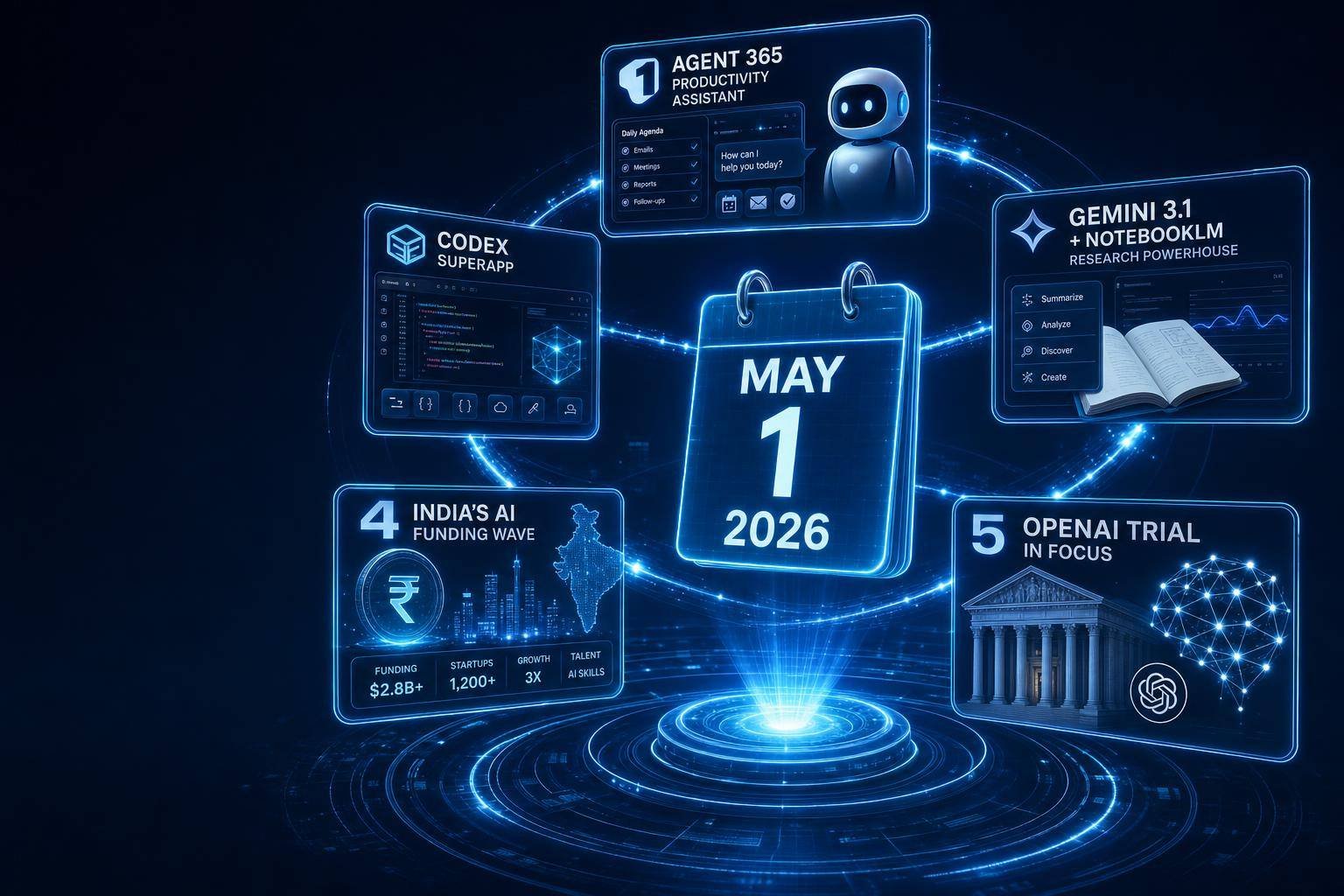
5 AI Updates You Need to Know Today (May 1, 2026): Agent 365, Codex SuperApp, Gemini 3.1 + NotebookLM, India’s Funding Wave, and the OpenAI Trial
May opened with AI updates that moved the goalposts for builders, security teams, and executives. The day wasn’t just about product drops—it spotlighted the maturing of AI agents, the consolidation of personal knowledge tools, and a structural shift in where venture dollars are betting on AI’s next act.
If you lead engineering, security, or operations, these AI updates matter because they define what will actually land in production this quarter: enterprise agents doing real work across Microsoft 365, a reinvention of OpenAI’s developer utility for code and actions, and Google’s push to make note-taking systems truly intelligent. Meanwhile, a headline OpenAI trial is shaping norms around safety, IP, and transparency. And India’s funding spike signals where AI R&D and go-to-market capacity may scale fastest over the next 12–24 months.
Today’s AI updates at a glance
- The OpenAI trial (Musk vs. Altman) moved forward with high-profile scrutiny on AI safety governance, data use, and corporate accountability—topics every AI buyer should treat as due diligence categories, not just headlines.
- Microsoft launched Agent 365, positioning multi-step enterprise agents as first-class citizens inside Microsoft 365. Expect deeper integration with Graph permissions, workflow orchestration, meeting insights, and policy-aware automation.
- OpenAI evolved Codex into a SuperApp—shifting from “only coding” to a general-purpose environment where code generation, tool invocation, and workflow execution converge.
- Google’s Gemini 3.1 Pro integrated with NotebookLM, upgrading personal knowledge work with better summarization, source-grounding, and context continuity across documents and media.
- India’s AI startup funding jumped, pointing to a significant redistribution of AI innovation capacity—especially in data tooling, applied ML, and verticalized automation.
Below, we unpack each development, with practical implementation guidance, security considerations, and takeaways for product leaders and CISOs.
The OpenAI trial: why the Musk vs. Altman case matters for builders and buyers
When AI companies are on trial, the courtroom can set the tone for procurement checklists, investor scrutiny, and board-level risk posture. Regardless of the outcome, the OpenAI trial has immediate implications:
- Governance and safety: Buyers will ask tougher questions about model provenance, red-team coverage, evals, and incident response. The NIST AI Risk Management Framework (AI RMF) offers a vendor-agnostic structure to assess these areas across “govern, map, measure, and manage.”
- Data collection and use: Expect more granular requirements around training data sources, opt-outs, internal fine-tuning, and retention policies for prompts and outputs.
- IP and attribution: Engineering leaders should track how companies represent their training data lineage and code generation policies, especially where code suggestions might include third-party-licensed fragments.
- Safety claims and marketing: Security and compliance teams will push vendors to align claims with documented controls. Agencies like CISA’s AI resources are increasingly shaping “secure-by-design” expectations for AI products.
Action for teams: – Update your AI procurement templates to map vendor responses to NIST AI RMF categories. Prioritize demonstrable controls (eval reports, red-team artifacts, incident playbooks) over generic promises. – For generative code tools, clarify how outputs are filtered and attributed; align with your open-source policy and code scanning processes. – Establish a cross-functional AI governance cadence (security, legal, product, data) to review new AI tooling before it reaches production.
Bottom line: The trial accelerates a shift from AI enthusiasm to AI accountability. Enterprises that operationalize this shift will adopt faster, with fewer surprises.
Microsoft brings agents to the center with Agent 365
Microsoft didn’t just rebrand its assistants; it put agents where most knowledge work already lives. If your workforce runs on Excel, Teams, Outlook, SharePoint, and Power Platform, “Agent 365” is zero-distance from your daily operating system.
What this likely means in practice: – Persistent multi-step workflows: Agents that monitor inboxes, analyze attachments, cross-reference SharePoint libraries, and draft responses or tasks—then follow up until completion. – Context via Microsoft Graph: Access to organizational context (files, emails, calendars) gated by permissions—potentially enabling nuanced actions while respecting data governance. – Orchestration for business processes: Triggered by forms, tickets, or events; orchestrating approvals, notifications, and content generation with audit trails you can review.
Where to start: – Map 3–5 high-friction workflows: Examples include weekly sales forecast roll-ups, incident postmortem prep, vendor intake reviews, or SOC alert triage drafts. – Safeguard with least-privilege Graph scopes: Give the agent only what it needs, and simulate edge cases in a sandboxed tenant before opening up. – Monitor with metrics: Define success (e.g., time saved, errors prevented, approvals completed) and create dashboards to validate impact.
Useful documentation to ground your implementation: – Microsoft 365 Copilot concepts (identity, permissions, data boundaries): Microsoft 365 Copilot overview – Building and governing custom agents/workflows: Microsoft Copilot Studio overview
Key risks and mitigations: – Over-broad agent permissions: Treat Graph access like production database credentials. Use conditional access, data loss prevention (DLP), and pilot groups. – Quiet failure modes: An agent that misinterprets a recurring instruction can automate mistakes at scale. Require human-in-the-loop for high-impact actions, at least initially. – Compliance and eDiscovery: Ensure generated content and agent actions are logged and discoverable per your retention policies.
Strategic takeaway: If Copilot was about assistance, Agent 365 is about outcomes. Design your rollouts around measurable, cross-app workflows—not just chat prompts.
OpenAI’s Codex becomes a SuperApp: from code to actions
OpenAI’s Codex once specialized in turning natural language into code. The SuperApp direction signals a consolidation: coding, tool invocation, and action execution under one pane. For developers and technical teams, this blurs the line between an IDE helper and an automation hub.
What developers should expect conceptually: – Code + tools: The model not only generates functions but calls tools to run analyses, fetch data, or kick off CI/CD steps—under supervision. – Assisted orchestration: Define tools, schemas, and guardrails; let the system decide which to call and in what order for a given goal. – Context persistence: Memory of previous tasks, project structure, and environment variables to avoid repetitive setup.
OpenAI documentation that maps to these capabilities: – Tool/function calling design patterns: Function calling guide – Multi-step orchestration and tool wrapping: Assistants API overview
Enterprise use cases beyond “autocomplete”: – DevOps copiloting: From “open a PR” to “open a PR that addresses the Snyk critical finding, reference issue #123, add unit tests, and update the Helm chart.” – Data operations: “Profile yesterday’s data load, identify null spikes by column, and file a ticket if anomalies exceed the control threshold.” – Security engineering: “Generate Sigma rules based on last week’s attacker TTPs, validate against our test corpus, and propose alert thresholds.”
What to standardize before rollout: – Tool contracts: Define strict JSON schemas and idempotent behaviors; all side-effecting tools should support dry-run modes. – Access boundaries: Don’t grant the agent your production keys. Use short-lived tokens, environment scoping, and explicit allowlists for repositories and services. – Observability: Log every tool call, arguments, return codes, and user approvals. Make it trivial to replay a session for incident review.
Known limitations: – Hallucinated APIs: The model may “call” a tool that doesn’t exist if your registry isn’t authoritative. Enforce tool whitelists and reject unknown calls. – Fragile prompts: Minor context changes can affect tool sequencing. Favor structured instructions and policy checks over free-form prompts.
Strategic takeaway: Treat the SuperApp like a programmable teammate. Invest in tool design, approvals, and telemetry—the plumbing is the product.
Google Gemini 3.1 Pro + NotebookLM: personal knowledge work, upgraded
Integrating a high-capability model with a personal knowledge workspace is a direct play for analyst, researcher, and operations roles that live in documents, transcripts, and data snippets. Gemini 3.1 Pro pairing with NotebookLM is less about novelty and more about depth: better citation, source-aware synthesis, and continuity across media.
What the integration enables for individuals and teams: – Source-grounded summarization: Ingest docs, spreadsheets, audio transcripts; receive concise outputs with links back to passages you can verify. – Cross-document reasoning: Ask “compare the terms” or “extract the changes across these versions” and get structured diffs or checklists. – Meeting-to-action pipelines: Convert multi-person notes into action items, owners, and deadlines—synced to your task system.
Relevant official references: – Gemini models and capabilities overview: Google Gemini API models – NotebookLM product site for feature scope and eligibility: NotebookLM
How to use it responsibly with enterprise data: – Segregate workbooks: Keep personal research, team documents, and confidential materials in separate notebooks with clear sharing rules. – Verify citations: Make citation checking a habit before forwarding summaries. Require links or paragraph references for sensitive material. – Export governance: If NotebookLM allows export to email or task systems, ensure it respects labeling (public/internal/confidential) and DLP.
Common pitfalls: – Over-trust in summaries: Even with citations, models can misinterpret ambiguous text. Treat outputs as drafts, not decisions. – Scope creep: NotebookLM is not a system of record. Don’t let it become your only place for critical policies or canonical data.
Strategic takeaway: The productivity upside is real when source-grounding is strong. Focus adoption on roles that already synthesize information—analysts, PMs, ops leads.
India’s AI funding surge: what global teams should plan for
India’s AI startup funding wave is more than a headline. It compounds an existing industrial advantage: a world-scale engineering talent pool, cost-effective product iteration, and digital public infrastructure (DPI) that makes “build-to-distribute” unusually fast.
Context that matters for strategy: – Distribution rails: India’s DPI (e.g., Aadhaar for identity, UPI for payments) accelerates adoption of AI-native services. See the official overview of India Stack components here: India Stack. – Applied AI focus: Expect growth in vertical AI for BFSI, healthcare administration, logistics, and SMB SaaS—often leveraging RAG on domestic data and multilingual support. – Compute and data center build-out: Capacity is catching up. Near-term, many Indian startups will blend local services with global cloud regions for training and inference.
How global orgs can engage: – Vendor scouting: Add India-based AI startups to your RFPs, especially for tooling around data labeling, RAG pipelines, cost-optimized inference, and multilingual assistants. – Co-innovation labs: Pilot with time-boxed sprints, clear KPIs, and joint IP frameworks. Optimize for fast learning, not just procurement speed. – Compliance early: Map data residency, cross-border flows, and model traceability requirements into contracts from day one.
Risks to manage: – Over-concentration on low-cost delivery: Look for architectural maturity—evals, observability, and rollback plans—not only price. – Model governance gaps: Insist on documented eval results and failure modes for your domain, not just generic benchmarks.
Strategic takeaway: India’s surge creates new options for cost-performance in applied AI. Build a structured scouting and pilot process now, before competitors lock in partnerships.
How to act on today’s AI updates: a 30-60-90 day plan
A crisp plan turns news into outcomes. Here’s a pragmatic track to execute against these AI updates.
30 days: Discover and de-risk – Inventory candidate workflows for agents: Collect 10 tasks across Sales Ops, Finance, HR, IT, and Security that are rules-based and repetitive. – Establish guardrails: Adopt the NIST AI RMF as your common language. Define approval thresholds for agent actions. – Pilot sandboxes: Stand up a non-prod M365 tenant and a dev environment for OpenAI/Google experiments. Seed with synthetic or scrubbed data. – Security baselines: Adopt the OWASP Top 10 for LLM Applications as your initial design checklist for prompts, tools, and memory.
60 days: Build and measure – Ship 2–3 agent pilots: One in Microsoft 365 (e.g., meeting-action pipeline), one developer-facing (e.g., Codex-like tool orchestration), and one knowledge synthesis (Gemini + NotebookLM). – Instrument everything: Log prompts, tool calls, response times, error classes. Create dashboards for time saved, rework avoided, and user satisfaction. – Legal and procurement alignment: Update AI vendor questionnaires with safety, data, and IP sections. Include controls from CISA’s AI security guidance.
90 days: Operationalize and scale safely – Graduate pilots: Move the highest-ROI agent to limited production with least-privilege scopes, approval workflows, and eDiscovery compatibility. – Training and change management: Deliver role-specific playbooks. Measure adoption and iterate prompts and tool contracts based on real usage. – Portfolio governance: Stand up a quarterly AI council to review incidents, metrics, and new requests. Use kill-switches and versioning for agents.
Mistakes to avoid – Skipping observability: If you can’t replay an agent’s decision path, you can’t secure it. – Unbounded actions: Start with read-only or draft modes. Add action privileges only after consistent accuracy. – Shadow integrations: Centralize API keys and tool registries. Rogue connectors create audit gaps.
Security, privacy, and compliance: don’t ship agents without these controls
The thematic throughline of today’s AI updates is agency: systems that act. That raises the bar for security and governance.
Must-have controls before production – Identity and access: Use service principals for agents; rotate short-lived credentials; gate privileged actions behind human approvals or policy checks. – Data minimization: Pass only the minimum context needed for the task. Mask PII and secrets. Apply field-level redaction in prompts and tool outputs. – Policy-aware tool registry: Maintain a signed, versioned registry of allowed tools with schemas and side-effect flags. Reject any call to unknown tools. – RAG hygiene: For NotebookLM- or Gemini-style retrieval, tag sources with sensitivity levels; filter what can flow into prompts. Verify citations. – Evaluation and red-teaming: Cover jailbreaks, prompt injection, data exfiltration, and tool abuse. Document failure modes and residual risks.
Frameworks and references to anchor your program – NIST AI RMF for program structure: NIST AI Risk Management Framework – OWASP’s LLM-specific threat list: OWASP Top 10 for LLM Applications – CISA’s secure-by-design expectations and AI resources: CISA AI
Operational practices – Human-in-the-loop as a control, not a crutch: Require approvals for high-impact actions and re-evaluate when error rates fall. – Canary actions: For potentially destructive operations, perform read-only validations first (e.g., “show me the diff,” “preview the email”). – Incident playbooks: Treat prompt injection and tool abuse as first-class incidents. Define containment, forensics, and communication steps.
Practical examples: where these AI updates add value now
Agent 365 in Microsoft ecosystems – Sales ops: Automatically compile weekly pipeline deltas from CRM exports, highlight risk deals, draft follow-ups, and schedule next steps with account execs. – Finance: Reconcile vendor invoices, flag anomalies, draft requests for clarification, and route to owners for approval. – IT helpdesk: Summarize patterns in tickets, propose knowledge base updates, and escalate clusters of similar issues.
OpenAI SuperApp for engineering and DevOps – Feature scaffolding: Generate service skeletons, tests, and CI configs; open PRs with linked issues; request review from the right team. – “Ops as code” assistant: Parse runbooks, propose Terraform diffs, and simulate changes before creating a change request.
Gemini + NotebookLM for analysts and PMs – Cross-document Q&A: “What changed between policy v3 and v4 that affects external vendors?” with citations. – Meeting synthesis: “Summarize the last three architecture meetings and list unresolved decisions with owners.”
Global sourcing with India’s AI ecosystem – Data tooling: Pilot a labeling or RAG pipeline vendor specialized in multilingual Indian languages and domain-specific ontologies. – AI for ops: Explore SMB-targeted tools that compress back-office workflows—often offering strong cost-performance out of the box.
FAQs
What is Agent 365 and how is it different from Copilot? – Copilot focuses on assistance (drafting, summarizing, answering). Agent 365 elevates multi-step, policy-aware workflows that act across Microsoft 365 apps with organizational context and auditability.
How should security teams evaluate AI agents before production? – Use a structured framework (e.g., NIST AI RMF), test against OWASP LLM risks, enforce least-privilege access, log all tool calls, and require human approvals for sensitive actions. Pilot in a sandbox with scrubbed data first.
Does the OpenAI trial change how enterprises should buy AI tools? – It strengthens the case for rigorous due diligence: ask for documentation on safety evaluations, red-teaming, data handling, and IP practices. Align vendor assessments with your compliance and legal requirements.
How do Gemini 3.1 Pro and NotebookLM help knowledge workers? – They enable source-grounded synthesis across documents, spreadsheets, and transcripts—speeding up research, comparison, and action-item extraction. Always verify citations before sharing outputs.
Is India’s AI funding surge relevant to non-Indian companies? – Yes. It expands the global vendor pool, often with strong cost-performance and multilingual strengths. Build a scouting program, run short pilots with clear KPIs, and negotiate data residency and governance upfront.
What are the biggest mistakes to avoid with AI agents? – Over-broad permissions, poor observability, and unreviewed destructive actions. Start with draft modes, implement tool registries, add approvals, and log everything.
The takeaway on today’s AI updates
May 1’s AI updates push agency to the foreground: Microsoft moving agents into the heart of daily work, OpenAI unifying code and action into a programmable environment, and Google doubling down on source-grounded knowledge work. At the same time, a high-stakes OpenAI trial is sharpening expectations around safety and accountability, and India’s funding surge is widening your options for applied AI partnerships.
Turn these AI updates into momentum with a short, secure path to value: pick a few measurable workflows, instrument ruthlessly, gate actions with policy and approvals, and standardize on frameworks like NIST AI RMF and OWASP LLM guidance. Move fast—but with the audit trails, permissions, and playbooks that make speed sustainable. Your next quarter’s productivity and risk posture will be decided by how well you operationalize agents, not just how loudly you celebrate them.
Discover more at InnoVirtuoso.com
I would love some feedback on my writing so if you have any, please don’t hesitate to leave a comment around here or in any platforms that is convenient for you.
For more on tech and other topics, explore InnoVirtuoso.com anytime. Subscribe to my newsletter and join our growing community—we’ll create something magical together. I promise, it’ll never be boring!
Stay updated with the latest news—subscribe to our newsletter today!
Thank you all—wishing you an amazing day ahead!
Read more related Articles at InnoVirtuoso
- How to Completely Turn Off Google AI on Your Android Phone
- The Best AI Jokes of the Month: February Edition
- Introducing SpoofDPI: Bypassing Deep Packet Inspection
- Getting Started with shadps4: Your Guide to the PlayStation 4 Emulator
- Sophos Pricing in 2025: A Guide to Intercept X Endpoint Protection
- The Essential Requirements for Augmented Reality: A Comprehensive Guide
- Harvard: A Legacy of Achievements and a Path Towards the Future
- Unlocking the Secrets of Prompt Engineering: 5 Must-Read Books That Will Revolutionize You