
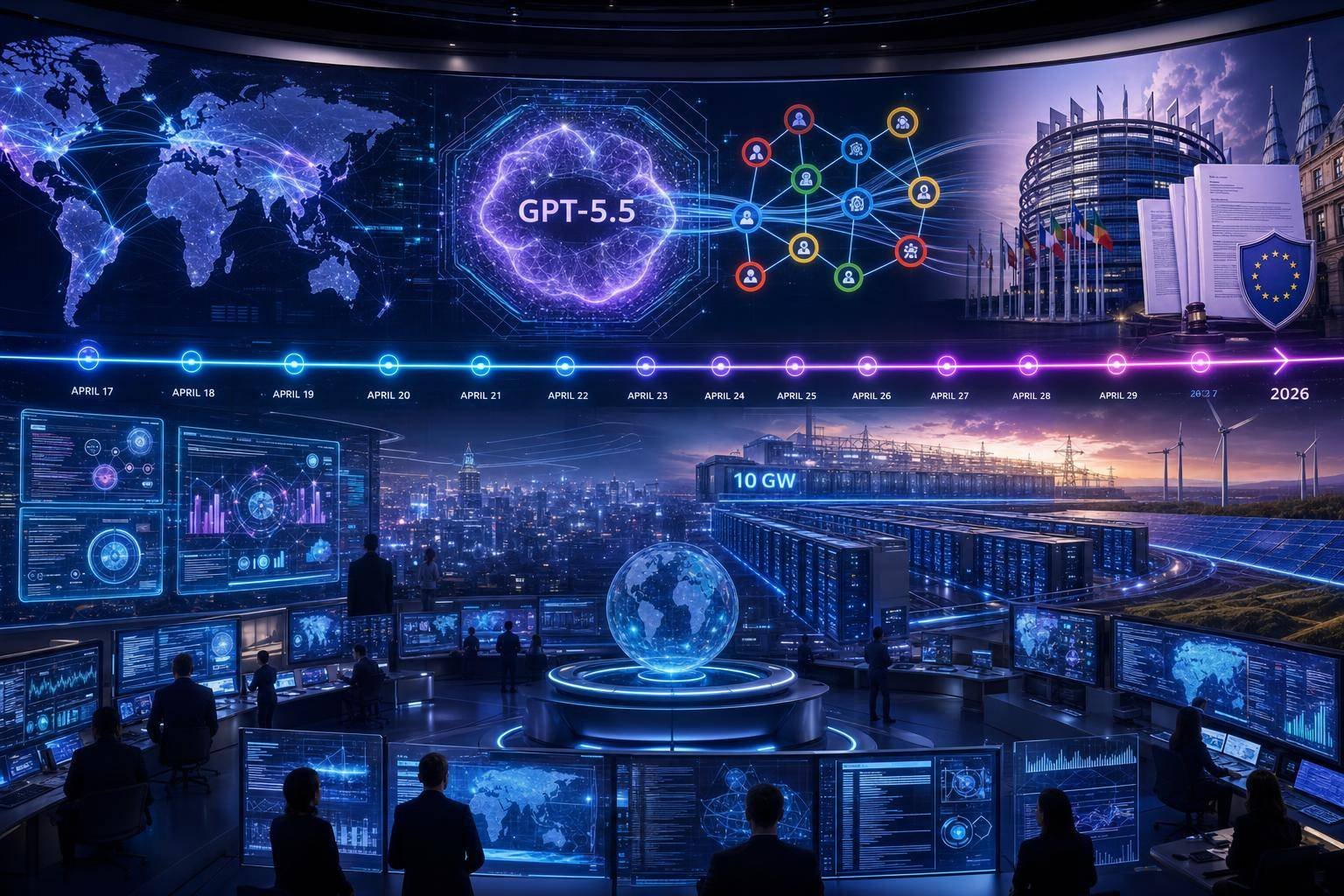
AI News Roundup (April 17–29, 2026): GPT-5.5, Google’s Agent Platform, EU AI Rules, and the Race to 10 GW
The closing days of April delivered one of the most consequential bursts of AI activity this year. Regulatory gears in the EU slipped just as hyperscale infrastructure leapt ahead; OpenAI and Google expanded the frontier in agents, research tooling, and orchestration; and a high-profile research bet signaled a coming contest between reinforcement learning “superlearners” and LLM-first strategies.
If your roadmap depends on model reliability, enterprise-grade agent tooling, or access to compute, these two weeks matter. This AI news roundup distills why: changing compliance pressures in Europe, megascale power and networking milestones, sharper agentic performance from GPT-5.5 and Gemini Enterprise, more rigorous safety testing in high-risk domains, and a bolder thesis for post-LLM AI research.
Why This AI News Roundup Matters Right Now
- The EU’s regulatory pivot could reshape vendor contracting, documentation burdens, and total cost of ownership for general-purpose (GPAI) and high-risk systems—especially for enterprises operating in or selling into Europe.
- Megascale compute announcements reveal a new reality: power, network fabric, and orchestration are the gating factors for next-gen model capability and reliability. Procurement teams need to plan for multi-year capacity constraints.
- Agents and autonomous research tools are maturing fast. GPT-5.5 narrows the gap between LLM output and multi-step, computer-using task completion. Google’s enterprise agent stack doubles down on orchestration and security.
- Safety testing is professionalizing. Targeted bounties on biological misuse defenses, coupled with red-teamable agent platforms, indicate a sharper line between consumer-grade and regulated AI deployment.
Below is the signal—separated from the noise—and what to do with it.
AI News Roundup: The Signals Behind the Headlines
The late-April window saw a flurry of major developments: – EU AI rule rewrite efforts stalled, with attention shifting to enforcement mechanics and compliance clarity for general-purpose and high-risk AI. – OpenAI’s Stargate infrastructure surpassed a 10-gigawatt U.S. target years ahead of schedule, adding 3 GW in 90 days. – OpenAI released GPT-5.5, emphasizing gains in coding, research, tool use, and multi-step agentic execution at similar latencies to prior flagship models. – OpenAI launched a GPT-5.5 Bio Bug Bounty aimed at universal jailbreaks that could circumvent biology safeguards in Codex Desktop. – Google unveiled the Gemini Enterprise Agent Platform—effectively Vertex AI evolved into a full-stack agent platform with integrated orchestration, DevOps hooks, and security features. – Google announced Virgo Network, a megascale data-center fabric approach designed for AI superclusters—part of a “campus-as-a-computer” vision meant to overcome limits in traditional networking topologies. – Google DeepMind advanced its autonomous research product to “Deep Research Max,” upgrading to Gemini 3.1 Pro and adding visualize-and-iterate capabilities, MCP support, and better long-horizon execution. – DeepMind veteran David Silver raised $1.1B for Ineffable Intelligence at a $5.1B valuation, with a stated goal to build a “superlearner” via reinforcement learning without human data—an explicit challenge to LLM-centric paradigms.
Let’s unpack what each stream means for builders, CISOs, and product leaders.
Regulation Reset: EU AI Rule Rewrite Stalls—What It Means for Builders
Efforts to soften or re-scope portions of the EU AI rules paused as lawmakers and member states failed to agree on proposed changes. The center of gravity is shifting to enforcement details for general-purpose systems (GPAI) and high-risk applications—documentation, risk controls, and incident reporting in particular.
- Who’s affected: Model providers serving EU customers; enterprises deploying GPAI internally at scale; vendors in high-risk domains (health, finance, safety, and critical infrastructure).
- What’s at stake: Compliance engineering and audit costs, go-to-market friction in the EU, necessary updates to system cards/model cards, and more formal evaluation pipelines.
Strategy implications: – Treat the EU regime as converging on documentation- and process-heavy enforcement. Expect standardized reporting, clearer incident definitions, and pressure for auditable evaluations. – Align to compatible frameworks now to avoid retrofits later—map internal governance to the NIST AI Risk Management Framework and track EU guidance as it clarifies. – For general orientation, monitor the Commission’s materials on AI policy and implementation (European Commission overview). Combine with EU-focused security guidance such as ENISA’s Security of AI report for technical controls that auditors will actually look for.
Practical takeaways: – Create a “single source of truth” for AI system inventories, data lineage, fine-tuning datasets, deployment contexts, and third-party dependencies. – Establish a repeatable model evaluation and red-teaming routine, with attestations and evidence stored in a structured registry. You’ll need this for procurement and external audits. – Budget for compliance as a line item in AI TCO. The cost won’t be uniform across vendors; compare not just price-per-token but also the governance burden each supplier reduces or adds.
Infrastructure Goes Megascale: Power and Fabric Are the Bottlenecks
OpenAI’s Stargate program reportedly surpassed its 10-gigawatt U.S. target years ahead of a 2029 horizon, expanding capacity by 3 GW in just 90 days. At the same time, Google announced Virgo Network to address the fact that building bigger clusters is increasingly a networking and orchestration problem, not merely a GPU procurement problem.
- Why it matters: Latency, reliability, and agentic performance are constrained by how tightly you can couple compute, storage, and network bandwidth across a campus-scale footprint. As models become more tool- and memory-centric, cross-service hops swamp naïve architectures.
- Power and sustainability: The infrastructure race intensifies pressure on energy grids and carbon targets. The International Energy Agency’s latest review of data center energy use frames the scale and trajectory of demand spikes (IEA analysis).
Network fabric is strategic: – Traditional leaf-spine fabrics are straining under cluster sizes required for frontier training and low-latency inference. Google has been public about the evolution of Jupiter-class fabrics, which prefigure the logic of Virgo (Google’s “Jupiter Rising” paper). – For enterprises: multi-zone, high-throughput fabrics inside your VPCs begin to matter as you chain models, vector stores, feature pipelines, and external tools. The same networking ideas that power hyperscale AI will trickle into enterprise blueprints.
Procurement reality: – Power availability and grid interconnect lead times are now material risks to AI roadmaps. – Expect burst capacity to become a premium service tier. Budget for variability and plan alternatives (e.g., queueing strategies, batched inference, surrogate models) when capacity tightens.
Models and Agents: From “Great Demos” to “Works All Day”
GPT-5.5: Incremental Latency, Step-Change in Agentic Consistency
OpenAI’s GPT-5.5 arrived with a clear focus: better performance in coding, research, computer use, and multi-step workflows—without blowing up latency relative to GPT-5.4. For production agents, that consistency matters as much as raw peak scores.
- Where it likely helps most: autonomous browsing/research; CLI or desktop toolchains; schema-constrained function calling; long-horizon tasks that require tracking plans, changes, and artifacts.
- Developer impact: fewer brittle steps in tool-using chains; better success rates for “act-think-act” loops; and stronger generalization across varied contexts where models must use external tools correctly.
What to do: – Re-run your tool-use and multi-hop evals. Evaluate not just end-score but also error profiles—are failures now concentrated in retrieval precision, tool argument formation, or long-context memory? – Review new capabilities through the lens of cost per successful task, not just tokens. If GPT-5.5 reduces retries and guardrail conflicts, your true throughput rises even at similar nominal pricing.
For documentation, SDK updates, and structured tool-use patterns, start with the OpenAI API documentation.
Google’s Gemini Enterprise Agent Platform: Orchestration Meets Governance
Google introduced the Gemini Enterprise Agent Platform—an evolution of Vertex AI into a more complete agent development and runtime environment. The headline: orchestration, DevOps integration, security controls, and access to 200+ models in a single governed plane.
- Why this resonates: Platforms are vying to become the “Kubernetes of agents.” That means standardized tooling for memory, tools, planning, retries, monitoring, and isolation—without glue code sprawl.
- For teams already on Google Cloud: tighter IAM, network egress controls, logging/observability, and DLP alignment can create real implementation leverage.
Where to start exploring: Google Cloud Vertex AI for model endpoints, pipelines, grounding, and security integration patterns.
Deep Research Max: Long-Horizon Web Research Becomes Software
Google DeepMind’s upgrade to Deep Research Max, now paired with Gemini 3.1 Pro, leans into long-horizon autonomous research. Two particularly useful signals: – Visualizations and deliberation artifacts move “black box” reasoning into more inspectable plans and summaries. – MCP (Model Context Protocol) support aligns with a broader industry movement to standardize how agents discover and use tools across environments (MCP specification).
Bottom line: as web research agents become inspectable and auditable, they’ll cross the line from “experimental” to “deployable under policy.”
Safety and Red Teaming Go Pro: Bio Bounty and Beyond
OpenAI’s GPT-5.5 Bio Bug Bounty is narrowly targeted: $25,000 for universal jailbreaks that defeat biology safety mechanisms in Codex Desktop. The choice of scope says as much as the prize: – This is about raising the cost for attackers who try to break domain-specific guardrails in high-risk areas. – It also signals a wider shift from general “prompt injection” worries to domain-specialized safety testing—in this case, biological misuse patterns and toolchains.
What responsible builders should do: – Separate consumer-grade safety heuristics from regulated-domain safety engineering. The latter needs formal test suites, domain-specific constraints, and human-in-the-loop gates. – Institutionalize red-teaming and invite external testing. Treat bounty programs and internal adversarial QA as complementary. For reference, see OpenAI’s bug bounty program.
Even outside biology, guardrail evasion and tool misuse remain live risks in enterprise agents. Align mitigations with the OWASP LLM Top 10 patterns—prompt injection, insecure tool binding, data exfiltration, and more (OWASP LLM Top 10).
A Research Bet: Reinforcement Learning “Superlearner” vs. LLM-First
David Silver’s new venture, Ineffable Intelligence, is capitalized to pursue a superlearner trained via reinforcement learning without human data. The thesis challenges today’s LLM pretraining dominance and asks: can we build systems that learn online from interaction, mastering tasks without vast static corpora?
Why it’s credible: – Silver’s DeepMind work demonstrated that RL plus planning can beat human champions in complex domains under partial information and long horizons. – The broader RL canon shows the power of interaction-driven learning to optimize policies in environments where supervised data is scarce or misleading.
For background on the lineage: – Google’s AlphaGo breakthrough provides a canonical reference for planning and self-play in complex domains (Nature paper on AlphaGo). – The reinforcement learning textbook by Sutton and Barto remains a foundational resource for theory and algorithms, including value-based, policy-gradient, and actor-critic methods (Sutton & Barto, online text).
What it could change: – Tool-using agents that learn to coordinate APIs, schedulers, and real-world systems via feedback could shed LLM limitations like hallucination when rewards penalize incorrect actions. – Data requirements may shift from curation to environment design and simulator fidelity, with implications for MLOps toolchains and evaluation.
Caveats: – RL can be sample-inefficient, brittle under reward misspecification, and hard to scale in sparse-reward domains. Integrating model-based components and curriculum design will be key.
Practical Playbook: 90-Day Actions for CTOs and CISOs
With model, platform, and infrastructure news converging, here’s a focused plan to capture upside while containing risk.
1) Re-baseline your agent architecture – Actions: Re-run your tool-use suites on GPT-5.5 and your current best alternative. Measure success rate per task, not just BLEU/ROUGE or subjective ratings. – Watch for: Argument formation errors; state carryover across steps; hidden latencies from chaining (network and I/O).
2) Consolidate orchestration into a managed plane – Actions: Pilot an agent platform that offers memory, planning, retries, tool registries, and observability out of the box. If you’re on GCP, evaluate the Gemini Enterprise Agent Platform via Vertex AI. – Watch for: IAM isolation per tool; audit logs for every agent action; policy enforcement on data exfiltration.
3) Build an eval-driven deployment gate – Actions: Stand up a model evaluation harness tied to CI/CD that must pass before production promotion. Include adversarial test cases and business KPIs. – Framework alignment: Map eval, risk, and governance artifacts to the NIST AI RMF controls you care about.
4) Harden against prompt injection and tool abuse – Actions: Implement allowlists for tools and schemas; strict argument validation; context scoping; and output filters. – References: Use the OWASP LLM Top 10 as a checklist for design and testing.
5) Formalize red-teaming and bounties – Actions: Create an internal red-team function for LLM/agent systems with reproducible playbooks. Consider narrow-scope external bounties for your riskiest domains. – Benchmark: Study how OpenAI structures bounty scope and evidence in its bug bounty program.
6) Prepare for EU enforcement mechanics – Actions: Inventory all AI systems that could be in scope. For each, attach a system card, data lineage, eval results, and incident response plan. – Resources: Track the Commission’s evolving materials and compliance interpretations (EU AI policy overview) and technical controls from ENISA’s Security of AI.
7) Stress-test cost and capacity – Actions: Model your spend under fluctuating latency and retry rates. Establish fallback models and dynamic routing. Negotiate SLAs with burst capacity where possible. – Note: With megascale buildouts, regional outages or congestion will still happen—architect for graceful degradation.
8) Optimize your network path – Actions: Reduce cross-zone chatter in tool chains; co-locate vector stores, feature stores, and model endpoints. Profile tail latencies end to end. – Rationale: The hyperscaler push toward campus-as-a-computer (e.g., Virgo-like fabrics building on designs such as Jupiter) is a cue—your internal architecture should minimize costly hops too.
9) Data governance for autonomous research – Actions: For agents that browse or synthesize from external sources, implement provenance tracking, source allowlists, and policy-based content gating. – Quality control: Require human review for high-impact outputs; store artifacts and rationales for audits.
10) Plan energy and sustainability posture – Actions: Work with vendors that can disclose energy sourcing and efficiency metrics. Consider where inference can be scheduled, batched, or compressed. – Context: Large language model infrastructure growth will keep pressure on grids and carbon budgets (IEA analysis).
Builder’s Notes: Choosing Tools and Patterns That Age Well
- Adopt a protocol-aware tool layer. MCP is a promising standard for tool discovery and invocation across model vendors (Model Context Protocol). Betting on open-ish interop reduces platform lock-in and lets you swap models as quality shifts.
- Prefer explicit memory and state. Systems with pluggable working memory and retrieval layers outperform prompt-only hacks in long-horizon tasks. Make state a first-class citizen.
- Use typed, schema-constrained calls. The more your agent-world contract is typed and validated, the less you’ll chase flakey errors.
- Observatory-first. Emit structured traces for every tool call, context update, retrieval hit, and guardrail decision. Production agents are software systems; debug them like one.
Risks and Limitations to Watch
- Overfitting to demos: Strong leaderboard results can mask brittle performance in your data and tools. Trust domain-relevant evals, not generic “chat” scores.
- Guardrail gaps: Domain-level safety (e.g., biology, finance) isn’t solved by generic content filters. Expect to invest in bespoke constraints and process controls.
- Network tax: As you chain more tools, tail latencies creep. Architectural discipline beats “just one more tool” sprawl.
- Regulatory surprises: Even if the EU pauses re-writes, enforcement guidance can add material time and cost. Keep a buffer in your delivery plans.
FAQs
What’s materially different about GPT-5.5 for enterprise use? – It appears more consistent on multi-step, tool-using tasks with similar latency to prior models. That can reduce retries and failures in agents that browse, write, code, or operate software.
How does the Gemini Enterprise Agent Platform compare to DIY orchestration? – You trade some flexibility for integrated security, IAM, monitoring, and multi-model access. If you’re already on GCP, the managed stack can simplify compliance and DevOps, with less glue code.
When will EU AI rules start to bite my organization? – Timelines vary by system type and your role (provider vs. deployer). Treat 2026 as the year to align governance and documentation, and expect enforcement clarity to increase for GPAI and high-risk cases.
What is MCP and why should I care? – The Model Context Protocol standardizes how agents discover and use tools across environments. Adopting MCP reduces lock-in and makes it easier to change models or platforms later.
How do I mitigate prompt injection and jailbreaking in agents? – Use strict context scoping, typed tool calls, allowlists, argument validation, and output filters. Align testing and design with the OWASP LLM Top 10, and add domain-specific controls where stakes are high.
What is “Virgo Network” and why does it matter? – It’s Google’s name for a megascale data-center fabric aligned with a campus-as-a-computer vision. The goal is to overcome networking limits that block bigger, faster, and more reliable AI clusters.
Conclusion: The Takeaway From This AI News Roundup
April’s endgame reveals a maturing field: regulation moving from principles to enforcement, infrastructure measured in gigawatts and campus fabrics, models tuned for day-long agent work rather than demos, and safety testing targeted at high-risk domains. The winners in this next phase won’t just have the best model—they’ll have disciplined orchestration, robust safety engineering, and a procurement strategy that anticipates power and capacity constraints.
Start with the 90-day plan: re-baseline your agents on GPT-5.5, consolidate orchestration with enterprise-grade controls, wire in eval-driven gates, and harden against prompt injection and tool abuse using frameworks like NIST’s AI RMF and OWASP’s LLM Top 10. Keep one eye on EU enforcement mechanics and another on your network path and energy posture.
This AI news roundup isn’t just a snapshot—it’s a blueprint for where to invest next: fewer ad hoc hacks, more engineered systems, and a practical path from impressive outputs to dependable outcomes.
Discover more at InnoVirtuoso.com
I would love some feedback on my writing so if you have any, please don’t hesitate to leave a comment around here or in any platforms that is convenient for you.
For more on tech and other topics, explore InnoVirtuoso.com anytime. Subscribe to my newsletter and join our growing community—we’ll create something magical together. I promise, it’ll never be boring!
Stay updated with the latest news—subscribe to our newsletter today!
Thank you all—wishing you an amazing day ahead!
Read more related Articles at InnoVirtuoso
- How to Completely Turn Off Google AI on Your Android Phone
- The Best AI Jokes of the Month: February Edition
- Introducing SpoofDPI: Bypassing Deep Packet Inspection
- Getting Started with shadps4: Your Guide to the PlayStation 4 Emulator
- Sophos Pricing in 2025: A Guide to Intercept X Endpoint Protection
- The Essential Requirements for Augmented Reality: A Comprehensive Guide
- Harvard: A Legacy of Achievements and a Path Towards the Future
- Unlocking the Secrets of Prompt Engineering: 5 Must-Read Books That Will Revolutionize You