SoftBank Launches Roze AI, a Robotics Company to Build Data Centers 10x Faster
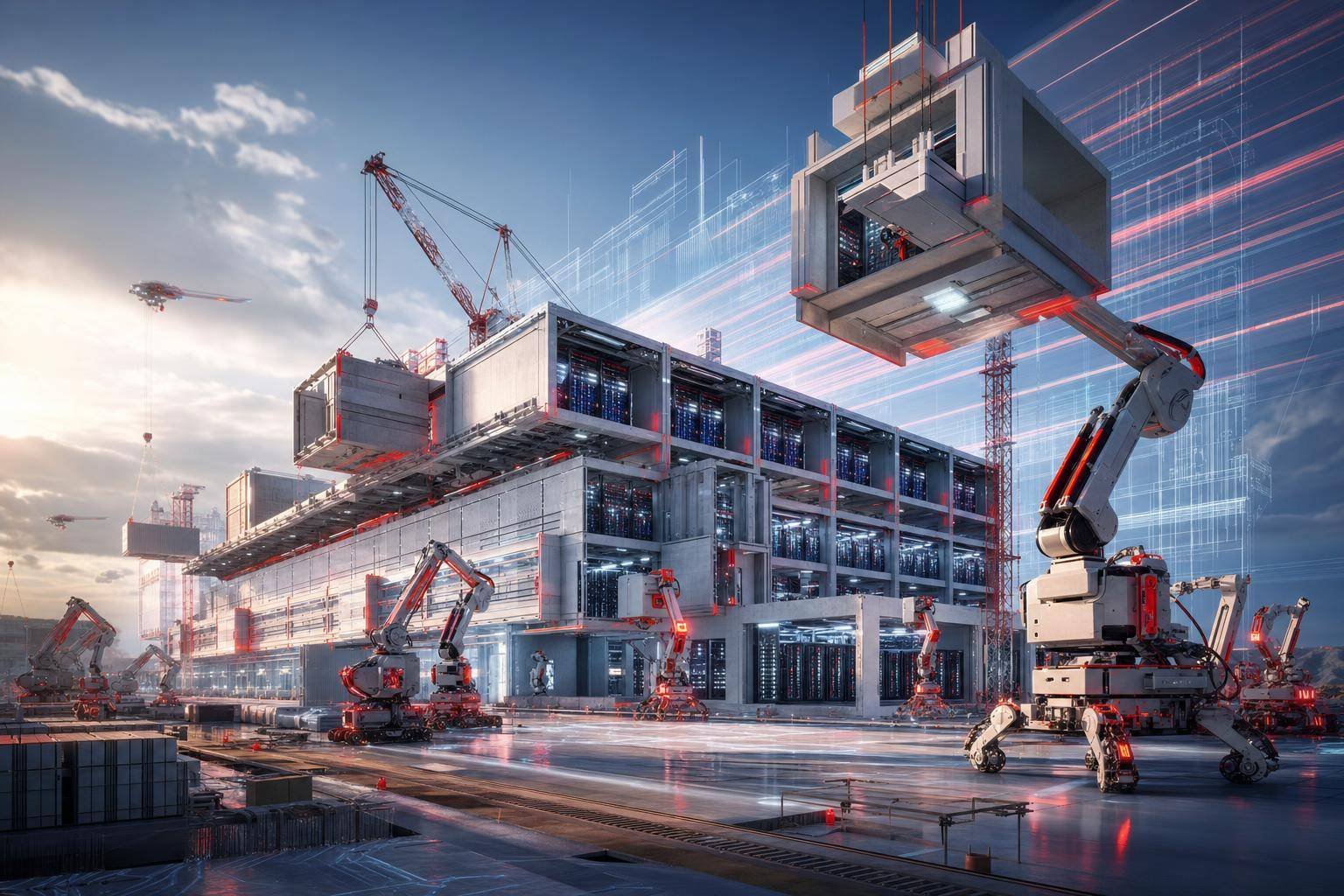
SoftBank just placed a very public bet that the physical bottlenecks of the AI era can be solved by robots. On April 29, 2026, the company announced Roze AI, a new robotics venture that plans to automate large swaths of data center construction with coordinated fleets of machines. Early pilots reportedly show 24/7 operation and step-function cost savings—exactly what hyperscalers need as AI compute demand soars and project timelines stretch from months to years.
The pitch is bold: deploy swarms of specialized robots for layout, rack installation, and cabling to assemble hyperscale facilities at “internet speed.” SoftBank is reportedly exploring a $100 billion IPO within 18 months and aligning Roze with its Physical AI thesis—where perception, planning, and actuation collapse into high-throughput, real-world automation. Industry-watchers will recognize the strategic alignment with NVIDIA’s “AI factory” narrative and the mega-scale compute projects now in the works across the sector. The question is not just whether it can work—it’s how quickly it can be scaled and safely integrated into one of the most complex, risk-sensitive build domains on earth.
According to reporting and public commentary, Roze’s tech stack blends NVIDIA-powered vision models for real-time site mapping, multi-agent coordination for tasks like cabling and rack installation, and planning agents derived from Gemini-class models. Pilots with Google Cloud and Microsoft Azure reportedly showed up to 40% cost reductions and around-the-clock execution. If validated at scale, this approach could redefine data center delivery models, compressing schedules and reshaping EPC (engineering, procurement, and construction) roles in the process. TechCrunch’s coverage captures the broad strokes of the plan and the stakes SoftBank is placing.
What Roze AI Actually Does: Robotics for Hyperscale Data Center Construction
Roze AI is positioning itself as a systems integrator for autonomous construction in highly structured, repeatable scopes inside data centers. Rather than attempting fully general construction autonomy—a notoriously hard problem—Roze appears to focus on narrow, high-volume tasks where robots excel.
- Site perception and mapping: Vision-first robots traverse new-build or fit-out spaces, generating detailed 3D maps and aligning them to project BIM models. This enables real-time QA against design tolerances (e.g., cold-aisle containment positions, tray heights, clearance envelopes) and predictive sequencing (“which bays are ready to rack?”).
- Rack and containment installation: Specialized manipulators place, level, and anchor racks and containment components using torque-controlled arms, vision-guided alignment, and structured-light verification.
- Power and network cabling: Cable-pulling and termination robots route bundles through trays and ladders, apply labeling, and perform continuity tests. Multi-agent coordination limits congestion in tight aisles and avoids tripping hazards or conflicts with other robots.
- 24/7 orchestration: A central scheduler coordinates task queues, work cells, and hand-offs across fleets. When prerequisites change—a failed anchor test, a delayed delivery—the plan updates on the fly.
Under the hood, Roze’s stack likely combines simulation-trained policies, visual-inertial SLAM for localization, and hierarchical task planning. NVIDIA GPUs power perception and model-based control, while planning agents reportedly draw on Gemini-derived models to translate intent (“rack rows A1–A8 to spec G.4 by Friday”) into robot-executable steps. For simulation and validation of workflows before deployment, the ecosystem commonly relies on digital-twin tools; NVIDIA’s Isaac Sim documentation is a good window into the state of the art for photorealistic robotics simulation, domain randomization, and sensor modeling that enable safer, faster physical rollout.
The immediate target is schedule compression and reproducible quality in the parts of a build with tight tolerances and high repetition. In other words: take the most “factory-like” slices of a data center and actually run them like a factory.
Why It Matters Now: The Compute Arms Race Meets the Construction Bottleneck
AI models like GPT-5.4 and Gemma 4 are pushing toward exaflop-scale training, and capital is chasing compute at unprecedented levels. Industry projections now cite trillion-dollar annual demand for advanced GPUs as early as 2027. Even if only a fraction materializes, the practical constraint is obvious: concrete, steel, power, cooling, and people.
- Long lead times: Transformational equipment (e.g., generators, switchgear, transformers) carries lead times stretching 12–24 months, depending on region.
- Site scarcity: Suitable land with fiber access and grid capacity is limited, especially near major metros.
- Skilled labor: The specific trades needed for mission-critical work are in short supply; labor availability can swing schedules by months.
- Quality risk: Rework from out-of-tolerance installs cascades into commissioning delays and missed compute ramps.
Robotics doesn’t solve utility interconnects or environmental permitting. But in the “last mile of the build”—mechanical assembly, electrical fit-out, racks, cabling, containment—autonomy can improve throughput and predictability. If Roze’s pilots generalize from controlled environments to live projects, the value is not just lower costs—it’s earlier revenue recognition and faster AI time-to-market.
Energy will remain the systemic limiter. The International Energy Agency projects that electricity demand from data centers, AI, and crypto could double by 2026 in some regions, prompting grid integration and efficiency urgency. For broader context, see the IEA’s overview of data centres, AI and cryptocurrencies.
Inside the Robotics Stack: Vision, Planning, and Multi-Agent Coordination
Getting a robot to place a server rack is not “just pick and place.” Tolerances can be millimeters; floors flex; fixtures vary; humans and forklifts share the same aisles. The risk of accumulated error (a few millimeters across 50 meters) can cause fit issues for containment or cable trays later.
Here’s how a mature stack handles this complexity:
- Perception and mapping
- Visual-inertial SLAM aligns the robot to a live site map and the BIM model. Structured-light or LiDAR refines depth around fixtures.
- Semantic segmentation flags anchor points, tray supports, obstructions, and human workers, augmenting safety zones.
- Continuous as-built capture creates a digital twin on site that feeds daily progress reporting and QA.
- Simulation and policy training
- Digital-twin environments mirror the site (fixtures, lighting, occlusions). Policies are trained with domain randomization (vary lighting, occlusion, surface reflectivity) to improve robustness.
- Tools like NVIDIA Isaac Sim bridge sim-to-real gaps for manipulation and navigation with physics-based modeling.
- Hierarchical planning
- High-level intent: “Complete cabling for Hall B rows 2–10 per rev. G design by 23:00.” A planning agent (e.g., a Gemini-derived model constrained by a schema) decomposes that into tasks and parameters.
- Mid-level coordination: Multi-agent path planning avoids collisions and aisle congestion, sequences subtasks (anchors before racks, racks before trays, trays before pulls), and reallocates resources dynamically.
- Low-level control: Impedance control and force-feedback close the loop during drilling, anchoring, and torquing to avoid substrate damage.
- Safety and human-in-the-loop
- Geofenced work cells and layered safety: perception-based slow/stop, emergency interlocks, and V2X alerts to nearby wearables.
- Human supervisors approve plan changes and handle exceptions. Risky or judgment-heavy tasks remain manual, particularly near live electrical systems.
- Data integration
- BIM (IFC), digital QA checklists (COBie-like schemas), and work-order systems feed the robot scheduler.
- As-built data, torque logs, and cable test results stream back to commissioning systems, reducing paperwork and accelerating handover.
A core lesson from industrial automation applies: the narrower and more standardized the scope, the faster autonomy pays back. That implies up-front design for robotic assembly (DFRA), modular kit-of-parts, and standardized bays. It’s the “factory-ization” of the data center floor.
For strategic context on complex cyber-physical integration, NIST’s work on Cyber-Physical Systems outlines best practices for interoperability, timing, safety, and assurance across networked physical systems—directly relevant when robots, site networks, and build management tools all interoperate.
Security, Safety, and Compliance for Autonomous Construction
Autonomous robots shift a portion of the build into the OT (operational technology) security domain. That raises real questions for owners and EPCs:
- Attack surface: Robots run networked compute, sensor stacks, and OTA update channels. Compromises could halt a project or cause physical damage.
- Safety risks: Misclassification (confusing a boot for a cone) or spoofed sensor inputs could cause unsafe motion. Layered failsafes are mandatory.
- Supply chain: Firmware provenance, SBOMs, and signed updates matter—especially when robots are onsite for months.
Practical controls to demand in contracts and deployment plans:
- Network segmentation: Isolate robot fleets on segregated VLANs with strict east–west controls, one-way telemetry out, and protected OTA channels.
- Identity and access: Hardware-backed identity for robots, short-lived certificates, and least-privileged service accounts for orchestration.
- Update governance: Cryptographically signed firmware and models, canary rollouts, rollback plans, and attestation at boot.
- Operational safety: Dual-channel emergency stops, perception-assisted speed and separation monitoring, supervisor acknowledgement for plan changes near live systems.
- Logging and assurance: Tamper-evident logs, command provenance, and evidence packs for commissioning and incident review.
CISA maintains deep guidance on protecting industrial and operational environments; their ICS resources are a solid starting point for controls owners should expect vendors to meet. See CISA’s overview of Industrial Control Systems security.
Traditional Builds vs. Robotic Construction: Benefits and Risks
Roze AI’s promise sits at the intersection of capex, schedule, and quality. Here’s a grounded comparison:
Benefits – Schedule compression: Parallelized, 24/7 work cells tighten the critical path once shells are ready. The earlier the compute turns on, the earlier revenue and model training. – Repeatable quality: Torque-verified anchors, automated level checks, and digital QA reduce rework that often slips commissioning. – Labor efficiency: Skilled supervisors oversee more work via exception handling. Robots take on repetitive, ergonomic-strain tasks. – Data-rich QA: Continuous as-built capture and test results simplify handover and audits. – Safety: Fewer human-hours in high-risk tasks (overhead ladder work, tight aisle moves) can reduce incidents.
Risks and constraints – Scope limitations: Early autonomy works best on standard, repeatable tasks. Edge cases and late-stage design changes still need humans. – Integration overhead: Misaligned BIM data, supply chain delays, or site network issues can idle robots. – Failure modes: A fleet-wide software bug can halt progress. Robust rollback and partitioning are non-negotiable. – Regulatory and labor relations: Jurisdictions may require new approvals for autonomous equipment; unions and workforce stakeholders must be engaged early. – Supply chain for robots: Lead times for actuators, sensors, and compute modules can mirror the very bottlenecks they’re meant to bypass.
For independent data on data center reliability expectations and the operational stakes of quality and uptime, Uptime Institute’s research series—including its Global Data Center Survey—provides a sober view of Tier objectives and operational reality. See the Uptime Institute’s research and reports hub.
How Owners, Cloud Providers, and Builders Can Prepare Now
You don’t need to wait for Roze AI’s general availability to capture many of the same gains. Here’s a practical playbook to de-risk and accelerate robotic construction adoption.
1) Identify the right scopes – Start with high-volume, repeatable tasks: rack install, tray mounting, cable pulls, containment assembly, labeling, and validation testing. – Avoid live electrical work, complex hot taps, or critical lifts in early phases.
2) Design for robotic assembly (DFRA) – Standardize bay dimensions, anchor patterns, and tray heights across halls. – Use consistent fasteners and anchor types compatible with torque-sensing tools. – Provide fiducials or distinct features that improve machine vision reliability.
3) Harden your data – Treat BIM as a product, not a document. Keep models current and structured. – Adopt open standards for interoperability like IFC from buildingSMART. – Define a data contract for as-built capture: naming conventions, coordinate frames, QA schemas, and handover packages.
4) Build the digital twin early – Stand up a preconstruction twin of at least one archetypal hall; validate workflows in sim. – Instrument with realistic lighting, occlusions, and clutter to stress plans before boots and bots hit the floor.
5) Instrument for safety and control – Create geofenced work cells with physical barriers; map out robot pathways and keep-outs. – Provide reliable site Wi‑Fi or private 5G with segmentation, QoS, and failover. – Issue safety wearables to human workers for proximity alerts and accountability.
6) Contract and compliance – Write cybersecurity and safety requirements into RFPs: SBOMs, signed updates, attestation, logging, privacy-respecting telemetry. – Define KPIs: installation cycle time, rework rate, QA pass rate, MTBF for robots, and mean time to recovery on software faults. – Establish incident response expectations for both safety and cybersecurity.
7) Pilot, then scale – Run a single-hall pilot with specific targets (e.g., “cut rework by 50%, reduce cabling cycle time by 30%”). – Use A/B comparison against a traditional hall to quantify value. – Build an internal center of excellence; train site managers and trades in exception handling with robots.
8) Integrate planning agents responsibly – If using LLM-based planning agents (e.g., Gemini-derived), constrain outputs through schemas and safety checkers. – Keep a human-in-the-loop for plan approval, especially near live power. – For background on model capabilities and integration touchpoints, review Google DeepMind’s overview of Gemini.
9) Don’t forget sustainability – Robots don’t fix the grid. Align with energy and cooling strategies early. – Design-in efficient airflow, heat reuse options, and water conservation; Google’s track record on data center efficiency offers practical reference points.
10) Secure the OT environment – Apply ICS security fundamentals from day one: segmentation, asset inventory, change control, and continuous monitoring. CISA’s ICS guidance is a practical foundation for OT risk reduction. Explore CISA’s ICS program overview here.
Market Outlook: Can Roze AI Capture 15% by 2030?
SoftBank and early backers are reportedly eyeing a 15% share of a $500 billion data center market by 2030. Is that plausible? A rough cut:
- Total addressable scope: Not all data center capex is addressable by robots. Site work, heavy civil, and utility interfaces remain largely manual. Interior assembly and fit-out might represent 25–40% of project value in many designs.
- Share of addressable work: In early phases, autonomy may penetrate a slice of that (say 20–50% of interior fit-out tasks). Wider standardization and DFRA could expand it.
- Velocity advantage: The highest ROI emerges where time-to-compute is most valuable: AI research clusters, GPU-dense halls, and regions with intense demand.
- Competition: Expect major EPCs and robotics firms to fast-follow. Open ecosystems and standards will pressure margins but expand the market.
If pilot claims of 40% cost reduction and 24/7 execution hold at scale—and if supply chains for robot components and site equipment normalize—Roze could secure meaningful share in hyperscale programs within 24–36 months. The more subtle moats will be in orchestration software, digital twin fidelity, QA data integration, and customer success at scale across different build archetypes.
NVIDIA, for its part, continues to push the “physical AI factory” message and the tooling that underpins it. The convergence of large-scale perception, fast simulation, and manipulation research is now mature enough to leave the lab and enter construction—provided the work is standardized, designed for automation, and backed by solid safety and security engineering.
Sustainability and Power: Robots Won’t Solve the Grid
Robotic construction can cut waste, improve precision, and enable lighter, modular designs. But energy remains the macro constraint.
- Power and cooling: Even with excellent PUE, the absolute energy demand of AI is rising. Efficient design, advanced heat reuse, and liquid cooling are crucial.
- Interconnect delays: Utility interconnect queues and transformer backlogs can outlast any interior build.
- Regulatory pressure: Local and national authorities are scrutinizing data center power and water use, sometimes restricting build approvals.
Owners should treat robotic construction as a component of a broader decarbonization and resilience strategy, not a substitute for it. A mature approach pairs robotic fit-out with sustainable design patterns, load flexibility (e.g., demand response), and regional energy strategies.
For perspective on energy trajectories and constraints, the IEA’s analysis of data center electricity demand is essential background. For reliability and Tier expectations that influence design tradeoffs, Uptime Institute’s research is a helpful benchmark.
Practical Mistakes to Avoid
- Treating BIM as an afterthought: Robots need accurate, structured data. If models lag or don’t reflect field changes, autonomy stalls.
- Ignoring network reliability: If the site network falters, so do the robots. Design for degraded operations and offline fallbacks.
- Over-scoping the pilot: Start with one hall, a few well-chosen tasks, and concrete KPIs. Expand once you’ve proven value.
- Weak change management: Teach crews how to work alongside robots, escalate exceptions, and avoid creating unsafe ad hoc workflows.
- Security as bolt-on: Attacker dwell time in OT can be long. Embed ICS security controls from day zero and audit regularly.
Frequently Asked Questions
What is Roze AI? – Roze AI is a SoftBank-backed robotics company focused on automating portions of data center construction, such as rack installation and cabling, using fleets of coordinated robots guided by advanced perception and planning software. Reporting indicates early pilots with major cloud providers and an aggressive scale-up plan. See TechCrunch’s overview for context.
How do robots actually build a data center? – They don’t do everything. Robots target repeatable, high-precision tasks: mapping the site against BIM models, installing racks and containment with torque and level verification, routing and labeling cables, and running validation tests. A central scheduler coordinates many robots in parallel, while humans handle exceptions and safety-critical work.
Is this safe to run around human crews? – Safety is engineered in layers: geofenced work cells, perception-based speed and separation monitoring, emergency interlocks, and supervisor approvals for plan changes. As with any OT system, operational discipline matters. Owners should demand evidence of safety cases, logs, and incident response plans aligned with established ICS guidance.
Will robots replace construction jobs? – Expect role shifts, not wholesale replacement. Repetitive, ergonomically challenging tasks get automated. Demand grows for supervisors, integrators, and technicians who manage robots, validate quality, and handle exceptions. In high-demand markets, robots can help address labor shortages and reduce schedule pressure while improving safety.
How soon will robotic data center construction be mainstream? – For narrow interior scopes in standardized designs, adoption could ramp materially within 12–24 months—especially in hyperscale programs. Broader tasks and less-standardized sites will take longer. Early adopters will pair design standardization with pilots to accelerate learning.
How is this different from modular or prefab approaches? – They’re complementary. Modular/prefab reduces on-site complexity by shifting work to factories. Robotic construction brings factory-like precision and 24/7 throughput to the remaining on-site assembly. The best results come from combining DFMA, modular kits, and robotic fit-out.
The Bottom Line
SoftBank’s Roze AI is a calculated strike at one of the AI era’s most stubborn constraints: the time and cost of building compute at scale. By narrowing the problem to repeatable, high-value tasks—site mapping, rack installation, cabling—and orchestrating fleets of robots with strong perception and planning, Roze aims to deliver data center construction at “internet speed.” Masayoshi Son’s framing—“data centers are the new oil refineries of the Intelligence Age”—captures why this matters: whoever can bring compute online faster has a durable edge.
For cloud providers, colos, and REITs, the practical path forward is clear. Start standardizing designs for robotic assembly, invest in digital twins and robust BIM, harden your site networks and OT security, and run disciplined pilots with clear KPIs. Anchor your program in safety, cybersecurity, and data quality. Draw on established guidance from organizations like NIST for cyber-physical integration and CISA for ICS security.
Robots won’t solve grid interconnects or power availability. But if Roze AI delivers even half of its reported gains, autonomous fit-out could become a default lever for schedule compression and quality in hyperscale builds. The smart move now is to prepare your designs, contracts, and teams so you can plug robotic construction into your next project—with confidence that it will pay back in both time-to-compute and total cost of delivery.
Discover more at InnoVirtuoso.com
I would love some feedback on my writing so if you have any, please don’t hesitate to leave a comment around here or in any platforms that is convenient for you.
For more on tech and other topics, explore InnoVirtuoso.com anytime. Subscribe to my newsletter and join our growing community—we’ll create something magical together. I promise, it’ll never be boring!
Stay updated with the latest news—subscribe to our newsletter today!
Thank you all—wishing you an amazing day ahead!
Read more related Articles at InnoVirtuoso
- How to Completely Turn Off Google AI on Your Android Phone
- The Best AI Jokes of the Month: February Edition
- Introducing SpoofDPI: Bypassing Deep Packet Inspection
- Getting Started with shadps4: Your Guide to the PlayStation 4 Emulator
- Sophos Pricing in 2025: A Guide to Intercept X Endpoint Protection
- The Essential Requirements for Augmented Reality: A Comprehensive Guide
- Harvard: A Legacy of Achievements and a Path Towards the Future
- Unlocking the Secrets of Prompt Engineering: 5 Must-Read Books That Will Revolutionize You