
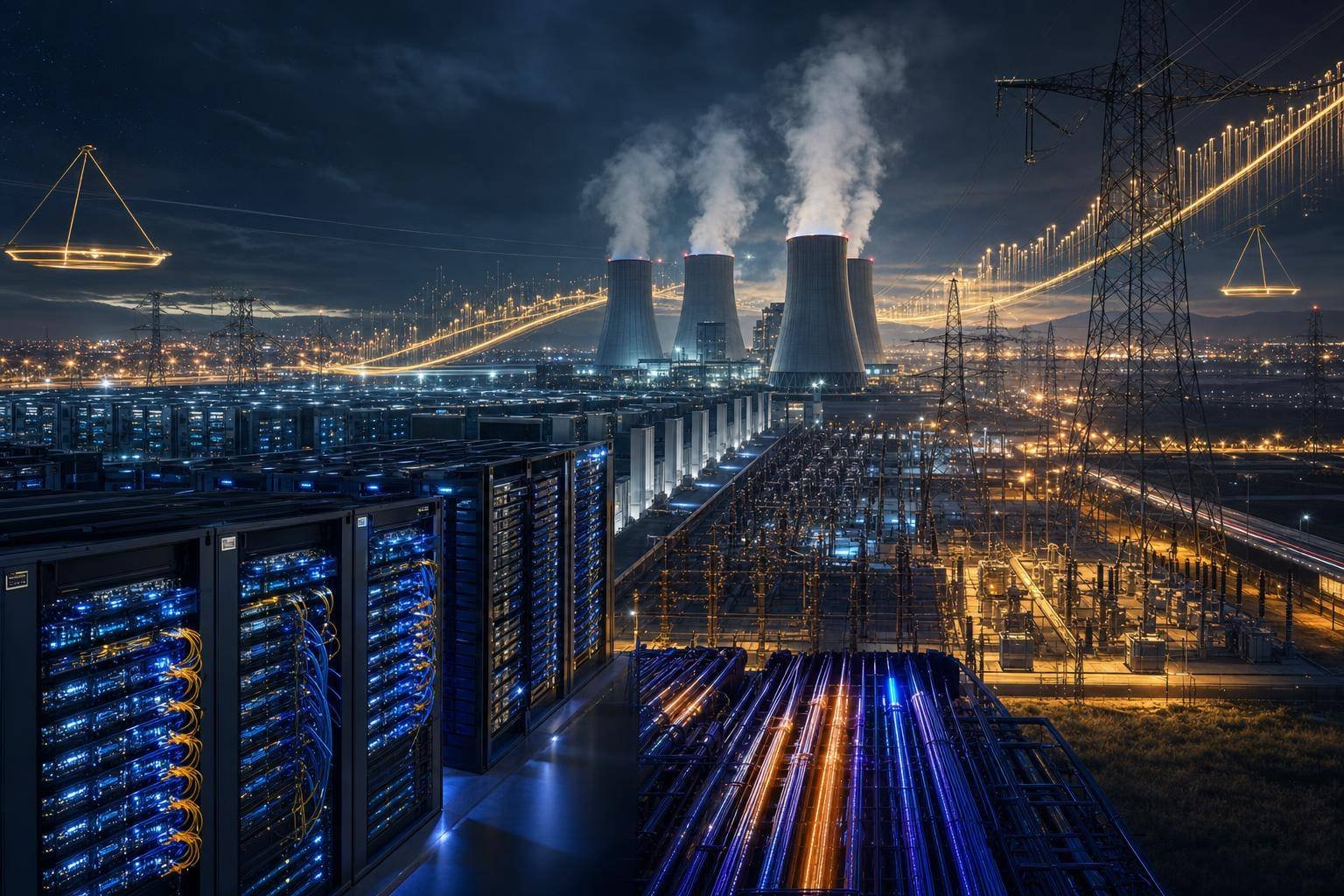
Inside Big Tech’s $700 Billion AI Infrastructure Spending Surge: Data Centers, GPUs, and the Power Constraint
The world’s largest tech companies are on track to pour roughly $700 billion into AI infrastructure in 2026, with no clear off-ramp. That spending isn’t just about more servers—it’s a full-stack bet on GPUs, custom accelerators, high-speed networking, energy, land, and advanced cooling to feed bigger, faster generative models and relentless inference demand.
Why it matters: AI infrastructure spending now sets the competitive pace for product velocity and model quality. For startups and enterprises alike, your strategy for where and how you run AI workloads—what you buy, rent, optimize, and secure—will shape margins, time-to-market, and risk for years. This piece breaks down what’s driving the capex boom, where bottlenecks will bite, and how to position your organization to benefit without getting burned.
According to recent reporting, hyperscalers like Amazon, Microsoft, Google, and Meta are escalating capex to build out massive data center campuses and AI superclusters, with new GPU generations and custom silicon at the core of the spending wave. The buildout’s pace is reshaping the economics of compute and the constraints of power grids, while drawing scrutiny around sustainability and AI safety. For context on the overall estimate and examples like Meta’s Hyperion site, see the Fortune analysis on hyperscaler AI capex.
Why AI infrastructure spending is accelerating in 2026
Three forces are pushing AI infrastructure spending to historic highs:
- Model ambition and scaling: Foundation models are growing in context length, modalities (text, image, audio, video, code), and reasoning depth, with larger training runs and more sophisticated training curricula. Historically, model quality tracked with compute budgets, as popularized by OpenAI’s “AI and compute” analysis of exponential increases in training FLOPs over the past decade (OpenAI research on AI and compute).
- Inference is eating the world: After the initial training run, serving billions of daily queries dominates cost. Latency requirements and user growth drive persistent capex—even if model sizes plateau—because inference must be close to users, resilient, and cheap per token.
- New competitive moats: Owning energy, land, and supply-chain priority for accelerators is quickly becoming as strategic as owning the software stack. First movers who secure power and GPUs can lock in model improvements, higher uptime, and faster product iteration.
Training vs. inference: different physics, different economics
- Training is bursty, all-to-all, and bandwidth-hungry. It prizes ultra-fast interconnects, colossal GPU memory bandwidth, and storage that can feed enormous batch sizes without choking.
- Inference is constant, latency-sensitive, and cost-driven. It requires flexible autoscaling, batching without hurting user experience, aggressive quantization, and memory-efficient architectures.
The capex boom reflects both needs: outsized GPU clusters for training, plus a fast-spreading edge of inference capacity near major population and enterprise data hubs.
Data, locality, and risk
High-value datasets often can’t leave sovereign boundaries or enterprise-controlled environments. That reality is pushing hyperscalers to deploy more regional capacity, and pushing enterprises to blend cloud AI with on-prem or colocation clusters for sensitive workloads. Data gravity and regulatory constraints mean the “where” of AI is now as important as the “how.”
The hardware race: GPUs, TPUs, networking, and memory
The hardware stack driving AI infrastructure spending is consolidating around a few pillars:
- NVIDIA’s AI platforms remain the reference standard. Current H100/H200 deployments dominate large training clusters, while the next-generation Blackwell architecture is poised to raise throughput per watt and model capacity further. For product and architectural specifics, see the NVIDIA Blackwell platform overview.
- Google’s custom Tensor Processing Units (TPUs) continue to mature for large-scale training and inference, integrating tightly with Google’s software stack. Documentation for current-gen cloud TPUs is public; for example, see Google Cloud TPU v5e docs.
- High-speed fabrics are kingmakers. NVLink, InfiniBand, and high-performance Ethernet (e.g., RoCEv2 with smart congestion control) determine whether you get close to theoretical training throughput. Memory bandwidth and interconnect topology—not raw FLOPs alone—often set the ceiling.
Memory bandwidth and interconnect are the new Moore’s Law
- Bandwidth buys time-to-accuracy. Faster links and more HBM capacity let you crank batch sizes and sequence lengths without dramatic training slowdowns.
- Topology discipline matters. Fat-tree, dragonfly, and NVLink switch fabrics must be matched to workload and failure domain design, or you’ll chase ghosts in utilization and tail-latency.
- Software maturity closes the loop. Compiler stacks, kernel fusion, better tensor parallelism, and smarter pipeline schedules drive practical gains that rival hardware jumps—especially as models add longer contexts and multi-modal tokens.
Power, land, and cooling: the hard limits ahead
GPUs can be bought. Megawatts take years.
- Power availability is the biggest governor on the AI buildout. New campuses need hundreds of megawatts, with power purchase agreements, substation upgrades, and multi-year grid interconnect queues. The IEA’s analysis of data centre electricity demand underscores the trajectory: AI data centers are a nontrivial share of future load growth.
- Cooling is evolving fast. Rear-door heat exchangers, direct-to-chip liquid loops, and immersion cooling are moving from niche to necessary at rack densities that exceed 50–100kW.
- Water and carbon scrutiny is intensifying. Expect more sites to pair with recycled water systems, onsite thermal storage, and cleaner firm power. Hyperscalers are experimenting with microgrids and diversified generation, but the timelines and permitting hurdles mean incremental gains, not overnight fixes.
For many metros, the practical bottleneck in 2026–2028 will be power and land near fiber, not GPUs. That shifts advantages toward operators who planned early, secured long-term energy, and built standardized, rapidly repeatable designs.
From digital AI to “physical AI”: why SoftBank’s Roze matters
Building and operating AI data centers at unprecedented speed is now a robotics and automation problem. SoftBank’s reported plan to spin out “Roze” as a physical AI and robotics company—aiming to accelerate data center construction and integrate energy, land, and digital infra—signals how central the build phase has become to AI leadership. For context on the plans and valuation targets, see the Financial Times coverage of SoftBank’s Roze initiative.
Whether or not Roze hits its timelines, the direction is right:
- Construction robotics and autonomous material handling can compress data hall fit-out cycles.
- AI-enhanced facilities operations (predictive maintenance, thermal optimization) can squeeze more capacity out of existing footprints and lower opex.
- Integrated energy planning—procurement, storage, and demand response—reduces exposure to volatile grids while improving sustainability claims.
If the last decade’s moat was software network effects, the next few years add a second moat: who can physically create and operate compute at scale, quickly and reliably.
Risks, diminishing returns, and smarter scaling
Throwing more compute at models still improves quality—but the returns are bending. Two bodies of evidence guide smarter scaling:
- Compute-optimal training laws: Research such as DeepMind’s Chinchilla work showed that for a fixed compute budget, training smaller models on more tokens can outperform ever-larger models trained on fewer tokens. It’s a reminder to balance parameters and data rather than chase size alone. Reference: “Training Compute-Optimal Large Language Models” (Chinchilla).
- Architecture matters: Mixture-of-Experts (MoE), retrieval-augmented generation (RAG), and better tokenizers/context management can deliver step-changes in efficiency. MoE routes tokens to a subset of experts, cutting active parameter counts per query. RAG shifts some “knowledge” into vector databases, reducing the need to memorize all facts in weights.
Other pragmatic levers:
- Quantization and sparsity: 8-bit and 4-bit inference unlock higher batch sizes and lower latency on the same silicon, with careful calibration to protect accuracy.
- Compiler and runtime wins: Kernel fusion, FlashAttention variants, and graph-level optimizations now deliver material cost-downs. Gains compound with better batching and cache-aware placement.
- Token discipline: Prompt engineering has matured into prompt budgeting. Shorter contexts and structured prompts drive better latency, cost, and carbon per request.
The implication: Capex alone no longer separates winners. Organizations that pair infrastructure with algorithmic efficiency, disciplined evaluation, and risk management will outrun those who just scale wallets.
For governance and risk, align with frameworks like the NIST AI Risk Management Framework, which provides guidance for mapping, measuring, and managing AI risk across the lifecycle.
Practical playbook: how to navigate the AI infrastructure boom
Here’s a concrete, defensible approach for CTOs, CISOs, and AI leaders.
1) Map workloads to the right substrate – Training bursts: Use hyperscaler reservation blocks or dedicated clusters where interconnect and storage throughput are proven for your model sizes. Validate with small-scale burn-in runs before committing. – Latency-sensitive inference: Deploy regionally with autoscaling, quantization, and MoE routing. Co-locate RAG stores with inference pods to avoid egress and tail-latency hits. – Sensitive data: Blend cloud with on-prem or colocation, and use confidential computing and VPC-level isolation where possible. Keep PII within regulated boundaries unless you have explicit legal cover and technical controls.
2) Build a vendor-hedge without adding chaos – Design to a minimum common denominator (e.g., containers + Kubernetes + a portable inference runtime) while taking advantage of cloud-native accelerators when lock-in risk is acceptable. – Maintain dual build targets for your most critical services (e.g., NVIDIA stack and one alternative like a TPU or CPU+accelerator path), even if only for disaster recovery.
3) Institutionalize AI FinOps – Track cost per 1K tokens and per successful task outcome by model, quantization level, and region. Focus on unit economics, not just instance pricing. – Bake in pre-production cost gates. No model or feature ships without a cost/performance SLO. – Align teams to a shared vocabulary and lifecycle. The FinOps Framework is a practical foundation for cross-functional cost governance.
4) Engineer for efficiency by default – Standardize on quantization-aware training or post-training quantization for serving. Enforce “quantize unless accuracy loss is proven unacceptable.” – Adopt RAG for knowledge-heavy tasks and manage your embeddings/indexes like first-class infrastructure. Cache aggressively. – Schedule training to grid-friendly windows when feasible. If you control on-prem power, align with demand response opportunities.
5) Treat AI pipelines as high-value targets – Secure data pipelines, model artifacts, and inference endpoints with the same rigor as payments systems. Start with basic hygiene: scoped credentials, signed artifacts, per-stage attestation, and private registries. – Threat-model prompt injection, model hijacking, data poisoning, and supply-chain risks. OWASP’s Top 10 for LLM Applications is a solid baseline for engineering teams. – Align enterprise controls with sector-wide practices like CISA’s Cybersecurity Performance Goals, and ensure incident response plans include AI-specific scenarios (e.g., compromised fine-tuning datasets).
6) Plan for power and sustainability dependencies – Ask cloud providers for the real story on power mix, water usage effectiveness (WUE), and expected availability by region. Prioritize locations with near-term power headroom. – For on-prem/colo, begin interconnection requests early and engage utilities on grid constraints. Co-develop long-term PPAs if your volumes justify it. – Use environmental budgets, not just dollar budgets. Track grams of CO2e per 1K tokens and report it alongside latency and cost.
7) Build evaluation and governance into the loop – Create task-specific eval suites and measure drift over time. Consider open evaluation resources and academic tooling for transparent benchmarking; for broad perspective, Stanford’s research community (e.g., HELM) provides useful framing. – Use model cards and data sheets for your internal and external models. Tie deployment approvals to governance checklists inspired by the NIST AI RMF.
8) Don’t ignore developer experience – Centralize model gateways, token budgets, and feature flags so teams can evolve models safely without whiplash. Guardrail policies—safety filters, PII redaction—should be callable as shared services rather than re-implemented per app.
Cybersecurity considerations specific to AI infrastructure
AI infrastructure magnifies familiar risks and introduces new ones:
- Expanded attack surface: GPUs, high-speed fabrics, firmware, and new management planes create more places to hide. Keep firmware and driver stacks on known-good versions; enforce attested boot paths for host and accelerator.
- Model and data exfiltration: Treat fine-tuning datasets and vector indexes as crown jewels. Encrypt at rest/in transit, segment networks, and restrict access by default.
- Prompt and toolchain abuse: Malicious inputs can trigger unintended tool execution or data disclosure. Enforce output filters and sandbox tools invoked by models.
- Supply-chain tampering: Signed containers, reproducible builds, and SBOMs are essential. Require attestations from model providers and verify them.
- Incident response: Run red-team scenarios for model drift, compromised adapters, or manipulated RAG sources. Pre-bake rollbacks and key rotation for model-serving infrastructure.
For engineering teams, the OWASP LLM Top 10 provides prioritized controls mapped to common failure modes.
What to watch through 2027: scenarios and signals
A few credible scenarios can guide planning horizons:
- Capex steady-high: AI infrastructure spending remains elevated as inference workloads explode and power constraints are managed via staged grid upgrades, PPAs, and creative siting. GPU supply loosens gradually, but power/land stay the primary bottlenecks.
- Efficiency renaissance: Cost pressure forces aggressive adoption of MoE, RAG, quantization, and compiler optimizations, flattening per-query costs even as usage grows. This scenario favors organizations that invest in software and MLOps excellence.
- Regional bifurcation: Regulatory, geopolitical, and grid differences fragment capacity. “Sovereign AI” clusters proliferate. Workload placement becomes a first-class design decision.
- Platform differentiation: NVIDIA maintains leadership while custom silicon from hyperscalers gains share for specific workloads. Cross-platform runtimes mature, enabling more fluid workload portability.
Leading indicators: – Accelerator backlogs and lead times – Interconnection queue lengths and utility substation commitments – Availability of liquid cooling and skilled construction labor – Model efficiency breakthroughs in peer-reviewed research and open benchmarks – Regulatory developments on AI safety, energy usage, and data residency
Reality check: sustainability, regulation, and public trust
Scaling endlessly is not a strategy. It’s a phase.
- Energy reality: Even optimistic grid expansion paths are measured in years. Expect stricter reporting and limits in constrained regions, with pressure to prove additionality of clean energy sourcing. The IEA’s guidance on data centers is a useful pulse check for policymakers and planners.
- Safety and governance: More capable models increase expectations for robust red-teaming, content safety, and incident disclosure. Frameworks like the NIST AI RMF help translate principle into process.
- Social license: Communities hosting data centers care about water, noise, jobs, and tax bases. Winning locally will require transparency and tangible benefits, not just ribbon cuttings.
Frequently asked questions
Q1: Why are hyperscalers spending so much on AI infrastructure right now? A: Model ambition, explosive inference demand, and the strategic value of controlling compute and energy are driving record capex. Bigger, more capable models and low-latency global serving both require specialized hardware, high-speed networks, and significant power.
Q2: Will power constraints slow AI progress? A: In some regions, yes—power and land near fiber have become gating factors. Providers are mitigating with long-term PPAs, new substations, and advanced cooling, but interconnection timelines mean constraints will persist through at least 2027 in several metros.
Q3: How can enterprises avoid runaway AI costs? A: Treat cost as an SLO. Use quantization, MoE, and RAG; enforce prompt budgets; choose regions carefully; and adopt FinOps practices that track cost per 1K tokens and per successful task outcome. Right-size models to the task, and standardize evaluation before scaling features.
Q4: Is bigger always better with LLMs? A: No. Research on compute-optimal training shows that balancing model size with more training tokens can outperform simply increasing parameters. Efficient architectures and better data often beat brute-force scaling for many use cases.
Q5: What cybersecurity steps are essential for AI systems? A: Secure pipelines end to end: signed artifacts, attested builds, segmented networks, encrypted datasets, and strict access controls. Address LLM-specific risks like prompt injection and data leakage with guardrails and testing. Have an incident response plan that includes AI-specific scenarios.
Q6: What does SoftBank’s focus on “physical AI” imply? A: It recognizes that building and operating compute at scale is a competitive moat. Robotics and automation can compress construction and operations timelines, integrate energy planning, and improve reliability—key advantages in a power- and land-constrained race.
The bottom line on AI infrastructure spending
AI infrastructure spending is the most decisive capital allocation in technology today. Compute, interconnect, energy, and land will determine who ships the fastest, most reliable AI products—and at what margin. But money alone won’t guarantee advantage. The winners will pair infrastructure with efficiency-first engineering, rigorous governance, and pragmatic workload placement.
Your next moves: – Audit where your AI dollars actually go, by workload and outcome. – Align on a portable, secure runtime for training and inference. – Invest in the software stack—quantization, RAG, MoE, compilers—that squeezes more value from every watt and GPU hour. – Engage early on power and sustainability, whether you buy or build.
The spending spree will continue, but durable advantage will come from strategy, not just scale. Organizations that master both will ride the AI infrastructure spending wave rather than be drowned by it.
Discover more at InnoVirtuoso.com
I would love some feedback on my writing so if you have any, please don’t hesitate to leave a comment around here or in any platforms that is convenient for you.
For more on tech and other topics, explore InnoVirtuoso.com anytime. Subscribe to my newsletter and join our growing community—we’ll create something magical together. I promise, it’ll never be boring!
Stay updated with the latest news—subscribe to our newsletter today!
Thank you all—wishing you an amazing day ahead!
Read more related Articles at InnoVirtuoso
- How to Completely Turn Off Google AI on Your Android Phone
- The Best AI Jokes of the Month: February Edition
- Introducing SpoofDPI: Bypassing Deep Packet Inspection
- Getting Started with shadps4: Your Guide to the PlayStation 4 Emulator
- Sophos Pricing in 2025: A Guide to Intercept X Endpoint Protection
- The Essential Requirements for Augmented Reality: A Comprehensive Guide
- Harvard: A Legacy of Achievements and a Path Towards the Future
- Unlocking the Secrets of Prompt Engineering: 5 Must-Read Books That Will Revolutionize You