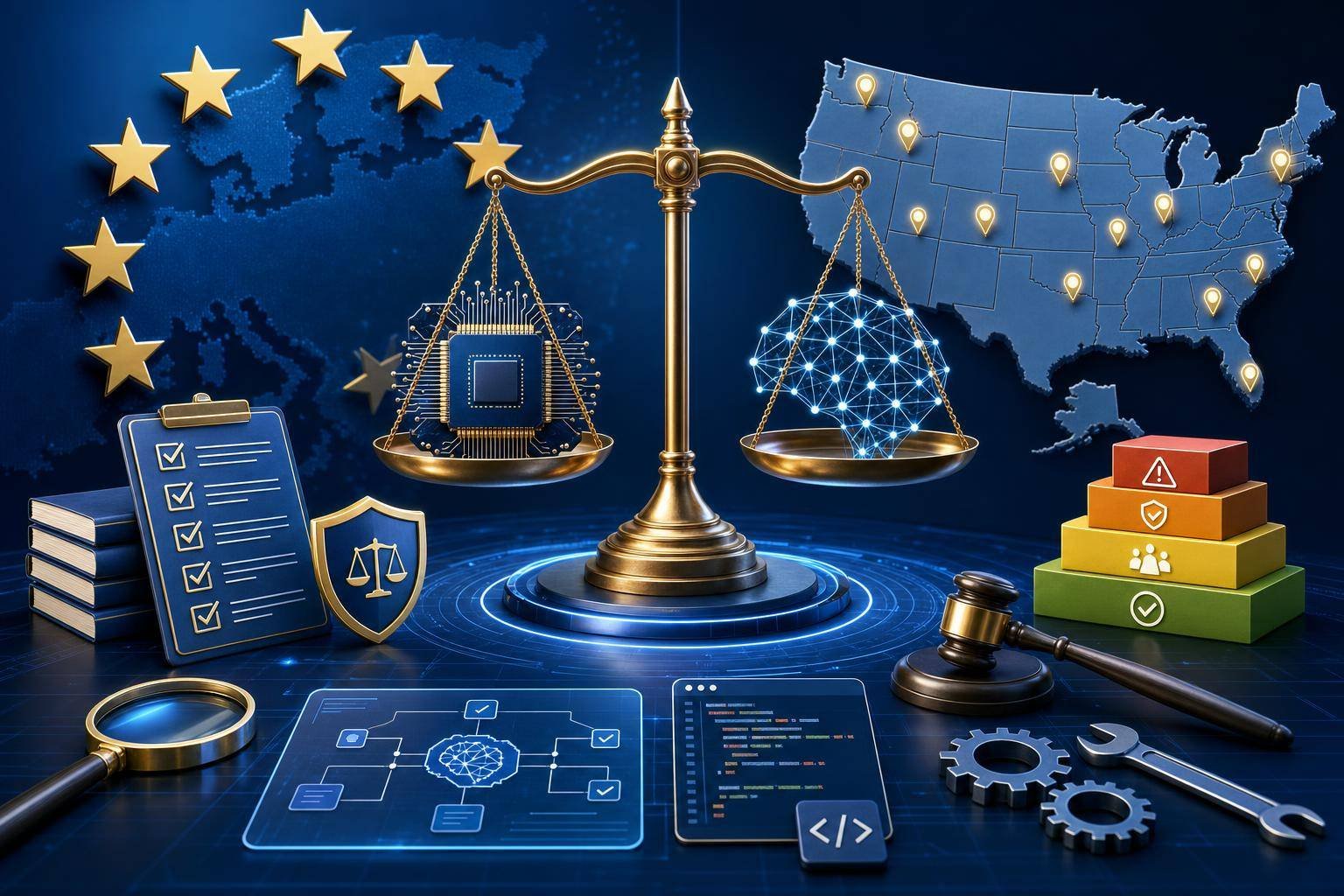
AI Regulation in 2026: A Practical Guide to the EU’s Risk-Based Rules, US State Laws, and What Builders Must Do Now
The rules of AI have finally arrived. 2026 is not a prelude—it’s enforcement. If you build, buy, or deploy AI systems at any scale, the legal and operational stakes changed this year. The European Union’s risk-based regime is entering full force, several US states have enacted their own sector-focused statutes, and regulators globally are signaling they intend to test compliance, not just posture about it.
This turning point isn’t just about fines. It’s about new ways of working: documenting data provenance, proving model robustness, demonstrating human oversight, labeling AI-generated content, and red-teaming models before they reach users. The organizations that translate “AI regulation” into reliable engineering, product, and governance practices will move faster—not slower—because they’ll ship systems they can defend.
This article maps the current state of AI regulation in 2026, compares the EU and US approaches, surfaces credible technical guidance, and gives you a step-by-step plan to operationalize compliance without stalling innovation.
The Global Shift to Risk-Based AI Regulation
Governments have converged on a core principle: regulate AI by use-case risk, not technology label. That design recognizes that the same model can be benign in one context and consequential in another.
The four tiers most organizations will recognize
Across jurisdictions, you’ll encounter a four-level risk model:
- Prohibited (unacceptable risk): AI practices that are fundamentally incompatible with rights or safety
- High risk: Systems used in consequential decisions (e.g., health, employment, education, law enforcement)
- Limited/low risk: Systems requiring transparency or targeted controls
- Minimal risk: General-purpose or low-impact use with minimal obligations
While definitions vary, the EU’s version is the most comprehensive and is explicitly tied to obligations and penalties. For a solid overview of the EU’s framework and timelines, see the European Commission’s summary of the Artificial Intelligence Act European Commission: AI Act overview.
Prohibited practices and penalties
As of February 2025, certain AI practices are banned in the EU, including:
- Systems that manipulate human behavior using subliminal or exploitative techniques
- Social scoring of individuals by public authorities
- Indiscriminate facial scraping for biometric databases (with narrow exceptions in some contexts)
- Real-time remote biometric identification for law enforcement in public spaces (subject to tightly controlled exceptions)
Enforcement has teeth. Violations of prohibited practices can trigger fines up to €35 million and/or 7% of global annual turnover, whichever is higher. Other violations carry penalties up to €15 million and/or 3% of global revenue. European institutions have made clear that 2026 is an enforcement year, not a grace period. The European Parliament’s adoption announcement underscores the accountability emphasis European Parliament press release.
High-risk systems—where obligations get real
High-risk AI systems are those used in critical domains where people can be harmed if the system fails or discriminates. By August 2026, providers and deployers of these systems must meet comprehensive obligations, including:
- Documented risk management and mitigation measures
- High-quality, relevant, and representative training/validation data
- Technical documentation, logs, and traceability
- Human oversight measures designed into the system
- Accuracy, robustness, and cybersecurity requirements
- Post-market monitoring and incident reporting
If you’re deploying AI in hiring screening, clinical decision support, creditworthiness, or public safety contexts, treat your system as “high risk” until a legal analysis proves otherwise.
EU AI Act: Entering the Enforcement Era
The EU AI Act is now the global reference point for comprehensive AI regulation. Even if your company is US-based, if your system touches EU users or is placed on the EU market, the Act likely applies.
Providers vs. deployers: know your role
- Providers (developers, model builders, system vendors) must design and document compliant systems, conduct conformity assessments, and affix CE markings for high-risk systems.
- Deployers (operators, enterprise buyers who implement AI) must use systems as intended, maintain logs, run post-deployment monitoring, and apply human oversight.
If you fine-tune a general-purpose model and place it on the market for a specific high-risk use, you may be considered a provider for that system. If you configure a vendor’s high-risk system and use it in hiring processes, you have deployer obligations.
Documentation and data governance are now engineering tasks
Regulation pushes documentation into the development pipeline, not just compliance binders. That means:
- Data sheets for datasets: provenance, licensing, representativeness, known gaps
- Model cards: intended use, limitations, evaluation metrics, known risks
- Logging and traceability: inputs, decisions, overrides, and key system events
- Robustness and cybersecurity testing: adversarial tests, stress tests, fail-safes
- Human oversight: concrete procedures for review, override, and escalation
For threat modeling and security controls specific to AI systems, ENISA’s AI Threat Landscape provides practical risks and mitigations from a European security lens ENISA AI Threat Landscape.
General-purpose and generative AI considerations
General-purpose AI (GPAI), including large language models, attracts transparency obligations, particularly when adapted for high-risk uses. Expect to provide:
- Sufficient technical documentation for downstream integrators
- Usage policies and safeguards against known misuse modes
- Information about training data sources at an aggregate level, where required by law
- Clear instructions for safe integration, including known limitations and guardrails
If your GPAI model enables or materially influences high-risk applications, your obligations move closer to those of a high-risk provider. Prepare your engineering and product teams accordingly.
United States: Decentralized, Sector-Led Compliance
The US has not passed an EU-style federal AI law. Instead, the regulatory posture is a mix of sectoral oversight, federal guidance, and assertive state laws.
Federal levers you can’t ignore
- Federal Trade Commission (FTC): Enforces against unfair or deceptive AI claims, biased outcomes, and inadequate security as Section 5 violations
- Equal Employment Opportunity Commission (EEOC): Scrutinizes AI in hiring and employment assessments for discriminatory impact
- Food and Drug Administration (FDA): Regulates AI/ML in medical devices and clinical decision support
- Consumer Financial Protection Bureau (CFPB): Oversees algorithmic decisioning in credit and lending
- Office of the Comptroller of the Currency (OCC) and Federal Reserve: Expect model risk management for financial services
Across sectors, the de facto technical baseline is the NIST AI Risk Management Framework (AI RMF). It’s voluntary, but widely adopted as an enterprise reference for mapping, measuring, managing, and governing AI risks. The AI RMF’s functions map naturally to EU-style obligations and can serve as your cross-jurisdiction backbone.
On security, the UK’s National Cyber Security Centre (NCSC) and US CISA published joint engineering guidance for building and operating AI systems securely—an excellent practitioner resource for devs and CISOs NCSC/CISA secure AI system development guidelines.
States are setting the pace: Colorado and California
- Colorado’s Senate Bill 24-205 (effective 2026) targets algorithmic discrimination in high-risk AI systems. It requires transparency, impact assessments, and consumer protection policies, pushing companies to document risks and mitigation steps Colorado SB24-205 bill page.
- California has advanced several AI-related bills. In 2026, California’s AB 2013 centers on data source disclosure for generative AI, and a state-level AI Transparency Act mandates the labeling of AI-generated content. To track finalized texts and guidance, monitor the California Legislative Information portal.
This decentralized model creates a compliance jigsaw for national deployments. Expect other states to emulate or iterate on these approaches, focusing on transparency, bias mitigation, and consumer rights.
Beyond the EU and US: Soft Law Is Hardening
Several jurisdictions are formalizing AI governance with a lighter-touch ethos, but the edges are getting firmer.
- United Kingdom: The “pro-innovation” framework relies on existing regulators to enforce AI within their remits, coordinated by central government. The UK has also stood up capabilities to evaluate “frontier” models and published white papers on regulatory expectations UK pro-innovation regulation paper.
- OECD: The OECD AI Principles remain a global north star for trustworthy AI—embraced by dozens of countries and often embedded in corporate AI policies OECD AI Principles.
- Asia-Pacific: Governments from Singapore to Australia have adopted model governance frameworks and voluntary codes that increasingly reference concrete testing, documentation, and labeling expectations. These often align with NIST-style risk management and EU-style transparency.
The net effect: even “soft law” is converging on real engineering practices—data documentation, risk testing, oversight, and user-facing transparency.
What This Means for Builders, Buyers, and Boards
If you lead AI products, security, or compliance, the job now is to operationalize. That doesn’t mean inventing a bespoke process for every jurisdiction. It means standing up a unified program with local add-ons.
A unified AI governance operating model
- Policy: Define plain-language policies for prohibited uses, risk classification, human oversight, data governance, model deployment, and incident response.
- Process: Build stage gates into your ML lifecycle—data collection, training, evaluation, deployment, monitoring—with required artifacts at each step.
- People: Stand up an AI governance committee (product, legal, risk, security, ethics, data science) that can approve exceptions and unblock delivery.
- Platform: Use your MLOps stack to automate documentation, testing, approvals, and monitoring—don’t treat compliance as a parallel manual track.
Technical controls that meet regulatory expectations
Security and safety are now part of compliance. Practical controls include:
- Dataset documentation and access control: Track provenance, licensing, consent, and representativeness. Lock down sensitive fields and maintain immutable audit logs.
- Model cards and evals: Publish intended use, limitations, and metrics. Run bias, robustness, and reliability tests that map to the use case (e.g., false positives in safety-critical contexts).
- Red teaming and adversarial testing: Simulate prompt injection, data leakage, content policy evasion, and jailbreak attempts for generative models. The OWASP Top 10 for LLMs is a useful threat model library OWASP Top 10 for LLM Applications.
- Guardrails and content filters: Enforce use policies at the application layer—topic restrictions, PII handling, contextual prompts, and safe output transforms.
- Human-in-the-loop design: Build clear reviewer workflows, thresholds for automatic vs. manual decisions, and escalation paths.
- Post-deployment monitoring: Drift detection, performance alerts, feedback capture, and rapid rollback mechanisms.
- Security by design: Apply secure SDLC to AI—secret management, dependency scanning for model pipelines, hardened inference endpoints, data isolation for memory/embeddings. For reference architectures and controls, see the NCSC/CISA secure AI guidance linked above.
Documentation is a product, not a PDF
Create living documentation:
- System description: Purpose, boundaries, dependencies, data flows
- Risk register: Identified harms, mitigations, residual risk, sign-offs
- User-facing notices: Clear explanations when users interact with AI, including labeling where required and known limitations
- Supplier dossiers: For third-party models and APIs—model cards, SLAs, security attestations, and testing evidence
Make these discoverable in your internal dev portal and version them like code.
Implementation Playbook: 90 Days to an AI-Ready Compliance Program
You don’t need a 400-page manual to get started. You need a crisp program you can ship. Here’s a 90-day plan that scales.
Days 1–30: Map and triage
- Inventory AI systems: – Identify all models, services, and features that make automated decisions or generate content. – Tag by use case, geography, data sensitivity, and business owner.
- Classify risk: – Use the EU categories as your baseline. Treat health, employment, education, credit, and public safety as high risk. – Flag prohibited use cases and halt them.
- Assign roles: – Name providers vs. deployers for each system. Identify system owners, risk leads, and sign-off authorities.
- Baseline assessments: – Run a quick NIST AI RMF-aligned risk assessment for each high-risk system NIST AI RMF. – Capture gaps in data quality, bias testing, documentation, oversight, and security.
Days 31–60: Build and embed controls
- Standardize artifacts: – Adopt templates: data sheets, model cards, risk registers, human-oversight playbooks, user notices.
- Engineering integrations: – Add mandatory checks to your CI/CD and MLOps flows: eval tests, bias tests, adversarial tests, and sign-offs before deployment.
- Security hardening: – Apply LLM-specific controls (prompt injection defenses, content filters, output validation) and standard AppSec practices. – Use OWASP LLM guidance for test cases OWASP LLM Top 10.
- Vendor governance: – Require third-party providers to supply technical documentation, security attestations, bias testing evidence, and uptime/SLA commitments. – Add AI-specific clauses to DPAs and MSAs (e.g., training data disclosure, incident reporting windows, model update notices).
Days 61–90: Prove and operationalize
- Post-market monitoring: – Deploy monitoring pipelines, establish incident criteria, and run a tabletop exercise for an AI incident (e.g., biased outcome or data leak).
- Transparency and labeling:
- Implement UI/UX labeling for AI-generated content where required (e.g., California’s labeling expectations).
- Publish accessible user notices and appeal processes for consequential decisions.
- Documentation and audits:
- Finalize system dossiers. Ensure every high-risk system has a complete trace from data to decision.
- Board and regulator readiness:
- Prepare a one-pager per system for executives and regulators: purpose, risk class, key controls, last eval dates, incident history, and owner contacts.
Mistakes to Avoid in 2026
- Treating “AI compliance” as a policy PDF. Regulators will ask for evidence in logs, tests, and product design—not just words.
- Overgeneralizing. Risk classification is use-case specific. The same model can be minimal risk in a chatbot and high risk in hiring.
- Ignoring security. AI-specific threats (prompt injection, data exfiltration via model outputs) can create both safety and privacy violations. See ENISA’s threat landscape for real cases ENISA AI Threat Landscape.
- Vendor blind spots. If a third-party model or API makes the decision, you still own the risk as the deployer.
- Last-mile opacity. Human oversight needs real authority and usability, not a buried “appeal” link.
EU vs US: Practical Differences That Matter
- Scope: The EU AI Act is comprehensive and cross-sector; the US is sectoral and enforcement-led (FTC, EEOC, FDA, CFPB).
- Obligations: The EU defines granular obligations for high-risk systems; US state laws emphasize transparency, impact statements, and anti-discrimination outcomes.
- Enforcement posture: The EU has explicit fines and conformity assessments; US regulators use existing statutes to pursue deceptive, unfair, or unsafe practices.
- Strategy: Multinationals should adopt a single control framework (e.g., NIST AI RMF) and layer on EU-specific documentation and conformity processes, plus US state transparency and impact rules (e.g., Colorado SB24-205 Colorado bill page and California’s labeling and data source disclosure via the California Legislative Information portal).
Building a Cross-Jurisdiction Compliance Backbone
Here’s a pragmatic architecture for global teams:
- Policy harmonization:
- Use OECD AI Principles for top-level commitments OECD AI Principles.
- Map NIST AI RMF functions (Govern, Map, Measure, Manage) to EU AI Act obligations and state-level rules.
- Control library:
- Reuse standardized controls (documentation, evals, logging, human oversight) across systems; attach local legal labels as tags.
- Evidence management:
- Centralize artifacts in a repository linked to your MLOps pipelines. Every deployment bundles its docs and test results.
- Local switches:
- Enable configuration by market (e.g., content labeling toggles, rights and appeals flows by state/country).
- Continuous updates:
- Assign legal and policy owners to watchlists (EU guidelines, US state bills, UK guidance) and run quarterly change reviews.
- Incident readiness:
- Stand up an AI incident response runbook aligned to your security IR plan. Include regulatory notification thresholds and timelines.
Security, Privacy, and Ethics: Converging Requirements
AI compliance isn’t a silo. It intersects with security, privacy, and ethics programs:
- Security: Align AI system hardening with secure SDLC. Adopt threat models that include supply chain (pretrained models), inference-time attacks, and data exposure. The NCSC/CISA guidance provides developer-level patterns Secure AI system development.
- Privacy: Data provenance and consent flow into dataset documentation. Use data minimization, synthetic data, and privacy-enhancing techniques where feasible.
- Responsible AI: Formalize fairness testing, error analysis, and stakeholder impact reviews. Document limitations transparently; don’t oversell capabilities to users or customers (an FTC magnet for enforcement).
Real-World Examples
- Hiring screening tool (high risk): Bias audits by job family and geography; candidate notices and non-AI alternative; human reviewer thresholds for edge cases; documented training data provenance; post-deployment drift watch.
- Clinical decision support (high risk): Clinician-in-the-loop design with override authority; validated performance against clinical endpoints; fail-safes when confidence is low; incident reporting pipeline.
- Generative marketing content (limited risk): Clear content labeling for AI-generated assets; guardrails to avoid sensitive topics; prompt and output logs; brand safety filters.
- Developer copilot (limited risk): Repository restrictions to prevent leakage of confidential code; prompt injection defenses; user training on secure use; telemetry to detect insecure suggestions.
FAQs: AI Regulation in 2026
Q: What qualifies an AI system as “high risk” under the EU model? A: Use in consequential domains such as health, employment, education, finance/credit, critical infrastructure, and certain public-sector functions. If the system can materially affect people’s rights or safety, assume high risk until proven otherwise.
Q: Does the EU AI Act apply to US companies? A: Yes, if you place AI systems on the EU market or your system’s outputs are used in the EU. Jurisdiction is based on market reach and use, not company headquarters.
Q: What are the deadlines I should care about in 2026? A: Banned practices took effect in February 2025. High-risk system obligations (documentation, risk management, oversight, monitoring) come fully into force by August 2026. State laws like Colorado SB24-205 also take effect in 2026.
Q: How do I avoid the largest fines? A: Do not deploy prohibited practices. For high-risk systems, implement a documented risk management program, maintain technical documentation and logs, ensure human oversight, and test for bias, robustness, and security. Monitor post-deployment and report incidents per legal timelines.
Q: Do I have to label AI-generated content? A: In some jurisdictions, yes. California’s AI Transparency Act mandates labeling of AI-generated materials, and the EU expects transparency for certain AI interactions. Build labeling into your content workflows and UIs.
Q: What framework should I use to organize my compliance program? A: Use the NIST AI RMF as your backbone, map it to EU AI Act and state-specific obligations, and add local transparency/impact requirements. This reduces duplication and audit fatigue.
Conclusion: Turn Regulation Into an Engineering Advantage
AI regulation in 2026 is not a future risk—it’s a present operating condition. The EU’s risk-based regime and US state laws are converging on the same fundamentals: know your system, document your data, measure your risks, secure your pipelines, involve humans wisely, and tell users the truth. The penalties for ignoring these rules are stiff, but the bigger cost is lost trust and product disruption when issues surface.
Treat AI regulation as a forcing function for maturity. Build a unified program grounded in the NIST AI RMF, align it with the EU AI Act’s detailed obligations, and implement transparent, testable controls. The organizations that do this well will ship faster with fewer surprises—and they’ll be able to prove, not just claim, that their AI is safe, fair, and secure. If you’re starting now, start small but start today: inventory, classify, document, test, and label. That’s how you make AI regulation in 2026 a competitive edge rather than a compliance drag.
Discover more at InnoVirtuoso.com
I would love some feedback on my writing so if you have any, please don’t hesitate to leave a comment around here or in any platforms that is convenient for you.
For more on tech and other topics, explore InnoVirtuoso.com anytime. Subscribe to my newsletter and join our growing community—we’ll create something magical together. I promise, it’ll never be boring!
Stay updated with the latest news—subscribe to our newsletter today!
Thank you all—wishing you an amazing day ahead!
Read more related Articles at InnoVirtuoso
- How to Completely Turn Off Google AI on Your Android Phone
- The Best AI Jokes of the Month: February Edition
- Introducing SpoofDPI: Bypassing Deep Packet Inspection
- Getting Started with shadps4: Your Guide to the PlayStation 4 Emulator
- Sophos Pricing in 2025: A Guide to Intercept X Endpoint Protection
- The Essential Requirements for Augmented Reality: A Comprehensive Guide
- Harvard: A Legacy of Achievements and a Path Towards the Future
- Unlocking the Secrets of Prompt Engineering: 5 Must-Read Books That Will Revolutionize You