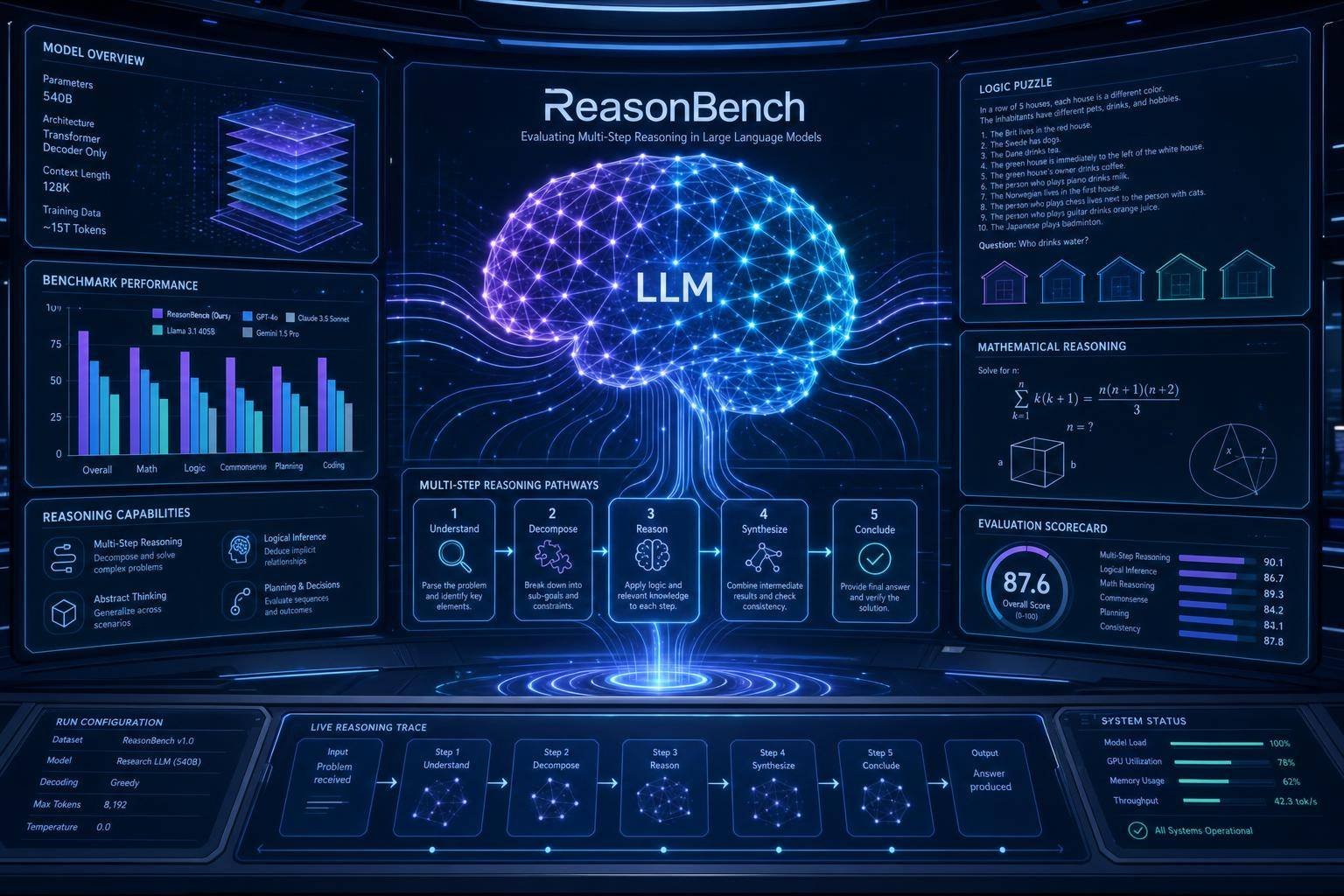
ReasonBench by Epoch AI: A Rigorous Benchmark for Measuring Multi‑Step Reasoning in LLMs
Large language models are getting better at tests—but not always better at thinking. As organizations push LLMs into planning, coding, analysis, and autonomous agents, the industry’s default metrics often reward pattern recall rather than structured reasoning. That gap is starting to matter in production.
Epoch AI’s new ReasonBench squarely targets this problem with a benchmark suite purpose‑built to measure multi‑step reasoning in LLMs. It evaluates both answers and the path taken to reach them, using tasks that reduce training-data leakage and require explicit intermediate steps. For teams building decision-critical AI, the shift from “did it get the answer?” to “did it reason correctly?” is overdue.
This analysis explains what ReasonBench measures, why it differs from familiar leaderboards, how to use it in practice, and how it can inform training strategies like process supervision and verifiable reward modeling. We also highlight where reasoning benchmarks can mislead—and how to avoid those traps.
Read Epoch AI’s announcement and documentation for ReasonBench.
Why multi‑step reasoning is hard—and why traditional benchmarks can mislead
Most popular benchmarks test knowledge and short-form problem solving. They reward models that recognize patterns or recall facts. That’s useful, but it doesn’t guarantee a model can decompose problems, apply rules consistently, or verify its own steps under perturbations.
Three issues show up repeatedly:
- Memorization vs. reasoning: Models may “know” many answers because training data contained the question or similar exemplars. In these cases, high scores confound recall with reasoning.
- Final-answer myopia: A model can guess right for the wrong reasons. Without evaluating intermediate steps, you can’t tell if the model’s chain of thought is robust or just lucky.
- Fragile reasoning: Seemingly minor changes—number perturbations, variable renaming, or reordering—can break brittle reasoning strategies, even when a model’s headline score looks strong.
Benchmarks like MMLU (Measuring Massive Multitask Language Understanding) or standardized coding tests are invaluable for breadth. But when you’re assessing whether an LLM can plan, prove, synthesize, or debug reliably, final-answer accuracy alone is not enough. ReasonBench centers the evaluation on the reasoning process, not just the outcome.
Inside ReasonBench: what it measures and how it works
ReasonBench is designed to isolate reasoning ability while minimizing the confounding effect of data leakage. It blends problem types that force stepwise decomposition, explicit justification, and verifiable intermediate outputs.
What’s in the suite
- Math word problems: Multi-line arithmetic, algebraic manipulation, and structured quantitative reasoning (e.g., “read the problem, set up equations, solve, verify”).
- Logic puzzles: Symbolic and propositional logic scenarios, truth tables, and deduction tasks that require consistent rule application across steps.
- Program synthesis challenges: Write or complete a function to meet a spec, often validated by tests or checkers. This is similar in spirit to HumanEval’s unit-test approach but tuned for stepwise reasoning rather than only final execution.
- Short proof-style questions: Mini-proofs or derivations demanding explicit claims and justifications at each step.
How it scores
- Final answer correctness: The usual end-state metric still matters—but it’s not the whole story.
- Intermediate reasoning quality: ReasonBench scores the chain of thought using a mix of rule-based checkers (e.g., algebraic equivalence, invariant preservation, unit tests) and LLM-based verifiers that assess structure, validity, and adherence to rubrics.
- Robustness probes: Many tasks include controlled perturbations (e.g., variable renaming, equivalent rephrasings, lightly altered numeric parameters) to test stability of the reasoning path.
Why this matters
- Data leakage defense: ReasonBench prioritizes tasks with minimal likelihood of appearing verbatim in model training corpora and provides documentation to help researchers extend the suite without reintroducing leakage.
- Process supervision ready: Because it evaluates stepwise traces, ReasonBench doubles as a scaffold for training strategies that reward correct intermediate reasoning, not just correct endpoints.
The release ships with open-source evaluation scripts, annotation guidelines, and contribution workflows so researchers can add tasks, propose scoring improvements, or test alternative verification rubrics. For many teams, this means a faster path from “we think our model reasons better” to “we can prove it across standardized tasks.”
How ReasonBench differs from familiar benchmarks and eval stacks
ReasonBench is not a replacement for breadth-focused or domain-specific evals—it’s a complement that adds a missing dimension: process fidelity.
- Compared to MMLU and similar general knowledge tests: MMLU measures task breadth and factual/commonsense proficiency across domains. ReasonBench narrows to tasks that require explicit, multi-line reasoning, with graded intermediate steps and perturbation robustness.
- Compared to math-only benchmarks (e.g., GSM8K/MATH): Datasets like GSM8K target mathematical reasoning, often with chain-of-thought solutions. ReasonBench broadens beyond math to logic, program synthesis, and proof-style questions, and emphasizes verifier-backed scoring of intermediate traces rather than only final numerical accuracy.
- Compared to coding evals like HumanEval: HumanEval validates synthesized code by running tests, which is excellent for end-to-end functional correctness. ReasonBench goes further by evaluating the reasoning trace (spec interpretation, algorithmic steps, invariants) and robustness to small task perturbations that can break brittle prompt overfitting.
- Compared to top-line “LLM-as-a-judge” leaderboards: LLM-judged conversational quality benchmarks (e.g., MT‑Bench) provide fast relative rankings but can inherit the judge model’s biases and may be weakly grounded. ReasonBench uses domain-specific rule checkers where possible and treats LLM verification as a complement, not a sole source of truth.
- Compared to comprehensive evaluation frameworks: Stanford’s HELM promotes evaluation across scenarios, risks, and metrics, including data contamination tracking. ReasonBench aligns with this spirit but concentrates specifically on multi-step reasoning, process scoring, and leakage-aware task design.
Crucially, ReasonBench requires or strongly encourages explicit reasoning traces. That gives you actionable visibility: you can audit a model’s steps, identify where logic fails, and tune decoding or prompts to shore up weak links.
What the baseline results imply: similar MMLU, very different reasoning robustness
Epoch AI reports baseline ReasonBench results for a range of models, including GPT‑5, Claude 4.5, Gemini 2.5 Pro, LLaMA 5, and selected open-weight systems. Without reproducing their numbers, the top-level pattern matters: models that look comparable on traditional metrics like MMLU can diverge significantly on reasoning robustness.
Three takeaways stand out:
- Final-answer parity hides process gaps: Two models may tie on end accuracy, but one maintains consistent intermediate steps across perturbations while the other collapses under rephrasings or off-by-one parameter changes.
- Longer chains amplify error propagation: Some models handle two–three logical hops but accumulate contradictions beyond that depth. ReasonBench’s graded traces help pinpoint the “breaking hop,” guiding targeted interventions (e.g., tool use, retrieval scaffolds, or shorter-step decompositions).
- Verifier-aware training signals matter: Systems trained with process supervision, rationale labeling, or verifier-guided rewards tend to produce cleaner, more checkable reasoning traces—even when their raw knowledge breadth is similar. This aligns with public findings such as OpenAI’s work on process supervision for mathematical reasoning.
For practitioners, the practical message is blunt: don’t assume a model will reason well just because it scores high on breadth benchmarks. If your application depends on structured thought—analysis, planning, proofs, synthesis—measure the process.
The mechanics of ReasonBench scoring: hybrid verification without rose-colored glasses
ReasonBench uses two complementary verification strategies:
- Rule-based checkers: For math and code, many intermediate steps can be validated mechanically. For example, algebraic transformations must preserve equivalence; code snippets should pass specific unit tests; logical deductions must match semantics.
- LLM-based verifiers: Where strict rules aren’t enough (e.g., evaluating an argument’s structure), LLMs serve as rubric-guided graders. To mitigate subjectivity, ReasonBench emphasizes clear grading rubrics, multiple-pass verification, and cross-checking with alternative phrasings.
This hybrid approach is pragmatic. Purely rule-based evaluation misses important aspects of reasoning quality (e.g., clarity, explicit justification), while LLM-only judging can be biased. Projects like MT‑Bench show LLM judges can be informative but imperfect; ReasonBench treats them as one tool among several, not a sole arbiter.
The suite also documents contamination-reduction strategies and encourages community scrutiny—echoing best practices from initiatives like HELM, which tracks data sources and coverage to help distinguish memorization from generalization.
How to adopt ReasonBench in your AI evaluation workflow
You don’t need to replace your existing evals. Fold ReasonBench into your pipeline where reasoning quality really matters.
A step-by-step playbook
- Define “reasoning-critical” use cases: – Where do intermediate steps affect safety, compliance, or user trust? Examples: financial analysis, privacy-sensitive data transformations, code refactoring, policy reasoning, stepwise troubleshooting.
- Select relevant ReasonBench task categories: – Map your use cases to math, logic, coding, or proof-style tasks. If gaps exist, propose new tasks via the project’s contribution workflow.
- Standardize decoding settings: – Fix temperature, top‑p, max tokens, and stopping criteria across runs. Record sampling strategies (e.g., self-consistency, voting). Inconsistent decoding makes comparisons noisy.
- Require explicit reasoning traces: – Use prompts that elicit structured steps. If you cannot store chain-of-thought for privacy reasons, opt for structured rationales or tool-augmented traces that avoid sensitive replication while remaining checkable.
- Integrate rule-based verifiers first: – Start with hard-ground truth where possible (tests, algebraic checks, symbolic solvers). Add LLM-based verifiers with clear rubrics and calibration checks.
- Track robustness, not just accuracy: – Run perturbation variants. Record where traces diverge, which steps fail, and whether minor rephrasings degrade performance.
- Automate in CI: – Hook ReasonBench into your model release process. Fail builds or flag regressions when reasoning metrics dip, even if final-answer accuracy stays flat.
- Instrument error analysis: – Tag failure modes: incorrect assumptions, algebraic slips, missing invariants, tool misuse. Use these tags to drive prompt updates or targeted fine-tuning.
- Close the loop with training: – Use process labels, verifier feedback, or curated exemplars to amplify correct intermediate reasoning. Techniques like chain‑of‑thought prompting (Wei et al.) and process supervision (OpenAI) can lift ReasonBench scores and real-world reliability.
- Report with nuance:
- Publish both final-answer and process metrics. Include decoding configs, verifier rules, and robustness probes. Transparency guards against benchmark gaming.
Mistakes to avoid
- Overfitting to the suite: Rotating holdouts and adding variants helps prevent “teaching to the test.”
- Ignoring cost-quality tradeoffs: Some decoding strategies (e.g., self-consistency with multiple samples) boost quality but raise latency and cost. Record both.
- Treating LLM judges as oracles: Calibrate, cross-verify, and periodically swap verifier models to detect bias.
Practical examples: mapping ReasonBench tasks to real-world workflows
- Financial modeling assistant:
- Use math word problems and proof-style tasks to ensure the model documents assumptions, shows derivations, and checks constraints (e.g., balance-sheet invariants). Rule-based checkers verify arithmetic and accounting identities.
- DevOps troubleshooting co-pilot:
- Leverage logic puzzles and program synthesis challenges that demand stepwise diagnosis, hypothesis testing, and reversible changes. Tests validate proposed configuration fixes.
- Policy compliance analyst:
- Short proof-style tasks can model “if–then” regulatory reasoning. LLM verifiers grade structure and citation alignment to policy clauses, while rule-based checkers ensure consistent application of defined terms.
- Research assistant for literature analysis:
- Logic and proof-style questions help evaluate argument decomposition and counterexample generation. Robustness probes catch brittle paraphrase sensitivity that could mislead users.
For each, the lesson is the same: if the chain is broken anywhere, the confidence you place in the final recommendation should fall. ReasonBench operationalizes that common-sense standard.
Training implications: from chain‑of‑thought to verifiable reward modeling
ReasonBench isn’t only an eval—it’s a training guidepost. If your scorecard rewards correct steps, you can design training signals that make those steps more likely.
Promising directions
- Chain-of-thought supervision: Provide exemplars with explicit, high-quality steps. Papers like Chain‑of‑Thought Prompting show that eliciting rationales can improve complex reasoning, though care is needed to avoid leaking sensitive chains in production.
- Process supervision: Reward correct intermediate steps rather than, or in addition to, final answers. See OpenAI’s public work on improving mathematical reasoning with process supervision.
- Verifiable reward modeling: Use rule-based checkers and rubric-driven verifiers to generate dense training signals. A “verifier in the loop” can grade each step, not just the outcome, shaping behavior toward checkable reasoning.
- Tool-augmented reasoning: Encourage models to invoke tools (calculators, theorem provers, unit test runners) during reasoning. Program-synthesis tasks with tests directly reward this behavior.
By aligning supervision with ReasonBench’s process metrics, you reduce the temptation for models to “shortcut” via recall or pattern-matching. You also create a more auditable training trail that fits governance expectations.
Governance and risk: evaluation aligned with trustworthy AI principles
If your organization follows AI governance frameworks, process-centric evaluation maps neatly to risk controls.
- NIST AI RMF alignment: The NIST AI Risk Management Framework emphasizes measurement, traceability, and mitigation of systemic risks. ReasonBench’s insistence on explicit steps and verifier-backed checks supports traceability and post-hoc audits.
- Safety and reliability: Reasoned, step-by-step outputs make it easier to detect hallucinations and to remediate with targeted guardrails.
- Privacy and security: If you cannot log chain-of-thought verbatim (e.g., to avoid storing sensitive user context), use structured, minimal rationales or tool traces. You still gain checkability without over-retaining data.
- Transparency to stakeholders: Publishing process-aware metrics and rubrics fosters trust and sets realistic expectations with users and regulators.
No benchmark is a panacea. But centering on process and robustness reduces the risk of deploying brittle systems at scale.
Tuning and operations: decoding, prompting, and iteration strategies
Even the best model will underperform on ReasonBench with sloppy decoding or prompting. Treat evaluation as a tuning partner.
Practical knobs
- Decoding:
- Temperature and top‑p: Lower values improve determinism and step consistency; higher values can escape local traps but risk incoherence. For stepwise tasks, a moderate temperature with self-consistency (sample multiple chains, vote) often works well—track cost.
- Max tokens and stop sequences: Ensure enough budget for full reasoning; cut off rambling with clear step markers or stop tokens.
- Prompting:
- Structure: Use templates like “Given, Plan, Steps, Check” to encourage discipline. Ask the model to verify each step before proceeding.
- Tool calls: Provide explicit tool affordances (e.g., “use calculator() for arithmetic”) and grade on correct tool use.
- Verification loops:
- Re-run verifiers after edits or self-corrections. Maintain a “retry budget” to prevent endless loops.
Operational practices
- Regression dashboards: Track process metrics—step correctness, verifier agreement, robustness deltas—side by side with final accuracy.
- Canary tasks: Keep a small, private set of high-sensitivity tasks to detect overfitting to public benchmarks.
- Eval drift monitoring: Periodically rotate verifier models and perturbations to ensure your metrics continue to reflect generalizable reasoning, not idiosyncrasies.
How ReasonBench raises the bar for the broader research community
ReasonBench arrives into an ecosystem already grappling with evaluation rigor. The community has learned hard lessons: contamination can inflate scores, LLM judges can be biased, and single-number leaderboards can obscure brittleness. By offering:
- Leakage-aware tasks across multiple reasoning domains,
- Hybrid verification with rule-based and LLM-based graders,
- Public baselines across leading and open-weight models,
- Transparent documentation and an open contribution path,
ReasonBench invites the field to converge on something more meaningful than “who has the highest average.” It’s a call to measure how models think, not just what they answer.
For researchers, it’s a fertile testbed for studying prompting, training, and decoding strategies. For enterprises, it’s a pragmatic tool to de-risk rollouts of reasoning-heavy LLM applications.
FAQ
What makes ReasonBench different from MMLU or general knowledge benchmarks? – ReasonBench focuses on multi-step reasoning with explicit intermediate steps and robustness probes. MMLU emphasizes breadth of knowledge and short-form problem solving. They’re complementary; ReasonBench adds process fidelity where it matters.
Can I use ReasonBench without exposing chain-of-thought outputs? – Yes. You can log structured, minimal rationales or tool traces that capture the necessary steps without storing sensitive verbatim content. You’ll still benefit from rule-based verification and rubric-based grading.
How reliable are LLM-based verifiers in ReasonBench? – They can be effective when guided by clear rubrics and cross-checked, but they are not perfect. ReasonBench uses hybrid verification: rule-based checkers where possible and LLM verifiers as a complement, with recommendations to calibrate and rotate judges.
Does strong ReasonBench performance translate to better agents in production? – Typically yes, for tasks that require structured thought. However, transfer depends on alignment between your use case and ReasonBench task types, as well as operational factors like tool use, context length, and retrieval quality. Always validate on domain-specific canaries.
How should I report ReasonBench scores responsibly? – Include final-answer accuracy, step-level scores, verifier configs, decoding settings, and results on perturbation variants. This transparency helps others reproduce results and reduces benchmark gaming.
Can ReasonBench inform training strategies? – Absolutely. It’s well-suited to process supervision, chain-of-thought training, and verifier-guided rewards. Align your training signals with the steps ReasonBench grades to improve both scores and real-world reliability.
Conclusion: ReasonBench puts the “how” back into LLM evaluation
If your business or research depends on LLMs that decompose problems, justify claims, and withstand small perturbations, you need to measure more than final answers. ReasonBench provides a leakage-aware, multi-domain, process-centric benchmark for multi-step reasoning in LLMs—complete with open scripts, rubrics, and community pathways.
Use it to diagnose brittle steps, guide prompt and decoding choices, and inform training methods like process supervision and verifiable reward modeling. Pair it with breadth evals and domain canaries, automate it in CI, and publish process-aware metrics that stakeholders can trust.
LLMs will keep improving at tests. With ReasonBench, we can help them get better at thinking—and prove it. For details, tasks, and baselines, see Epoch AI’s ReasonBench announcement and documentation.
Discover more at InnoVirtuoso.com
I would love some feedback on my writing so if you have any, please don’t hesitate to leave a comment around here or in any platforms that is convenient for you.
For more on tech and other topics, explore InnoVirtuoso.com anytime. Subscribe to my newsletter and join our growing community—we’ll create something magical together. I promise, it’ll never be boring!
Stay updated with the latest news—subscribe to our newsletter today!
Thank you all—wishing you an amazing day ahead!
Read more related Articles at InnoVirtuoso
- How to Completely Turn Off Google AI on Your Android Phone
- The Best AI Jokes of the Month: February Edition
- Introducing SpoofDPI: Bypassing Deep Packet Inspection
- Getting Started with shadps4: Your Guide to the PlayStation 4 Emulator
- Sophos Pricing in 2025: A Guide to Intercept X Endpoint Protection
- The Essential Requirements for Augmented Reality: A Comprehensive Guide
- Harvard: A Legacy of Achievements and a Path Towards the Future
- Unlocking the Secrets of Prompt Engineering: 5 Must-Read Books That Will Revolutionize You