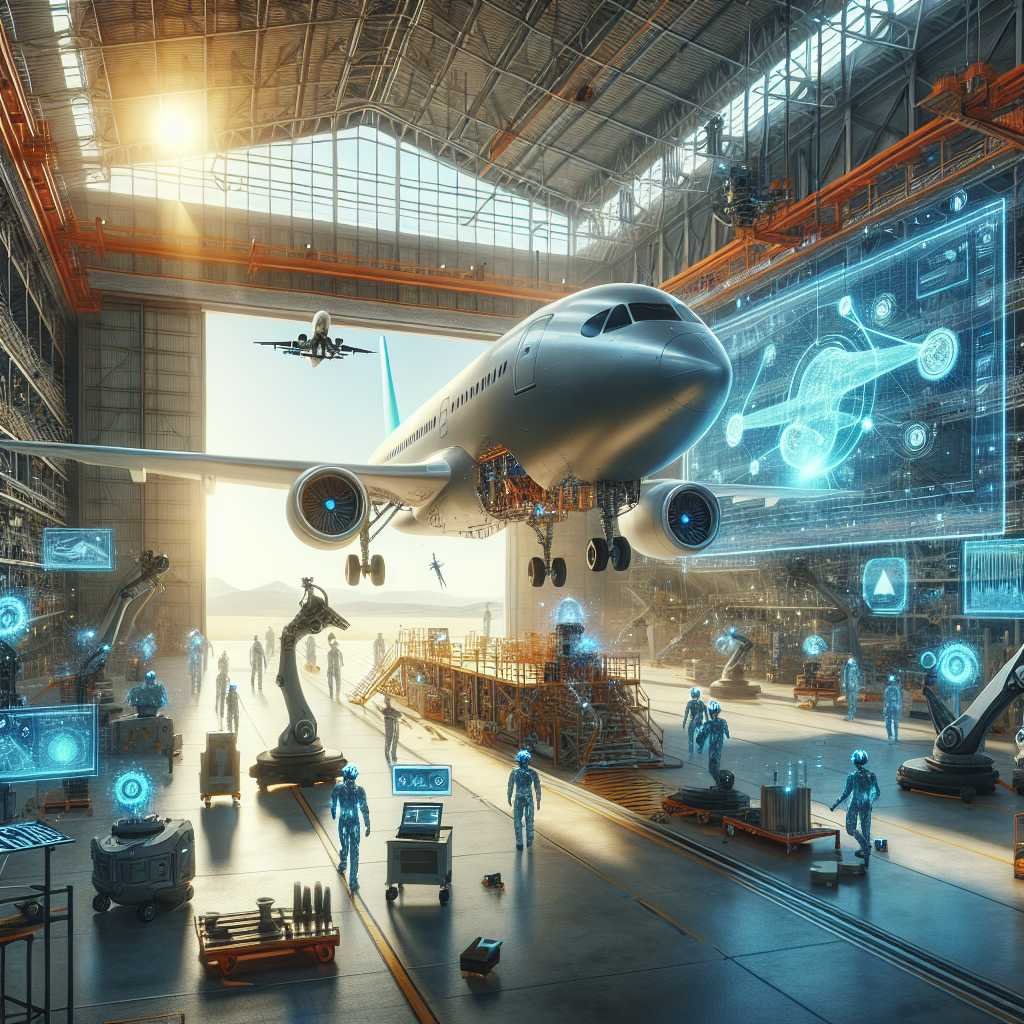
AI at the Precipice of an Aviation Revolution: How Boeing’s Next Airplane Could Be Built Smarter, Faster, and Safer
What if the next great leap in aircraft design doesn’t arrive on the factory floor—but in the data? That’s the premise transforming aerospace right now. According to a new report from Leeham News, Boeing’s next all-new airplane will be developed with Artificial Intelligence not as a sidekick, but as a core teammate—reimagining how we design, test, certify, build, and maintain aircraft at scale. If that sounds like a turning point, it is. We’re standing at the edge of an industry-changing wave where AI moves from promising experiments to the digital backbone of next-generation jets.
Leeham’s series by Scott Hamilton frames it succinctly: AI is perched on “the precipice of an absolute technology revolution” in aviation. Boeing formally signaled its commitment years ago—citing AI among emergent tools in its Innovation Quarterly—yet the scale and stakes are now dramatically higher. From AI-driven simulations that outpace traditional methods to machine learning models that comb through billions of data points from test flights, the implications touch every phase of an aircraft’s lifecycle. Safety, sustainability, speed-to-market, and competitive dynamics are all in play.
In this deep dive, we’ll unpack what’s changing, why it matters now, and how AI could quietly determine which manufacturers set the pace in the decade ahead.
Sources to explore: – Leeham News: AI at the precipice of a technology revolution in aviation link – Boeing Innovation Quarterly (archive landing) link – Airbus Skywise platform link – NIST AI Risk Management Framework link – EASA Artificial Intelligence Roadmap 2.0 link – NASA on digital twins link
Why AI in Aviation Is Hitting Its Moment
Aerospace has flirted with AI for years—route optimization, anomaly detection, predictive maintenance trials. But three shifts are converging to make this moment different:
- Data gravity: Modern aircraft generate torrents of high-fidelity data from sensors, flight tests, wind tunnels, and production lines. The more data you collect, the more value AI can extract—especially across fleets and programs.
- Compute and modeling breakthroughs: Accelerated computing and physics-informed machine learning make it possible to run simulations and surrogate models far faster, often with near-CFD fidelity in a fraction of the time.
- Digital thread maturity: Model-Based Systems Engineering (MBSE), digital twins, and integrated Product Lifecycle Management (PLM) tools now weave a “digital thread” from concept to operations—giving AI continuous, contextual data to learn from and act on.
The result is a tipping point. AI isn’t just automating old tasks; it’s changing what’s possible in the first place.
From Experimental to Essential: Boeing, Airbus, and the Competitive Imperative
Leeham’s analysis notes Boeing’s next airplane program will lean heavily into AI to compress timelines, wring out cost, and raise safety margins. Expect Airbus to continue an equally aggressive push—its Skywise platform already gives operators data-driven insights into reliability and maintenance, and the company has been investing in AI-powered design, manufacturing, and flight operations. In short: this is a race. Falling behind on AI now risks structural disadvantage later, because the gains compound over time as models learn from ever-growing datasets.
What “AI-First” Aircraft Development Looks Like
Here’s how AI could reshape each phase of the aircraft lifecycle—and why each step matters.
1) Conceptual Design and Aerodynamics: Speed and Insight, Not Guesswork
- AI-accelerated aerodynamics: Machine learning surrogates trained on CFD and wind tunnel results can predict aerodynamic performance orders of magnitude faster than conventional solvers. This lets design teams iterate rapidly across wing shapes, high-lift devices, nacelle placements, and fuselage tweaks—searching a much larger design space for optimal solutions.
- Generative design and topology optimization: Algorithms propose lightweight structural concepts that meet load cases and manufacturability constraints. Think truss-like internal structures or composite layups tuned for strength where needed and mass trimmed where not. The payoff: lower weight, lower fuel burn, and lower emissions.
- Multi-objective trade-offs: AI helps weigh conflicting goals—range, payload, noise, fuel consumption, maintenance costs—against certification requirements and sustainability targets. Instead of serial compromises, you get a data-driven Pareto frontier of best-possible trade-offs.
Technologies to watch: – Physics-informed ML (hybrids that respect conservation laws and boundary conditions) – Generative design toolchains from leading CAE vendors – Real-time co-optimization across aerodynamics, structures, and propulsion
2) Structural Analysis and Materials: Predict Before You Break
- Virtual testing at scale: AI-driven simulations can flag likely structural failure modes earlier—buckling, fatigue hotspots, delamination in composites—reducing “discoveries” during expensive physical tests.
- Materials discovery and layup tuning: Models analyze historical coupons and panel tests to guide resin systems, fiber orientations, and cure cycles. The objective is better damage tolerance with less weight and more predictable manufacturing outcomes.
- Sensor fusion and structural health monitoring (SHM): Fiber-optic sensing, acoustic emission, and strain gauges feed machine learning models to monitor in-service aircraft. Predictive models catch anomalies before they cascade into repair events or AOG (aircraft on ground) situations.
The larger picture: You get lighter, tougher, more maintainable airframes—and a faster march from early prototypes to certification-grade confidence.
3) Flight Controls, Avionics, and Systems Integration: Confidence Through Coverage
- Virtual integration labs, supercharged: AI automates test-case generation and coverage analysis across avionics and flight control software. It can prioritize edge cases and regressions most likely to surface integration bugs.
- Scenario exploration: Digital twins of the full aircraft-systems stack simulate thousands of abnormal conditions—sensor dropouts, actuator lag, icing effects—to prove robustness before the first flight.
- Assurance with explainability: While flight-critical algorithms must meet standards like DO-178C, explainable AI tools can help show how non-deterministic components behave under varying conditions—critical for regulators and safety assessors.
Oversight matters. Regulators like EASA are already mapping out how AI can be safely used in aviation, and frameworks such as the NIST AI RMF guide organizations on governance, bias, and robustness.
4) Manufacturing and Quality: Fewer Defects, Better Throughput
- Vision-driven inspection: Computer vision checks fastener placement, sealant application, surface defects, and composite layup alignment in real time. The result is earlier error detection and less rework.
- Predictive yield: Models anticipate production bottlenecks, tool wear, and variation trends by line and shift. This helps factories plan maintenance, adjust takt times, and reduce scrap.
- Human-in-the-loop assembly: AR headsets and cobots guided by AI can assist technicians with complex tasks, reducing fatigue and error rates while preserving human judgment for exceptions and sign-offs.
The prize here is throughput with precision—making ramp-ups less painful and new program learning curves shallower.
5) Flight Test and Certification: Faster Paths to Evidence
- Test card optimization: AI prioritizes test points to maximize information gain per flight hour, cutting redundant runs and compressing envelope expansion.
- Telemetry triage: Streaming analytics flag anomalies immediately, enabling the team to pivot sooner—and catch issues days or weeks earlier.
- Evidence automation: For compliance documents, AI can help construct traceability chains from requirements to tests to results, easing audits and demonstrating coverage to authorities.
Note: none of this replaces regulatory scrutiny; it augments it, building greater confidence with richer, more targeted evidence.
6) Operations and Maintenance: Reliability as a Competitive Advantage
- Predictive maintenance: ML models ingest engine health data, FOQA/flight data, environmental conditions, and maintenance records to forecast component failures—shifting carriers from scheduled to condition-based maintenance. Airlines can plan part swaps and window downtime to minimize disruptions.
- Fuel and route optimization: Smarter trajectory planning and in-flight recommendations cut fuel burn and contrails, feeding sustainability goals without new airframe hardware.
- Fleet-wide learnings: AI can generalize insights from one tail to the fleet, spotting failure patterns early and updating maintenance intervals. With platforms like Skywise, this network effect is already real—and Boeing’s equivalents will be crucial.
The Digital Backbone: Twins, Threads, and Trust
For AI to deliver durable value, it needs structure—a way to pull, relate, and reason over engineering, manufacturing, and operational data consistently. Three concepts matter:
- Digital twins: High-fidelity, continuously updated models of the aircraft (and its subsystems) that mirror real-world performance. NASA’s work on AI and digital twins offers a glimpse of the architecture and benefits in complex systems.
- Digital thread: End-to-end traceability that connects requirements to models, to bills of materials, to shop-floor execution, to in-service telemetry. This thread lets AI see cause-and-effect across lifecycle silos.
- Model-Based Systems Engineering (MBSE): SysML-driven architectures standardize interfaces and assumptions, so AI tools can query systems behavior without constant rework.
These aren’t buzzwords; they’re prerequisites. Companies that get the data plumbing, semantics, and governance right will extract exponentially more value from the same models.
Safety, Ethics, and Regulation: Building AI You Can Certify
Aircraft safety isn’t negotiable, and AI must meet that bar. Industry and regulators are converging on principles to ensure responsible integration:
- Human-in-the-loop by design: Critical decisions keep humans in control, with AI providing decision support, anomaly alerts, and recommended actions.
- Explainability and traceability: Systems must be auditable. It should be clear what data the model saw, how it was validated, and how it behaves under edge conditions.
- Robustness to shift: Models should be stress-tested against distribution changes—new routes, climates, maintenance regimes—to minimize performance drift.
- Security-first: AI expands the attack surface. Threat modeling, red-teaming, and secure MLOps pipelines are essential to prevent data poisoning or model tampering.
Expect more explicit guidance from EASA and the FAA; for now, the EASA AI Roadmap and NIST AI RMF offer practical scaffolding while formal standards evolve.
The Data Challenge: What It Takes to Make AI Useful
Aerospace data is complex: scattered across legacy systems, guarded by suppliers, and often inconsistent at the edges. Success hinges on:
- Data quality and lineage: Clean, labeled, versioned data with clear provenance is non-negotiable. You can’t validate or certify what you can’t trace.
- Federated access: Secure ways to learn from supplier and airline data without centralizing everything—think privacy-preserving approaches and clear contractual frameworks.
- MLOps discipline: Reproducible training, model registries, monitoring, and rollback plans are table stakes for safety and uptime.
- Skilled teams: AI engineers, domain experts, safety assessors, and certification specialists working as one team—because context is everything in aviation.
Companies that invest early in data foundations will see compounding returns as more models deploy.
Sustainability: Lighter, Cleaner, Smarter
AI’s sustainability story is compelling:
- Lighter structures and efficient aerodynamics reduce fuel burn long before new propulsion architectures mature.
- Real-time routing and descent profiles cut contrails and CO₂.
- Predictive maintenance keeps aircraft flying optimally, limiting heavy fixes and wasted cycles.
- Smarter supply chains reduce scrap and unnecessary logistics.
In the near term, AI offers one of the most scalable levers for emissions reduction—complementing sustainable aviation fuel (SAF) and future hybrid/electric propulsion research.
Risks and Reality Checks
AI won’t magic-wand the complexity out of aircraft development. Watch for:
- Overfitting to the past: Historical data encodes yesterday’s designs and conditions. Models must generalize to new architectures and operations, or they’ll mislead confidently.
- Organizational gaps: If incentives reward local optimizations (e.g., factory throughput) at the expense of system-level outcomes (e.g., maintainability), AI value stalls.
- Tool sprawl: Point solutions without integration become another layer of siloed complexity. The digital thread matters.
- Talent bottlenecks: Shortages in safety-focused ML engineering and data stewardship can slow deployment—and introduce risk if corners are cut.
Acknowledging these risks isn’t pessimism; it’s how you integrate AI responsibly in a safety-critical industry.
What to Watch in Boeing’s Next Program
If Boeing executes an AI-forward strategy, expect signals like:
- An MBSE-first approach where requirements, models, and verification artifacts are digitally linked from day one.
- Heavy use of AI surrogates for aerodynamics and structures, reducing wind tunnel and physical test campaigns while maintaining (or increasing) confidence through smart validation.
- AI-augmented integration labs that find system conflicts earlier, with automated test generation and coverage analytics.
- Factory lines with pervasive computer vision QA, predictive scheduling, and AR-assisted assembly.
- A proactive safety case, aligning with EASA and emerging FAA guidance, built on explainability, traceability, and robust model monitoring.
- Operator-facing analytics that lower cost per available seat mile (CASM) via reliability gains and fuel optimization—creating a business case beyond the airframe itself.
The competitive lesson is simple: the clock has started, and learnings will compound.
How Airlines and Suppliers Can Prepare Now
- Invest in data readiness: Governance, quality pipelines, and secure data-sharing frameworks.
- Pilot a few high-impact use cases: Predictive maintenance on select components, computer vision defect detection, or test optimization—prove value, then scale.
- Build cross-functional AI councils: Engineering, safety, IT, legal, and operations aligned on priorities and guardrails.
- Upskill the workforce: Train engineers on ML literacy and toolchains; train data scientists on aerospace safety and certification realities.
- Align with emerging standards: Track EASA guidance, NIST frameworks, and industry working groups to avoid rework later.
The Bottom Line: AI Isn’t Replacing Engineers—It’s Amplifying Them
The romantic image of the master designer sketching a wingtip on a napkin won’t vanish. But that sketch will flow into a model-based pipeline where AI explores thousands of variations, checks them against a web of constraints, wars-game failures in virtual environments, and surfaces the best, safest options. Engineers still decide; AI extends their reach.
If Leeham News is right, Boeing’s next airplane will be a public test of this premise. Others will follow—because when AI improves safety, reduces fuel burn, shortens schedules, and lowers life-cycle cost, it ceases to be optional. It becomes the way modern aircraft are built.
Frequently Asked Questions
Q: What does “AI-driven airplane design” actually mean? A: It means using machine learning models and optimization algorithms alongside physics-based tools to explore designs faster, predict performance more accurately, and catch issues earlier. Think surrogate models for aerodynamics, generative structural concepts, and automated trade-off analysis tied into a digital thread.
Q: Will AI make aircraft safer? A: Properly applied, yes. AI expands test coverage, speeds anomaly detection, and supports predictive maintenance—building more evidence for safety, not less. Importantly, critical decisions remain human-controlled and compliant with certification standards.
Q: Are pilots being replaced by AI? A: No. AI will increasingly assist pilots with better situational awareness, route optimization, and anomaly alerts. Human-in-the-loop remains the standard for safety-critical aviation operations, and certification pathways reflect that.
Q: How soon will we see an “AI-built” Boeing? A: Timelines depend on program launches and regulatory pathways, but AI is already embedded in aspects of design and operations. The next clean-sheet aircraft is likely to feature AI across the lifecycle—from early design through manufacturing and fleet analytics.
Q: What are the biggest risks of using AI in aerospace? A: Data quality and drift, lack of explainability, cybersecurity threats to models and data, and organizational misalignment. These are solvable with strong governance, rigorous validation, and collaboration with regulators.
Q: What’s the difference between a digital twin and predictive maintenance? A: A digital twin is a high-fidelity, dynamic model of a system that mirrors real-world behavior over time. Predictive maintenance uses data and ML to forecast failures. A digital twin can power predictive maintenance, but also supports design, testing, and operations beyond maintenance.
Q: How are regulators approaching AI in aviation? A: EASA has published an AI roadmap outlining principles for trustworthy AI in aviation, and NIST offers a cross-industry AI Risk Management Framework. Expect more granular guidance as use cases mature, especially around assurance and explainability.
Q: Is AI only for big OEMs? A: No. Airlines, MROs, and suppliers can capture value with focused projects: computer vision for inspection, predictive part replacements, or intelligent scheduling. The key is data readiness and well-scoped pilots that scale.
Clear Takeaway
AI is no longer a side project in aerospace—it’s the scaffolding of the next era. Boeing’s anticipated AI-first development approach, mirrored by aggressive moves at Airbus, signals a structural shift: design spaces get wider, test cycles get smarter, factories get sharper, and fleets get more reliable. The winners will be those who build a trustworthy digital backbone, partner closely with regulators, and let AI amplify—not replace—the expertise of their engineers and crews. In aviation’s next chapter, the smartest data will shape the best airplanes.
Discover more at InnoVirtuoso.com
I would love some feedback on my writing so if you have any, please don’t hesitate to leave a comment around here or in any platforms that is convenient for you.
For more on tech and other topics, explore InnoVirtuoso.com anytime. Subscribe to my newsletter and join our growing community—we’ll create something magical together. I promise, it’ll never be boring!
Stay updated with the latest news—subscribe to our newsletter today!
Thank you all—wishing you an amazing day ahead!
Read more related Articles at InnoVirtuoso
- How to Completely Turn Off Google AI on Your Android Phone
- The Best AI Jokes of the Month: February Edition
- Introducing SpoofDPI: Bypassing Deep Packet Inspection
- Getting Started with shadps4: Your Guide to the PlayStation 4 Emulator
- Sophos Pricing in 2025: A Guide to Intercept X Endpoint Protection
- The Essential Requirements for Augmented Reality: A Comprehensive Guide
- Harvard: A Legacy of Achievements and a Path Towards the Future
- Unlocking the Secrets of Prompt Engineering: 5 Must-Read Books That Will Revolutionize You