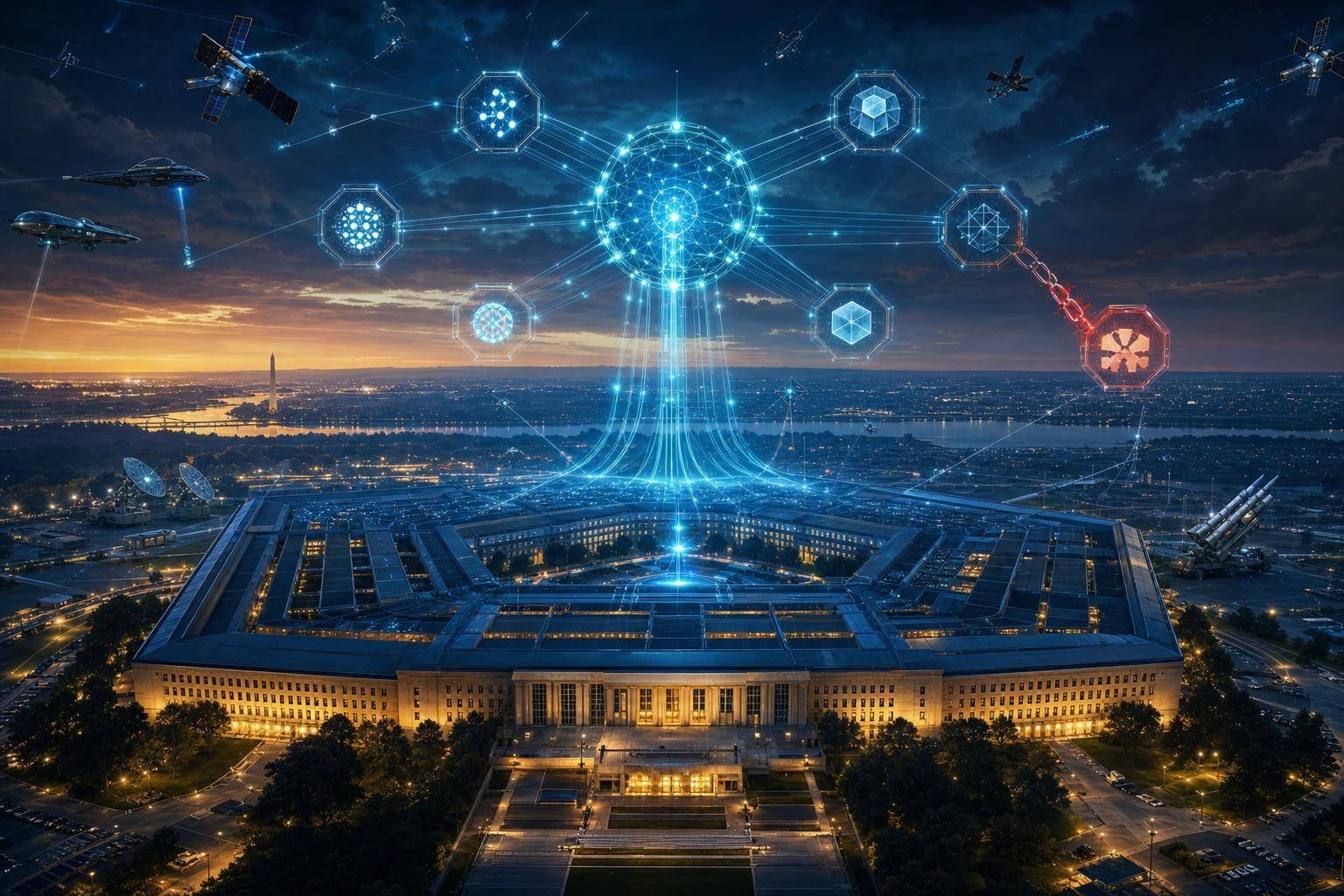
Pentagon AI Deals: OpenAI, Google, Microsoft, NVIDIA, Amazon, Oracle, SpaceX, and Reflection AI—Why Anthropic Was Cut and What It Means for Defense AI
The Pentagon has moved decisively to operationalize artificial intelligence across the U.S. Department of Defense (DoD), signing agreements with OpenAI, Google, Microsoft, Amazon, Oracle, NVIDIA, SpaceX, and Reflection AI. The deals accelerate AI adoption in both unclassified and classified environments for analysis, logistics, and large-scale data processing—without building entirely new classified compute from scratch.
Equally notable is who’s not included: Anthropic. After a contract dispute, the DoD flagged the vendor as a supply-chain risk and severed access to Claude models that had been available in classified settings via Palantir’s Maven platform. The message to the market is unmistakable: in defense, model quality is necessary but not sufficient. Provenance, hosting, and supply-chain assurances can trump benchmarks.
If you work in defense, aerospace, national security, or any regulated enterprise, these Pentagon AI deals are a blueprint for how to scale AI securely. This analysis breaks down what the government actually bought, why supply-chain governance is now a competitive moat, and the technical patterns—cloud, open models, edge, and agents—that will shape mission-grade AI over the next 12–24 months.
What the Pentagon actually signed: scope, access, and guardrails
At a high level, the Pentagon’s new AI agreements give DoD teams access to:
- Frontier and enterprise AI models (OpenAI, Google, Microsoft) for text, code, and multimodal tasks
- Cloud infrastructure already accredited for sensitive workloads (Microsoft, Amazon, Oracle)
- Open models from NVIDIA tuned for autonomous agents and multi-step tasks
- Edge connectivity and compute pathways (SpaceX) to push AI closer to the mission
- Additional specialized capabilities from Reflection AI
The intent is pragmatic: deploy AI where it can deliver decision advantage quickly, prioritize security and oversight, and avoid the cost/time of bespoke classified compute.
Enterprise models plus accredited cloud
Microsoft Azure, Amazon Web Services, and Oracle can provide both AI models and the cloud platforms that meet government accreditation standards. That’s a big accelerator for adoption because many DoD workloads already run in these environments:
- AWS operates dedicated Secret and Top Secret regions with government-accredited controls for classified missions (AWS Secret and Top Secret Regions).
- Microsoft supports AI services inside Azure Government, including Azure OpenAI with additional compliance, isolation, and audit controls (Azure OpenAI Service in Azure Government).
Practically, that means teams can run RAG (retrieval-augmented generation), translate and summarize sensitive documents, or automate logistics planning with auditability and without re-architecting everything for classified conditions.
NVIDIA’s open models for inspectability and agents
NVIDIA contributes its Nemotron family—open models optimized for multi-step task automation and synthetic data workflows (NVIDIA Nemotron models). For the DoD, “open” matters for three reasons:
- Inspectability: engineers can examine weights and training artifacts to understand behavior envelopes.
- Reproducibility: builds can be pinned and re-created inside classified enclaves.
- Control: open models can be constrained, fine-tuned, and instrumented for secure tool use and logging.
This improves the DoD’s ability to validate, red-team, and govern model behavior—essential in mission contexts where failure modes have real-world consequences.
SpaceX at the edge
SpaceX isn’t just bandwidth; low-latency, resilient links and Starshield-style government services can move data and models between forward-deployed assets and secure clouds (SpaceX Starshield). Expect more AI “at the edge,” including on small form-factor GPUs and specialized accelerators, with models distilled for size, power, and intermittent connectivity.
An explicit guardrail: no mass surveillance or autonomous weapons
Vendors say their tech won’t be used for mass surveillance or to power autonomous weapons. The Pentagon’s policy framework is clear that fully autonomous lethal decisions are restricted and subject to rigorous oversight under DoD Directive 3000.09 (DoD Directive 3000.09). But as reported, there’s no independent enforcement body noted in these deals; compliance will rely on DoD oversight, contractual controls, and internal governance.
Why Anthropic was left out: supply-chain risk, not model quality
By multiple accounts, Anthropic’s exclusion was driven by supply-chain risk following a contract dispute—not an indictment of Claude’s raw capabilities. In national security contexts, “supply-chain risk” spans far more than typical vendor due diligence:
- Model provenance and hosting: where weights live, how they’re accessed, and lifecycle controls
- Software dependencies: third-party libraries, cryptographic components, and MLOps toolchains
- Build reproducibility: the ability to deterministically rebuild the model and verify artifacts
- Personnel and facility controls: who can touch what, and under which authorizations
- Data governance: isolation, lineage, and verifiable deletion within agreed SLAs
- Legal exposure: export controls, cross-border data access, and corporate structure risk
For enterprises, this is a crucial takeaway: AI procurement is shifting from “best model wins” to “best model plus demonstrable, auditable supply-chain posture wins.” The U.S. government has already set stronger expectations for software producers via NIST’s Secure Software Development Framework (NIST SSDF SP 800-218). Expect AI suppliers to be assessed on similar lines, including attestation, SBOMs for ML stacks, and build pipeline integrity.
Strategic implications: from pilots to decision advantage
The Pentagon’s AI push is not a vanity project. It’s a force design choice aimed at compressing the observe–orient–decide–act (OODA) loop across missions:
- Intelligence analysis: multilingual transcription, entity extraction, and multi-source fusion to accelerate indications and warnings
- Operations and planning: course-of-action generation, wargaming, and red-teaming of plans using simulation-backed agents
- Logistics and sustainment: predictive maintenance, route optimization, and demand forecasting across contested supply lines
- Cyber defense: rapid triage of alerts, playbook generation, and automated containment recommendations
- Workforce productivity: drafting, code assistance, policy summarization, and compliant document generation
The signal to contractors and partner nations is clear: align to mission-ready AI patterns, prove your security posture, and show how your tools plug into existing accredited environments. The winners will combine accuracy, speed, and compliance discipline.
Technical patterns shaping AI in classified environments
Running AI in classified settings is a fundamentally different engineering problem than shipping a SaaS chatbot. Four design patterns are standing out.
RAG inside secure enclaves
Most mission use cases require grounding models in highly specific, often classified corpora. Retrieval-augmented generation:
- Keeps sensitive data inside an accredited enclave (IL5/IL6 or classified networks)
- Uses vector search over documents with strict access controls
- Injects citations and structured facts into prompts for verifiable outputs
- Logs retrieval events, prompts, and outputs for auditing
This minimizes hallucinations and provides traceability while avoiding model fine-tunes on sensitive data.
Air-gapped inference and cross-domain solutions
For higher classifications, teams will:
- Run inference on-premises or in air-gapped government regions with pre-approved model images
- Use cross-domain solutions (CDS) to move sanitized outputs between classifications
- Prefer deterministic tool use and constrained function calling to reduce attack surface
- Cache or distill models for compute-limited environments
Cloud remains vital, but the deployment pattern becomes hybrid and heavily policy-driven.
Agents with tool-use, not free-roaming autonomy
Mission agents should be orchestration layers with:
- Explicit tool registries and least-privilege credentials
- Step-by-step plans surfaced to human operators
- Hard-stop checkpoints for high-impact actions
- Replayable logs and signed action traces
NVIDIA’s Nemotron focus on multi-step tasks aligns with this “autonomy under supervision” pattern, where the agent composes tools rather than self-directing high-risk operations.
Evaluation and assurance baked in
Adopt a safety case approach—documented evidence that a model is fit-for-purpose under defined conditions. Practical ingredients include:
- Risk mapping aligned to the NIST AI Risk Management Framework (NIST AI RMF 1.0)
- Red-teaming for jailbreaks, prompt injection, and data exfiltration
- Grounded evals (closed-book vs. RAG-enabled accuracy) with mission-specific test sets
- Drift monitoring and performance budgets
- Signed model cards and deployment manifests for traceability
The bar for “production” is higher in classified settings; treat every deployment as a controlled experiment with measurable guardrails.
Risks, constraints, and the enforcement gap
The Pentagon’s deals acknowledge ethical boundaries, but execution details matter. Three risk clusters deserve special attention.
Model error and over-reliance
- Hallucinations and misplaced confidence remain real risks, especially under time pressure.
- Mitigations: RAG with citations, confidence scoring, adversarial prompts in evaluation, and human-on-the-loop for consequential tasks.
Data leakage and isolation
- Prompt data can leak into logs or training if not isolated.
- Mitigations: strict data handling contracts, encryption at rest/in transit, no-retain policies, and pre-deployment privacy reviews. In government contexts, leverage segregated regions and sovereign operations models (e.g., Azure Government, AWS Secret/Top Secret).
Autonomy boundaries and legal constraints
- DoD policy restricts the development and use of autonomous weapon systems without stringent requirements and senior-level reviews (DoD Directive 3000.09).
- “No mass surveillance” commitments are laudable but must be anchored in U.S. law, DoD intelligence oversight rules, and transparent technical controls.
Pledges vs. enforceable controls
The current approach relies on DoD oversight. To tighten the loop, contracts should embed:
- Technical attestations: model versions, weight hashes, and build provenance
- Real-time auditability: full, tamper-evident logs of prompts, tool calls, and actions
- Safety preconditions: documented safety cases before fielding, with periodic re-authorization
- Incident response: defined triggers for rollback, disclosure, and re-testing
- Independent assurance: third-party red teams and alignment testing for high-risk models
This moves “trust us” into verifiable, enforceable compliance.
How to apply this: a playbook for defense contractors and regulated enterprises
You don’t need a Pentagon-scale program to put these patterns to work. Here’s a step-by-step plan that mirrors what the DoD is operationalizing—adapted for defense suppliers, critical infrastructure operators, and heavily regulated enterprises.
1) Map use cases by impact and data sensitivity – Classify tasks into low/medium/high consequence and data tiers (public, CUI, secret). – Start with retrieval-heavy, decision-support use cases that tolerate human review (summarization, triage, knowledge lookup).
2) Choose the right hosting environment – For sensitive workloads, prefer sovereign or government cloud footprints with IL5/IL6-style controls where applicable (e.g., AWS Secret and Top Secret Regions, Azure OpenAI in Azure Government). – For on-premises/classified, establish an air-gapped MLOps pipeline with signed artifacts.
3) Decide on model sources and supply-chain posture – Frontier APIs: fastest path to capability; require strict data-use contracts and isolation. – Open models: greater control and inspectability; ensure licensing, security hardening, and reproducibility. Consider families like NVIDIA Nemotron for agent patterns. – Hybrid: use open models for sensitive RAG and frontier APIs for non-sensitive tasks.
4) Implement robust RAG and data protections – Build a document ingestion pipeline with PII scanning, classification tags, and access controls. – Use vector stores with namespace isolation and encrypted indexes. – Render citations into responses; require operators to confirm sources for high-impact actions.
5) Instrument agents with least privilege – Use explicit tool registries and short-lived credentials. – Add human checkpoints for actions that change state (tickets, configs, orders). – Maintain signed execution logs and playback for after-action reviews.
6) Adopt an AI security baseline – Align your threat model to the OWASP Top 10 for LLM Applications. – Secure prompt supply (no uncontrolled template concatenation), validate tool outputs, and sandbox code execution. – Segment networks; apply Zero Trust principles and hardware-backed attestation for model-serving nodes.
7) Build your assurance pipeline – Define success metrics and risk thresholds per use case. – Establish an evaluation harness with adversarial prompts, jailbreak tests, and domain tasks. – Align governance artifacts to the NIST AI Risk Management Framework.
8) Operationalize model and data lineage – Pin model versions and weight hashes; store signed manifests. – Maintain SBOMs for your ML stack, aligned with NIST SSDF. – Track data lineage for every RAG hit and generated artifact.
9) Prepare for audits and incidents – Pre-authorize rollback procedures for model regressions. – Define incident response for prompt injection, data leaks, or unsafe outputs. – Conduct periodic, independent red-team exercises.
10) Scale with cost controls – Right-size models; distill where possible. – Use batch inference and caching. – Track unit economics per use case; measure ROI against cycle time and accuracy gains.
What this means for the AI market
The Pentagon’s moves crystallize several market dynamics:
- Compliance is a moat. Vendors with verifiable supply-chain security, sovereign hosting, and auditability will win regulated spend even if their raw benchmarks are similar to rivals.
- Open models have a durable role. Inspectability and on-prem deployment aren’t just preferences; they’re requirements for many missions. Expect continued investment in capable, compact open models and inference optimizations.
- Cloud adjacency matters. Microsoft, Amazon, and Oracle benefit from being both the model gateway and the accredited substrate. Frictionless procurement beats bespoke infrastructure in most cases.
- Agents are the next battlefield. The shift from chatbots to controllable, tool-using agents—monitored and logged—will define mission utility. Vendors that make agents verifiable and governable will lead.
- Edge is strategic, not optional. With contested comms and intermittent links, AI that runs forward—supported by resilient backhaul like Starshield—will be decisive.
Policy will continue to tighten. The White House’s 2023 Executive Order on AI set the tone for model testing, reporting, and security expectations across federal use (White House AI Executive Order). Expect stricter attestation, evaluation, and incident reporting baked into future solicitations.
FAQ
Q: What are the Pentagon AI deals actually enabling in the near term? A: Faster, safer access to capable models inside accredited environments, with RAG for mission data, auditability, and deployment patterns that work at IL5/IL6 and classified levels. Think analysis triage, logistics planning, multilingual translation, and code assistance—under governance.
Q: Why was Anthropic excluded if Claude performs well on benchmarks? A: Benchmarks are only part of the equation. The DoD prioritized supply-chain assurances—provenance, hosting, build reproducibility, and contractual controls. A dispute raised enough risk to pause access despite model quality.
Q: Will these systems create autonomous weapons? A: No. DoD policy restricts autonomous weapon systems and requires stringent oversight and approvals for any autonomy in lethal force decisions, as outlined in DoD Directive 3000.09. The vendors also stated their tech won’t be used for such purposes.
Q: How can enterprises replicate DoD-grade safeguards without classified clouds? A: Use enterprise analogs: segregated VPCs or sovereign clouds, RAG with strict access controls, model pinning, full audit logs, and evaluation pipelines aligned to the NIST AI RMF and OWASP LLM Top 10. Start with non-consequential use cases and scale as assurance improves.
Q: Are open models safe enough for sensitive data? A: They can be, if deployed correctly. Open models offer inspectability and on-prem control, but they still need hardened serving stacks, least-privilege tool access, encrypted storage, and rigorous evaluation. Many organizations pair open models for sensitive RAG and hosted frontier APIs for lower-risk tasks.
Q: What about AI at the edge? A: Expect more distilled models on ruggedized hardware, with intermittent syncs to secure clouds over resilient links like Starshield. Edge AI reduces latency and bandwidth needs but increases the importance of signed artifacts, secure boot, and remote attestation.
Conclusion: The real story behind the Pentagon AI deals
The Pentagon AI deals are less about splashy hype and more about operational realism: use the models that work, run them where it’s safe, ground them in mission data, and keep humans in the loop for consequential actions. The exclusion of Anthropic underscores a new market reality—supply-chain trust and verifiable controls can outweigh pure capability.
For technology leaders, the path is clear. Treat AI as a safety-critical system. Choose environments with accredited controls. Favor patterns like RAG in secure enclaves, tool-using agents with explicit permissions, and continuous evaluation aligned to frameworks such as the NIST AI RMF. Leverage accredited clouds (AWS Secret/Top Secret, Azure OpenAI in Government), consider open, inspectable models (NVIDIA Nemotron) where mission demands, and harden your software supply chain with NIST SSDF.
The takeaway for enterprises outside defense is equally compelling: if the DoD can safely field AI in classified contexts, you can deploy AI in regulated ones—provided you invest in governance, assurance, and secure-by-design engineering. That’s the enduring lesson of these Pentagon AI deals.
Discover more at InnoVirtuoso.com
I would love some feedback on my writing so if you have any, please don’t hesitate to leave a comment around here or in any platforms that is convenient for you.
For more on tech and other topics, explore InnoVirtuoso.com anytime. Subscribe to my newsletter and join our growing community—we’ll create something magical together. I promise, it’ll never be boring!
Stay updated with the latest news—subscribe to our newsletter today!
Thank you all—wishing you an amazing day ahead!
Read more related Articles at InnoVirtuoso
- How to Completely Turn Off Google AI on Your Android Phone
- The Best AI Jokes of the Month: February Edition
- Introducing SpoofDPI: Bypassing Deep Packet Inspection
- Getting Started with shadps4: Your Guide to the PlayStation 4 Emulator
- Sophos Pricing in 2025: A Guide to Intercept X Endpoint Protection
- The Essential Requirements for Augmented Reality: A Comprehensive Guide
- Harvard: A Legacy of Achievements and a Path Towards the Future
- Unlocking the Secrets of Prompt Engineering: 5 Must-Read Books That Will Revolutionize You