
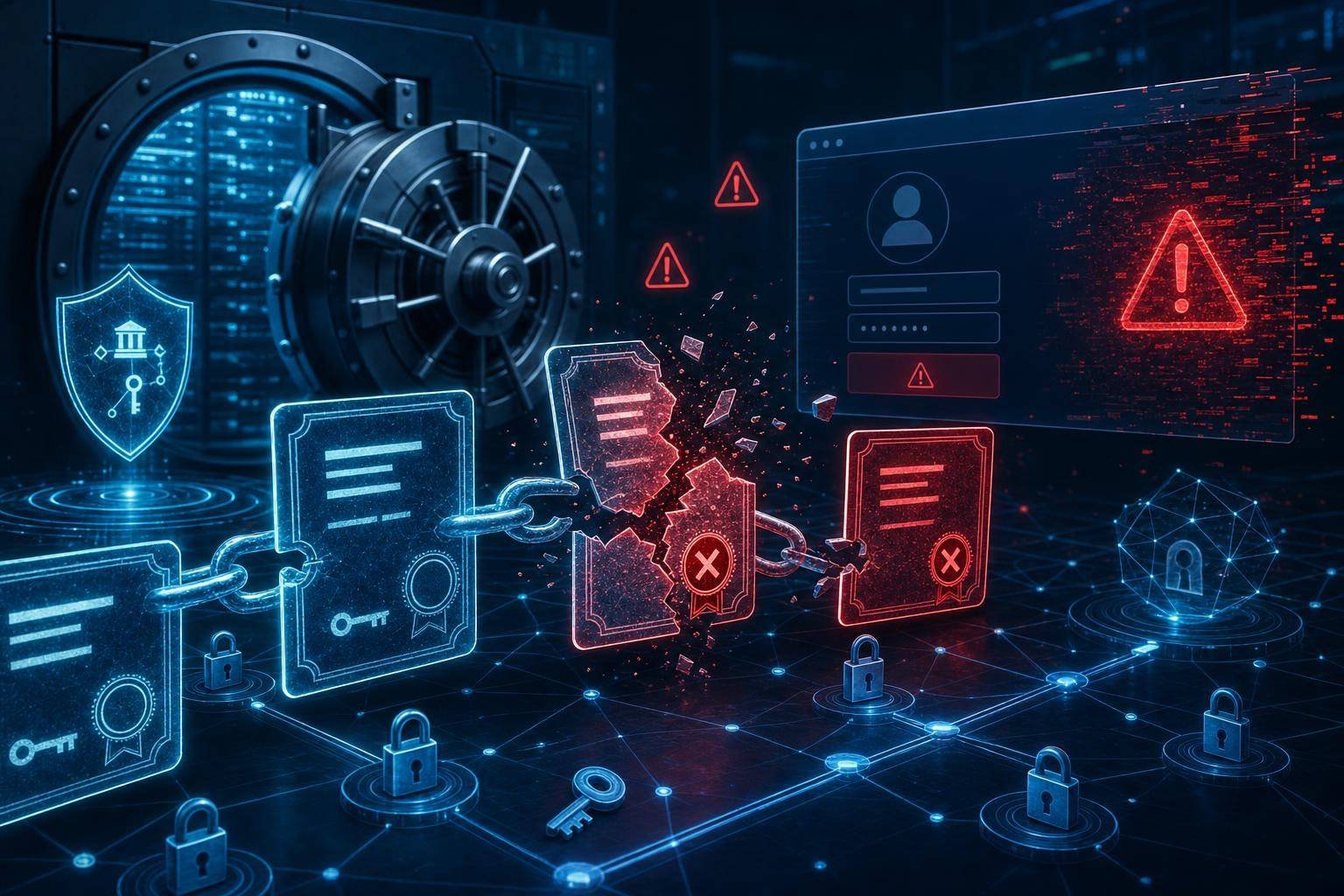
DigiCert Revokes Certificates After Support Portal Hack: What It Means for PKI Trust and Your Security Posture
When a leading certificate authority revokes certificates, the ripple effects touch everything from e‑commerce checkout flows to API authentication and zero‑trust gateways. That’s exactly the scenario many teams faced after DigiCert revoked multiple certificates in the wake of a support portal breach disclosed on May 4, 2026. Attackers reportedly exploited a vulnerability to steal session tokens, impersonate users, and potentially request fraudulent certificates. DigiCert says it found no evidence of broad malicious issuance, but took the conservative path and revoked impacted certs anyway.
Revocation is painful—but it’s the right move when a trust boundary has been crossed. This incident is a wake‑up call: your PKI isn’t just keys and crypto; it’s people, processes, and portals. Below, we’ll unpack what happened, why a support portal compromise can cascade into public key infrastructure (PKI) risk, how revocation really works (and where it fails), and what you can do right now to reduce blast radius and harden your certificate lifecycle.
Inside the Incident: Why DigiCert Revokes Certificates After a Support Portal Hack
DigiCert’s disclosure pointed to a targeted attack against its customer support system, where intruders extracted session tokens to impersonate users. In most SaaS apps that’s bad. In a certificate authority’s orbit, it’s existential. With a valid session, an attacker could:
- View sensitive account details.
- Submit or approve certificate issuance requests depending on role.
- Modify certificate profiles, SAN entries, or revocation settings.
- Harvest organization validation artifacts or reuse past validation to accelerate issuance.
To be clear, DigiCert reported no evidence of widespread malicious issuance. But PKI is about provable guarantees. If there’s reasonable doubt about who initiated an issuance request or controlled the validation flow, revocation becomes the safest path to restoring trust. That decision, while disruptive, aligns with the principle that identity assurance and lifecycle controls must be conservative when trust anchors are at stake.
The practical impact: customers had to regenerate and redeploy certificates on web properties, APIs, VPNs, and device fleets, leading to brief outages or degraded experiences where rollouts lagged. This is a stark reminder that your dependency on a CA doesn’t end at the cryptographic boundary—it includes the security of every touchpoint in the issuance and support chain.
How a Support Portal Vulnerability Becomes a PKI Problem
A support portal sounds peripheral to core cryptographic operations. In reality, it’s often tightly coupled with the workflows that prove control over domains and organizations.
Session tokens and impersonation risk
Support applications rely on session tokens or cookies to keep users authenticated. If those tokens can be stolen or replayed, an attacker can piggyback on a legitimate user’s privileges. That’s why rigorous session management—short lifetimes, binding tokens to device and IP context, and robust invalidation—is essential. The OWASP Session Management guidance lays out core controls to prevent token theft and abuse.
When applied to a CA ecosystem, weak session protections can translate directly into elevated issuance or account‑change authority. Even read‑only access exposes artifacts (like past domain control validations) that might be misused to bootstrap rapid certificate requests.
Registration authority workflows and identity assurance
CAs commonly separate functions: the certificate authority (CA) does the signing, while the registration authority (RA) handles validation and approves issuance. If a support channel allows case updates, attachment uploads, or approvals that intersect with RA workflows, then compromising that channel can influence issuance indirectly. The stakes are highest when:
- Identity evidence from prior validations can be reused.
- Support agents can trigger or override checks for exceptional cases.
- API tokens or automation credentials are accessible from support contexts.
NIST’s digital identity guidance emphasizes lifecycle management of authenticators and sessions to reduce these risks, including phishing‑resistant MFA for sensitive operations. See NIST SP 800‑63B for details on authenticator assurance and session binding.
“No evidence” is not “no risk”
Absence of observed abuse doesn’t eliminate residual risk. Logs can be incomplete or attackers may remain dormant. In PKI, the harm from a single rogue certificate can be outsized: it can enable TLS interception, domain spoofing, or SSO token theft. Proactive revocation is the only way to close that window once uncertainty exists around issuance requests or account control.
Certificate Revocation That Actually Works: CRLs, OCSP, Stapling, and Short‑Lived Certs
Revocation is the safety valve of PKI. But the history of revocation checking is complicated—and many production stacks still “soft fail,” accepting a certificate if the revocation server can’t be reached. Understanding how revocation propagates helps you reduce outage time and shrink exploit windows.
RFC 5280 basics: CRLs and OCSP
Two primary mechanisms communicate revocation:
- Certificate Revocation Lists (CRLs): Periodically published lists of revoked serial numbers signed by the CA. Clients download and cache them.
- Online Certificate Status Protocol (OCSP): A real‑time query/response protocol to check a certificate’s status.
Both are defined in IETF RFC 5280, the core X.509 PKI standard for the Internet. CRLs scale via caching and CDNs but can be slow to update. OCSP is more timely but can be a bottleneck and privacy‑leaking if clients query per‑connection.
OCSP stapling and Must‑Staple
OCSP stapling shifts the performance burden away from clients. The server fetches a time‑bounded OCSP response from the CA and “staples” it into the TLS handshake. This preserves privacy and improves speed. Some deployments enable “OCSP Must‑Staple,” which instructs clients to require a stapled response.
- For a practical deep dive on benefits and pitfalls, see Cloudflare’s explanation of OCSP stapling and revocation.
- For protocol and configuration best practices, NIST’s SP 800‑52 Rev. 2 provides guidance on selecting and configuring TLS implementations and parameters.
Key operational note: Must‑Staple can cause outages if your servers fail to staple fresh responses. Test thoroughly before enforcing it globally.
Certificate Transparency and continuous monitoring
Certificate Transparency (CT) logs are append‑only, auditable ledgers of issued certificates. Most browsers require CAs to log new certs, creating a public trail you can monitor for suspicious issuance against your domains. Google’s overview, What is Certificate Transparency?, explains how CT mitigates hidden mis‑issuance.
Practical use: – Subscribe to CT monitoring for your registrable domains. – Alert on unexpected SANs, uncommon key sizes, or unrecognized issuing CAs. – Treat unexpected certs as an incident until proven otherwise.
Operational pain points you should plan for
- Propagation delays: It can take minutes to hours for revocation information to propagate, depending on caching and client behavior.
- Soft‑fail clients: Many clients accept a cert when OCSP is unreachable, limiting the effectiveness of revocation for active attacks.
- Mobile and IoT: Embedded clients often have outdated trust stores, weak revocation logic, or intermittent connectivity.
- CDNs and proxies: Multi‑layer TLS termination means you may need to update certs across edge nodes, API gateways, service meshes, and internal load balancers.
Strategies to mitigate: – Shorten certificate lifetimes (e.g., 90 days) to reduce exposure windows. – Use automation (ACME) for rapid issuance and rollouts. – Enable stapling on all edge endpoints and monitor freshness of OCSP responses.
What Security and Platform Teams Should Do Now
Whether or not you use DigiCert, treat this as a dry run for CA‑adjacent incidents. The following steps prioritize resilience, speed, and auditability.
Immediate triage (first 24–72 hours)
- Confirm scope with your CA – Check notifications in your CA portal and dedicated status pages. – Pull a list of potentially affected certificates by serial number, FQDN, and environment tags.
- Inventory deployed endpoints – Enumerate all TLS termination points: public websites, APIs, CDNs, WAFs, VPNs, EDR/agent update services, service mesh ingress/egress, internal load balancers, and partner‑facing interfaces. – Include mobile apps and embedded devices that pin certificates or public keys.
- Reissue and redeploy – Generate fresh key pairs in secure HSMs or key vaults. Avoid reusing compromised keys. – Reissue certificates with the same SANs and profiles where possible to minimize config churn. – Stagger rollouts in non‑production first, then proceed environment by environment to avoid global brownouts. – Validate each endpoint with automated smoke tests: TLS version, ciphers, OCSP stapling status, and application health.
- Update trust bundles and keystores – For Java, refresh truststores and keystores across JVMs. For NGINX/Envoy/HAProxy, reload configs without dropping connections when possible. – For mTLS, synchronize both server and client cert rotations.
- Communicate early and often – Provide internal status updates to SRE, SecOps, Help Desk, and customer success. – If customer‑facing services may experience brief disruptions, use status pages and in‑app banners to set expectations.
- Increase monitoring – Alert on TLS handshake failures (e.g., certificate expired/revoked, OCSP errors). – Track traffic anomalies post‑rotation (unexpected drops in regions or specific user agents).
Short‑term hardening (first 2–4 weeks)
- Lock down portal and CA access
- Enforce phishing‑resistant MFA (FIDO2/WebAuthn) for all CA and support portal accounts, aligning with NIST SP 800‑63B.
- Restrict access to issuance APIs by IP allowlists and device compliance.
- Rotate API tokens and revoke all active sessions where compromise is plausible.
- Strengthen revocation effectiveness
- Enable and verify OCSP stapling on all public endpoints.
- Decide where OCSP Must‑Staple is viable; pilot in low‑risk services first.
- Tune cache lifetimes and health checks to keep stapled responses fresh.
- Stand up CT monitoring
- Monitor for new certs matching your domains, including wildcard variants.
- Define an escalation path when unexpected issuance appears.
- Reduce complexity and variance
- Standardize on a small number of vetted certificate profiles.
- Use ACME‑based automation for issuance and renewals where supported.
- Document the incident
- Capture timelines, decisions, and lessons learned.
- Update runbooks for “CA‑driven revocation” and test them quarterly.
Application‑specific considerations
- Mobile apps and desktop agents
- If you use certificate or SPKI pinning, deploy app updates with new pins before rotating certificates. Consider backup pins to avoid bricking apps when certs change unexpectedly.
- Avoid strict leaf‑cert pinning for public CAs; prefer intermediate or SPKI pins with a backup.
- Partner and B2B integrations
- Proactively notify partners about upcoming certificate changes.
- Provide test endpoints so partners can validate trust paths and cipher compatibility.
- Service mesh and internal TLS
- For mTLS within meshes (Istio, Linkerd), ensure rotation doesn’t desynchronize workloads. Automate trust bundle distribution and validate sidecar behavior during reloads.
Hardening Your PKI and CA Dependencies for the Long Term
Incidents at the periphery of a CA relationship can still undermine trust. Use this moment to re‑evaluate standards alignment, privilege boundaries, and supply chain exposure.
Demand standards alignment and transparency
- Verify that your CA adheres to the CA/Browser Forum rules. Familiarize yourself with the Baseline Requirements so you can ask the right questions about validation and revocation SLAs.
- Review how your CA aligns with independent root store policies, such as the Mozilla Root Store Policy, which often includes stricter operational expectations.
Reduce standing privileges and tighten workflows
- Separate duties: Keep RA approval rights distinct from general support access; use break‑glass workflows with enhanced logging and secondary approval for exceptions.
- Minimize token power: Use short‑lived API tokens scoped to specific issuance functions and domains.
- Bind sessions to device and network context, and revoke sessions after privilege elevation.
Invest in key and lifecycle management
- Hardware protection: Store private keys in FIPS‑validated HSMs or cloud KMS/HSM services; rotate keys on any suspicion of exposure. The foundational principles in NIST SP 800‑57 can guide your key management policies.
- Prefer short lifetimes: 90‑day certificates reduce the risk window and make emergency rotation part of normal operations.
- Automate renewals: Adopt ACME where possible, with environment‑specific accounts and strict admission controls.
Build revocation‑aware delivery
- Endpoints must staple: Treat OCSP stapling as a baseline. Monitor for absent or stale staples and alert SREs to refresh.
- Cache wisely: Use CDN caching for CRLs and OCSP to improve availability, but keep TTLs short enough to reflect revocations promptly.
- Test real clients: Validate revocation behavior across major browsers, Java stacks, mobile SDKs, and embedded clients you actually serve.
Embed supply chain risk management
PKI is part of your digital supply chain. Incorporate CA and support system risks into organizational SCRM efforts:
- Use CISA’s guidance on Supply Chain Risk Management to structure vendor assessments, continuous monitoring, and incident playbooks.
- Review ENISA’s research on the threat landscape of supply chain attacks to map realistic scenarios, including helpdesk and portal compromises that pivot into higher‑sensitivity systems.
Detection and Response for Certificate Abuse
Assume that at some point a certificate may be mis‑issued or stolen. Build telemetry and playbooks that compress discovery and response time.
- Telemetry sources
- Web server logs: TLS alerts, handshake errors, and OCSP stapling status.
- Network sensors: JA3/JA4 TLS client fingerprints that deviate from norms.
- CT monitors: Unexpected issuance events trigger investigations.
- Endpoint EDR: New trust anchors or modified system keychains on critical hosts.
- Signals to prioritize
- Certificates with unexpected SANs (e.g., staging subdomains, typo variants).
- Unusual key parameters (weak key sizes, unexpected curves).
- Issuance from an unrecognized intermediate or CA account.
- Response actions
- Immediate revocation of suspect certs.
- Browser and platform‑level reporting (if participating in any emergency revocation channels).
- Temporary geofencing or traffic shaping while rotating certs.
- Communications to partners and customers if risk of interception or impersonation exists.
- After‑action improvements
- Tune allowlists for issuance domains and names.
- Add secondary approvals for high‑risk SANs (wildcards, login, api, sso).
- Expand phishing‑resistant MFA to every workflow that can touch issuance or validation.
The Bigger Picture: PKI Trust Under Pressure and the Road Ahead
Trust on the public Internet rests on a small number of root programs and a larger set of operational CAs. Over the last few years, supply chain intrusions have shifted upstream—targeting the systems around the keys rather than the keys themselves. Helpdesk portals, ticketing systems, and support SSO flows are all attractive precisely because they’re adjacent to high‑impact actions but often governed by general IT policies rather than hardened PKI procedures.
Expect the industry to push further in several directions:
- Phishing‑resistant authentication everywhere: WebAuthn‑based MFA for all sensitive portal and API access, not just for the CA but for customer accounts interacting with issuance.
- More automation, less exception handling: ACME‑first issuance with guardrails and policy engines that leave fewer manual pathways to abuse.
- Shorter lifetimes and better revocation: Continued movement toward 90‑day or shorter public certs to reduce the half‑life of incidents.
- Stronger transparency and attestation: Deeper use of CT, plus better customer‑visible audit logs around who requested, approved, and fulfilled each issuance.
None of that eliminates risk. But it shifts the balance toward rapid detection, small blast radii, and routine, safe rotations rather than once‑in‑a‑year “big bangs.”
FAQ
Q: How do I know if one of my DigiCert certificates was revoked? A: Check notifications in your DigiCert account portal and compare against your certificate inventory. You can also test endpoints with TLS inspection tools to see if clients report a revoked status or OCSP errors, and review CT logs for any unexpected reissuance events.
Q: What’s the difference between revocation and expiration? A: Expiration is a scheduled end of validity embedded in the certificate. Revocation is an early invalidation by the CA due to compromise, mis‑issuance, or policy reasons. Revocation depends on clients checking CRLs/OCSP, whereas expiration is universally enforced by all conforming clients.
Q: Will enabling OCSP Must‑Staple prevent incidents like this from impacting users? A: Must‑Staple improves revocation effectiveness, but it can also cause outages if your servers fail to provide fresh stapled responses. Pilot carefully, monitor stapling freshness, and ensure robust failover before enforcing it widely.
Q: Could a support portal breach compromise the CA’s root keys? A: That kind of leap is highly unlikely. Root and issuing CA private keys are protected with strong physical, logical, and procedural controls, often in HSMs with strict ceremonies. The larger risk from a support portal breach is misuse of account privileges to request or approve certificates.
Q: Are short‑lived certificates a substitute for revocation? A: No. Short lifetimes reduce the exposure window and make rotations routine, but they don’t help if a malicious cert needs to be invalidated immediately. You still need working revocation and stapling.
Q: Do I need to change my pinned certificates in mobile apps? A: If you pin leaf certificates or SPKI hashes that are replaced, yes. Plan app updates with backup pins in advance so you can rotate without breaking connectivity. Consider pinning at the intermediate level when feasible to reduce churn.
Conclusion: Treat “DigiCert Revokes Certificates” as a Drill for Real‑World Resilience
The fact that DigiCert revokes certificates after a support portal hack is not a failure of PKI—it’s PKI doing its job under uncertainty. The lesson is that your trust posture depends as much on the security of adjacent systems and workflows as it does on cryptography. Make revocation and rotation muscle memory, not emergencies.
Starting today: – Inventory and automate your certificate lifecycle. – Enable OCSP stapling everywhere and monitor its health. – Enforce phishing‑resistant MFA and strict session controls on every portal or API that can influence issuance. – Stand up CT monitoring and alerting for your domains. – Drill your “CA‑driven revocation” runbook quarterly.
You can’t prevent every upstream incident. But you can design your PKI and delivery pipelines so that when a CA like DigiCert revokes certificates, your services keep running, your customers stay protected, and your trust posture emerges stronger.
Discover more at InnoVirtuoso.com
I would love some feedback on my writing so if you have any, please don’t hesitate to leave a comment around here or in any platforms that is convenient for you.
For more on tech and other topics, explore InnoVirtuoso.com anytime. Subscribe to my newsletter and join our growing community—we’ll create something magical together. I promise, it’ll never be boring!
Stay updated with the latest news—subscribe to our newsletter today!
Thank you all—wishing you an amazing day ahead!
Read more related Articles at InnoVirtuoso
- How to Completely Turn Off Google AI on Your Android Phone
- The Best AI Jokes of the Month: February Edition
- Introducing SpoofDPI: Bypassing Deep Packet Inspection
- Getting Started with shadps4: Your Guide to the PlayStation 4 Emulator
- Sophos Pricing in 2025: A Guide to Intercept X Endpoint Protection
- The Essential Requirements for Augmented Reality: A Comprehensive Guide
- Harvard: A Legacy of Achievements and a Path Towards the Future
- Unlocking the Secrets of Prompt Engineering: 5 Must-Read Books That Will Revolutionize You