
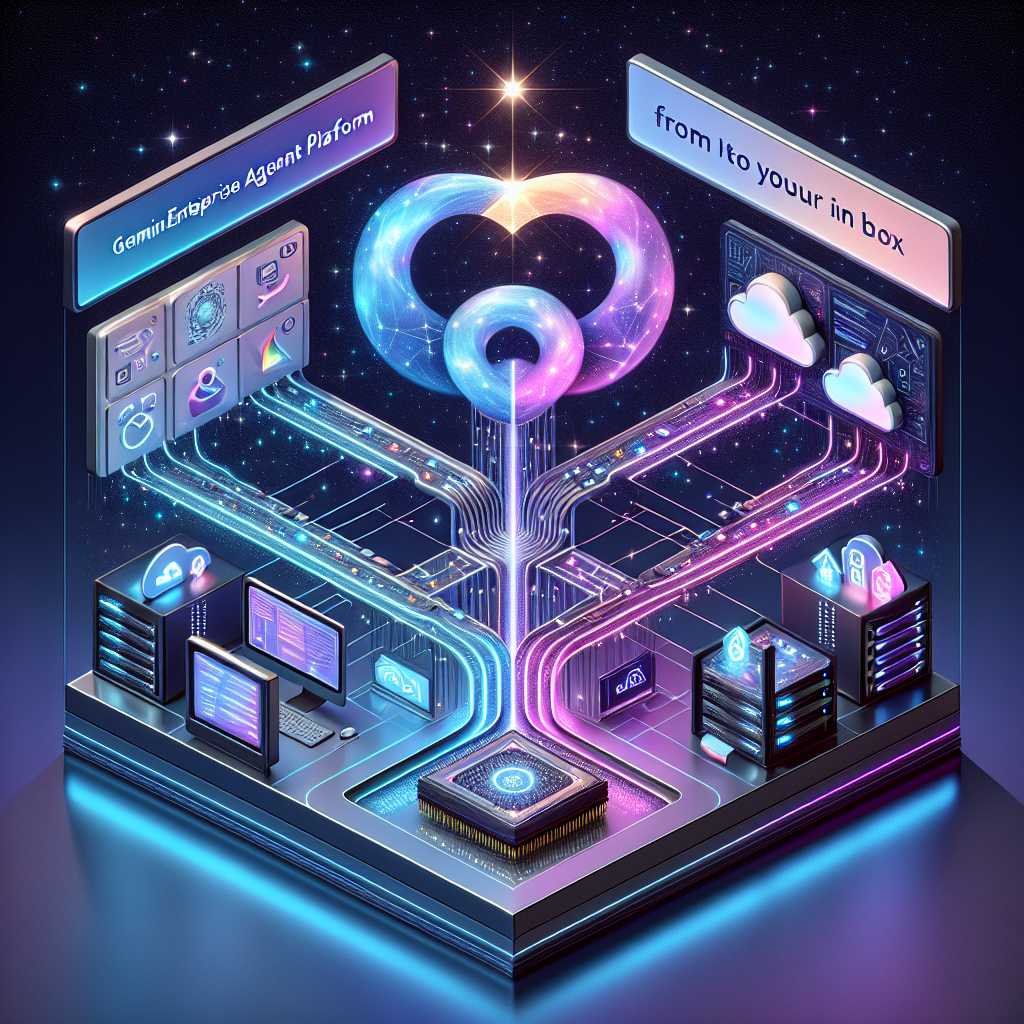
Google Rebrands Vertex AI to Gemini Enterprise Agent Platform: A Full‑Stack Bet from TPU Chips to Your Inbox
What if your company could stand up AI agents that are faster, cheaper, and safer—without stitching together a dozen vendors or juggling brittle integrations? That’s the promise behind Google’s bold rebrand of Vertex AI to the Gemini Enterprise Agent Platform. Announced on April 23, 2026, this move signals a decisive shift: Google isn’t just offering models or tooling—it’s pitching a true full‑stack approach, from custom silicon to enterprise inbox.
If you’ve been waiting for enterprise AI to grow up—governable, scalable, compliant, and more cost‑effective than DIY—this might be the moment you’ve been waiting for.
In this deep dive, we’ll unpack what changed, why it matters, and how to evaluate whether Google’s new platform fits your roadmap.
Reference: Google rebrands Vertex AI as Gemini Enterprise Agent Platform
What Changed—and Why It Matters
Google has reintroduced its enterprise AI stack under a new banner: the Gemini Enterprise Agent Platform. This rebrand is more than marketing. It clarifies the company’s strategy to deliver an end‑to‑end AI platform that:
- Runs on Google’s own silicon (TPUs) for both training and inference
- Orchestrates complex, multi‑agent workflows without “agent sprawl”
- Bakes in security, compliance, and governance by design
- Supports open‑weight models (like the Gemma family) to reduce lock‑in
- Scales from proof‑of‑concepts to millions of inferences per second
According to early adopters, organizations are seeing up to 40% lower inference costs versus GPU‑based setups, with lower latency thanks to specialized TPUs and tight vertical integration. In short: Google thinks the winners in enterprise AI will own the stack—and it’s betting big on being your one‑stop shop.
- Source: Announcement coverage (April 23, 2026)
- Learn about TPUs: Google Cloud TPU
- Explore Gemini models: Gemini by Google
From Vertex AI to Gemini Enterprise Agent Platform: What’s Actually New?
Under the hood, much of the DNA from Vertex AI remains—but the focus sharpens around agents, orchestration, and enterprise readiness.
Here’s what stands out:
- A unified “agent‑first” design: Tools for building, chaining, monitoring, and scaling autonomous agents (not just chatbots).
- Vertical integration: Everything from model training and serving on TPUs to inbox‑level integrations—minimizing latency and fragmentation.
- Governance at the core: Fine‑grained access controls, audit logs, policy enforcement, hallucination detection, and safety tools aligned to emerging regulations.
- Hybrid/on‑prem optionality: Capabilities to deploy frontier‑class models like Gemini 3 in your data center or a hybrid environment, lowering latency and improving data control.
- Open‑weight support: Bring your own models and fine‑tune open families like Gemma for custom agents without full vendor lock‑in.
- Learn more about open models: Google Gemma
The Full‑Stack Play: From Chip to Inbox
“Chip to inbox” describes how Google wants to remove friction across the entire AI lifecycle:
- Silicon: TPUs tuned for modern transformer workloads—optimized for both training and high‑volume inference.
- Serving: Low‑latency, high‑throughput runtimes with autoscaling.
- Orchestration: Multi‑agent coordination, memory, tools, and guardrails.
- Security: Access policies, secrets management, auditability.
- Integration: Connectors into enterprise systems (e.g., Salesforce, SAP) to move beyond prototypes and into real workflows.
This combination is designed to avoid the common trap of AI pilots that never make it to production due to infrastructure sprawl or governance gaps.
- Salesforce: salesforce.com
- SAP: sap.com
Hardware Advantage: Why TPUs Matter for Enterprises
For organizations serious about performance, reliability, and cost, hardware matters. Google’s latest TPUs are built for the exact math that powers today’s frontier models, which translates to:
- Lower inference latency for real‑time and near‑real‑time experiences
- Higher throughput under peak loads
- Improved cost dynamics, with early adopters citing up to 40% lower inference costs vs. GPUs
- Options for on‑prem or hybrid deployments to keep data local and reduce network hops
This is especially relevant for regulated industries—finance, healthcare, public sector—where data residency and predictable performance are table stakes.
- Learn about TPUs: Google Cloud TPU
Model Strategy: Gemini 3 Meets Open‑Weight Gemma
The platform’s strategy balances frontier‑class proprietary models with open‑weight flexibility:
- Gemini 3 for general and advanced agent tasks, reasoning, and multimodal workflows
- Open‑weight options like Gemma for customization, portability, and cost control
- Fine‑tuning and distillation pathways to tailor agents to domain‑specific tasks
This “best of both worlds” setup is a hedge against lock‑in and a nod to the reality that many enterprises will continue to mix and match models based on use case, risk, and cost.
- Gemini: Gemini API
- Gemma open models: Gemma by Google
Agent Sprawl Is Real—Google’s Orchestration Tackles It
As companies experiment with dozens (sometimes hundreds) of internal agents—HR assistants, finance copilots, IT troubleshooters—things can get chaotic. Google’s orchestration layer is aimed squarely at “agent sprawl”:
- Centralized registry and lifecycle management for agents
- Role‑ and attribute‑based access controls to define who/what they can touch
- Shared memory/store patterns to avoid redundant context fetching
- Tool and connector governance (e.g., who can call the SAP connector and under what conditions)
- Observability and replay, with per‑agent audit trails
This helps you avoid “shadow agents”—untracked automations that increase risk and cost.
Security, Compliance, and Governance: Built‑In, Not Bolted On
Enterprise AI stops being a science experiment the moment you add guardrails. Google is emphasizing:
- Fine‑grained access controls (RBAC/ABAC) and secrets management
- Audit logs across prompts, decisions, tool calls, and data access
- Policy enforcement (e.g., PII handling, data retention, redaction)
- Hallucination detection and model behavior monitoring
- Alignment with emerging AI safety regulations and industry certifications
While specifics will vary by region and vertical, these capabilities are designed to satisfy teams responsible for legal, risk, and compliance—without derailing velocity.
- NIST AI RMF: AI Risk Management Framework
- ISO 27001: iso.org
- SOC 2 overview: aicpa.org
Performance and Scale: From Pilots to Millions of Inferences per Second
To graduate from prototype to production, you need predictable scale. The Gemini Enterprise Agent Platform highlights:
- Horizontal autoscaling across inference loads
- Traffic shaping, rate limiting, and per‑tenant QoS
- Model caching and token‑efficient prompting
- Support for massive throughput—into the millions of inferences per second for large fleets
Pair that with cost controls and observability, and you can reliably run business‑critical workloads.
Integration Ecosystem: From CRM to ERP and Beyond
AI agents only deliver value when they touch the systems people actually use. Google is expanding integrations with enterprise staples including Salesforce and SAP, among others. Expect:
- Turnkey connectors for read/write operations
- Tool access policies (e.g., agents can read cases but not close them without approval)
- Event‑driven triggers (e.g., respond to a high‑priority case; auto‑draft an invoice exception)
- Auditability of every tool call for compliance
This is where “from chip to inbox” becomes real: the model knows your workflows—and acts on them safely.
- Salesforce: salesforce.com
- SAP: sap.com
Who Should Care? Use Cases That Benefit Most
The platform is aimed at both innovators and late adopters who demand enterprise‑grade reliability. High‑fit scenarios include:
- Financial services: KYC/AML triage, fraud insights, policy‑aware copilot for advisors
- Healthcare: Intake summarization, RCM automation, coding support with PHI guardrails
- Retail/e‑commerce: Product attribution, dynamic pricing support, contact center agents
- Manufacturing: Predictive maintenance assistants, SOP copilots, supplier risk monitors
- Public sector: Case management assistants with strict data residency controls
- IT and security: Tier‑1/2 ticket triage, change request drafting, automated runbooks
If your org faces regulated data, spiky workloads, or multi‑system workflows, the Gemini Enterprise Agent Platform’s alignment with governance and scale is compelling.
Build vs. Buy: How to Think About the Platform
Ask these questions to determine fit:
- Governance: Do you need native auditability, policy enforcement, and safety tooling?
- Latency: Do you require low‑latency inference for real‑time experiences?
- Data control: Is on‑prem or hybrid deployment important for privacy or residency?
- Cost: Are inference costs a bottleneck—and could TPU‑based serving reduce TCO?
- Openness: Do you need open‑weight options (e.g., Gemma) to avoid lock‑in?
- Integrations: Do you depend on systems like Salesforce or SAP that benefit from deep connectors?
- Skills: Do you have ML ops capability—or prefer to offload to a managed full‑stack?
A Pragmatic ROI Framework
Use this simple model to forecast value:
- Baseline costs: Current infra + API/model costs + engineering/ops overhead
- Efficiency gains: Agent‑driven reductions in handle time, resolution time, or content production time
- Revenue lift: Better conversion, upsell, or retention from AI‑enhanced journeys
- Risk reduction: Lower compliance risk via enforced guardrails and auditability
- Infra delta: Potential 40% inference cost reduction vs GPU setups (per early adopters)
Run scenarios by use case (e.g., contact center agent, finance copilot). Prioritize the ones where governance and latency are make‑or‑break.
Source: Launch coverage (April 23, 2026)
Migration Paths: From Vertex AI or Mixed Stacks
- From Vertex AI: Expect continuity, with new agent‑oriented features unlocked. Inventory existing models, pipelines, and endpoints; map them to new orchestration patterns; phase migration to minimize disruption.
- From mixed stacks (e.g., Azure + open‑source): Start by centralizing evaluation, observability, and governance. Port highest‑impact agents first; maintain dual‑run periods to validate parity.
- From on‑prem GPUs: Pilot TPU‑based inference where latency and cost matter most; evaluate hybrid for sensitive data.
Competitors still matter. Microsoft’s Azure AI and offerings tied to M365 remain strong, especially where Office integration dominates. Anthropic’s Claude family is a top choice for reasoning and harmlessness, with growing enterprise tooling.
- Azure AI: Azure AI Services
- Anthropic: Claude for Enterprise
Risks and Trade‑Offs to Consider
- Stack dependence: Vertical integration brings speed—but raises switching costs. Mitigate via open‑weight models and standardized interfaces.
- Governance complexity: Centralized guardrails are powerful; ensure teams understand policies to avoid accidental blocks.
- Cost visibility: TPU economics can be favorable; still model total cost (infra + usage + ops).
- Skills shift: Orchestration and safety tooling simplify ops but require platform fluency.
- Change management: Agents that act on business systems need robust approvals and human‑in‑the‑loop patterns.
30‑60‑90 Day Action Plan
- Days 1‑30: Identify 2–3 high‑value agent use cases with clear KPIs. Stand up a sandbox. Validate latency, quality, and governance. Set accept/reject thresholds.
- Days 31‑60: Pilot in a limited production cohort. Enable audit logs and hallucination detection. Integrate one core system (e.g., Salesforce). Establish approval workflows.
- Days 61‑90: Scale to more users. Add a second integration (e.g., SAP). Tune prompts/fine‑tunes. Implement cost controls and SLOs. Document standard operating procedures.
Governance checklist: – Map data classes and residency requirements – Define RBAC/ABAC policies for agents and tools – Enforce redaction and retention policies – Enable per‑agent audit trails and incident response workflows
How This Could Reshape the Enterprise AI Market
By fusing TPUs, Gemini models, agent orchestration, and compliance into a single platform, Google is attempting to short‑circuit the “prototype purgatory” many teams face. If the reported performance and cost numbers hold at scale, expect:
- Faster time‑to‑value as teams skip bespoke integrations
- A platform standard for auditability and safety
- Broader SME adoption via simplified, no‑code agent builders
- Competitive pressure on GPU‑heavy inference stacks
- A clearer path to multi‑agent systems that actually cooperate
With an estimated $200B enterprise AI market by 2027, the consolidation toward integrated stacks was inevitable. Google’s bet is that vertical integration—done right—wins.
Source: Announcement coverage (April 23, 2026)
Practical Tips Before You Commit
- Benchmark on your data: Don’t rely solely on public leaderboards. Test your prompts, tools, and datasets with target SLAs.
- Start with constrained actions: Let agents “read” widely but “write” narrowly at first; gradually expand privileges with policy gates.
- Instrument everything: Turn on observability from day one; log decisions, tool calls, and outcomes.
- Plan for fallbacks: Define safe degradation modes if a model or toolchain underperforms.
- Keep a portable core: Maintain some workloads on open‑weights to preserve negotiating leverage and optionality.
Key Takeaways
- Google’s Gemini Enterprise Agent Platform is a true full‑stack play: TPUs + Gemini models + agent orchestration + governance + integrations.
- Early adopters report up to 40% lower inference costs vs GPUs, with latency wins from TPU‑optimized serving.
- Governance is first‑class: access controls, audit logging, hallucination detection, and compliance alignment.
- Open‑weight support (e.g., Gemma) helps mitigate lock‑in and reduce cost for specialized agents.
- Best fit: regulated or performance‑sensitive environments that need secure, scalable agents plugged into core business systems.
Reference: Details and quotes from the April 23, 2026 launch
FAQs
Q: What is the Gemini Enterprise Agent Platform? A: It’s Google’s rebranded and expanded enterprise AI stack (formerly Vertex AI) focused on building, orchestrating, and governing AI agents with end‑to‑end integration—from TPUs to enterprise apps.
Q: How is it different from Vertex AI? A: It retains core capabilities but shifts to an “agent‑first” experience with deeper orchestration, stronger governance, hybrid/on‑prem options, and tighter integration across Google’s stack, including TPUs and the Gemini model family.
Q: Can I run it on‑prem or in a hybrid setup? A: Yes. A core promise is the ability to deploy frontier‑class models like Gemini 3 on‑prem or hybrid for data control and low latency. Validate hardware requirements and supported topologies with Google.
Q: Does it lock me into Google? A: The platform emphasizes openness by supporting open‑weight models (e.g., Gemma), allowing fine‑tuning and deployment without full lock‑in. Still, vertical integration can raise switching costs—plan for portability where it matters.
Q: How does it manage “agent sprawl”? A: Through centralized agent registries, fine‑grained permissions, tool governance, observability, and audit logs—so you can track, control, and evolve agents safely at scale.
Q: What about compliance and safety? A: Built‑in controls include RBAC/ABAC, auditability, policy enforcement, and hallucination detection—aligned with emerging AI safety regulations and industry standards like ISO 27001 and SOC 2. Always confirm certifications for your region and industry.
Q: How does it compare to Azure AI or Anthropic’s enterprise solutions? A: Azure AI offers strong Microsoft ecosystem ties (notably M365). Anthropic’s Claude excels at reasoning and safety with growing enterprise tools. Google’s edge is vertical integration—from TPUs to orchestration. The “best” choice depends on your stack, governance needs, and latency/cost targets. – Azure AI: Azure AI Services – Anthropic: Claude for Enterprise
Q: Is it affordable for SMEs? A: The platform includes simplified onboarding and no‑code tooling to broaden access. Early adopters report meaningful inference savings vs GPU stacks; SMEs should pilot with tight KPIs and cost controls.
Q: What integrations are available? A: Google highlights expanding integrations with systems like Salesforce and SAP to operationalize agents. Confirm connector capabilities, permissions, and audit features for your exact workflows. – Salesforce: salesforce.com – SAP: sap.com
Q: Where can I read the official announcement details? A: See coverage here: Google rebrands Vertex AI as Gemini Enterprise Agent Platform (April 23, 2026)
Final Word
Google’s Gemini Enterprise Agent Platform raises the bar for what “enterprise‑ready” AI should look like: governed, scalable, fast, and deeply integrated. If you’ve struggled to move beyond pilots—or you’re hitting cost and latency walls—this full‑stack approach could unlock your next phase. Start small with a high‑impact use case, turn on the guardrails, and measure ruthlessly. The future of enterprise AI won’t be won by demos; it’ll be won by the platforms that quietly run the business—safely, cheaply, and at scale.
Discover more at InnoVirtuoso.com
I would love some feedback on my writing so if you have any, please don’t hesitate to leave a comment around here or in any platforms that is convenient for you.
For more on tech and other topics, explore InnoVirtuoso.com anytime. Subscribe to my newsletter and join our growing community—we’ll create something magical together. I promise, it’ll never be boring!
Stay updated with the latest news—subscribe to our newsletter today!
Thank you all—wishing you an amazing day ahead!
Read more related Articles at InnoVirtuoso
- How to Completely Turn Off Google AI on Your Android Phone
- The Best AI Jokes of the Month: February Edition
- Introducing SpoofDPI: Bypassing Deep Packet Inspection
- Getting Started with shadps4: Your Guide to the PlayStation 4 Emulator
- Sophos Pricing in 2025: A Guide to Intercept X Endpoint Protection
- The Essential Requirements for Augmented Reality: A Comprehensive Guide
- Harvard: A Legacy of Achievements and a Path Towards the Future
- Unlocking the Secrets of Prompt Engineering: 5 Must-Read Books That Will Revolutionize You