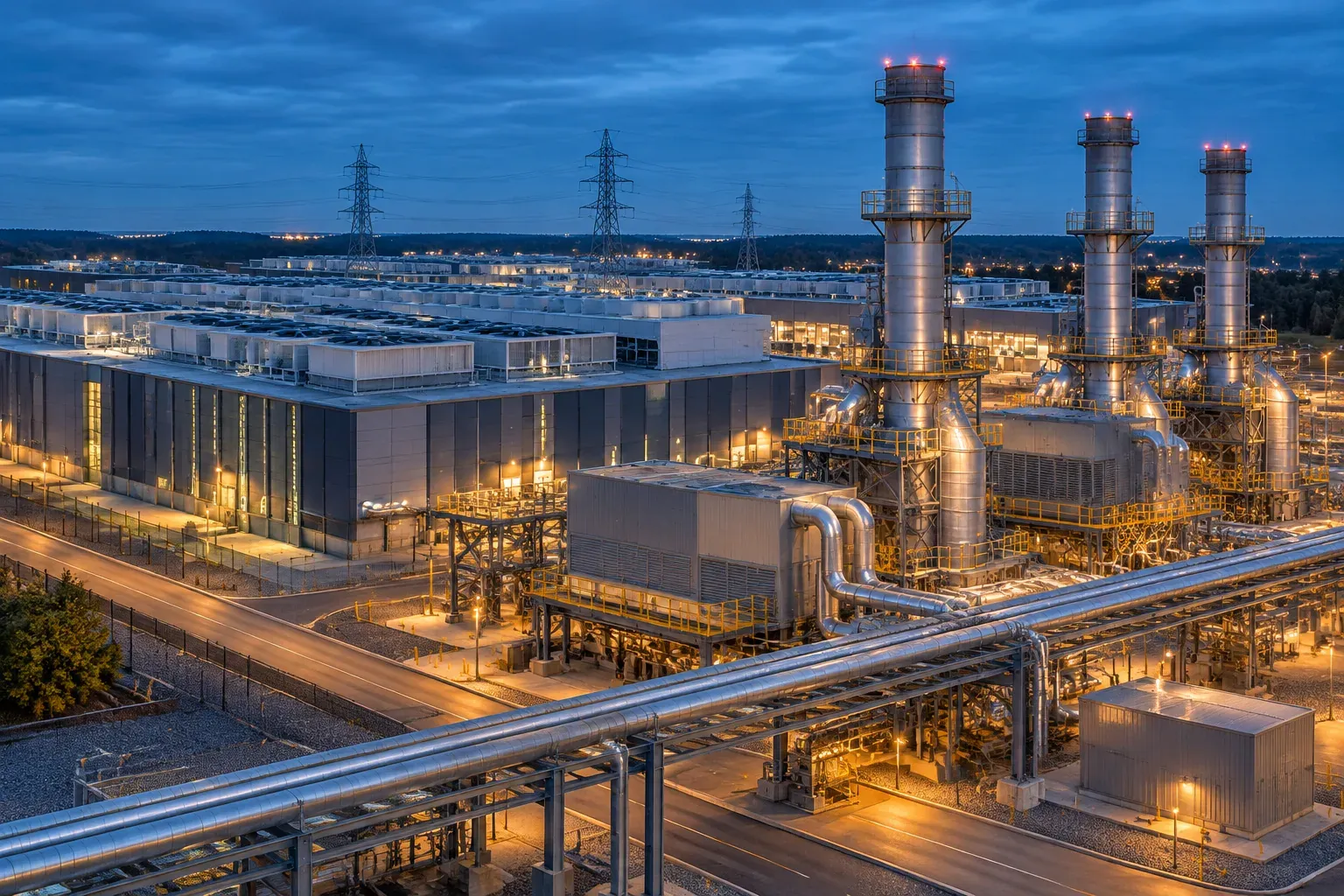
Data Center Natural Gas Plants and the Cost of Getting Power Faster
Key takeaways
- Developers build on-site gas plants to start operating while they wait for a utility connection.
- Cleanview counted more than 100 announced US projects as of October 2026, with over 115 gigawatts of planned capacity.
- A plant built to bridge a grid delay can stay in service after the utility connection arrives, either as backup or as a regular power source.
- The business case depends on the value of opening early, the cost of keeping power available during outages, and the cost and emissions of running the plant over time.
Developers build data center natural gas plants to get electricity sooner when a utility connection could take years. Generating power on-site gives a project more control over its opening date, while adding responsibility for fuel, maintenance, and outages. Whether the trade pays off depends on how much an earlier opening is worth and how often the plant runs after grid power arrives.
In November 2026, MIT Technology Review reported that Cleanview had tracked plans for more than 100 behind-the-meter gas plants at US data centers as of October 2026. Their combined planned capacity exceeded 115 gigawatts. Most announcements came from the beginning of 2025 onward, and only a small fraction of the projects were under construction or operating at the time of reporting. MIT Technology Review’s reporting on data centers and on-site gas power
Those announcements show how central the power schedule has become to AI infrastructure planning. A developer can have a site and a construction plan in hand while the date it can begin using the electricity it needs remains uncertain. InnoVirtuoso’s coverage of the AI infrastructure power constraint
Why developers build data center natural gas plants
A developer seeking a large grid connection asks a utility or regional grid operator to supply the site. Grid planners study how to deliver that power while maintaining reliability. The answer can involve new transmission lines or larger transformers, with the developer potentially paying part of the cost. MIT Technology Review reported that the wait for a connection can stretch to a decade. US Department of Energy Grid Deployment Office
A plant built on the customer’s side of the utility meter supplies the data center directly. That arrangement is called behind-the-meter generation. A campus can rely on its own plant when it opens, connect to the grid later, and retain the turbines for backup. MIT Technology Review described this temporary arrangement as a bridge to a utility connection.
The economic logic is easiest to see when a completed building would otherwise sit idle. If customers are ready to use the computing capacity, opening early can justify paying more for electricity. The same premium becomes harder to justify if computing demand arrives later than expected or if only a small share of the campus can open ahead of the grid connection. At a large campus, the most useful question is how much computing capacity each power option makes available at each stage. InnoVirtuoso’s coverage of Vantage’s Frontier data center campus
Does an on-site gas plant make a data center more reliable?
Reliability comes down to how much power remains available when something goes wrong. A campus that depends on its own plant needs to know how much computing load it can keep running during scheduled maintenance, after a turbine trips, or when fuel delivery is interrupted. A plant’s rated capacity describes its output under specified conditions. The capacity the campus can count on during those scenarios is the figure that should guide operating commitments. North American Electric Reliability Corporation
Start with a concrete scenario. Suppose one turbine is already offline for maintenance and a second unit trips. Can the remaining equipment support the committed computing load and the cooling it requires? If the answer depends on buying electricity from the utility, the developer needs to confirm that the connection will be available by then and can deliver the required power.
The same logic applies once the campus connects to the grid. If the gas plant is kept for backup, the team still needs a plan to maintain and test it. If the operator expects to use both sources regularly, each has a different role in the operating plan. Spell out which source carries the load under normal conditions and which takes over during an interruption.
How does on-site gas affect data center emissions?
MIT Technology Review reported that nuclear and renewables together accounted for about 40% of US electricity generation. That mix generally favors the US grid in an emissions comparison with a data center that relies entirely on on-site gas. For a specific campus, the result depends on the electricity the utility would supply, the plant’s efficiency, and how much the operator expects to run it. US Energy Information Administration electricity data
The turbine choice matters. Combined-cycle plants use heat from the gas turbine to generate additional electricity. Single-cycle plants are generally cheaper to build, but they produce less electricity from the same amount of fuel. MIT Technology Review reported that equipment suppliers were struggling to keep up with demand and that, according to BloombergNEF analyst Musfika Mishi, very few planned behind-the-meter facilities would use combined-cycle turbines.
| Power option | What shapes the emissions comparison |
|---|---|
| Grid connection | The mix of sources generating the electricity the campus uses |
| On-site single-cycle gas | Lower fuel efficiency increases emissions per unit of electricity compared with combined-cycle gas |
| On-site combined-cycle gas | Using exhaust heat to generate more electricity improves fuel efficiency |
BloombergNEF estimated that if all planned US behind-the-meter gas plants for data centers went ahead, they could emit 345 million metric tons of carbon dioxide equivalent annually by 2035, according to MIT Technology Review. That was 152 million metric tons more per year than BloombergNEF estimated for supplying the same data centers from the US grid. The figures describe a scenario tied to announced projects and show how much the choice of power supply could matter if those projects proceed.
When does a temporary gas plant become a long-term cost?
MIT Technology Review reported that building a gas plant generally costs more than connecting to the grid. To evaluate the premium, compare the value of opening sooner with the cost of delivering power over the campus’s operating life. The on-site estimate should account for construction, financing, fuel, maintenance, and equipment needed to cover outages. The grid estimate should include any share of network upgrades the developer may have to fund, alongside what it expects to pay for electricity once connected.
A bridge plant creates a decision when the grid connection finally arrives. If the operator keeps it for backup, the campus still pays to keep the equipment ready. If the operator runs it routinely, fuel and emissions remain part of the operating picture. Retiring the plant can bring those operating costs to an end while leaving the developer with less time to recover its investment. A project that looks attractive under one of these outcomes may look very different under another. InnoVirtuoso’s coverage of data center investment and returns
This is the risk of fossil fuel lock-in that Mishi raised in the source reporting. Once equipment is built and available to run, the operator may find it attractive to keep using it beyond the original bridge period. The assumptions behind that decision belong in the financial and emissions estimates from the start.
What should you check before choosing on-site gas?
Compare grid-only power, a temporary gas bridge, and continued on-site generation using the same campus schedule and computing load. The goal is to identify which assumptions about timing, cost, and availability change the preferred option.
- Confirm both power dates. Ask the utility when it can deliver usable capacity for each phase and what upgrades those dates depend on. Ask the plant team for the equivalent schedule, including fuel supply, equipment delivery, and permitting.
- Test the operating plan. Ask what load the campus can support during maintenance or an interruption to fuel supply. Confirm which equipment or utility service covers any shortfall and when that capacity becomes available.
- Price an earlier opening. Estimate the value of the computing capacity the plant actually brings online ahead of the grid. Rework the comparison if customer demand grows more slowly, the gas plant opens late, or grid power comes sooner.
- Define the plant’s role after connection. Model backup use, regular operation, and retirement. Use expected operating hours for each case so the cost and emissions estimates reflect what the equipment is likely to do.
The Bottom Line
A data center natural gas plant can buy time when a grid connection would delay the opening of a campus. Its value depends on the computing capacity it brings online early, the power it can deliver during disruptions, and the cost of its eventual role. Put the proposed grid connection date and the plant’s expected operating hours after that date in the same project model, then test what happens when either assumption changes.
Frequently Asked Questions
Why are data centers building their own natural gas power plants?
Some developers use on-site gas generation to start operating while they wait for a utility connection. A large grid connection can take years if the utility needs to study the added demand and upgrade its network.
What does behind-the-meter power mean for a data center?
Behind-the-meter generation sits on the customer’s side of the utility meter and supplies the site directly. A data center can rely on it at startup and retain the plant as backup after a grid connection arrives.
Is on-site natural gas cheaper than grid power for data centers?
Building a dedicated gas plant generally costs more than connecting to the grid. A developer may accept that premium if opening earlier generates enough value to cover construction, fuel, maintenance, and backup capacity.
Is on-site natural gas cleaner than electricity from the grid?
A data center that relies entirely on on-site gas will generally produce more emissions than one using the US grid mix described by MIT Technology Review. A site-specific comparison depends on the grid’s generation mix, the gas plant’s efficiency, and its operating hours.
What happens to an on-site gas plant once the grid connection arrives?
The operator can keep the plant for backup, continue running it regularly, or retire it. That choice determines how much the campus continues to spend on fuel and maintenance and how much the plant continues to emit.
Sources
- Data centers are getting their own natural gas power plants — MIT Technology Review
Read more on InnoVirtuoso
- Big Tech’s $600B AI Spending Race in 2026: Chips, Data Centers, Power—and the Path to Returns
- The $3 Trillion AI Data Center Build-Out: 2026 Outlook and the Top Stocks to Watch
- The $3 Trillion AI Data Center Build-Out Reshaping Global Debt Markets
- SoftBank Launches Roze AI, a Robotics Company to Build Data Centers 10x Faster
- Meta to Record Employees’ Keystrokes to Train AI: Privacy, Power, and the New Data Gold Rush
Enjoyed this? Subscribe to the InnoVirtuoso newsletter for practical AI, security and tech insights — and share your thoughts in the comments.