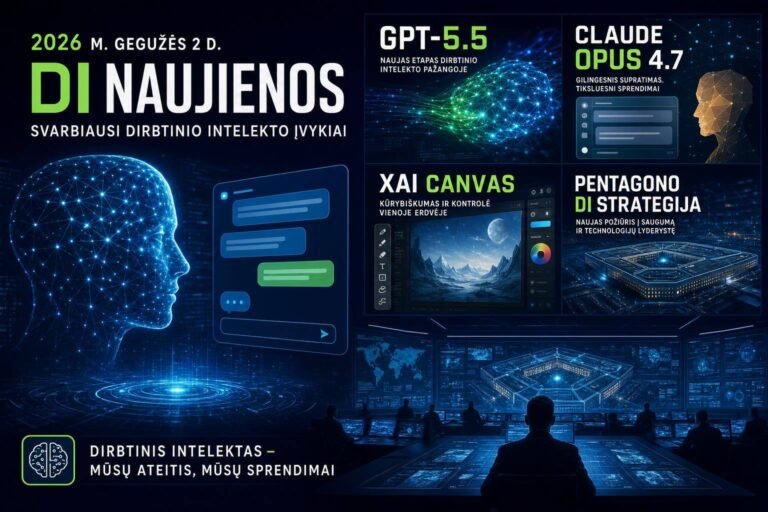

AI Daily Brief (May 3, 2026): Pentagon Clears 8 Vendors for Classified AI, Nebius Bets $643M on Infrastructure, Meta Expands, and Qwen 3.6 Lands on Fireworks
The week’s AI daily brief signals a decisive shift from experimentation to deployment. The Pentagon has cleared eight technology firms to run AI on classified networks—an explicit green light for secure LLM and machine learning workloads in sensitive environments. Simultaneously, Nebius is pouring $643 million into infrastructure, Meta is quietly adding to its AI bench via acquisition, and Alibaba’s Qwen team has launched Qwen 3.6 Plus as a closed-weight model on Fireworks AI’s inference platform.
Together, these moves accelerate a new reality: the center of gravity is moving toward safe, scalable, and cost-optimized AI in production. If you’re a CIO, CISO, head of data or platform engineering, or a founder building AI-native products, this week’s developments offer clear signals on where to focus—security-by-design, robust infrastructure, and savvy model selection that balances performance with total cost of ownership.
Below, we unpack the strategic implications, offer practical playbooks, and highlight technical considerations to help you operationalize these shifts with confidence.
Defense-Grade AI: What the Pentagon’s Approval Means for Secure LLMs
The U.S. Department of Defense reportedly approved eight firms to deploy AI on classified networks—likely across impact levels that include secret and top-secret domains. That’s a pivotal milestone for the adoption of large language models (LLMs) and ML analytics in scenarios where confidentiality, integrity, and availability are non-negotiable.
Why it matters: – It validates that modern AI can meet stringent security and accreditation requirements when designed and operated correctly. – It creates a de facto playbook for high-security enterprises (defense industrial base, financial services, healthcare) to follow. – It pushes vendors to deliver hardened inference, auditability, and governance baked into the stack.
Key policy and security anchors: – The Pentagon’s AI adoption is shaped by the DoD’s AI Ethical Principles, emphasizing responsible use, traceability, and reliability. – Deployment patterns will align with the DoD’s Zero Trust Strategy, requiring identity- and policy-driven enforcement at every control point, including model access and data retrieval. – Expect alignment with modern AI security guidance such as NIST’s AI Risk Management Framework and CISA’s joint Guidelines for Secure AI System Development, which promote threat modeling, secure coding, and continuous monitoring for AI-specific risks.
What “classified-ready” likely entails: – Isolated or air-gapped inference environments (including SCIF-hosted clusters) with strict egress controls; no external calls unless mediated by cross-domain solutions. – Privileged access management for model endpoints; workload attestation, signed artifacts, and robust SBOMs for all model and runtime components. – Fine-grained audit logs for prompts, system messages, retrieval queries, and outputs—retained under strict chain-of-custody. – Model and data segmentation to prevent cross-tenant data exposure, with encrypted memory and disk, strict handling of embedding stores, and redaction pipelines. – Model-specific risk mitigations: prompt injection defenses, output filtering for sensitive content, and reasoning-time checks for hallucination-prone tasks.
Defense and regulated-industry takeaway: – The door is now open. If the Pentagon can run LLMs on classified networks, critical-infrastructure organizations can confidently design “defense-grade” AI services—provided they adopt the same discipline: Zero Trust-by-default, rigorous model evaluations, and AI-specific security controls that go beyond generic cloud posture management.
The Infrastructure Arms Race: Nebius Allocates $643M to AI Capacity
Nebius announced a $643 million investment into AI infrastructure, underscoring the simple truth of 2026: the constraint is capacity. GPUs, high-bandwidth memory, energy, and interconnects remain bottlenecks. This spend is not just about GPUs—it’s about reliable throughput, predictable latency, and sustainable cost of inference at scale.
Why this investment matters: – Compute scarcity continues to shape AI roadmaps. Access to performant clusters determines both speed-to-value and unit economics. – Inference costs can eclipse training spend as applications move to production. Capex on the right interconnects, storage, and scheduling has a direct impact on gross margins and SLAs. – Regionalized infrastructure can reduce data residency friction, latency, and geopolitical risk.
Enterprise implications: – Don’t optimize for model “accuracy” alone—optimize for total inference economics. Token throughput, batch efficiency, quantization support, and effective context windows often matter more than marginal benchmark gains. – Plan for multi-provider strategies. If you’re all-in on a single GPU vendor or cloud region, you’re exposed to supply shocks and pricing power.
For organizations evaluating infrastructure partners, include: – Network fabric and topology: Are you getting NVLink/NVSwitch islands for intra-node bandwidth? Is the inter-node fabric InfiniBand with SHARP or RoCEv2 at 400G+? These determine training and inference scaling efficiency. – Storage architecture: Tiered NVMe, object storage, and fast metadata services to keep retrieval and feature stores low-latency. – Energy and sustainability: Facility PUE/WUE, power availability, and heat re-use options affect long-term economics and ESG commitments. – Scheduling and orchestration: First-class support for multi-tenant isolation, MIG partitioning, and priority queues for latency-sensitive inference.
Contextual resource: – For performance benchmarking and hardware-informed decision-making, track MLCommons’ MLPerf Inference results to understand tradeoffs across architectures and workloads. – Explore provider capabilities directly; Nebius details its AI offerings at nebius.ai.
Meta’s Acquisition: Consolidating Talent and Capabilities for the Next AI Phase
Meta’s latest AI-adjacent acquisition continues a consistent strategy: aggregate top-tier talent and technology that compound with its open model portfolio and on-device ambitions.
Strategic levers at play: – Open model gravity: By championing open-weight models and an active research pipeline, Meta benefits from a compounding ecosystem. M&A that accelerates inference efficiency, video or multimodal capability, or on-device performance slots neatly into that flywheel. – On-device and edge AI: Expect ongoing investment in model distillation, sparsity, and custom kernels to enable performant inference on consumer and enterprise endpoints. – Enterprise relevance: Even if Meta’s commercial focus remains consumer-centric, tooling that enhances controllability, safety, and analytics over model behavior will pull enterprise developers into its orbit.
For product leaders: – Talent-centric acquisitions often manifest as enabling features: better token streaming, more robust function calling, improved video and speech generation, or smarter retrieval orchestration. Watch for these showing up in SDKs and developer tooling rather than headline products first. – If you’re building on open LLMs, track how new Meta research and tools affect your latency/cost curves—particularly around speculative decoding, KV-caching, and quantization.
Qwen 3.6 Plus on Fireworks: Closed Weights, Open Options
Alibaba’s Qwen team partnered with Fireworks AI to debut the closed-weight Qwen 3.6 Plus model on Fireworks’ inference platform. That’s notable for two reasons: (1) Qwen’s rapid iteration cadence and strong multilingual/coding performance, and (2) Fireworks’ developer-friendly, high-throughput inference infrastructure.
What “closed-weight” means in practice: – You cannot download or self-host the raw weights; you access the model via a hosted API or managed runtime under commercial terms. – You typically gain enterprise features—SLA-backed performance, safety filters, enhanced logging, abuse detection, and guardrails—without provisioning your own cluster.
Why developers care about Fireworks: – It offers fast, scalable inference with consistent latency, function calling, and JSON-constrained outputs—suited for agent frameworks, RAG, and structured automation. – It provides tooling for A/B tests, evals, and model routing that helps teams iterate quickly on prompts and system behaviors.
Resources: – Explore Fireworks’ capabilities in the official documentation. – Track Qwen’s model family and tooling on the Qwen team’s GitHub organization, which highlights open variants, tokenizers, and evaluation artifacts.
Practical upside: – If you’re optimizing for multilingual knowledge work, technical writing, or code generation in cost-sensitive environments, Qwen models are increasingly competitive. Qwen 3.6 Plus being closed-weight suggests enterprise positioning—expect tuned guardrails, scalable throughput, and pricing that undercuts frontier closed models for many tasks.
AI Daily Brief: What These Moves Signal for Builders and Buyers
Zooming out, the AI daily brief points to three durable trends:
1) Security and trust are product features, not checkboxes. – Defense validation shows secure LLMs can be operational at the highest sensitivity levels. Enterprises should harden their own deployments accordingly. – Adopt recognized frameworks and guidance from NIST’s AI RMF and CISA’s secure AI development guidelines to align engineering, risk, and compliance.
2) Inference efficiency decides winners. – Investments like Nebius’ are about meeting demand without crushing gross margins. Teams that master batching, quantization, caching, and model routing will own unit economics in 2026.
3) Model ecosystems matter more than model names. – Fireworks + Qwen is an example of where platforms and models meet developers. Function calling stability, streaming reliability, and eval tooling can outweigh small leaderboard differences.
From Signals to Systems: A Practical Playbook for 2026 AI Roadmaps
Use the following blueprint to convert this week’s news into operational advantage.
1) Establish an AI security and governance baseline
- Map critical use cases and data classes:
- Identify which applications touch PII, PHI, financial data, export-controlled data, or trade secrets.
- Assign policies for prompt input, retrieval scopes, output handling, and retention.
- Implement Zero Trust controls for AI:
- Enforce service identity and least privilege for model endpoints, vector stores, and tool integrations.
- Require scoped API keys, workload attestation, and signed model/container artifacts.
- Adopt credible guidance and threat intel:
- Align governance to NIST’s AI Risk Management Framework.
- Use CISA’s Secure AI System Development Guidelines to drive secure coding, dependency hygiene, and monitoring.
- Threat model against adversarial ML using MITRE’s ATLAS knowledge base; include prompt injection, data poisoning, model exfiltration, and jailbreaks.
- Harden LLM apps using the OWASP Top 10 for LLM Applications.
Checklist: – Audit logging on for all prompts, system messages, tools, and outputs – Secrets isolation; never embed secrets in prompts or tool specs – PII redaction and data minimization at ingestion – Output filtering and policy enforcement (DLP, compliance, safety) – Human-in-the-loop for high-impact decisions – Incident response runbooks for model abuse, drift, or leakage
2) Optimize inference economics before you scale users
- Benchmark realistically:
- Use representative prompts, context lengths, and tool chains, not marketing benchmarks.
- Track throughput (tokens/sec), P95 latency, context-window hit rates, and cost per 1K tokens.
- Cross-check hardware and runtime choices with MLCommons’ MLPerf Inference results to calibrate expectations.
- Apply efficiency techniques:
- Quantization: Run 8-bit or 4-bit where acceptable; validate quality deltas on your data.
- KV-caching and speculative decoding: Lower latency for chat and agent loops.
- Batching: Group compatible requests; consider micro-batching to balance latency and cost.
- Routing: Use small/fast models for most tasks; escalate to larger models only as needed.
- Plan for the “real” cost drivers:
- Long-context prompts become the silent margin killer. Build retrieval systems that craft minimal, high-signal contexts.
- Tooling overhead (search, DB, APIs) often dominates compute; monitor end-to-end latency and spend.
3) Choose models by task, not logo
- Build a portfolio:
- General-purpose instruction model
- Lightweight, low-latency model for summarization, classification, and simple agents
- Code-focused model for developer workflows
- Domain-tuned LoRAs for specialized tasks (legal, healthcare, finance)
- Evaluate beyond benchmarks:
- JSON fidelity and function calling stability
- Tool-use efficacy (grounded retrieval, calculators, SQL, document parsing)
- Multilingual accuracy in your top languages and dialects
- Test on your data with your constraints:
- Many “wins” on leaderboards vanish under your latency, privacy, or token limits.
- Use platforms like Fireworks for rapid A/B routing across options, including Qwen 3.6 Plus via the Fireworks docs and Qwen’s broader ecosystem on GitHub.
4) Harden RAG and agent pipelines
- Retrieval: Maintain high-quality indexes; prioritize semantic recall without ballooning context. Analyze embedding drift.
- Guardrails: Validate tool outputs and external calls. Use allowlists/denylists and schema validation for JSON/function outputs.
- Policy enforcement: Implement templates that specify tone, citation requirements, and refusal behavior for sensitive topics.
- Observability: Track hallucination rates, citation accuracy, and user feedback loops. Replay incidents to improve prompts and policies.
5) Prepare for regulated and classified-like environments
- Data handling: Adopt data-classification tags that follow content through prompts, embeddings, and outputs; enforce DLP and retention policies.
- Network posture: Assume no outbound calls from sensitive environments without policy-controlled mediators and auditable proxies.
- Documentation: Maintain model cards, intended-use statements, fine-tuning data lineage, and hazard analyses to satisfy auditors and risk teams.
- Red-teaming: Perform structured adversarial tests using MITRE ATLAS techniques and the OWASP LLM Top 10 to validate controls before go-live.
Technical Deep Dive: Inference Architecture for Secure, Cost-Effective AI
Teams charged with running production AI at scale should align around a few architectural pillars.
Compute and runtime: – Select inference servers supporting continuous batching and efficient KV-cache sharing (e.g., vLLM-like runtimes). – Standardize on quantization-aware runtimes to toggle precision (FP8/BF16/INT8/INT4) per endpoint. – Segment clusters by latency class (interactive vs. batch) and sensitivity (public vs. confidential vs. restricted).
Networking and data: – Deploy vector stores near compute to reduce cross-zone latency; co-locate RAG indexes with inference clusters. – Use policy-enforced egress gateways for any external tool calls; inspect and log requests/responses for policy violations. – Apply encryption on the wire and at rest; consider memory encryption and confidential computing for high-sensitivity workloads.
Security controls: – Identity-bound tokens for every call; short-lived credentials rotated automatically. – Prompt provenance tagging to track system prompts, tool specs, and chain-of-thought policies (even if chain-of-thought is not logged, track the directive set used). – Differential privacy or noise-injection where legally required or beneficial for analytics over sensitive logs.
Resilience and SLOs: – Define per-endpoint SLOs (P95 and P99 latency, availability, error budgets). – Capacity planning: simulate burst loads tied to product launches, seasonal usage, or incident response spikes. – Blue/green or canary deploys for model and prompt changes; rollback within minutes.
Vendor and Platform Strategy: Avoid the Lock-In Traps
Given the pace of change, intelligent optionality beats perfect foresight.
- Contract for portability:
- Reserve the right to export logs, embeddings, and fine-tuned adapters.
- Favor standards-based APIs and open-source tokenizers where possible.
- Multi-model routing:
- Abstract model selection behind a policy/routing layer so you can switch vendors when economics or performance shift.
- Shadow benchmarking:
- Continuously benchmark 2–3 contender models against your live traffic (with appropriate privacy controls) to detect drifts and opportunities.
Security Corner: Concrete Steps to Reduce AI Risk This Quarter
- Implement a model firewall pattern:
- Pre-prompt scrubbing for secrets and policy violations
- Post-output scanning for sensitive content, PII, and disallowed instructions
- Enforce content provenance:
- Tag outputs that incorporate retrieval results; track citations and source integrity
- Train staff:
- Provide short, scenario-based training: prompt injection, sensitive data handling, output verification, and escalation paths
- Test disaster scenarios:
- Simulate a jailbreak campaign or data exfiltration via function calling; assess detection and response
Leverage public guidance where possible: – NIST AI RMF: align risk controls and measurement – CISA’s secure AI development guidance: actionable steps for engineering teams – OWASP LLM Top 10: concrete vulnerabilities and mitigations
What to Watch Next: Signals for the Next 90 Days
- Government-grade AI pipelines in the enterprise:
- We’ll see “classified-adjacent” deployments: air-gapped inference for board communications, M&A diligence, and regulatory submissions.
- Infrastructure price movements:
- As providers like Nebius expand capacity, monitor GPU availability, reserved-capacity discounts, and region-specific latency SLAs.
- Model differentiation via tooling:
- Less about raw benchmarks; more about function calling reliability, multi-agent orchestration, JSON compliance, and eval/observability integrations.
- On-device AI acceleration:
- Distilled models with better small-context performance and device-optimized kernels will blur the line between cloud and edge.
FAQs
Q1: What does the Pentagon approving vendors for classified AI actually change for businesses? – It proves AI can meet stringent security and compliance requirements when engineered correctly. Enterprises can adopt similar controls—Zero Trust enforcement, strict logging, and AI-specific guardrails—to deploy LLMs on sensitive data with greater confidence.
Q2: How should I think about choosing between open and closed-weight models? – Start with your constraints: data sensitivity, latency, cost, and required capabilities. Closed-weight models may deliver better SLAs, guardrails, and support, while open-weight models provide portability and customization. Many organizations adopt a hybrid approach with routing.
Q3: Will Nebius’ $643M investment lower my inference costs? – Not directly and not immediately, but increased capacity among providers typically improves availability and negotiating leverage. Watch for new instance types, regional options, and discounted reserved capacity.
Q4: What makes Qwen 3.6 Plus on Fireworks interesting for developers? – Qwen’s strong multilingual and code performance combined with Fireworks’ high-throughput, structured outputs, and A/B routing make it attractive for production apps that need dependable function calling, JSON mode, and predictable latency.
Q5: How do I benchmark models fairly for my use case? – Build task-specific evals with your data. Measure tokens/sec, P95 latency, JSON validity, function call success rate, and cost per 1K tokens. Include long-context tests if you use RAG. Run side-by-side comparisons under identical prompts and constraints.
Q6: What are the top AI security mistakes to avoid? – Logging sensitive data without redaction, letting models make unreviewed high-impact decisions, skipping prompt/output filtering, and relying on vendor default settings without policy overlays. Use guidance from NIST, CISA, and OWASP to structure defenses.
Conclusion: The AI Daily Brief Points to One Direction—Operate, Don’t Just Experiment
The May 3 AI daily brief underscores a turning point. The Pentagon’s approvals legitimize secure LLM deployment at the highest sensitivity levels. Nebius’ $643 million bet reminds us that compute and interconnects are the new oil fields. Meta continues to assemble the pieces for efficient, broad-based capability. And Qwen 3.6 Plus on Fireworks shows how the model-platform stack is maturing for cost-effective, production-grade inference.
For leaders and builders, the path is clear: adopt Zero Trust for AI, optimize inference economics, and choose models by task—then measure relentlessly. Anchor your program to recognized frameworks like the NIST AI RMF, apply security guidance from CISA and partners, test realistically with MLPerf-style rigor, and use platforms like Fireworks to iterate fast. The organizations that operationalize these lessons will turn this AI daily brief into durable competitive advantage.
Discover more at InnoVirtuoso.com
I would love some feedback on my writing so if you have any, please don’t hesitate to leave a comment around here or in any platforms that is convenient for you.
For more on tech and other topics, explore InnoVirtuoso.com anytime. Subscribe to my newsletter and join our growing community—we’ll create something magical together. I promise, it’ll never be boring!
Stay updated with the latest news—subscribe to our newsletter today!
Thank you all—wishing you an amazing day ahead!
Read more related Articles at InnoVirtuoso
- How to Completely Turn Off Google AI on Your Android Phone
- The Best AI Jokes of the Month: February Edition
- Introducing SpoofDPI: Bypassing Deep Packet Inspection
- Getting Started with shadps4: Your Guide to the PlayStation 4 Emulator
- Sophos Pricing in 2025: A Guide to Intercept X Endpoint Protection
- The Essential Requirements for Augmented Reality: A Comprehensive Guide
- Harvard: A Legacy of Achievements and a Path Towards the Future
- Unlocking the Secrets of Prompt Engineering: 5 Must-Read Books That Will Revolutionize You