CISA Orders Rapid Patching of Windows Zero‑Day CVE‑2026‑32202 as Pass‑the‑Hash Risk Escalates
A new Windows zero‑day, CVE‑2026‑32202, has moved from a technical curiosity to an urgent enterprise priority. The U.S. Cybersecurity and Infrastructure Security Agency (CISA) added the flaw to its Known Exploited Vulnerabilities (KEV) Catalog and ordered Federal Civilian Executive Branch agencies to patch within days—signaling active exploitation and elevated risk to government and commercial networks alike.
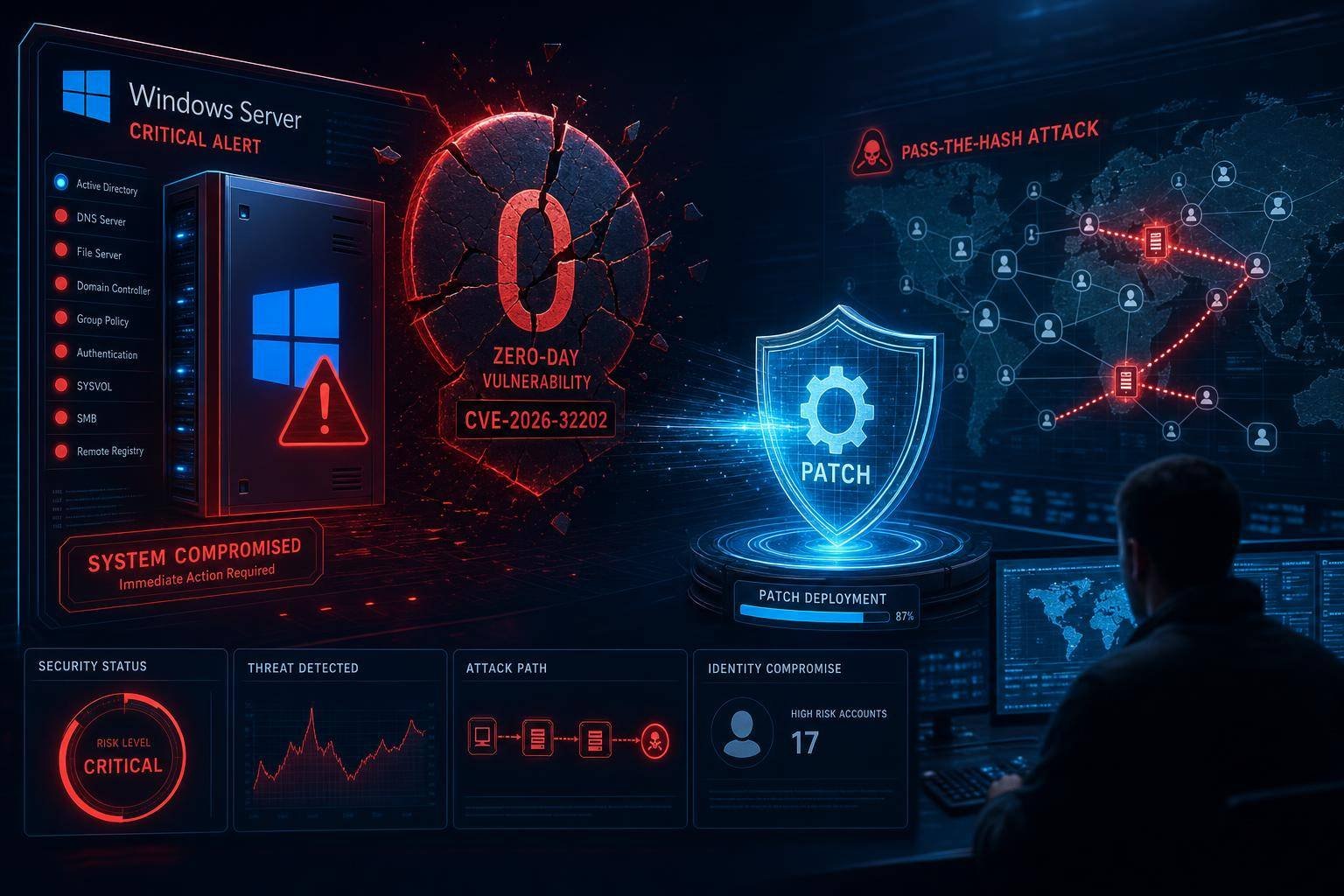
Why this matters now: CVE‑2026‑32202 is an NTLM hash leak vulnerability that adversaries can weaponize for pass‑the‑hash (PtH) attacks. With valid NTLM hashes in hand, attackers can authenticate as real users, pivot laterally, escalate privileges, and exfiltrate data without cracking passwords. The flaw also appears to stem from an incomplete fix for a previous Windows RCE (CVE‑2026‑21510), which raises the likelihood of creative bypasses and rapid exploit evolution.
This briefing unpacks what’s new, how the exploit chain works, what to do in the next 72 hours, and how to harden identity systems long‑term—especially if you can’t patch everything immediately.
What changed this week: a KEV addition and a hard deadline
CISA has added CVE‑2026‑32202 to the Known Exploited Vulnerabilities Catalog, requiring federal agencies to patch impacted Windows endpoints and servers on an accelerated timeline under Binding Operational Directive 22‑01. The directive compels remediation within two weeks of listing; for this case, that means by May 12.
Why KEV matters: – It’s a short list of vulnerabilities with confirmed in‑the‑wild exploitation. – It’s not advisory; for federal agencies, it’s mandatory with enforceable deadlines. – It’s a public signal: if adversaries have a working exploit, broader industry should prioritize patching too.
CISA also advises organizations outside the federal space to move with urgency. While BOD 22‑01 is scoped to federal civilian agencies, the combination of an NTLM hash leak and ongoing exploitation is a high‑value target for ransomware crews, data‑theft actors, and advanced persistent threats.
Understanding Windows zero‑day CVE‑2026‑32202
CVE‑2026‑32202 is an information disclosure flaw that allows an attacker to obtain NTLM hashes from a Windows system. Microsoft classifies the exploitation complexity as low; in some scenarios the attack may require a user to execute a malicious file, while Akamai’s discovery indicates “zero‑click” pathways may exist in certain conditions. This nuance matters: if any effective zero‑interaction vectors are available, exploitation scales faster across enterprise fleets.
This vulnerability surfaced after Microsoft’s February fix for a related remote code execution bug, CVE‑2026‑21510. Incomplete patches are common catalysts for “n‑day” bypasses—adversaries reverse‑engineer the update, then probe adjacent code paths, edge cases, and protocol quirks to recreate the original primitive through a different route. That appears to be the pattern here.
For authoritative patch and severity details, track the Microsoft Security Response Center’s Security Update Guide.
NTLM, hashes, and why this is dangerous
Windows supports multiple authentication protocols; NTLM (NT LAN Manager) remains widely used for legacy compatibility and non‑Kerberos scenarios. In an NTLM exchange, the client proves knowledge of a secret without sending the password in cleartext, using challenge‑response. But NTLM is susceptible to relay and replay techniques if an attacker can capture the hashed credentials or coerce authentications to attacker‑controlled endpoints.
Key terms in plain English: – NTLM hash: A one‑way representation of a user’s password. It’s not the password itself, but it can be reused to authenticate in certain situations (no cracking required). – Pass‑the‑hash (PtH): An adversary technique to authenticate using a stolen hash, bypassing the need to know the underlying password. See MITRE ATT&CK T1550.002. – Lateral movement: Using any valid credentials to move from one system to another, seeking higher privileges or more sensitive data.
Even “read‑only” leaks become catastrophic when what’s leaked can be reused for authentication. That’s why CVE‑2026‑32202 is more than an information disclosure bug—it’s a credential theft and identity compromise vector.
For background on NTLM’s design and usage patterns, review Microsoft’s NTLM overview.
How attackers weaponize CVE‑2026‑32202 in real environments
Attackers play the long game with identity. Hashes from a single compromised endpoint become keys to neighboring systems, service accounts, and eventually domain controllers. Here’s a plausible kill chain leveraging CVE‑2026‑32202 based on public descriptions:
- Initial foothold or delivery – Adversary gains code execution on a low‑value host via phishing, a browser exploit, or a malicious document, or triggers a path that causes NTLM authentication leakage. – Alternatively, the attacker convinces or coerces the system into making an outbound NTLM authentication to an attacker‑controlled relay point.
- Credential capture – Using CVE‑2026‑32202, the attacker extracts NTLM hashes without interactive prompts or high user friction. If the vector is “zero‑click,” scaling is easier; if it requires a user to run a file, they’ll pair it with social engineering.
- Pass‑the‑hash and pivot – The attacker uses captured hashes to authenticate to adjacent machines (e.g., SMB shares, remote services). – If local administrator hashes are reused across endpoints—a common misconfiguration—lateral movement becomes trivial.
- Privilege escalation – With broader access, the attacker targets service accounts, scheduled tasks, or weakly configured domain trusts. – They may combine with NTLM relay, Kerberoasting, or shadow credential techniques to escalate.
- Objective actions – Exfiltrate data, deploy ransomware, or establish persistent access via scheduled tasks, WMI subscriptions, or new admin users.
Factors that increase risk: – Widespread NTLM use and legacy compatibility settings. – Reuse of local admin passwords across multiple machines. – Lack of SMB signing, allowing NTLM relay in some paths. – Absent Credential Guard or attack surface reduction (ASR) policies.
Immediate actions: patch with urgency and verify remediation
Treat CVE‑2026‑32202 as an identity‑impacting flaw with active exploitation. Move quickly and methodically.
1) Identify exposure and prioritize assets – Build an inventory of all Windows endpoints and servers, including domain controllers, file servers, VDI pools, and remote worker devices. – Prioritize systems with high NTLM traffic or critical business functions.
2) Apply the latest Microsoft updates – Use your patch management tool to push the update containing the fix for CVE‑2026‑32202 to all supported Windows versions in scope. – Follow Microsoft’s guidance in the Security Update Guide for any version‑specific prerequisites or registry toggles.
3) Validate with post‑patch checks – Confirm successful installation via build numbers and update IDs. – Spot‑check representative machines from each device class (workstations, servers, domain controllers). – Reboot where required; some credential‑related protections only take effect after restart.
4) Scan and monitor – Run authenticated vulnerability scans to verify that affected binaries or components are at patched levels. – Ensure EDR telemetry is healthy on high‑risk systems to catch post‑patch exploitation attempts.
5) Communicate and coordinate – Alert IT operations and help desk teams about potential reboots and downstream application impacts. – Notify security leadership and stakeholders of KEV‑driven deadlines and progress.
If you operate in a change‑controlled environment, establish an emergency patch window. For federal environments, aligning to BOD 22‑01 timelines is non‑negotiable.
A 72‑hour rollout plan for busy teams
- Hours 0–8: Identify impacted assets, form a patch cell, and deploy to a small validation ring (IT/security workstations, non‑production servers).
- Hours 8–24: Expand to Tier‑2 assets and general workstations. Run scans and confirm success rates. Begin targeted mitigations (see below) where patching lags.
- Hours 24–48: Patch servers and privileged admin workstations. Reboot windows scheduled. Intensify monitoring for anomalous NTLM activity.
- Hours 48–72: Sweep for stragglers, enforce compensating controls, and document exceptions with clear remediation dates.
Compensating controls if you can’t patch today
Even with aggressive patching, large fleets have stragglers. Deploy layered mitigations to reduce blast radius and make PtH harder.
- Reduce NTLM exposure
- Where feasible, migrate services to Kerberos and disable legacy NTLM, at least on sensitive segments. Start by restricting NTLM on domain controllers and high‑value servers.
- Review Microsoft’s NTLM overview for compatibility and configuration nuances.
- Enable Windows Defender Credential Guard
- Credential Guard isolates and protects derived credentials in hardware‑backed containers, curbing many credential theft paths. See Microsoft’s Credential Guard guidance for prerequisites and deployment models.
- Enforce SMB signing and disable insecure protocols
- SMB signing mitigates relay risks on SMB; ensure it’s enabled on clients and servers handling sensitive workloads.
- Harden local admin credentials
- Deploy Microsoft LAPS or its modern successor to ensure unique, rotated local admin passwords per machine, blocking easy PtH reuse.
- Turn on Attack Surface Reduction (ASR) rules
- Configure Defender for Endpoint ASR rules to limit credential dumping behaviors and common initial vectors. See Attack surface reduction rules for recommended baselines.
- Kill legacy name resolution tricks
- Disable LLMNR and NetBIOS name resolution where possible to reduce credential coercion paths to attacker‑controlled hosts.
- Network segmentation and egress controls
- Limit workstation‑to‑workstation lateral movement. Block outbound NTLM authentication to untrusted networks and known sinkholes.
- Monitor for anomalous authentications
- Alert on spikes in NTLM authentications, unusual logon types or sources, and failed logon bursts on sensitive accounts.
These controls do not replace the patch; they buy time and constrain adversary movement while you close exposure.
Detection and response: what to watch for in logs and EDR
If an attacker has already exploited CVE‑2026‑32202, you may see little initial noise. Focus on downstream signals of credential theft and reuse.
High‑value telemetry: – Authentication anomalies – Unusual Type 3 (network) logons across many hosts within short windows. – Successful logons from atypical workstations to admin‑only servers. – Consider Microsoft’s documentation on Event ID 4624 for parsing logon types and fields.
- Lateral movement indicators
- New administrative shares being accessed (C$, ADMIN$) from non‑admin endpoints.
- Remote service creation, scheduled tasks propagation, or PsExec‑like patterns.
- Privilege changes
- New members added to Domain Admins or local Administrators groups.
- Service account authentications from endpoints where they rarely appear.
- Credential dumping attempts and process behaviors
- Blocks or alerts from ASR/EDR around LSASS access, memory scraping, or known credential theft tools.
- NTLM traffic spikes
- Increased NTLM outbound attempts to unfamiliar hosts or IP ranges.
Incident response quick wins: – Quarantine endpoints showing lateral movement or suspicious authentication spikes. – Invalidate and rotate exposed credentials—especially privileged and service accounts. – Review DC logs for unusual patterns and consider staging a golden ticket/golden SAML check if indicators escalate. – Conduct a targeted hunt aligned to MITRE ATT&CK T1550.002 (Pass the Hash) across your environment.
For larger incidents, anchor your playbooks to NIST’s guidance in the Computer Security Incident Handling Guide (SP 800‑61 Rev. 2) to structure triage, containment, eradication, and recovery.
Strategic guidance for CISOs and security leaders
CVE‑2026‑32202 is another reminder that identity is the new perimeter and patch quality can regress in complex codebases. Strengthen your program on three fronts:
- Prioritization: Make KEV entries automatic P1s
- Build pipelines that map KEV updates to asset inventories and remediation SLAs. Treat KEV listings like emergency change tickets, not routine patch cycles.
- Use asset criticality and exposure scores to order rollout intelligently.
- Identity hardening as a baseline, not a project
- Set an organization‑wide goal to reduce or eliminate NTLM where feasible.
- Mandate unique local admin passwords (LAPS), enforce SMB signing, and roll out Credential Guard to high‑value endpoints first.
- Patch management maturity
- Invest in visibility (what’s running, where, and why) and orchestration (how fast can you change it). NIST’s Guide to Enterprise Patch Management (SP 800‑40 Rev. 4) is a solid framework for governance and tooling decisions.
- Assume incomplete fixes happen
- Expand validation beyond “does it install” to “does it close the primitive.” Red/purple‑team critical vulns after patch releases, especially when they’re follow‑ons to earlier bugs.
- Practice least privilege for real
- Tier administrators, separate jump hosts, and restrict workstation‑to‑workstation access. Design so that a single NTLM hash leak can’t cascade to domain compromise.
Federal vs. non‑federal: if BOD 22‑01 doesn’t apply, why act like it does
BOD 22‑01 is enforceable for federal civilian agencies—but its rationale applies universally: – Active exploitation means defenders are already behind. – The vulnerability’s value to adversaries is high (credential theft that bypasses password‑cracking). – NTLM remains deeply embedded in mixed Windows estates, and legacy dependencies slow remediation.
Even if you’re outside the federal space, adopting similar timelines and urgency reduces dwell time and shrinks the window for ransomware or data theft. If you’re hybrid or cloud‑first, apply the same rigor to identity providers, domain controllers in IaaS, and management planes—malicious Windows authentication traffic often traverses those boundaries.
Implementation checklist: from patch to posture
Use this checklist to translate urgency into action:
- Patch now
- Deploy Microsoft’s fix for CVE‑2026‑32202 to all supported Windows versions.
- Reboot and verify via inventory/scan reports.
- Close easy identity gaps
- Enforce SMB signing.
- Turn on Credential Guard for privileged workstations.
- Roll out or confirm LAPS is active and rotating local admin credentials.
- Reduce NTLM dependence
- Map NTLM usage by system/service.
- Disable or restrict NTLM where apps support Kerberos.
- Phase legacy exceptions into contained network segments.
- Monitor and hunt
- Baseline NTLM authentication patterns, then alert on anomalies.
- Hunt for PtH indicators and recent lateral movement attempts.
- Ensure logs from endpoints, servers, and domain controllers are centralized and retained.
- Strengthen governance
- Assign an executive owner for KEV‑driven patch SLAs.
- Run a post‑mortem on cycle time and obstacles; adjust change windows and tooling.
Common mistakes to avoid
- Treating an “information disclosure” CVE as low risk
- When the information is a reusable credential, the risk is elevated.
- Delaying reboots or skipping verification
- Unrebooted systems and failed installs are common blind spots.
- Ignoring legacy enclaves
- If NTLM can’t be disabled in one corner of the network, isolate and instrument it.
- Over‑relying on passwords
- Move toward phishing‑resistant MFA (e.g., FIDO2) and device‑bound credentials. Even with MFA, PtH can still work in some machine‑to‑machine flows—so hardening endpoints remains essential.
FAQ
Q: What is CVE‑2026‑32202, and why is it serious? A: It’s a Windows vulnerability that leaks NTLM hashes, enabling pass‑the‑hash attacks. With a valid hash, an attacker can authenticate as a user without knowing the password, pivot laterally, and escalate privileges—turning a “data leak” into a potential domain compromise.
Q: Is this a remote code execution bug? A: No, it’s primarily an information disclosure flaw. However, because the leaked data (NTLM hashes) can be reused for authentication, the operational impact can rival RCE in real environments, especially where identity hardening is weak.
Q: Does exploitation require user interaction? A: Microsoft describes low‑complexity exploitation and, in some cases, malicious file execution by the victim. The discovering researchers described “zero‑click” avenues in certain conditions. Defenders should assume low‑interaction exploitation may be possible and patch quickly.
Q: Who is affected by CISA’s directive? A: Federal Civilian Executive Branch agencies must patch by the CISA deadline under BOD 22‑01. CISA strongly urges all organizations—public and private—to prioritize patching due to confirmed exploitation.
Q: If I patch, do I still need mitigations? A: Yes. Defense‑in‑depth controls like Credential Guard, unique local admin passwords (LAPS), SMB signing, and reduced NTLM usage limit the impact of future credential theft bugs and make lateral movement harder.
Q: How can I check if we were exploited? A: Look for downstream signs: unusual NTLM authentication bursts, anomalous Type 3 logons, unexpected admin connections between peers, new privileged group members, or EDR alerts on credential dumping. Review relevant Windows logs such as Event ID 4624 and correlate across endpoints and domain controllers.
The bottom line
CVE‑2026‑32202 is a Windows zero‑day with active exploitation and significant identity risk. CISA’s KEV listing and BOD 22‑01 deadline make the directive clear for federal agencies; for everyone else, the operational lesson is the same: patch fast, verify, and assume adversaries will chase incomplete fixes.
The practical path forward: – Patch all affected Windows systems now and confirm remediation. – Deploy compensating controls—Credential Guard, LAPS, SMB signing, restricted NTLM—to contain blast radius. – Monitor for pass‑the‑hash behaviors and investigate anomalies. – Use this event to mature KEV‑driven patch governance and accelerate NTLM deprecation.
Windows zero‑day CVE‑2026‑32202 is a reminder that in modern enterprises, identity is infrastructure. If you defend your credentials with the same rigor you defend your perimeter, you deny attackers their easiest routes to impact—and you turn an urgent patch sprint into durable resilience.
Discover more at InnoVirtuoso.com
I would love some feedback on my writing so if you have any, please don’t hesitate to leave a comment around here or in any platforms that is convenient for you.
For more on tech and other topics, explore InnoVirtuoso.com anytime. Subscribe to my newsletter and join our growing community—we’ll create something magical together. I promise, it’ll never be boring!
Stay updated with the latest news—subscribe to our newsletter today!
Thank you all—wishing you an amazing day ahead!
Read more related Articles at InnoVirtuoso
- How to Completely Turn Off Google AI on Your Android Phone
- The Best AI Jokes of the Month: February Edition
- Introducing SpoofDPI: Bypassing Deep Packet Inspection
- Getting Started with shadps4: Your Guide to the PlayStation 4 Emulator
- Sophos Pricing in 2025: A Guide to Intercept X Endpoint Protection
- The Essential Requirements for Augmented Reality: A Comprehensive Guide
- Harvard: A Legacy of Achievements and a Path Towards the Future
- Unlocking the Secrets of Prompt Engineering: 5 Must-Read Books That Will Revolutionize You