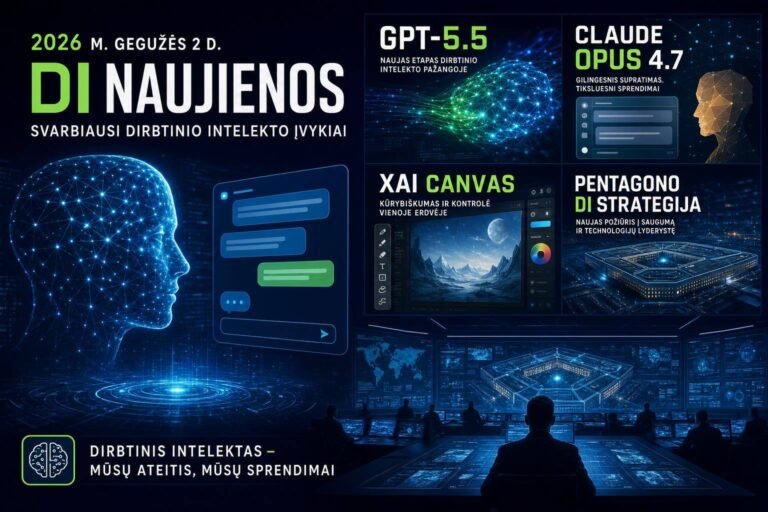

AI Daily Brief (May 2, 2026): Microsoft 365 E7 and Agent 365 Hit GA, UiPath–Databricks Align, Meta Tests Consent-First Ads—and the Compute Race Accelerates
The AI Daily Brief for May 2, 2026 signals a clear inflection: enterprise platforms are shipping agentic capabilities at scale, automation stacks are converging with data platforms, and the hardware layer is intensifying under global pressure. Meanwhile, regulators and courts are shaping how AI can be used in advertising and employment, forcing leaders to upgrade governance as fast as they modernize infrastructure.
If you’re steering AI adoption, this briefing gives you a practical vantage point—what just changed, why it matters, and how to respond. Expect concrete guidance on procurement, architecture patterns, security controls, and change management you can act on this quarter.
Enterprise AI goes mainstream: Microsoft 365 E7 and Microsoft Agent 365 reach GA via CSP
Microsoft pushing Microsoft 365 E7 and Microsoft Agent 365 to general availability through Cloud Solution Provider (CSP) channels is a watershed for enterprise AI adoption. “GA” isn’t just a label—it means enterprises can acquire, deploy, and support these capabilities through standard commercial routes with predictable SLAs, billing, and partner support.
Two things stand out:
- Distribution via the CSP channel matters. For many organizations, the CSP model is how they acquire and manage Microsoft workloads, consolidate invoices, and get lifecycle guidance from partners. Making advanced AI features available there lowers friction and accelerates time-to-value. For context on CSP operations and responsibilities, see Microsoft’s Cloud Solution Provider program overview.
- Agent-native work in Microsoft 365. While Copilot popularized generative assistance inside Office apps, the “Agent 365” label signals a shift from “responding to prompts” to “orchestrating multi-step tasks” across calendars, mail, documents, chats, and line-of-business plugins. In practice, that means routing tasks, summarizing meetings into structured actions, kicking off workflows, and integrating third-party systems. If you’re evaluating fit, Microsoft’s overview for Copilot in Microsoft 365 is a useful baseline for identity, data boundaries, and tenant controls: Copilot for Microsoft 365 documentation.
What this means for CIOs and IT leaders:
- Expect licensing and TCO conversations to refocus on outcomes. The value case shifts from “time saved per user” to “closed-loop processes”—e.g., automatically triaged customer emails with draft replies and tickets created in your ITSM, or quarterly business reviews generated with live data and stakeholder tasks assigned.
- Data governance rises to the critical path. The agent can only act on what it can see. Tenant-scoped permissions, sensitivity labels, and conditional access become preconditions for safe automation. If your Microsoft 365 governance is a patchwork, expect leakage (agents surfacing documents from open Teams sites) or under-delivery (agents blind to key repositories).
- Change management needs an upgrade. Agents that kick off workflows or send communications are “users” in your org. They need onboarding, naming conventions, lifecycle management, and incident playbooks. Treat agent identities with the same rigor as service accounts.
A good starting checklist:
- Map top 5 agentic scenarios (Sales follow-ups, vendor onboarding, RFP compilation, QBR prep, employee offboarding).
- Harden data boundaries: confirm sensitivity labels, access reviews, and DLP rules work as intended in representative test sites.
- Pilot with a partner who can provision via CSP and capture success metrics (cycle-time reduction, ticket deflection, quality KPIs).
- Define agent guardrails: who can create agents, who approves new connectors, and how exceptions are handled.
Automation meets the Lakehouse: UiPath validated as a Databricks technology partner
UiPath’s technology validation with Databricks is more than a logo swap. It’s a practical bridge between data/ML and operations: models living in the lakehouse can now trigger, enrich, and learn from end-to-end business processes in UiPath—closing the loop between predictive insights and automated action.
Why this pairing matters:
- Event-driven automation. In a Databricks job, an inference (say, churn risk) can directly trigger a UiPath workflow (personalized retention outreach). That compresses the gap between analytics and execution.
- Unified feature and feedback pipelines. Features used for training in Databricks can be logged alongside outcomes captured by UiPath bots, enabling continuous improvement and responsible monitoring of model drift.
- Governance and observability. Centralized lineage in Databricks, plus operational telemetry in UiPath, helps audit who made what decision, when, and why—critical for regulated industries.
If you’re architecting this stack, anchor on reference docs and proven components: – Databricks provides native ML tooling, vector search, and serving endpoints suitable for enterprise deployment. See Databricks machine learning documentation. – UiPath’s AI Center and orchestrator give you model packaging, deployment, and workflow governance on the automation side. Explore UiPath AI Center documentation.
Patterns to implement:
- Human-in-the-loop (HITL) gates where confidence is low or risk is high (e.g., claims adjudication).
- Data contracts between model outputs and UiPath queues to avoid silent failures due to schema drift.
- Batch-to-event migration: start with scheduled jobs, then move to event streams (e.g., Delta Live Tables to queue triggers) for near-real-time flows.
Advertising under scrutiny: Meta opens to third-party AI with a consent-first model in Europe
Meta’s decision to allow third-party AI tools in its ads ecosystem—while adopting a consent-first approach in Europe—acknowledges two realities: advertisers want to bring their own models, and EU privacy law demands explicit user permission for certain kinds of tracking and profiling.
What “consent-first” implies:
- You must demonstrate a lawful basis for processing, with consent being the strictest and most auditable path for personalization. The General Data Protection Regulation (GDPR) sets the bar for valid consent as “freely given, specific, informed and unambiguous.” Review the legal text on EUR-Lex (GDPR Article 4(11) and Recital 32).
- Measurement and attribution will bifurcate. Expect more server-side conversions, modeled lift, and clean-room collaborations that avoid direct sharing of personal data. Creative optimization can still benefit from AI, but with tighter constraints on data provenance and usage.
- BYO-model operational complexity. If you plug in a third-party model, be ready to explain what data it was trained on, how it handles user requests, and whether it honors per-jurisdiction consent signals.
Practical steps for ad leaders:
- Maintain a jurisdiction-aware consent ledger and propagate signals to both platforms and internal tools.
- Use privacy-preserving workflows (cohorting, synthetic control groups) that don’t rely on granular identifiers.
- Keep transparency docs: model versioning, training data classes, known limitations, and rollback procedures.
Compute bets escalate: Huawei’s chip revenue outlook and Riot Platforms’ AMD build-out
On the hardware front, two signals stand out: Huawei projects a sharp increase in AI chip revenue, while Riot Platforms doubled its AMD-backed AI data center allocation to 50 megawatts. Together they underline a straightforward reality—demand for AI compute remains insatiable, and buyers are diversifying beyond a single GPU vendor.
Why it matters:
- Sourcing resilience. With global supply volatility and export controls, enterprises are testing multi-vendor strategies for training and inference. This isn’t just about GPUs—it’s about software stacks, interconnects, memory bandwidth, and operational maturity.
- Economics of inference. As models proliferate, the long tail of inference workloads may dominate spend. A hybrid of high-end accelerators and CPU+accelerator mixes can optimize TCO if model sizes and latency targets are tuned accordingly.
- Software readiness is decisive. Procurement often underestimates the cost of porting and optimizing kernels, retraining quantized variants, and validating operator coverage across frameworks.
If you’re evaluating AMD-based capacity, build around reference accelerators and supported software: – AMD’s Instinct class accelerators target training and inference at scale. Review capabilities and ecosystem support on the AMD Instinct MI300 product page.
Procurement and engineering checklist:
- Benchmark with your real workloads (token throughput, latency budgets, memory-bound ops) rather than synthetic tests.
- Validate framework support (PyTorch/XLA, Triton kernels, ROCm versions) and driver stability on your chosen OS.
- Plan for orchestration parity—ensure your Kubernetes stack, schedulers, and observability tools support the new hardware without brittle one-offs.
- Model portfolio sizing: prioritize 4-bit/8-bit inference and distillation for high-traffic end points to cut cost and improve responsiveness.
Apple’s balance sheet hints at AI-scale M&A
Apple reportedly stepping back from a long-standing net-cash-neutral target suggests flexibility for significant capital deployment—possibly a large AI acquisition or multiple tuck-ins spanning models, on-device inference, and developer tooling. While Apple’s strategy is famously vertically integrated and privacy-forward, the competitive context (foundation models, agent frameworks, and edge inference) raises the bar for speed.
What an AI-forward Apple acquisition could look like:
- On-device model optimization: compilers, quantization toolchains, and accelerators engineered around Neural Engine/APIs to keep AI experiences private and snappy.
- Domain expert models: speech, vision, and multimodal assistants that excel in productivity, personal data organization, and context management.
- Privacy-preserving analytics: federated learning, differential privacy expertise, and clean-room infrastructures to balance utility with confidentiality.
Signal to watch: developer SDKs. If Apple opens richer agent APIs that coordinate across apps under a tight permissions model, it would mirror the enterprise “agent” moment—only on consumer devices. Keep an eye on investor communications and developer documentation from Apple’s public channels for confirmation and details.
Labor rights in the automation era: a court pushback on AI replacement firings
A Chinese court ruling that employers cannot fire staff solely for AI replacement is a reminder that automation strategy is as much about labor law and ethics as it is about throughput. Even if jurisdictions differ, several common themes are emerging:
- Process-based justification. Terminations framed as “AI replaced you” are vulnerable. Restructuring efforts need legitimate, documented business reasons and fair processes.
- Human dignity clauses. Many labor codes recognize dignity, retraining, and redeployment obligations—especially in large-scale automation plans.
- Social license. Beyond compliance, morale and reputation matter. Role redesign and upskilling programs are not just kind; they’re risk mitigation.
What to do:
- Build explicit reskilling tracks tied to your automation roadmap. Measure internal placement rates, not just cost savings.
- Maintain a change log: before/after job descriptions, technology triggers, and employee consultation records.
- Involve legal and employee reps early—especially where union or works council frameworks apply.
Musk’s ecosystem compacts: Tesla ties to xAI and SpaceX, and the distillation debate
Tesla disclosed material sales to xAI and SpaceX in 2025, reinforcing the growing web of related-party transactions around AI and compute in the broader Musk ecosystem. For observers, these arrangements raise interesting governance questions—transfer pricing, resource prioritization, and potential conflicts—alongside strategic synergies in data, infrastructure, and talent. You can track official filings and updates via Tesla Investor Relations.
Equally notable: testimony in Oakland that xAI used model distillation of OpenAI systems to help train Grok. Knowledge distillation—the process of transferring behaviors from a “teacher” model to a smaller “student” model—has a long research pedigree. The canonical paper by Hinton et al. is a useful primer on technique and trade-offs: Distilling the Knowledge in a Neural Network (Hinton, 2015).
Why this matters for your AI program:
- Contractual boundaries. Even if distillation is technically clean (no weight copying), it can still violate terms of service or API usage limits. If you train students on third-party outputs, you need explicit rights to do so.
- Auditability. Keep a model card that states training data sources, the role of third-party outputs, and the provenance of evaluation sets. A robust audit trail shortens legal discovery and speeds incident response.
- Competitive positioning. Distilled models can deliver near-teacher performance with lower inference costs—valuable for latency-sensitive or on-prem deployments. But expect scrutiny from vendors and regulators if the data path is murky.
Governance and security you can implement now
As AI capabilities scale across productivity suites, automation platforms, ad stacks, and custom models, robust governance is how you move fast without breaking trust. Two frameworks deserve a place in your playbook:
- The NIST AI Risk Management Framework. Treat it as a backbone for identifying, mapping, measuring, and managing AI risks across your portfolio. It’s practical, technology-agnostic, and compatible with internal control environments.
- The OWASP Top 10 for Large Language Model Applications. Use this to harden agentic and LLM-enabled apps against prompt injection, data leakage, insecure plugin calls, and supply-chain risks.
Implementation blueprint:
1) Inventory and tier your AI systems – Build a central registry: purpose, data classes, model lineage, integration points, owners. – Tier by impact and risk; allocate review depth accordingly.
2) Guardrails for agentic workloads – Enforce least privilege for agent identities. No broad “read all SharePoint” unless justified. – Add content filters, system prompts, and policy validators before external actions (email send, ticket close, payment approve).
3) Data protection by design – Mask or tokenize sensitive fields before model exposure. – Keep logs, prompts, and outputs in secure, time-bounded storage with access controls.
4) Human-in-the-loop where it counts – Define clear thresholds for HITL. Pair with sampling audits to detect bias, hallucinations, or policy drift.
5) Secure integration surfaces – Threat-model plugins and connectors. Validate input/output schemas and enforce rate limits. – Scan third-party packages; maintain SBOMs for AI components and automate dependency updates.
6) Continuous evaluation – Track quality KPIs (accuracy, latency, coverage) and safety KPIs (PII leakage rate, jailbreak attempts blocked). – Run red-team exercises quarterly with attack patterns from OWASP and internal findings.
7) Communicate and train – Publish plain-language AI use policies. Train employees on safe prompting, data sensitivity, and escalation paths. – Document incident playbooks: model rollback, connector disablement, user notification.
For teams that want threat intelligence tailored to AI, complement these steps with sector-specific reporting; for example, ENISA’s analyses of attack surfaces and vectors in AI systems provide a European security agency viewpoint on evolving risks and mitigations. See the ENISA Artificial Intelligence Threat Landscape.
Practical playbooks: applying today’s news inside your enterprise
Here are targeted actions mapped to each update:
- Microsoft 365 E7 and Agent 365 GA
- Run a 60-day pilot with 150–500 users across sales, operations, and finance. Baseline cycle times and quality before rollout.
- Preconfigure sensitivity labels, DLP, and insider risk policies in pilot tenants. Validate agent behavior in “noisy” real-world environments.
- Create an “agent request” intake process. Standardize templates: objective, systems touched, risk rating, approval chain.
- UiPath + Databricks integration
- Start with a single high-volume process (invoice exception handling, claims triage). Serve a classification model from Databricks; trigger UiPath queues on predictions.
- Implement feedback capture: UiPath writes human overrides back to a Delta table for retraining.
- Institute a model governance gate: every new model-to-automation link requires a test plan, rollback plan, and owner.
- Meta’s consent-first ad integrations in the EU
- Harmonize CMP (consent management platform) events with ad and analytics tools. Ensure signals propagate to any third-party model endpoints.
- Shift incrementality measurement to methods that don’t require user-level tracking in restricted jurisdictions (geo experiments, synthetic controls).
- Create a “BYO-model” standard for agencies: document data provenance, consent alignment, and retention policies.
- Compute expansion (AMD and beyond)
- Build a reference inference stack with 4-bit quantization for your top 3 models; benchmark on AMD Instinct-class hardware and your current GPUs.
- Validate ops: node autoscaling, container images, health checks, and telemetry pipelines for new accelerators.
- Negotiate capacity with flexibility clauses—option to convert training to inference-optimized SKUs as workloads evolve.
- Labor and legal guardrails
- Publish an automation ethics policy. Commit to retraining pathways for impacted roles (with budget).
- Involve HR and legal in automation steering committees. Track job redesign outcomes and internal mobility rates.
- Distillation and data rights
- Review all third-party API terms for training restrictions. If you distill off external outputs, get explicit rights or segregate experiments.
- Maintain a provenance dossier: teacher(s), datasets, evaluations, and compliance reviews per model.
FAQ
Q: What’s the difference between Microsoft 365 E7 and earlier enterprise plans for AI? A: E7, arriving with Agent 365, signals a shift from assistant-style Copilots to agentic automation across Microsoft 365. Expect deeper orchestration, identity-aware actions, and broader governance requirements. Evaluate based on agent scenarios, data access needs, and compliance controls rather than just per-seat price.
Q: How does “consent-first” change my EU advertising strategy? A: You need explicit, auditable consent for certain forms of personalization and measurement. Build campaigns and analytics that respect consent choices, shift toward privacy-preserving attribution, and ensure any third-party AI tools ingest consent signals correctly.
Q: What are practical use cases for UiPath with Databricks? A: High-value examples include invoice exception routing, customer churn interventions, claims triage, and dynamic pricing approvals. Databricks serves models and features; UiPath executes workflows with HITL steps where confidence is low or risk is high.
Q: How should I evaluate AMD-based AI capacity? A: Test with your real models and datasets. Verify framework support, kernel performance, and orchestration readiness. Prioritize quantized inference for cost efficiency and ensure your observability stack tracks accuracy, latency, and error budgets per model.
Q: Is model distillation from third-party outputs allowed? A: It depends on the provider’s terms and your data rights. Even if technically feasible, contractual restrictions may prohibit training on outputs. Seek explicit permissions, keep detailed provenance records, and be prepared to demonstrate compliance.
Q: How can I reduce AI security risks as I roll out agents? A: Adopt the NIST AI RMF for governance, apply OWASP LLM Top 10 guidance, enforce least-privilege for agent identities, validate plugins, monitor for prompt injection and data leakage, and run regular red-team exercises with clear rollback procedures.
Conclusion: The AI Daily Brief takeaway
This AI Daily Brief captures a pivotal moment: enterprise platforms are operationalizing agentic work, automation is fusing with data platforms, adtech is testing consent-centered interoperability, and compute strategies are diversifying under pressure. The opportunity is clear—faster cycles, smarter workflows, and new products—but only if leaders pair rollout speed with strong governance.
Your next steps are straightforward: pilot agentic scenarios under tight data controls, connect models to real workflows with HITL and robust feedback, pressure-test your compute portfolio, and codify AI risk management. Do this well, and the next wave of updates won’t just be headlines—you’ll be ready to capture the value behind them.
Discover more at InnoVirtuoso.com
I would love some feedback on my writing so if you have any, please don’t hesitate to leave a comment around here or in any platforms that is convenient for you.
For more on tech and other topics, explore InnoVirtuoso.com anytime. Subscribe to my newsletter and join our growing community—we’ll create something magical together. I promise, it’ll never be boring!
Stay updated with the latest news—subscribe to our newsletter today!
Thank you all—wishing you an amazing day ahead!
Read more related Articles at InnoVirtuoso
- How to Completely Turn Off Google AI on Your Android Phone
- The Best AI Jokes of the Month: February Edition
- Introducing SpoofDPI: Bypassing Deep Packet Inspection
- Getting Started with shadps4: Your Guide to the PlayStation 4 Emulator
- Sophos Pricing in 2025: A Guide to Intercept X Endpoint Protection
- The Essential Requirements for Augmented Reality: A Comprehensive Guide
- Harvard: A Legacy of Achievements and a Path Towards the Future
- Unlocking the Secrets of Prompt Engineering: 5 Must-Read Books That Will Revolutionize You