AI News This Week (May 2, 2026): GPT‑5.5 Lands, Claude Opus 4.7 Climbs, xAI Debuts Canvas, and the Pentagon Doubles Down
The pace picked up again. In the six weeks since the last wave of frontier releases, we’ve seen a flurry of model updates, new tooling for persistent multimodal workflows, fresh voice cloning capabilities, and—crucially—signals that AI is now treated as core infrastructure by the U.S. government and Big Tech alike. AI news this week isn’t about splashy demos; it’s about hard economics, enterprise reliability, and strategic alignment.
If you lead AI strategy, engineering, or security, the headlines translate into immediate action items: re-benchmark workloads against new models, re-price your token budgets, revisit guardrails for voice and agents, and prepare for a sustained capex supercycle that will influence cloud pricing and availability. Below, we break down what changed, why it matters, and how to respond with a practical playbook you can put to work now.
This Week’s Headlines at a Glance
Reports this week pointed to an acceleration on all fronts:
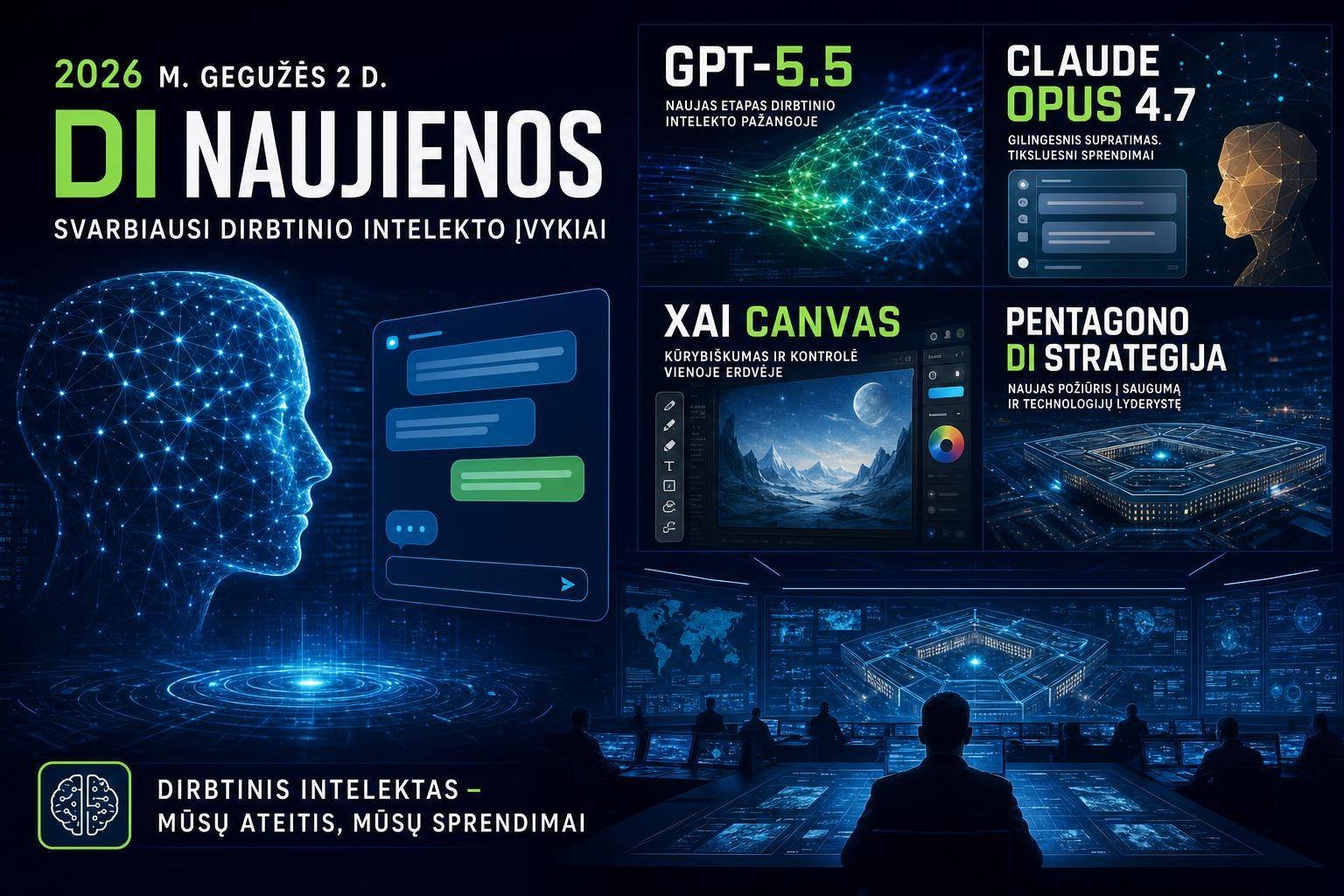
- OpenAI shipped GPT‑5.5 on April 23—just six weeks after 5.4—with stronger coding, research, and agent performance. ChatGPT reportedly has 900 million weekly users and generates roughly $2B per month in revenue. The trade-off: GPT‑5.5 doubled token costs for many tiers without speed gains or larger context windows.
- xAI introduced Canvas for Grok Imagine, a persistent workspace for iterative image generation, opened access to a Grok 4.3 API, and added voice cloning from short samples.
- Anthropic’s Claude Opus 4.7 reportedly surpassed GPT‑5.5 on six of ten internal and third-party benchmarks and earned praise in enterprise pilots for reduced hallucinations. Anthropic matched OpenAI’s cadence with four updates in 50 days.
- The Pentagon signed AI contracts with Amazon, Google, Microsoft, and others on May 1 to bring AI into classified systems—another marker that AI is now part of national infrastructure strategy.
- Big Tech AI capex is projected to reach $700B in 2026, up from roughly $200B in 2024, underscoring continued build-out of compute and networking capacity. SoftBank is reportedly spinning out a $100B AI-robotics venture, Roze.
- Despite well-known readiness gaps, Deloitte reports about 80% of tech leaders are confident they can deploy AI this year.
Those signals collectively point to a simple truth: AI capability is rising fast, but unit economics, reliability, and security now differentiate winners from headline-chasers.
GPT‑5.5: Faster Iteration, Higher Token Costs, and What It Means for Builders
The headline: GPT‑5.5 has arrived quickly on the heels of 5.4, with stronger performance in code generation, research assistance, and agentic workflows. Reports also indicate higher token prices—roughly double in many cases—without concurrent increases in context length or generation speed.
What improved, and where it shows up
- Coding: More consistent function signatures, better adherence to types, and fewer “near-miss” bugs in integration code. Practically, teams observe fewer retries when generating multi-file diffs or service stubs.
- Research and summarization: Cleaner synthesis across multi-document corpora, with more stable citations and fewer lost threads across sub-questions.
- Agent tasks: Stronger tool-use sequencing, better self-correction, and fewer dead-ends when orchestrating multi-step jobs.
If your workloads are code-heavy or rely on tool orchestration, GPT‑5.5 may reduce error-handling glue and human-in-the-loop overhead.
The trade-off: cost pressure without speed/context relief
Token costs doubling—absent speed or context gains—shifts ROI calculations. If you’re using 5.4 today, a naïve migration to 5.5 may raise your bill materially with only moderate quality gains.
Practical implications: – Re-baseline cost per successful task, not per token. If 5.5 reduces retries or human QA, higher token rates might still be cheaper at the workflow level. – Be intentional about when you need frontier models. Many content or Q&A flows perform near-parity on smaller, cheaper models. – Turn on or build prompt caching and result memoization for deterministic or semi-deterministic prompts (e.g., policy checks, redaction rules). – Optimize prompts for brevity. Cutting 15–25% of tokens via tighter instructions, structured outputs, and tool schemas can outweigh model price changes.
Useful references: – OpenAI platform documentation for model usage patterns and API behaviors: OpenAI API docs – Understanding tokenization to shrink prompts and outputs: OpenAI Tokenizer
Budget levers teams should pull this quarter
- Implement a model router. Gate low-risk or low-complexity tasks to smaller models; reserve GPT‑5.5 for hard cases. Update routing rules weekly during this release cadence.
- Enforce maximum output tokens per endpoint. Many teams quietly bleed cost with generous max_tokens defaults.
- Adopt structured outputs and function/tool calling wherever possible. Constraint schemas reduce wasteful verbosity and follow-up clarifications.
- Batch operations where latency permits. Document clustering, large-scale tagging, and code audits are good candidates.
- Bring a real-time cost dashboard into sprint reviews. Engineers build what they can see; expose token and dollar spend by feature, not just by environment.
Claude Opus 4.7 vs. GPT‑5.5: Reliability, Hallucinations, and Enterprise Fit
Anthropic’s Claude Opus 4.7 reportedly edged out GPT‑5.5 on six of ten benchmarks this week, with enterprises favoring Claude for reduced hallucinations in early tests. The delta in perceived reliability has business impact: fewer factuality errors translate to lower risk, less human QA, and more predictable SLAs.
What this means in practice: – Regulated content generation (e.g., healthcare summaries, finserv explainers) benefits from Claude’s style: cautious with claims, strong refusal policies when uncertain. – Long-form reasoning tasks—policy synthesis, RFP drafting, root-cause analysis—often surface fewer unsupported assertions on Claude. – Coding parity varies by stack. For Pythonic data workflows, differences may be small; for complex multi-file changes with tool-calling, GPT variants may still lead.
Two caveats: – Task-specific performance can invert headline rankings. A top score on general benchmarks doesn’t guarantee superiority on your proprietary tasks. – Safety filters can trade off with throughput. More guardrails may incur extra back-and-forth for borderline prompts—factor this into latency targets.
Evaluation resources: – Anthropic’s developer docs for prompt patterns, tool use, and safety behaviors: Anthropic Claude docs – Open, multi-metric model evaluation framework for systematic comparisons: Stanford HELM
Bottom line: If you have high-stakes factuality or compliance needs, run a shootout across your top 50 real prompts with gold answers. Many teams end up with a dual-provider strategy: Claude for reliability-sensitive tasks and GPT for heavy tool-use, agents, or code generation.
xAI’s Canvas, Grok 4.3 API, and Short‑Sample Voice Cloning: Opportunity Meets Risk
xAI’s updates this week add three enterprise-relevant capabilities:
- Canvas for Grok Imagine: a persistent multimodal workspace for iterative image generation. Think “living design documents” that track prompt edits, mask changes, and variants across sessions.
- Grok 4.3 API access: indicates continued strides toward enterprise integration—SDKs, latency targets, and quotas will matter here.
- Voice cloning from short samples: enables custom voices for IVR, training content, and accessibility—but introduces fresh security and consent risks.
Where Canvas helps: – Enterprise design systems can now maintain versioned “prompt assets,” improving auditability and reuse across brand guidelines. – Creative teams can collaborate across time zones with shared states rather than throwing screenshots over Slack.
Risk and policy interventions for voice cloning: – Obtain documented consent and use signed voice rights management for any cloned voice. This is not optional in most jurisdictions. – Implement no-impersonation filters and allow-list target numbers for outbound calls. – Watermark and log synthetic audio with immutable audit trails. – Expect more fraud attempts. The U.S. FTC has warned about voice-cloning scams and social engineering; bake verification controls into your processes. See the FTC’s guidance for businesses on voice cloning fraud patterns: FTC on voice cloning scams
Developer docs: – For Grok models and APIs: xAI documentation
Government–Big Tech Alignment: Pentagon AI Contracts Signal “Core Infrastructure” Status
On May 1, the Pentagon reportedly signed contracts with Amazon, Google, Microsoft, and others to deploy AI within classified systems. This is less about splash and more about governance, accreditation, and supply chain assurance.
Why it matters to enterprises even outside defense: – Accreditation standards will shape cloud configurations, enclave designs, and audit requirements that often cascade into commercial best practices. – Expect stronger attention to model provenance, data lineage, and isolation—especially for agentic systems with write privileges. – Vendor assessments will tighten around retraining on customer data, retention windows, and incident response playbooks.
If you’re building for sensitive workloads, use DoD-aligned frameworks as north-stars: – DoD’s Responsible AI Strategy and Implementation Pathway outlines risk categories, governance structures, and lifecycle practices that map well to enterprise GRC: DoD Responsible AI Strategy (PDF) – Track the DoD Chief Digital and AI Office programs and policies for hints on acceptable architectures and supplier requirements. Public materials live at ai.mil.
The $700B Capex Supercycle, SoftBank’s Roze, and the New Unit Economics
Projected AI capex reaching $700B by 2026 telegraphs two realities:
- Capacity will expand, but not evenly. Regions and providers will show different wait times for GPUs and networked memory. Early reservations still matter for large-scale training and fine-tuning.
- The cost of inference—not just training—will dominate P&Ls. If GPT‑5.5 doubles token prices and competitors follow, inference efficiency, caching, and model distillation become differentiators, not nice-to-haves.
SoftBank’s reported $100B Roze spinout underscores a bet that model advances will feed directly into embodied systems—logistics, inspection, eldercare, agriculture. For enterprises, this points to pilots that mix perception, language reasoning, and actuation. Expect new safety stacks, from motion planning guardrails to real-time LLM veto layers.
Takeaway: Secure favorable cloud terms where you can, pressure-test your inference budgets, and start validating robotics-adjacent use cases only if you have clear paths to physical safety and liability coverage.
A 2026 Enterprise AI Playbook: What to Do Next
The headlines are interesting; your next quarter is about disciplined execution. Use this checklist to translate “AI news this week” into action.
1) Re-benchmark your top 10 workloads
- Choose representative prompts, inputs, and success criteria per workflow (code assist, document Q&A, summarization, planning/agents).
- Evaluate GPT‑5.5, Claude Opus 4.7, and your current production model side-by-side.
- Measure cost per successful task, P95 latency, factuality error rate, and human-override frequency.
- Keep a holdout set to detect overfitting to your test prompts.
Useful evaluation frameworks: – Multi-metric evaluation and head-to-head comparisons: Stanford HELM
2) Implement a model router and a fallback plan
- Route by complexity and risk: small model for routine, frontier for edge cases.
- Maintain warm backups across providers for critical endpoints. Outages and quota limits still happen.
- Decide when to degrade gracefully (e.g., shorter answers or delayed async jobs) before a hard fail.
3) Take control of token budgets
- Set per-feature token ceilings and review them in sprint demos.
- Tighten prompts: remove small talk, use variables, and prefer structured outputs to reduce verbose prose.
- Preprocess inputs: strip boilerplate, compress text with extractive summaries before generation.
- Cache aggressively: exact-match caches for deterministic prompts; fuzzy caches for near-duplicates.
Reference docs: – Tokenization behavior and planning: OpenAI Tokenizer
4) Red-team and secure your AI apps
Common failure modes: prompt injection, data exfiltration, tool abuse by agents, prompt leakage in logs, and jailbreaks via multimodal inputs.
- Adopt a secure development lifecycle for AI features. Pair with established frameworks:
- NIST AI Risk Management Framework for governance and controls: NIST AI RMF
- OWASP Top 10 for LLM Applications for application-layer threats and mitigations: OWASP LLM Top 10
- Conduct canary tests: seed models with hidden instructions to detect injection susceptibility.
- Tightly scope tool permissions for agents. Use allow-lists and time-bound credentials.
- Apply content filters both pre- and post-generation. Never rely on a single pass.
- Log prompts and outputs with PII-safe redaction. Retain enough context for forensics without violating privacy.
- Align to national-level guidance. CISA provides an overview of securing AI in critical systems: CISA AI resources
5) Establish governance for fast-moving models
- Maintain a model registry: versions, providers, safety settings, known failure modes, and evaluation scores.
- Use decision logs for upgrades. Record why you switched a model and the measured impact.
- Require human-in-the-loop policies for high-risk actions (financial transfers, contract generation, access changes).
- Track data usage terms per provider: training opt-out status, retention windows, encryption guarantees.
6) Prepare for voice and multimodal risk
- Mandate explicit consent for any voice cloning; archive consent artifacts.
- Watermark and cryptographically sign synthetic audio assets.
- Institute “safe words” or verification callbacks for sensitive requests performed over audio channels.
- Train staff to recognize deepfake patterns; rotate verification questions that cannot be scraped.
Guidance on voice cloning fraud trends and controls: – FTC: Scammers using voice cloning technology
7) Watch the latency tail
- Track P95 and P99 latency, not just averages. Frontier models have heavier tails under load.
- Pre-validate tool plans with small models to reduce back-and-forth on complex agent tasks.
- Use parallel tool calls when safe; serialize only when order matters.
8) Don’t skip documentation and training
- Create “prompt components” libraries with vetted snippets for style, safety, and structure.
- Teach engineers and analysts how token costs map to dollars. Put budgets next to dashboards.
- Share failure postmortems early and often; normalize catching safety and reliability issues in review.
Benchmarking and Migration: A Lightweight, Defensible Process
When you run the shootout between GPT‑5.5, Claude Opus 4.7, and any Grok variant you’re testing, keep your process simple, consistent, and audit-ready.
- Define tasks and success metrics upfront. Example metrics: factual accuracy vs. gold answers, pass@N for coding tasks, BLEU/ROUGE for summarization, and human preference scores.
- Control for prompt variance. Use the same system prompts and tool schemas across models where possible.
- Normalize costs. Compute dollars per successful task, not just per 1K tokens, to reflect retries and human QA.
- Measure safety. Track refusal rates where refusals are appropriate, jailbreak susceptibility via standardized red-team prompts, and data exfiltration attempts in agent tool chains.
- Capture tail behavior. Record P95/P99 latency and timeouts; they break SLAs first.
- Validate over time. Re-run a subset weekly during fast release windows; drift happens.
If you’re working with agent frameworks, also evaluate tool sequencing and error recovery. For inspiration on orchestration patterns and multi-agent setups, Microsoft’s open-source work is a good reference point: – Microsoft AutoGen on GitHub
Cybersecurity Considerations for Agents and Short‑Sample Voice
As models gain better tool-use and organizations flirt with autonomous loops, a new class of failures emerges: the model can do exactly what you asked—and also what an attacker tricked it into thinking you asked.
Key risks to address now: – Prompt injection and cross-domain data exposure through RAG or browser tools. Sanitize and constrain all retrieved content; don’t let raw external text become privileged instructions. – Tool permission creep. Create narrowly-scoped API keys for each action; rotate them frequently. Avoid “god-mode” service accounts wired into agent frameworks. – Output handling. Treat model outputs as untrusted until validated—sanitize, parse with strict schemas, and gate actions behind policy checks. – Voice channel exploitation. Synthetic voices can trigger human actions outside your tech controls. Move sensitive approvals to out-of-band, phishing-resistant channels (e.g., FIDO2 security keys).
Security frameworks to anchor your program: – Governance and risk controls for AI: NIST AI RMF – Application-layer threats and mitigations for LLMs: OWASP LLM Top 10 – National guidance and threat intel tailored for critical infrastructure: CISA AI resources
Strategy Notes: Reading This Week’s Signals
- Model quality is converging; differentiation shifts to reliability, cost control, and safety posture. Assume a multi-model, multi-cloud future.
- Vendors will continue to adjust token pricing. Design contracts and architectures that let you change models with minimal rework.
- Government demand will push providers toward stronger assurances around data handling, provenance, and supply chain. Borrow those standards for your own RFPs.
- The capex supercycle suggests continued competition for specialized hardware and staff. Lock in key dependencies early, and grow your own internal capability for inference optimization.
- Robotics and embodied AI will produce adjacent compliance and safety requirements. If you explore these, establish multidisciplinary review boards that include safety, legal, and field ops.
FAQ
Q: Should my team switch to GPT‑5.5 right now? A: Run a week-long A/B with your top workflows. If GPT‑5.5 materially lowers error rates or human QA time, the higher token price may still pay off. If gains are marginal, keep your current model and revisit after the next update.
Q: Which is better for enterprise reliability—GPT‑5.5 or Claude Opus 4.7? A: It depends on your tasks. Reports suggest Claude Opus 4.7 hallucinates less on many knowledge tasks, while GPT‑5.5 may lead on complex tool-chains and some coding work. Benchmark on your data and measure cost per successful task.
Q: How do I manage rising token costs without sacrificing quality? A: Use a model router, cap tokens per endpoint, tighten prompts, and cache deterministic results. Move routine tasks to smaller models and reserve frontier models for genuinely hard cases.
Q: Are short‑sample voice cloning features safe for business use? A: They can be—with strong consent management, watermarking, audit logs, and impersonation controls. Treat any voice-triggered action as high risk and require secondary verification. The FTC has warned about voice-cloning scams; adjust your processes accordingly.
Q: What’s the impact of Pentagon AI contracts on commercial adopters? A: Expect stricter norms for data isolation, provenance, and incident response to filter into commercial requirements. Align early with responsible AI frameworks and be ready to evidence your controls to customers and auditors.
Q: How can we benchmark models quickly and fairly? A: Use a fixed prompt set, shared tool schemas, and clear success metrics. Track cost per successful task, P95 latency, and safety outcomes. Open frameworks like HELM can guide a defensible setup.
Conclusion: From “AI News This Week” to Quarterly Results
AI news this week isn’t just a scorecard for model races. It’s a reminder that capability is compounding, while reliability, unit economics, and security decide who actually ships durable value. GPT‑5.5 raises quality but also costs; Claude Opus 4.7 stakes a claim on enterprise reliability; xAI’s Canvas and voice cloning expand multimodal workflows and risk surfaces; and the Pentagon’s moves underscore that AI has entered the realm of critical infrastructure.
Your next steps are clear: re-benchmark workflows, tune token budgets, tighten guardrails for agents and voice, and align governance with proven frameworks. Use NIST’s AI RMF to structure risk, lean on OWASP’s LLM guidance for application defenses, tap CISA’s AI materials for security posture, and consult vendor docs for practical integration details—OpenAI, Anthropic, and xAI.
Ship features that measurably improve outcomes at a price you can defend. Everything else is just next week’s headline.
Discover more at InnoVirtuoso.com
I would love some feedback on my writing so if you have any, please don’t hesitate to leave a comment around here or in any platforms that is convenient for you.
For more on tech and other topics, explore InnoVirtuoso.com anytime. Subscribe to my newsletter and join our growing community—we’ll create something magical together. I promise, it’ll never be boring!
Stay updated with the latest news—subscribe to our newsletter today!
Thank you all—wishing you an amazing day ahead!
Read more related Articles at InnoVirtuoso
- How to Completely Turn Off Google AI on Your Android Phone
- The Best AI Jokes of the Month: February Edition
- Introducing SpoofDPI: Bypassing Deep Packet Inspection
- Getting Started with shadps4: Your Guide to the PlayStation 4 Emulator
- Sophos Pricing in 2025: A Guide to Intercept X Endpoint Protection
- The Essential Requirements for Augmented Reality: A Comprehensive Guide
- Harvard: A Legacy of Achievements and a Path Towards the Future
- Unlocking the Secrets of Prompt Engineering: 5 Must-Read Books That Will Revolutionize You